


The Matching Software Costs $19.99. The Reveal Sells for $1,500.
In mid-July 2026, a photo booth appeared in Manhattan's Union Square, parked outside a taco shop.
You answer 26 questions. You pay $10. You step inside, take your photos, and the machine prints a strip with your own pictures on one side and a stranger's face and first name on the other. That stranger is supposedly your match, and the machine gives you no way to message them, browse them, or swipe past them.
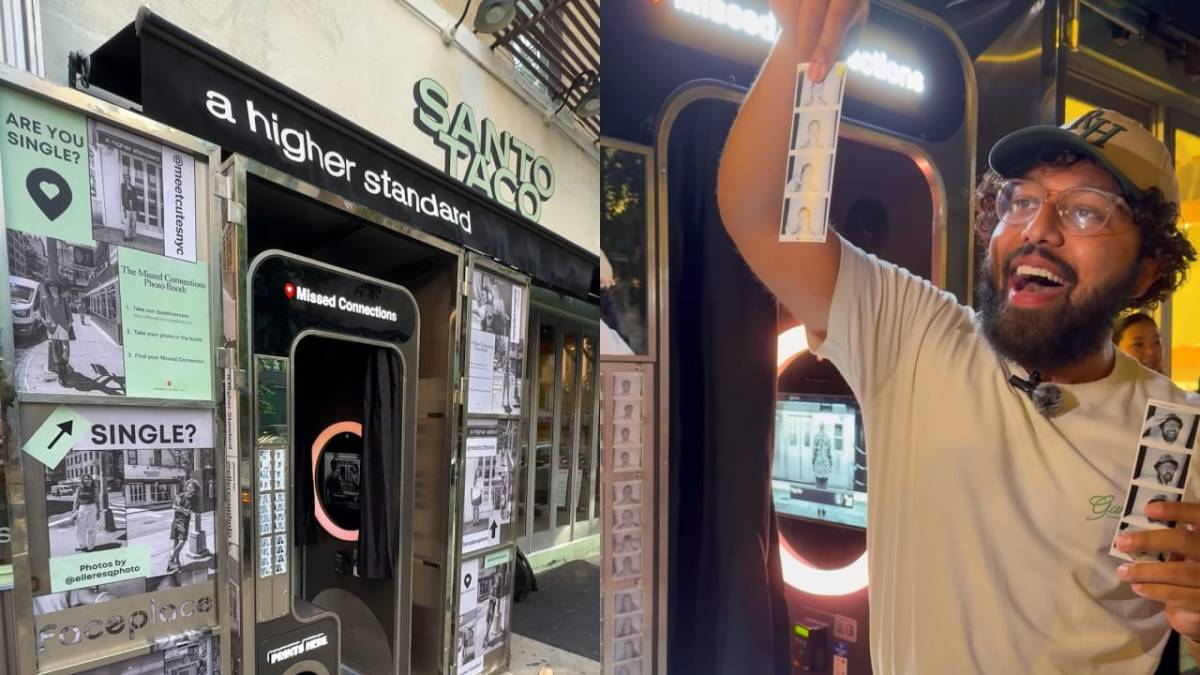
By early August 2026, the Missed Connections Booth had matched roughly 3,500 people. It's a collaboration between the matchmaking startup Matchbox, the Instagram account Meet Cutes NYC, and the photo-booth company Faceplace. Some days it drew a line down the block. The operators are weighing other cities.
The obvious read is that offline dating is back and somebody should build a matchmaking app for events. That read is wrong, and it's expensive to be wrong about. The money sits one layer over from where everyone is looking.
The money: Managed activations at $499 to $995 build to $18K a month. Seventy-five licensed operators at $300 each is $22,500 MRR.
Inside:
• Six reveal templates, none of them romantic
• The host console that makes organizers rebook
• A 30-day launch: fake it, sell five, then build
• Pricing from $79 self-serve to $2,500 activations
The Software Floor Is Already at Zero
Every technical component of that booth is a commodity, and the market has already priced it.
Matchbox, the company inside the booth, will run a questionnaire-based matching event for up to 50 guests for free. Its Basic tier is $4 per guest. Premium is $95 plus $5 per guest and adds custom questions, private text relay, and public ticketing. Elite runs $95 plus $8 per guest for multi-round events. The company says its algorithm has matched 750,000 people to date.
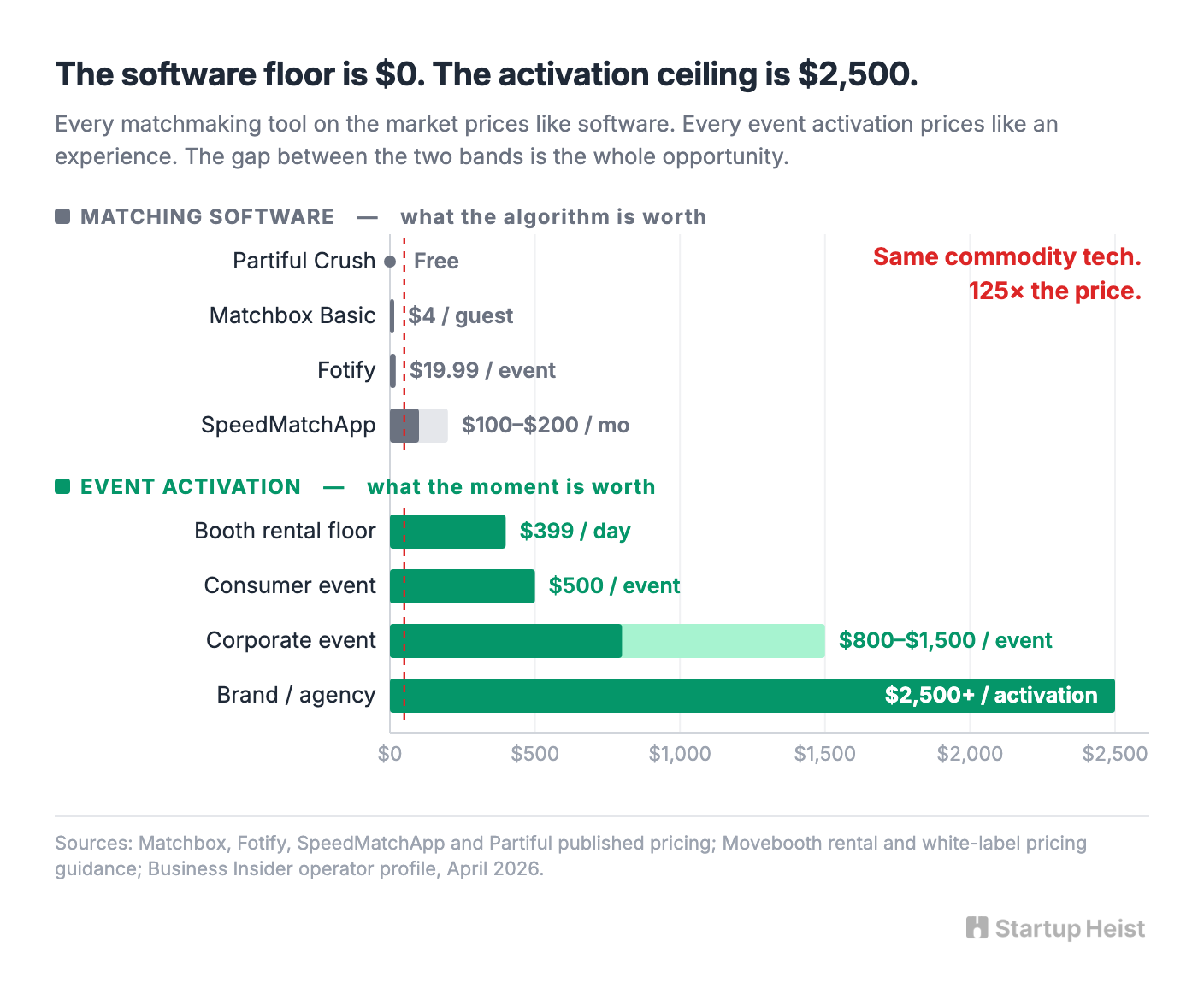
The rest of the category prices the same way. Partiful gives away a version of it: the Crush feature, which rolled out in late December 2025 and expanded ahead of Valentine's Day 2026, lets guests anonymously flag romantic interest in people they've attended events with, then reveals a name only when the interest is mutual. Fotify sells browser-based event matchmaking at $19.99 per event with no subscription. SpeedMatchApp, built for rotation-style speed dating, runs $100 to $200 a month.
The verdict is in: event matchmaking software is worth somewhere between zero and twenty dollars.
Meanwhile, a photo booth at a corporate event bills $800 to $1,500. The gap between those two numbers is the entire opportunity.
The Product Was Never the Algorithm
In Union Square, the compatibility score is invisible and the questionnaire is a ten-minute chore nobody photographs. What people posted, and what pulled the line down the block, was the object: a physical strip with a stranger's face on it and no instructions.
Now move that mechanic into a room with a budget. At a 120-person founder dinner, check-in is a QR code and a single line of copy: WHO HERE SHOULD YOU START A COMPANY WITH? Answer 14 questions. Results at 8:45.
You answer, you forget about it, you eat. At 8:45 the host cuts the music and a thermal printer starts running:
YOUR FOUNDING ACCOMPLICE
MAYA — TABLE 7
She sells. You build.
Neither of you wants to raise venture money.
You both think meetings before 10 a.m. are a crime.
Within two minutes half the room is standing up, comparing receipts with people they weren't even matched with. Nobody is thinking about the software. What survives the night is the story that starts, "So I let this weird machine pick somebody for me." The product is that manufactured moment and the artifact you take home from it.
Underneath the dinner is a much bigger business: a white-label reveal system for event organizers. No downloads, no accounts. A room full of strangers goes in, and dinner partners, collaborator pairs, festival squads, and conference introductions come out, packaged in a reveal theatrical enough that people film it.
Swap the prompt and the same machine runs a wedding ("your most statistically chaotic dinner companion"), an alumni mixer ("the person here you should have met 10 years ago"), a festival ("your side-quest squad"), or a conference ("the one person here who can actually help you"). The output can land on a receipt, a card, a photo strip, a projection screen, or a badge printer.
The mechanics cost almost nothing, and the experience is where the money sits. What you'd be building is an event activation business with a thin software layer on top, and that distinction determines your pricing, your buyer, your competitors, and whether you have a business at all.
Why Now, and What Organizers Actually Pay
Two things are converging, and only one of them is about romance.
Eventbrite's dating data is strong on its own. Attendance at singles and dating events on the platform rose 42% from 2022 to 2023. Between May 2023 and April 2024, it logged more than 1.5 million searches for dating and singles events and over 376,000 attendees, with speed dating accounting for more than 57% of them. Game-based dating events grew 163% and athletic ones 135%, which says people want a format rather than a bar.
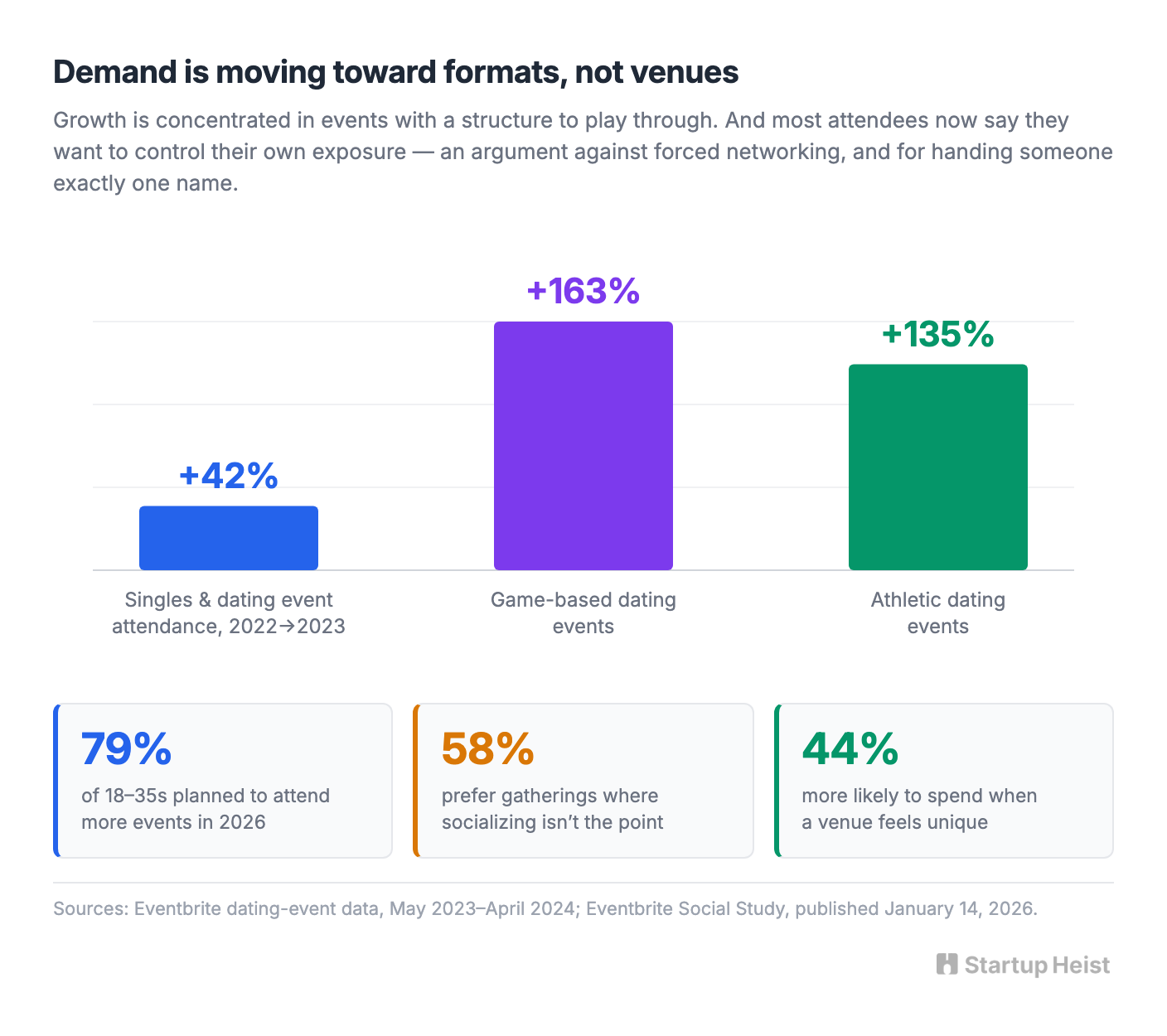
The broader signal matters more. Eventbrite's inaugural Social Study, published January 14, 2026, found that 79% of 18-to-35-year-olds planned to attend more events during the year, and 79% said they value spontaneity over a perfect plan. Attendees were 44% more likely to spend when a venue felt unique. The report's framing, a "reset to real" and a hunger for unrepeatable moments, reads like a product brief.
One finding cuts against the obvious build. Fifty-eight percent said they prefer gatherings where socializing isn't the main focus, where they can sit, observe, and control how they engage. Which is an argument against forced networking, and an argument for a system that hands someone one name and lets them decide what to do with it.
On the supply side, a venue pays rent on Tuesday whether forty people show up or four. Monday through Wednesday is the dead stretch in the bar and restaurant business, and Tuesday and Wednesday are where operators concentrate their programming to fix it. It's why trivia, bingo, karaoke, run clubs, tastings, and paint nights keep multiplying. Operators are hunting for formats, and most of the corporate event entertainment on offer is twenty years old.
So you don't pitch a venue on "AI-powered compatibility software." Nobody has a line item for that. You pitch "a new event format you can run next Thursday," which is a line item every venue already has. Grand View Research puts the U.S. event management market at $285.18 billion in 2024, heading to $471.44 billion by 2033. Treat that number as evidence rather than as an addressable market: venues, agencies, brands, and planners are already writing checks for experiences. Your job is to steal one of those checks.
The right comparison isn't matchmaking software. It's the photo booth rental business. Movebooth rents booths from $399 a day with shipping included and no technician required. It tells its white-label partners to charge $500 to $1,500 per event, and specifically to price corporate activations at $800 to $1,500 against $500 for consumer work, because corporate buyers are paying for lead capture. Its iPad booth hardware sells for $2,499, and the company's own math says twelve bookings a year returns $6,000 to $18,000 gross. Business Insider profiled a New York operator in April 2026 who clears around $6,000 a month from photo booths at 60% to 70% margins, with some corporate bookings landing between $4,000 and $7,000.
Nobody pays $1,500 because photography is difficult. They pay for setup, branding, reliability, prints, staffing, guest engagement, something people share, and somebody else being accountable when it breaks at 9:40 p.m. Sell the reveal on those terms and your competition stops being a $19.99 app and becomes experiential marketing vendors, which is a much better neighborhood to price in.
The Best First Market Isn't Dating
Dating produced the signal, and you should still not start there.
Unlock the Vault.
Join founders who spot opportunities ahead of the crowd. Actionable insights. Zero fluff.
“Intelligent, bold, minus the pretense.”
“Like discovering the cheat codes of the startup world.”
“SH is off-Broadway for founders — weird, sharp, and ahead of the curve.”


