


The Chargeback Vault
A customer walks into a jewelry repair shop, pays $1,400 for a serviced watch, and carries it out the door.
Square records everything about the money: the payment, the amount, the timestamp, the receipt, the transaction ID. The camera above the counter records the part the payment record can never hold: the customer standing there, the employee sliding the watch across the glass, the customer taking it.
Thirty days later, the camera overwrites the footage.
Ninety days after that, the customer disputes the charge.

The merchant now holds exactly half of a strong evidence package. The other half deleted itself before anyone knew it mattered.
Two systems, each doing its job correctly, producing an absurd result. There's a business in that gap, and it looks like this:
The money: 1,000 merchants at $59 a month is $59,000 MRR. Square has 4.5 million sellers, so that's a rounding error of the base.
Inside:
• Full MVP scope: capture, archive, alert, package
• The timestamp problem that decides the product
• Three-tier pricing from $49 to $149 a month
• Outreach script and the 90-day build plan
The build connects a merchant's Square account to the UniFi Protect cameras already hanging in the store. When a qualifying transaction clears, say a card-present payment above $500, the system automatically preserves a short clip, a few still frames, the receipt metadata, and the exact transaction timestamp. It holds that package for 12 to 18 months. When a dispute finally arrives, it assembles the material into something a bank will actually read.
That's the whole product: transaction-triggered evidence preservation, deliberately narrow. High-value physical handoffs, Square on one side, UniFi Protect on the other, an archival layer in between. No surveillance analytics, no loss-prevention AI, no facial recognition.
The two clocks
Chargebacks usually get framed as a detection problem: spot the risky payment before it happens. This is something else. The merchant frequently had good evidence and no way of knowing which of last quarter's 300 transactions would turn into a dispute four months later.
Card network timelines make that ignorance expensive. Cardholders generally get 120 days from the transaction to file, and for goods or services that never arrived, the window can run 120 days from the expected delivery date with an outer limit of 540 days from the sale. A dispute landing in month four or month five is completely ordinary.
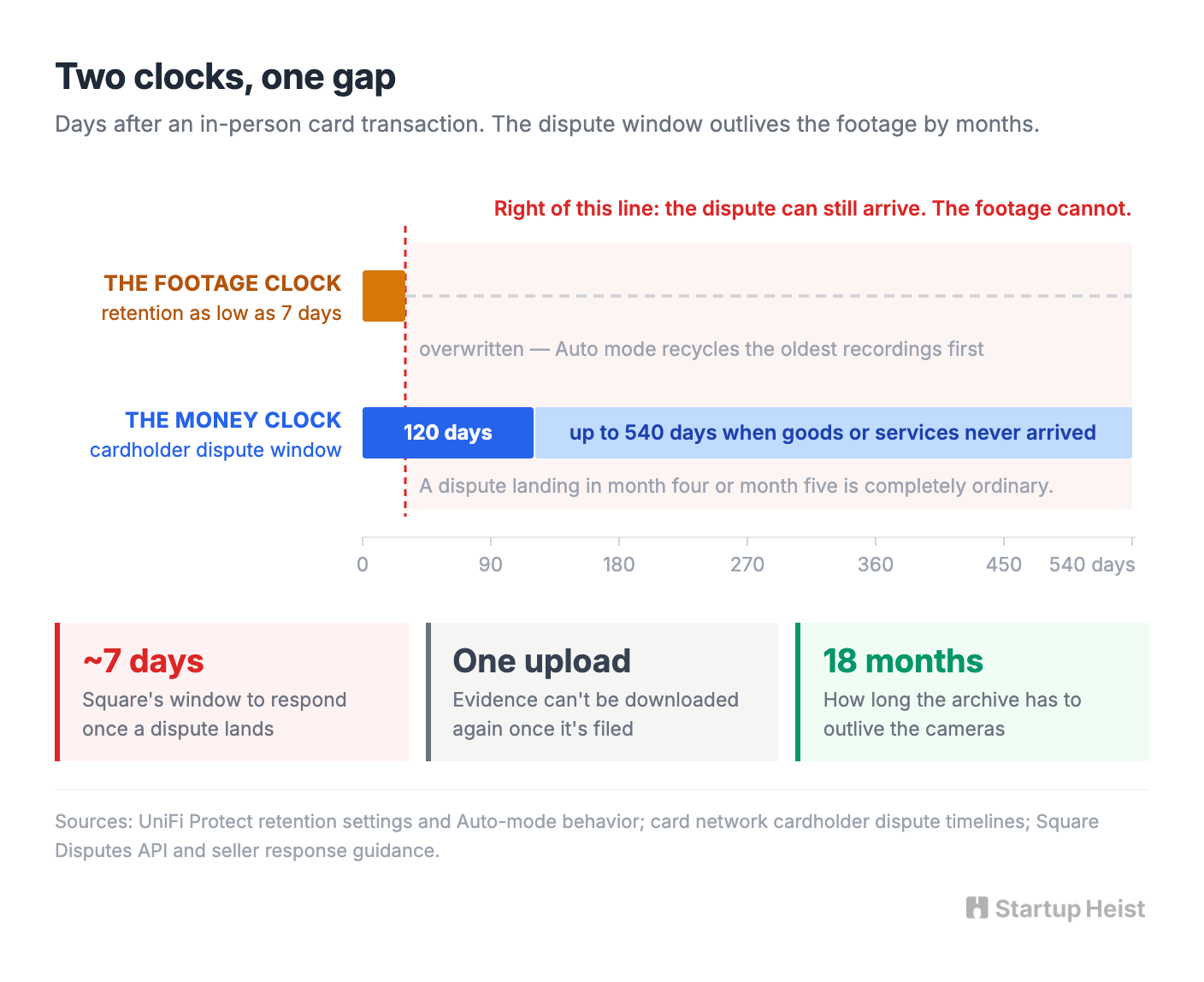
Now the other clock. UniFi Protect lets an operator set retention as low as 7 days, and its default Auto mode simply runs until the drive fills, then overwrites the oldest recordings. Most small shops never touch the setting and run whatever the installer left them. Protect 5.1 and later adds a second failure mode: Enhanced Retention keeps recent footage at full resolution while automatically downgrading older recordings to low quality. Sometimes the clip survives and the usable detail doesn't.
A permanent payment record on one side. A rolling, quietly degrading video record on the other. The startup lives in between.
Closing that gap requires almost no storage. You aren't keeping months of surveillance video; you're deciding, at the moment of payment, which twenty seconds might matter later. Preserve a low-bitrate 20-second clip plus three stills for 500 high-value transactions a month, at roughly 3 to 6 MB per record, and an 18-month rolling archive lands in the tens of gigabytes. S3 Standard runs about $0.023 per GB-month. A customer's entire archive costs you pocket change.
Your real costs are integration reliability and support calls, which should tell you where the engineering goes. Nobody needs Dropbox for security footage. They need Stripe-grade reliability around one very specific timestamp.
The disputes that actually reach a counter
When a chip card is read properly at an EMV-compliant terminal, counterfeit-fraud liability sits with the issuer, not the merchant. A Square seller running a modern reader is largely insulated from the classic "someone cloned my card" chargeback.
So the disputes that reach a jewelry counter skew heavily toward consumer disputes: merchandise or services not received, not as described, service never performed, paid by other means. The customer isn't claiming a stranger used their card. They're claiming the transaction didn't deliver what it promised, which is precisely the category where video of a physical handoff has something to say.
It also explains the win rates. Industry-reported representment win rates cluster somewhere between 40 and 55% overall, fraud-coded disputes run far lower at roughly 17 to 20%, and net recovery after costs and second chargebacks settles into the low-to-mid teens. Research firms disagree on the exact numbers because they measure different merchant mixes, but the shape holds.
First-party misuse, better known as friendly fraud, means the customer who genuinely bought the thing and disputes it anyway. In 2025 it topped the list of fraud types merchants reported experiencing globally for the first time, and Sift puts first- and third-party fraud combined at 45% of merchant dispute volume.
The product is weakest when the dispute is subjective. Footage proving a haircut occurred does nothing about a salon client who says the haircut was bad. Where it's strong is handoff proof: someone stood at this counter, at this minute, and took possession of this item. That's the positioning, and it's narrower than the category slogan. "Fight chargebacks with video" is a bigger claim than the product can honor.
Two operational facts make the timing brutal. Square gives a seller about seven days to respond once a dispute lands, and Square's documentation notes that evidence can't be downloaded again after it's uploaded. The merchant has one week to reconstruct a four-month-old afternoon, and no way to retrieve what they filed last time. The archive answers both.
The market is not $41 billion
Chargebacks are enormous in aggregate. Sift projects global chargeback volume reaching 324 million transactions by 2028, up 24% from 2025, with worldwide losses climbing from $33.79 billion to $41.69 billion. North America carries $20.47 billion of that 2028 total, and U.S. merchants pay about $4.61 for every $1 lost.
Resist all of it. The same research attributes most of that growth to card-not-present commerce, where retail e-commerce chargeback rates jumped 233% over the course of 2025. A camera behind a jewelry counter does nothing for an online order shipped to Ohio.
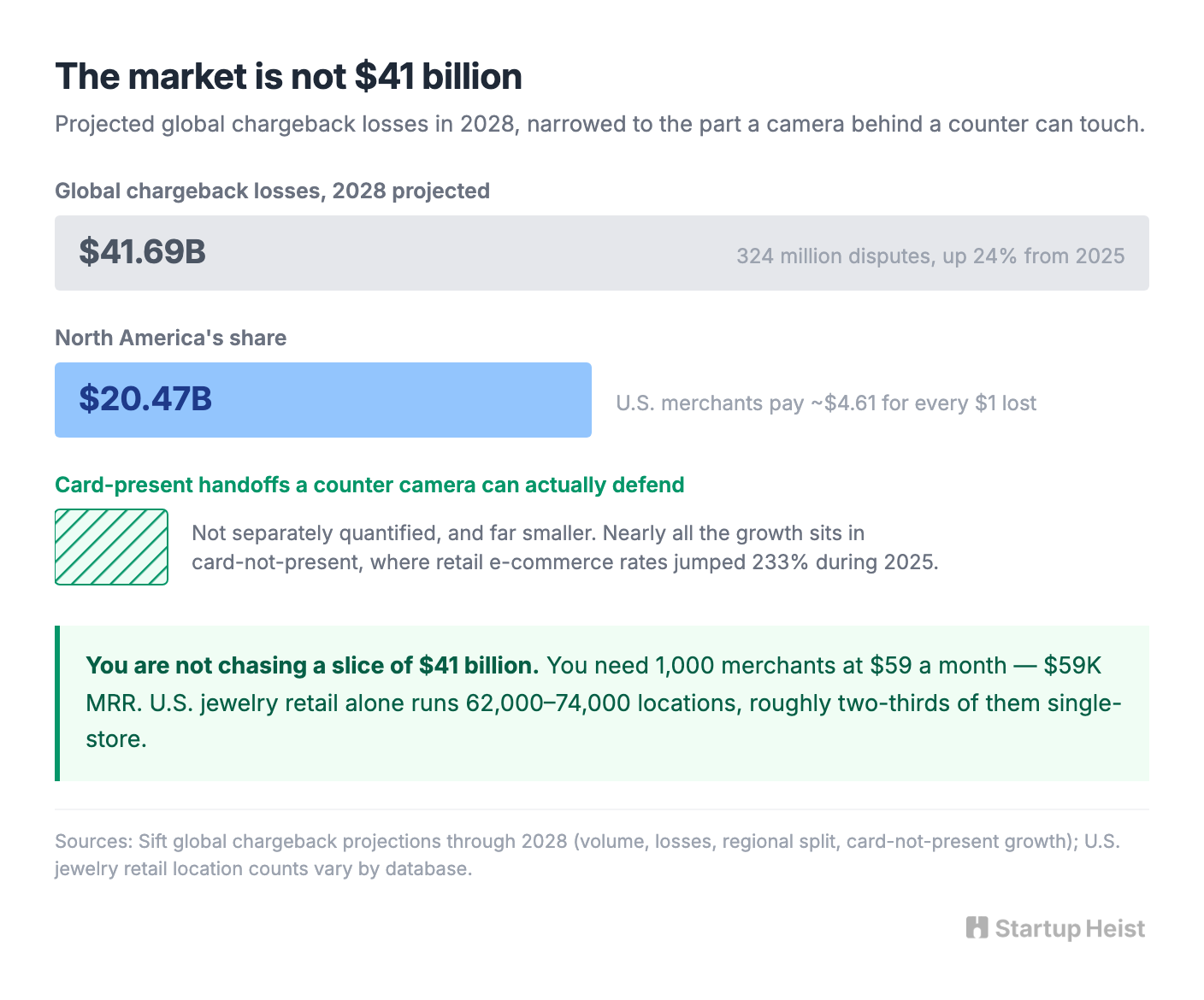
Your market is smaller and far more specific: Square merchants taking expensive in-person payments where the physical handoff itself carries evidentiary weight. Jewelry and watch repair. Luxury resale and consignment. Specialty electronics repair. Collectibles dealers. Equipment rental and pickup counters. Anywhere a future dispute reduces to "I never got it," "that wasn't what I picked up," or "nobody ever did the work."
U.S. jewelry retail alone runs somewhere between 62,000 and 74,000 locations depending on whose database you trust, and roughly two-thirds are single-store operations. That's one vertical, and you need a rounding error of it.
Who's already in this room
This isn't greenfield. Square handles disputes natively through its Disputes API, which exposes status and deadlines and accepts evidence uploads. Around it sits an entire category of POS-to-video products: VideoRegister in Square's own app marketplace, Solink correlating Square transactions with searchable footage at a per-location monthly price, OpenEye's POS Connect joining transaction data to video for loss prevention and investigations, Eagle Eye selling the same through its cloud VMS. Even National Retail Solutions bundles camera-to-POS matching for $9.95 a month with its payment product, or $12.95 without, plus the hardware.
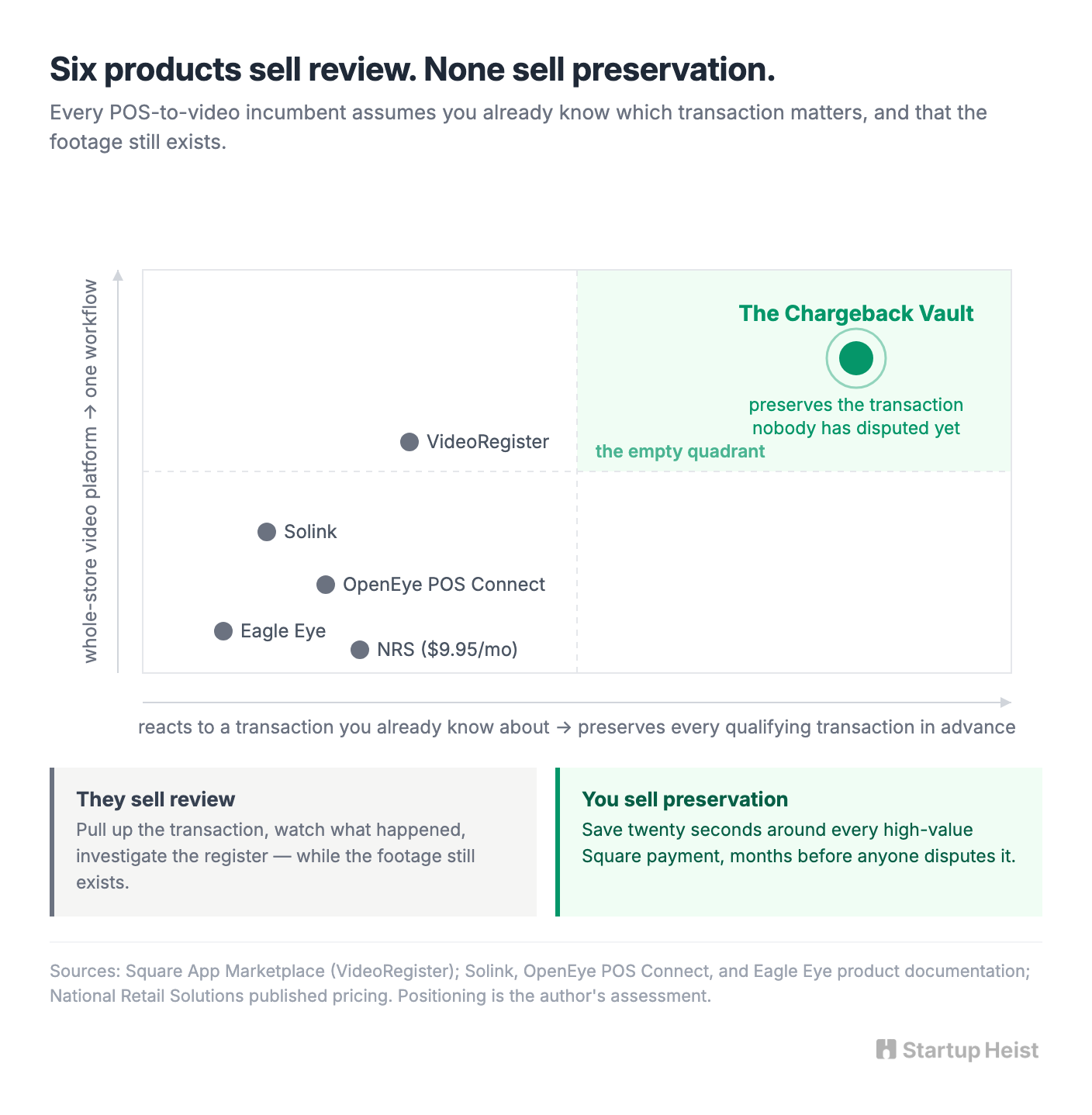
The pattern is consistent. Every one of them sells review: pull up a transaction, watch what happened, investigate the register. They all assume you already know which transaction you care about, and that you're looking at it now, while the footage still exists. None are built for the merchant who won't know for four more months.
That's where you compete. "See your transactions alongside your footage" already exists six times over. Sell the sentence that keeps a jeweler up at night instead: your cameras are deleting evidence before some disputes arrive, and we automatically preserve the twenty seconds around every high-value Square payment. Existing platforms want merchants living inside their video ecosystem. Your product should be invisible. Install it, set the threshold, forget it exists. Then six months later, when a $1,700 dispute lands with a seven-day clock on it, the email arrives: we saved this.
The deliverable is a PDF, not a video
The instinct is to hand the merchant an MP4. Look at what the receiving systems actually accept.
Unlock the Vault.
Join founders who spot opportunities ahead of the crowd. Actionable insights. Zero fluff.
“Intelligent, bold, minus the pretense.”
“Like discovering the cheat codes of the startup world.”
“SH is off-Broadway for founders — weird, sharp, and ahead of the curve.”


