


The Private AI Employee for Boring Businesses
A solo immigration attorney in suburban New Jersey runs intake through voicemail, a Squarespace contact form, and a paralegal who reads emails between hearings. By the time a prospect gets a callback, half of them have already hired someone else. What she needs is something between a live receptionist and a smarter phone tree, and nobody in her market is selling it to her.
The opportunity is to become that vendor. A small law firm, HVAC shop, dental practice, or insurance broker is not waking up wanting a LoRA adapter. They're waking up to missed calls, half-trained front-desk staff, buried PDFs, pricing rules locked inside one person's head, and prospects asking the same twenty questions every week. The product they'll pay for is a private AI employee that handles one painful workflow from start to finish.
Sell the workflow. The model is plumbing. Here's the opportunity:
The money: 20 firms at $600/month plus setup fees clears $12K MRR from a one-person shop. Specialist AI agents show 3 to 5x the retention of horizontal tools.
Inside:
• Full MVP scope for AI intake assistants
• Three-tier pricing from $300 to $1,500/month
• Estate-planning outreach scripts that convert
• Five compounding moats for vertical AI agencies
Why The Window Is Open Now
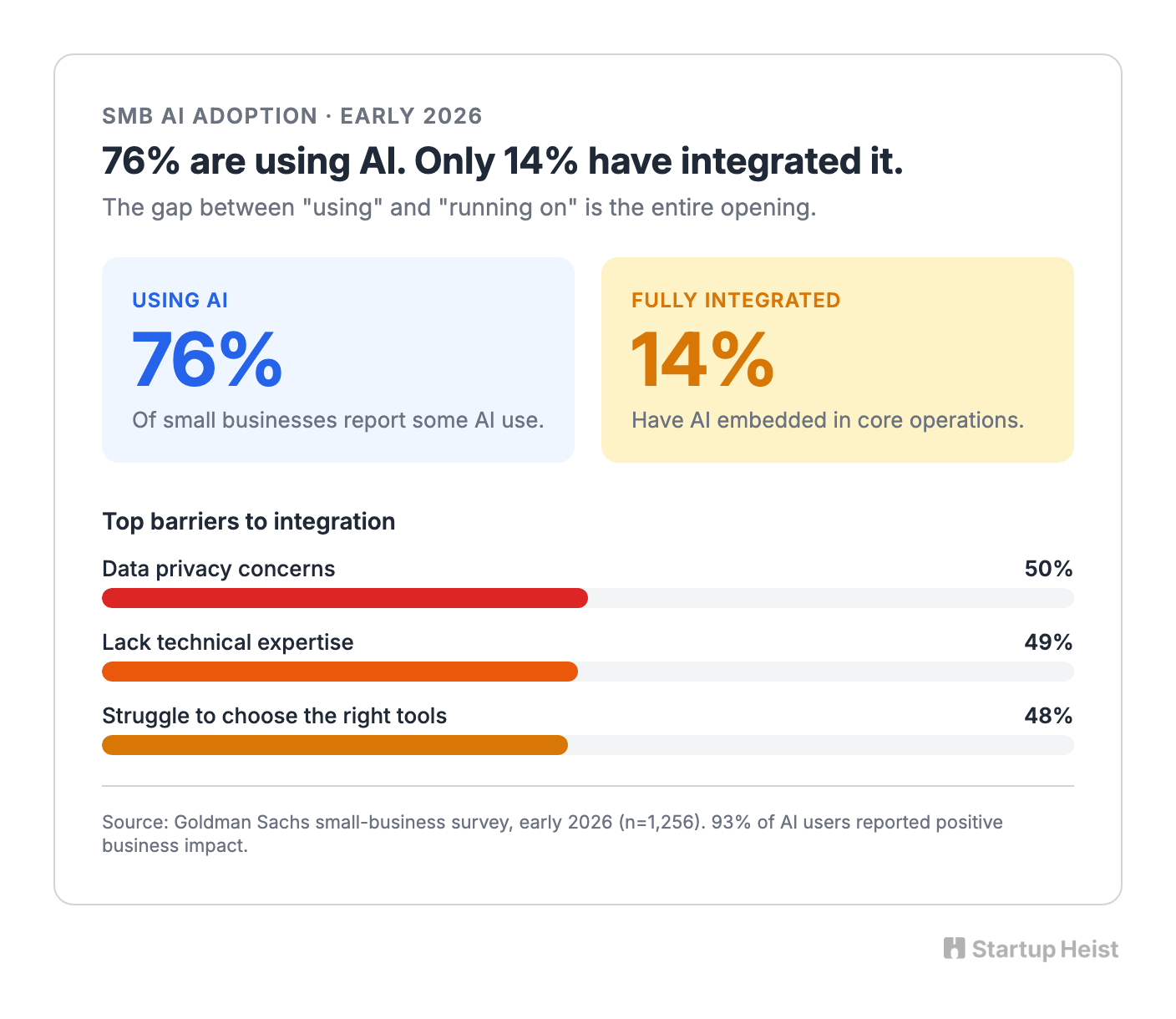
Goldman Sachs surveyed 1,256 small businesses in early 2026. Three-quarters reported using AI. Only 14% had integrated it into core operations. Half cited data privacy concerns, 49% lacked technical expertise, and 48% struggled to choose the right tools. Ninety-three percent of AI users reported positive business impact. The gap between "I have a ChatGPT tab open" and "my office runs on AI" is the entire business opportunity for a small business AI consultant.
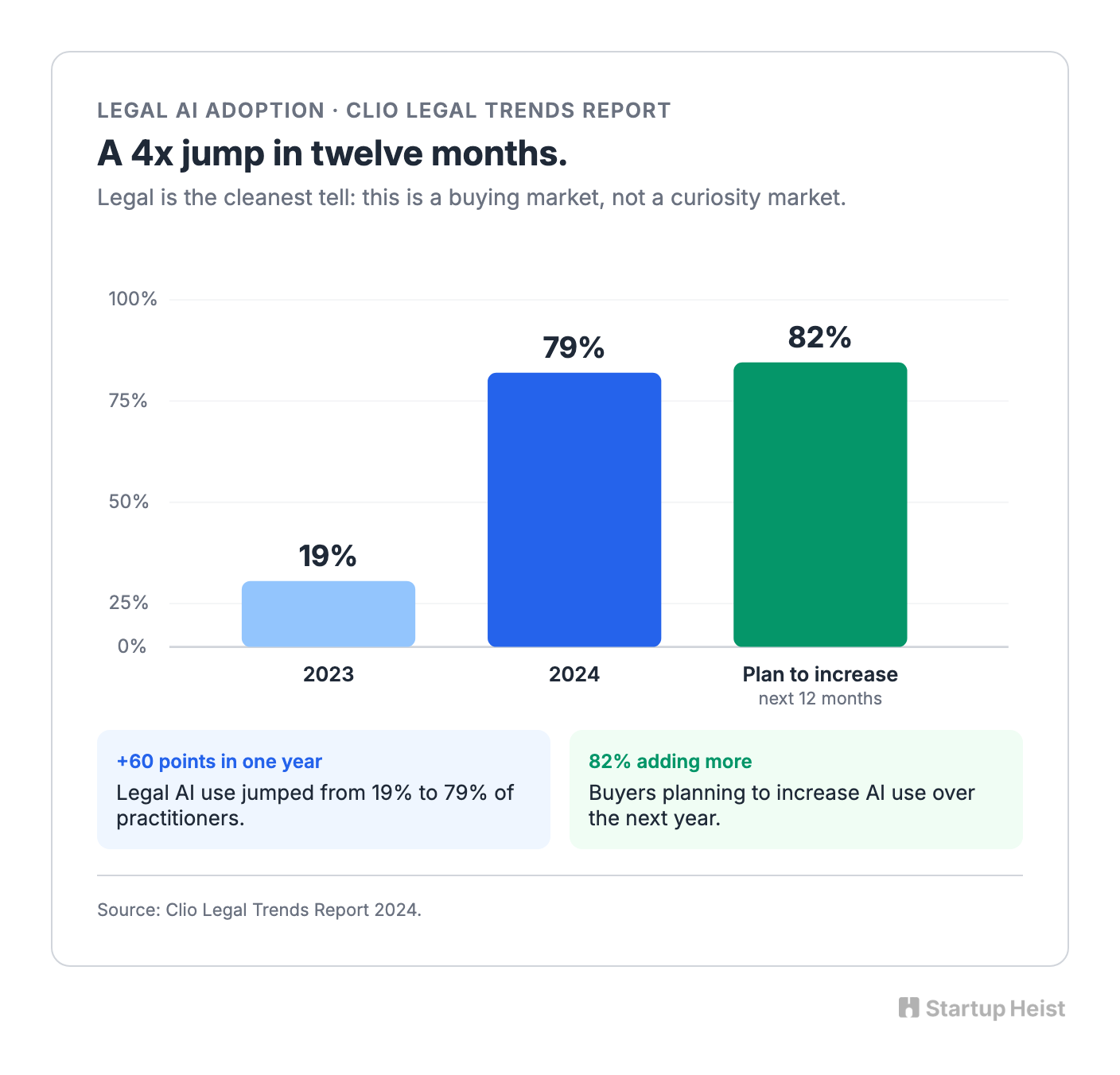
Legal is the cleanest tell. Clio's Legal Trends Report tracked AI use among legal professionals from 19% in 2023 to 79% in 2024, with 82% planning to increase use over the next twelve months. Up the stack, Harvey raised $200 million at an $11 billion valuation in March 2026, now serving the majority of the AmLaw 100, 500 in-house legal teams, and 50 asset managers across 60 countries. Harvey seats run roughly $1,000 to $1,500 per attorney per month with 20- to 25-seat minimums, well over $300,000 a year before procurement starts asking questions.
Harvey isn't selling to the three-partner family law firm in Ohio or the two-attorney estate-planning shop in Tampa. The long tail of professional services has the same operational chaos Big Law has, minus the budget and the IT department. Someone has to do the ugly work for them: collect the files, map the workflow, build the assistant, test edge cases, train staff, and keep it from hallucinating something embarrassing in front of a client.
That's the heist.
The Real Product
Pick one vertical. Name the product. Resist the urge to be flexible early.
A clean naming pattern looks like this:
- Private Intake Assistant for Estate Planning Firms
- AI Dispatch and Quote Assistant for Residential HVAC
- Front Desk AI Knowledge Assistant for Multi-Chair Dental Offices
The product does four jobs. It answers questions from the firm's private documents: policies, service menus, pricing sheets, FAQs, state-specific rules, internal SOPs. It runs structured workflows: collects intake details, classifies the request, routes the lead, generates a summary, drafts the follow-up. It enforces boundaries: refuses regulated answers, escalates sensitive cases, logs responses, keeps a human in the loop on anything risky. And it improves over time through templates, evaluation sets, and the occasional fine-tune where a narrow task genuinely benefits from custom examples.

Most of this is retrieval and workflow logic. Retrieval-Augmented Generation became the default pattern for enterprise AI in 2026, and a naive RAG pipeline costs roughly $0.001 per query at the model layer. The boring document cleanup is the product. The vector database is a commodity. Tools like Tinker, Thinking Machines Lab's LoRA fine-tuning API in private beta since October 2025, keep lowering the technical floor for custom models. The money sits in the service layer above all of that: ingestion, templates, workflows, trust, deployment, maintenance.
The wrong founder builds a fine-tuning agency. The smart founder builds a vertical AI agency and uses fine-tuning sparingly.
The Wedge: Estate Planning Intake
Estate planning and probate firms with 2 to 20 attorneys. Start there.
The documents are repetitive. Client questions are predictable. Intake follows a rough script. Consultations are high-value, often $2,000 to $10,000 per matter, and the firm makes more when the attorney walks into the room already prepped. Confidentiality is already part of the culture, which makes private AI for law firms an easy sell. These firms are local-market businesses, small enough that procurement won't stall the deal in month four.
A private intake assistant for an estate-planning firm should explain the firm's process in plain English, collect family and asset information, identify whether the matter involves trusts, wills, probate, guardianship, or tax-sensitive planning, generate an attorney-ready summary, recommend the consultation type, draft the follow-up email, push the lead into Clio or Lawmatics, flag urgency or potential conflicts for human review, and answer firm-specific questions only from approved materials.
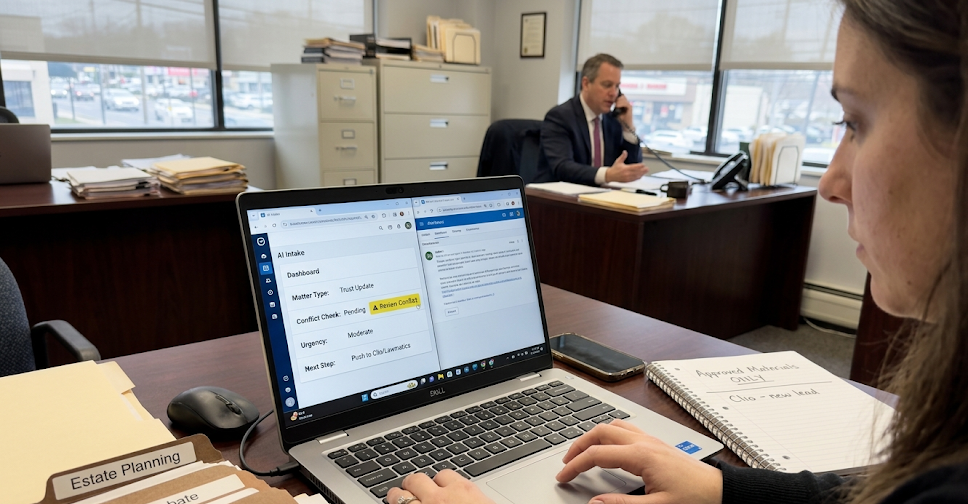
That's a pre-consultation operations layer. The buyer pays because every unqualified call eats two staff hours, every missed lead costs thousands in lifetime value, and every messy intake makes the partner repeat the same questions when the client finally sits down. A firm doing 20 consultations a month doesn't need much productivity gain to justify $300 to $700 per month for an AI assistant for estate planning. Save five staff hours, prep one cleaner consultation, convert one extra qualified client, and the math is obvious by month two.
Worth knowing: Gavel.io already sells AI document automation to solo estate practitioners at around $160 a month, but that product drafts wills and trusts from structured data — it doesn't qualify leads or run intake. The pre-consultation workflow is a different gap, and it's wide open.
The MVP
The first version is a repeatable service package with a thin software layer, not a SaaS platform.
The stack is unglamorous on purpose: a web-based assistant interface for staff and customers, a secure document upload area, a retrieval system over approved firm documents, a workflow form layer for structured intake, a guardrail system, a transcript and analytics dashboard, integrations with email and calendar and the firm's CRM or practice management software, and a monthly review process.
For the first three implementations, the work is mostly hand-rolled and looks like this:
Unlock the Vault.
Join founders who spot opportunities ahead of the crowd. Actionable insights. Zero fluff.
“Intelligent, bold, minus the pretense.”
“Like discovering the cheat codes of the startup world.”
“SH is off-Broadway for founders — weird, sharp, and ahead of the curve.”


