


The Store Sold Out Before It Opened
On July 13, 2026, Seven-Eleven Japan sent a letter to its franchise stores. Social media posts and customer complaints had surfaced a pattern the company confirmed: at some outlets, popular anime and game merchandise was being sold before the release dates printed on the company's own promotional materials. Owners and employees were setting product aside before it reached the shelf, buying it in volume, and reselling it. Pokémon cards were among the items moving at markups on resale sites. By July 23 the story was in the Japan Times, and Seven-Eleven had moved to terminate some franchise agreements early.

Nothing in that story is a technology failure in the usual sense. The inventory system worked. The registers worked. Every unit was scanned, paid for, and recorded. The books balanced. The customers standing outside at open still had a reasonable question the entire retail software stack couldn't answer: did we ever have a chance at this?
Strip away the anime merchandise and the incident turns into a category. Pokémon cards, sneakers, Sonny Angels, LEGO, limited vinyl, streetwear, cosmetics collaborations. Any time demand exceeds supply, the person standing closest to the inventory holds an information advantage. Sometimes that person is a reseller refreshing a product page at 10:00:00, and sometimes it's an employee holding the carton at 8:30. Software has plenty to say about the first case and almost nothing about the second.
The second case is where the business is.
The money: 150 locations at $79 a month is $11,850 MRR. Card Shop Hub lists roughly 6,844 U.S. card shops.
Inside:
• The seven-job MVP, built in six to ten weeks
• Three-tier pricing under the POS Pro ceiling
• Cold email plus the concierge validation run
• The 90-day plan and three signals to walk away
What Point of Sale Can't See
A point-of-sale system is very good at counting. It will tell an owner that five boxes sold, which employee rang them, and when the drawer opened. What it can't tell you is whether those five boxes were handled the way the store publicly said they would be.
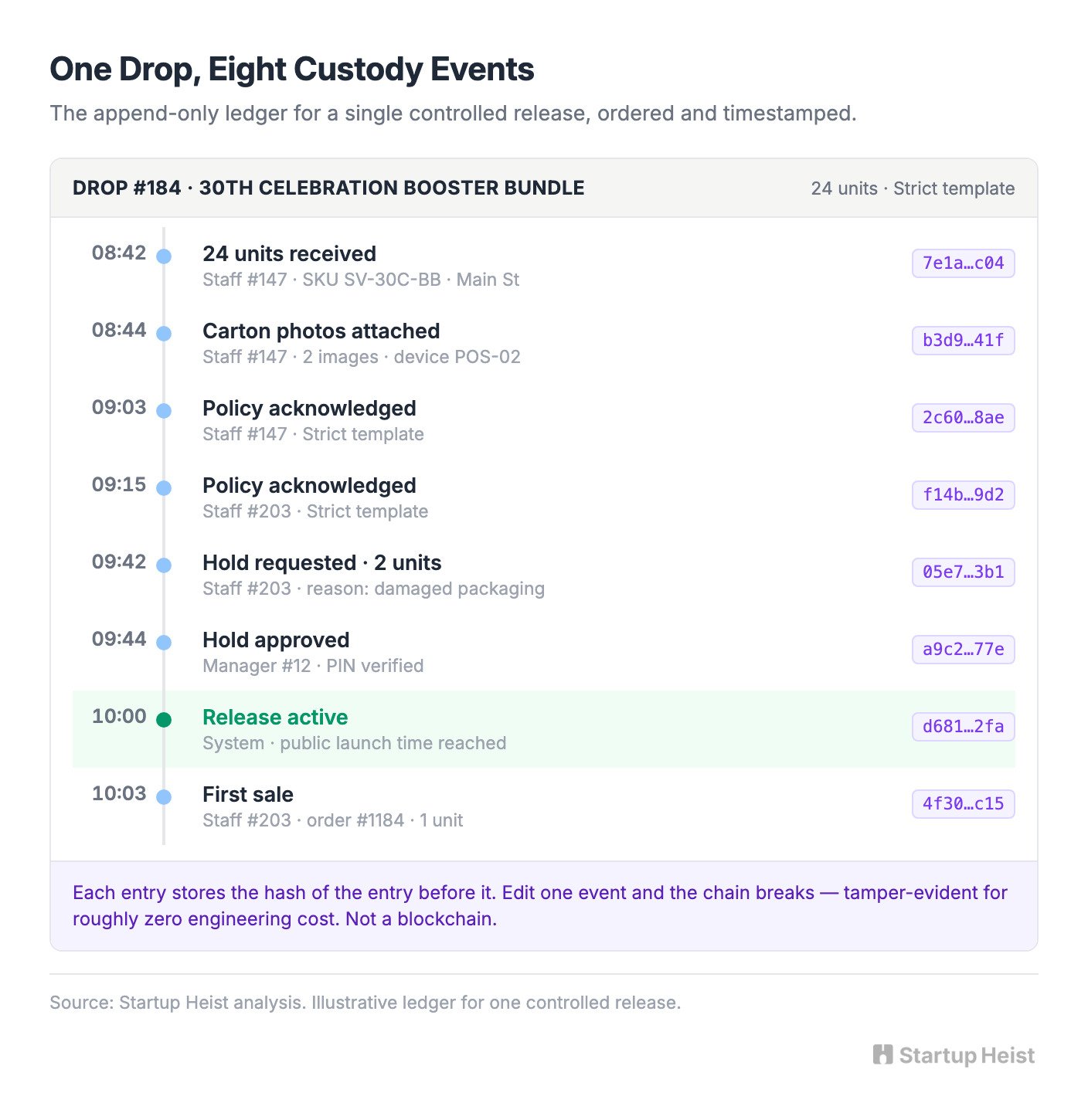
Were all 24 units actually received, or did three vanish into the back room between the loading dock and the shelf? Nobody can establish whether the hold on those two damaged units was authorized, or whether someone wrote a name on a sticky note. The system has no idea whether the product stayed unavailable until 10 a.m. And when an exception happened, the reason usually gets attached three weeks later, once a customer gets loud on Instagram, rather than at the moment it occurred.
Scarce inventory creates a chain-of-custody problem. Inventory software counts units, loss prevention watches the register, and neither one answers it.
There's a startup in that gap, and it's smaller than the obvious version, which is why it's worth doing. Skip the raffle app, skip the virtual queue, and don't try to replace Shopify POS. Build the compliance log for physical drops.
The store declares a policy before the drop, the staff record what actually happens to the cartons, and the software reconciles the two afterward into a single report: thirty-six received, thirty-two sold, one approved hold, one damaged, zero pre-release exceptions.
It sounds boring, and boring is the appeal. The best vertical software takes a messy human process running on group texts and manager intuition and turns it into a standardized audit trail.
Shopify Just Narrowed the Wedge
There's a complication here, and it explains why so many people who look at this idea will build the wrong thing.
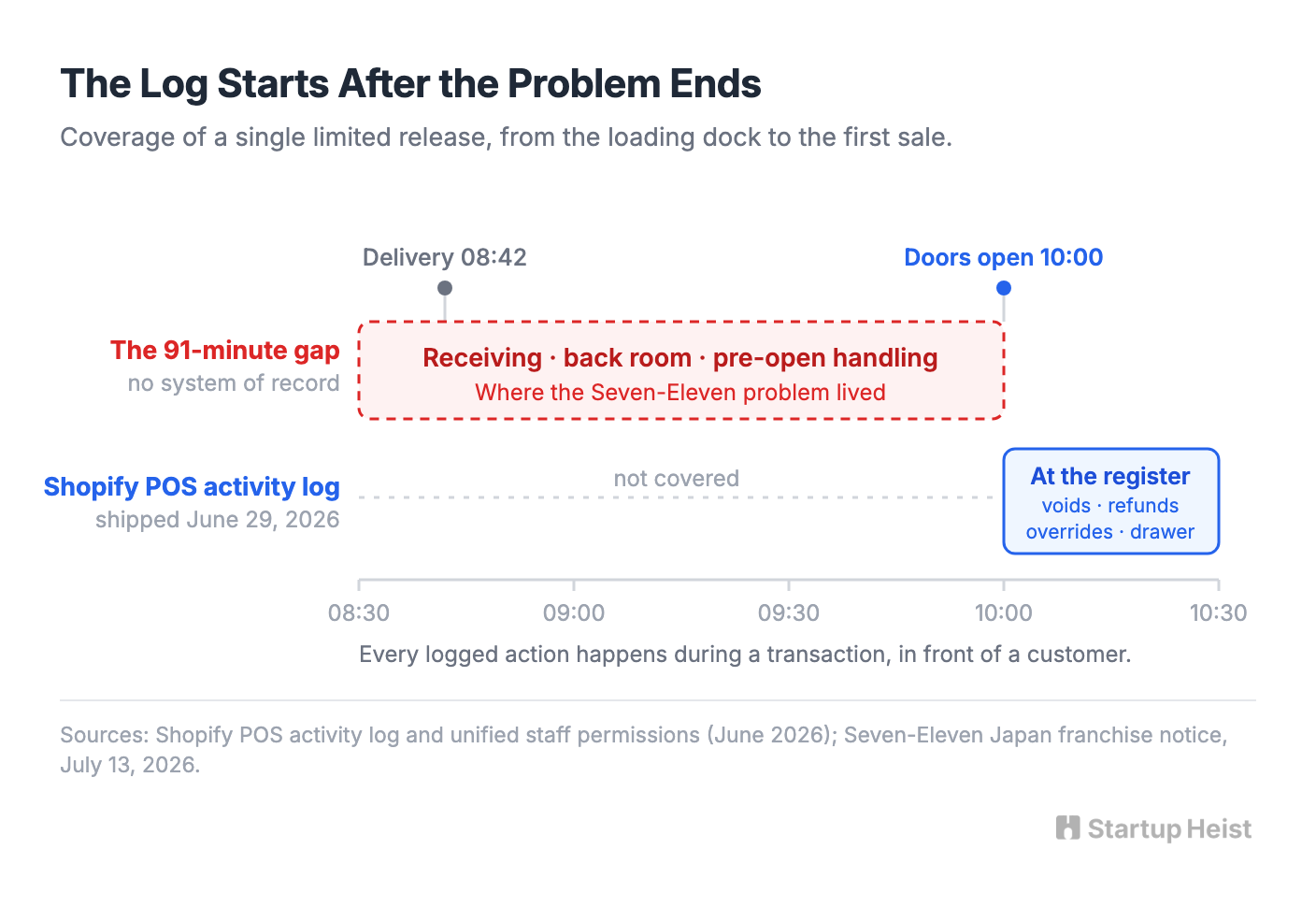
Shopify is getting much better at staff accountability on its own. In June 2026 it unified staff management and permissions across retail teams, so merchants can assign roles and unique PINs, restrict sensitive actions, and require manager approval for specific operations. On June 29 it shipped a POS activity log. Cash drawer operations, manual discounts, voids, returns and refunds, customer record access, and manager overrides now attach to a named staff member with time, device, and location captured automatically. As of July 6, staff attribution on sales turns on by default for stores that never configured it.
The lazy version of this business is already dead. "Audit what your employees do in Shopify" is no longer a product. Shopify does it natively, for free, and will keep going. Generic apps cover part of what's left: Inventory History Guardian starts at $19.99 a month and preserves inventory adjustments with user, location, and notes past Shopify's 180-day history window.
Now look at what's actually on Shopify's list. Every logged action happens at the register, during a transaction, in front of a customer. Nothing on that list touches the receiving dock, the back room, or the ninety minutes before the doors open, which is exactly where the Seven-Eleven problem lived.
The opportunity, then, is a workflow built around one operational event: a limited release. Shopify can tell you that Sarah adjusted inventory by negative two. Your product explains that Sarah pulled two units from Drop #184 at 9:17 a.m., forty-three minutes before release, for damaged packaging, approved by David, quarantined rather than sold. Shopify records transactions. You supply context, and the context is the entire product.
Why Trading Cards Go First
Resist the urge to serve "retailers with limited products." That's how a clean software business turns into integration hell. Start with trading-card and collectible shops, because the demand signal is loud and the calendar is dense.
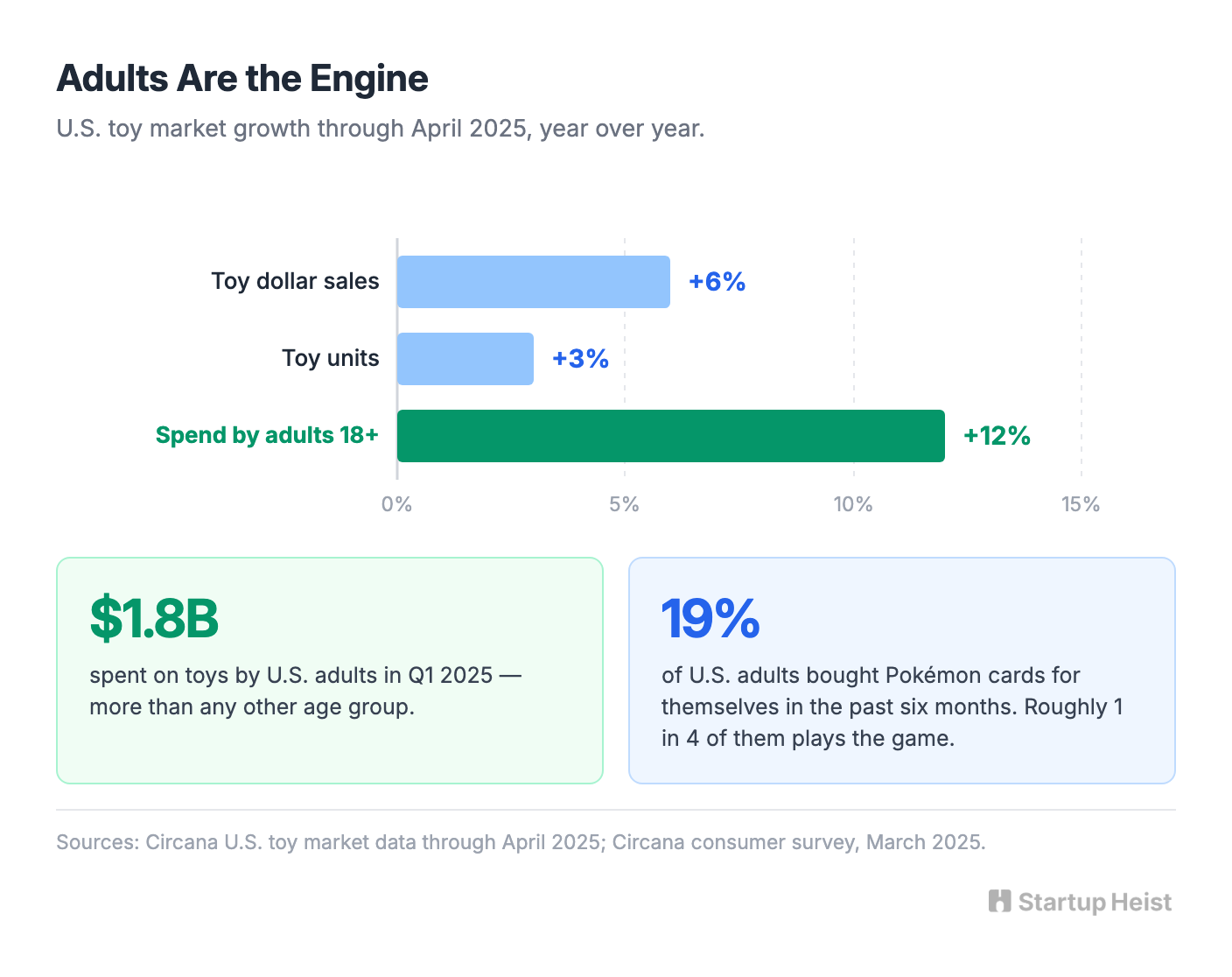
Circana reported U.S. toy dollar sales up 6% through April 2025, with units up 3%, and attributed the growth heavily to new Pokémon releases and collectible sports cards. Adult buyers were the engine: spending by people 18 and over rose 12% year over year in Q1 2025 to $1.8 billion, more than any other age group. In Circana's March survey, 19% of American adults said they had bought Pokémon cards for themselves in the previous six months, and only about a quarter of those buyers actually play the game. The rest are collecting, displaying, or buying in bulk to resell.
When a $50 product trades immediately at $80 or $150, inventory stops being inventory and becomes an asset with embedded arbitrage. Four constituencies now want the same carton: collectors, resellers, employees who collect, and the owner trying not to alienate any of them. Online, merchants defend with CAPTCHAs, purchase limits, and account authentication. The physical store has a different attack surface, because the bot is standing behind the counter.
Pokémon collector forums are full of accusations that employees, restockers, and insiders get first look or leak restock timing. Those posts can't establish how often it happens. They do establish how fast the accusation becomes the story, and for a merchant, perception carries nearly the weight of misconduct. Once regulars believe the staff takes the good stuff before open, a clean shop has a trust problem anyway. Which gives the product a second job beyond internal control: prove you followed your own rules.
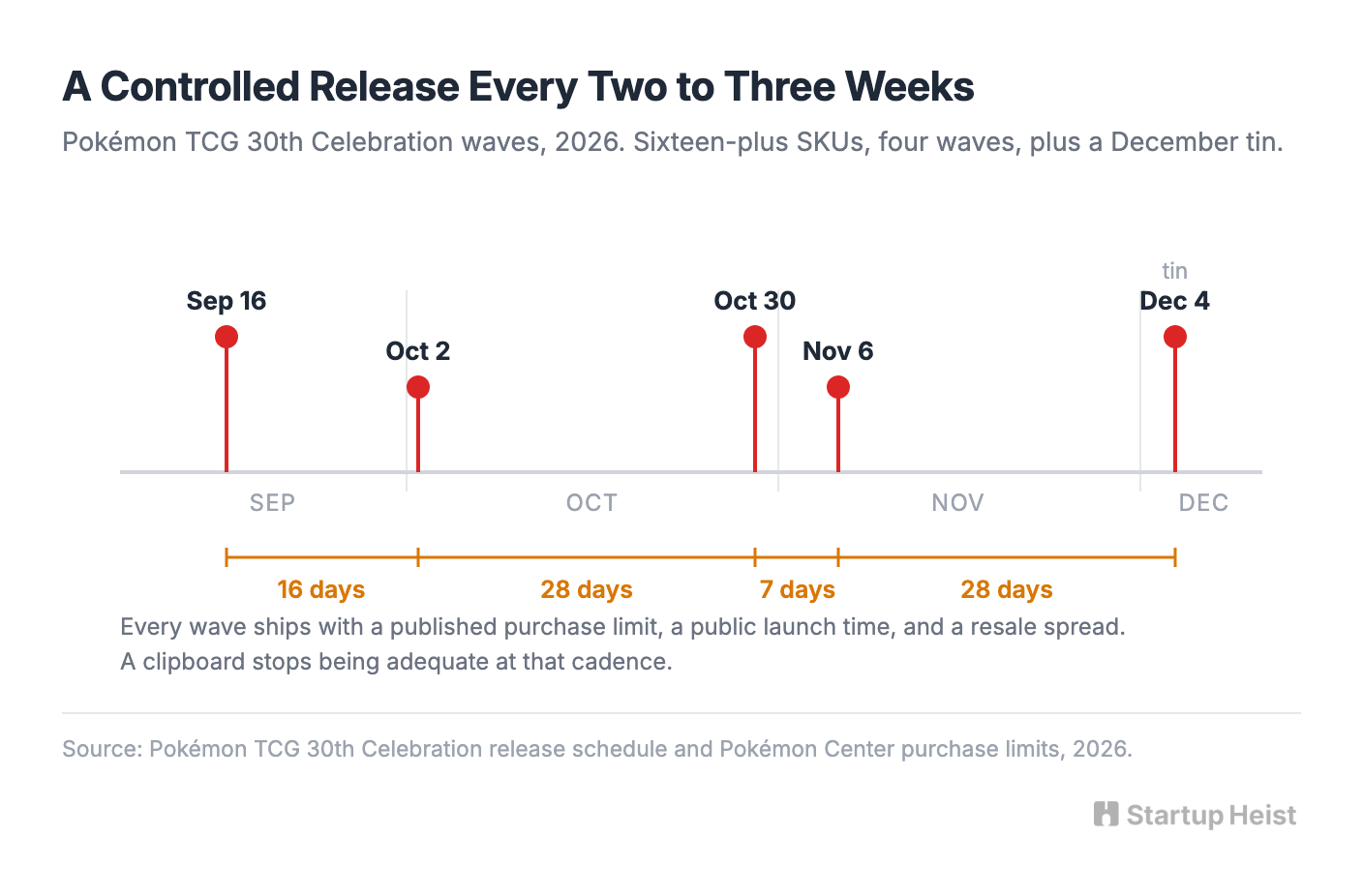
The timing argument is the strongest part of the case. The Pokémon TCG's 30th Celebration lineup runs at least sixteen SKUs across four waves in 2026, on September 16, October 2, October 30, and November 6, with a tin release following December 4. Purchase limits are already published at Pokémon Center, and allocation at the chains is being set per location. Analysts expect the Pokémon Company to print heavily, which means retailer allocation is what makes a shop's supply scarce. Translation: from September through early December, an independent card shop handles a controlled release every two to three weeks, each with a public limit, a public time, and a resale spread. A clipboard stops being adequate at that cadence.
Sell Evidence, Not Fairness
This positioning decision determines whether the company works.
Don't tell merchants you guarantee fair drops. You can't. An employee can ring the item at another register, scan it under the wrong SKU, or walk a carton out the back for cash, and a manager can be part of the problem. A Shopify app doesn't turn a hobby shop into Fort Knox, and any founder who pitches it that way gets destroyed by the first store that has a bad week.
Say instead that you document that every limited release followed the store's own policy. That's a claim about evidence, and it's one you can actually keep. Think SOC 2 for Pokémon cards, dramatically simpler.
That framing also dodges the trap that kills adoption from below. Staff won't use software that reads as surveillance. The message on the floor has to be that these are the release rules, everyone runs the same process, and exceptions get written down. If it lands instead as the boss suspecting you of stealing Charizards, the data never gets entered at all.
The MVP Has Seven Jobs
This is an unusually buildable product. There's no model to train, no payments stack, no hardware, no computer vision, and nothing on a chain. A capable Shopify developer ships a credible first version in six to ten weeks.
Unlock the Vault.
Join founders who spot opportunities ahead of the crowd. Actionable insights. Zero fluff.
“Intelligent, bold, minus the pretense.”
“Like discovering the cheat codes of the startup world.”
“SH is off-Broadway for founders — weird, sharp, and ahead of the curve.”


