


Pinterest Put Ads Inside Visual Search. The First Business to Build Is a $750 Audit.
Google trained a generation of marketers to think in keywords. A shopper types "Japandi walnut nightstand," and the advertiser can see the phrase, estimate demand, choose a bid, build a landing page, and measure what happens next. Visual search breaks that loop. A shopper on Pinterest sees a bedroom she likes, taps the nightstand, and asks for something like it with softer corners, a lighter finish, and a lower profile. Her intent is commercial, and the advertiser has no words for it, because furniture catalogs are organized around SKUs, product types, materials, and prices while shoppers increasingly discover through shape, mood, proportion, and resemblance.

On September 17, 2026, Pinterest put a price on that gap. At its Pinterest Presents advertiser summit, the company announced Visual Search Ads, a format that lets eligible advertisers bid for placements inside search results and Pin closeups while users compare products. Pinterest says its users run more than 80 billion searches a month, the vast majority visual and more than half commercial. CEO Bill Ready framed the shift as making the creative asset itself part of the targeting. If you sell furniture, your product photography now does some of the work your keyword list used to do.
There's a catch. Pinterest isn't handing advertisers a visual Keyword Planner, and no API lets you type "rounded cream bouclé chair" and get back visual-query volume, CPC, and Pinterest's internal read of intent. Pinterest owns that intelligence and will keep owning it. The buildable opportunity is smaller and sharper: sell furniture and home-décor brands a $750, human-reviewed visual merchandising audit that tells them how to group, photograph, test, and promote the products they already have, now that the search query is increasingly a picture.
The short version:
The money: Ten $750 audits a month plus 25 brands on $399/mo monitoring comes to about $17,500 a month, before you land a single agency program.
Inside:
• $750 audit scope and the 5-screen MVP stack
• Sample report with a five-step test sequence
• Agency-first outbound email, word for word
• Kill gate and three compounding moats
The gap between the catalog and the customer
Take a furniture brand with 380 SKUs. Its database knows SKU 1427 is an oak nightstand, 24 inches wide, $549, in stock. The photo says more: rounded corners, short cylindrical legs, pale grain, almost no visible hardware, shot against a cream wall beside rumpled linen. The image carries a second layer of product information the feed never captured: soft silhouette, light neutral palette, Japandi mood, low visual weight, warm bedroom context.
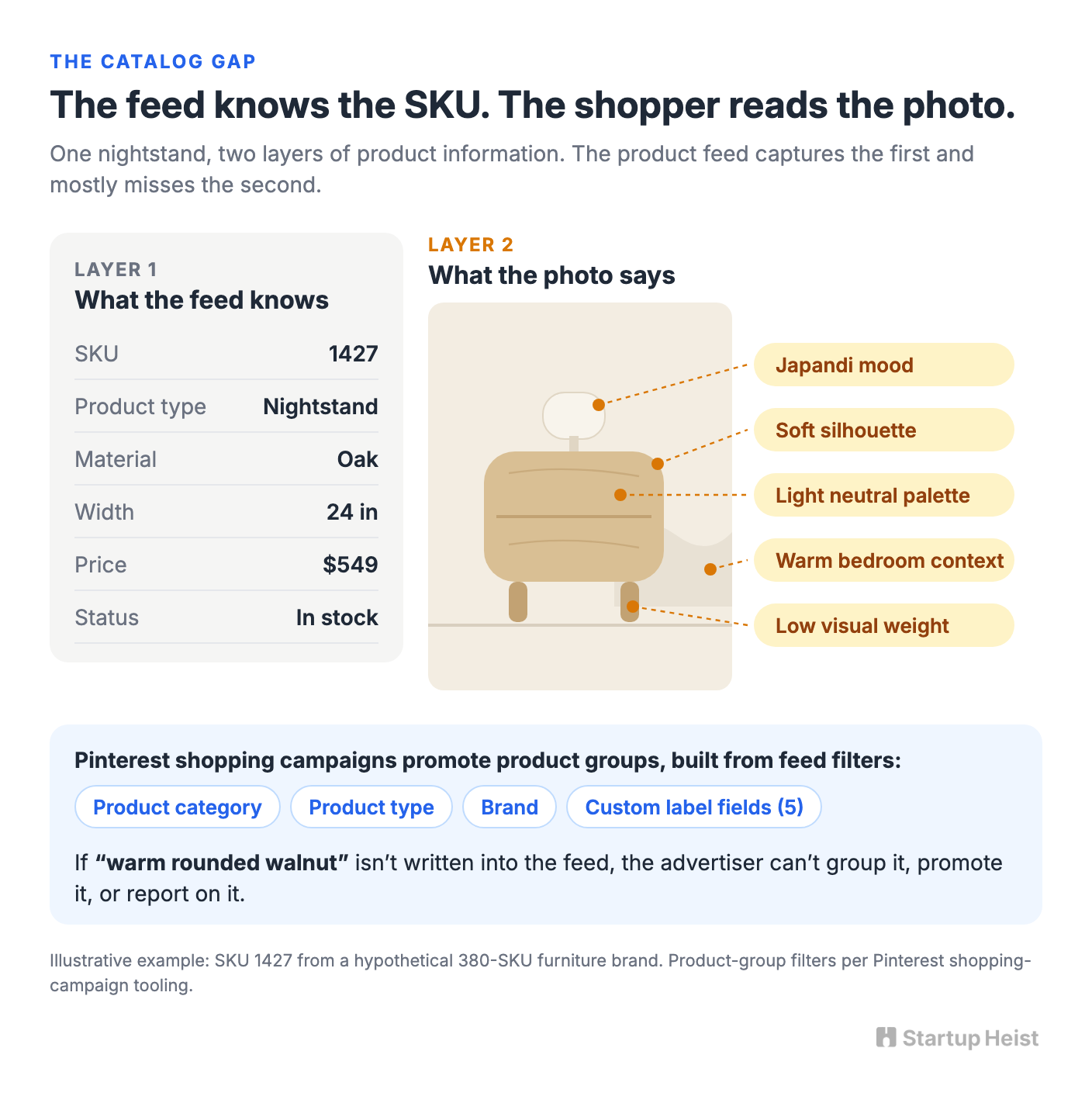
Shoppers read that layer instantly, and Pinterest's computer vision increasingly does too, but the merchant's product data mostly misses it. Pinterest's own tooling shows where this bites. Pinterest shopping campaigns promote product groups, and product groups are built from feed filters: product category, product type, brand, and five custom label fields. If "warm rounded walnut" isn't written into the product feed, the advertiser can't group it, promote it, or report on it.
A startup can close that gap by ingesting the merchant's feed and photography, using multimodal image models to organize the catalog visually, applying a controlled vocabulary, and having a human correct the machine. The deliverable is a set of decisions: these eight nightstands belong together; these three only look related because of the room styling; this hero shot hides the feature that sets the product apart; these two are near-duplicates, so promoting both wastes budget; this group deserves its own landing page. Call it a Visual Merchandising & Creative Readiness Audit, and keep "intent engine" out of the pitch.
Why furniture first
The method could work for apparel, jewelry, or any visually shopped category, but furniture is where structured attributes explain the least of the purchase. "Accent chair" is accurate and commercially useless. A shopper separates a chunky bouclé chair from a spindly mid-century lounger, a rolled-arm traditional, and a sculptural postmodern piece in a fraction of a second, and a model has plenty of visible dimensions to read: silhouette, leg shape, material appearance, color family, visual weight, room style.
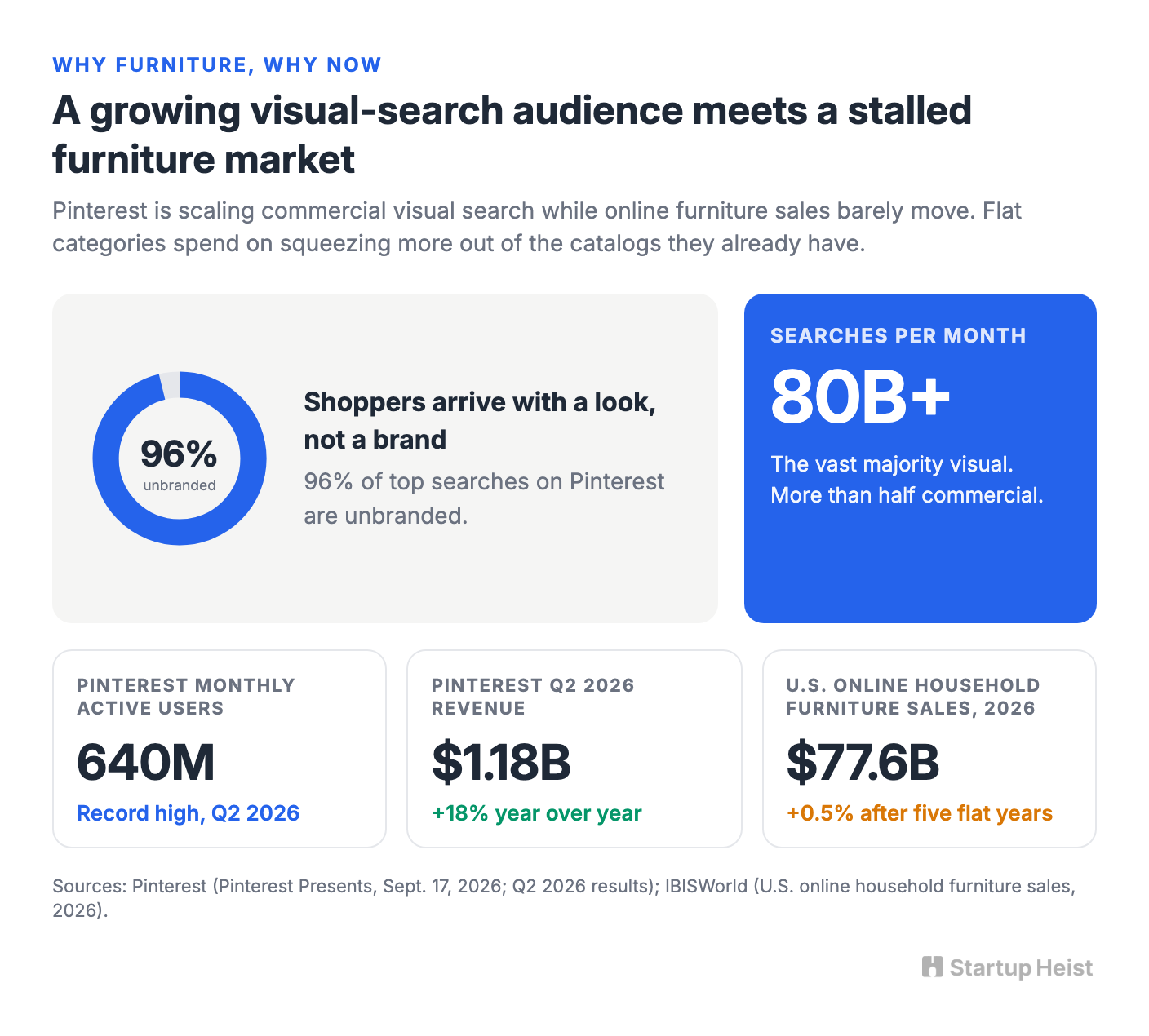
Pinterest's audience shops exactly this way. The company says 96% of top searches on the platform are unbranded, so shoppers mostly arrive with a look in mind and no brand attached, which is the behavior a SKU-and-category feed can't describe. At the same September 17, 2026 event, Pinterest previewed Restyle, a consumer AI feature in beta in the U.S. and Canada that lets users photograph a room and test furniture, décor, and style changes in it, including items from Pins they've saved, which pulls home shopping on the platform even closer to the photo itself.
The market is large and stuck. IBISWorld puts U.S. online household furniture sales at about $77.6 billion in 2026, up 0.5% after five flat years, with a weak housing market and tariffs squeezing margins. Stagnation works in your favor: retailers who can't count on growth spend on getting more out of catalogs and photography they already paid for. Pinterest has the advertiser base to matter, too, with $1.18 billion in Q2 2026 revenue, up 18% year over year, on a record 640 million monthly active users. None of this proves anyone will buy the audit, only that there are enough potential buyers to make finding the first five worth your time.
The competition tells you where to stand
Unlock the Vault.
Join founders who spot opportunities ahead of the crowd. Actionable insights. Zero fluff.
“Intelligent, bold, minus the pretense.”
“Like discovering the cheat codes of the startup world.”
“SH is off-Broadway for founders — weird, sharp, and ahead of the curve.”


