


Tastewise Sells Trend Data to PepsiCo. Nobody Sells the Launch Kit to Main Street.
A food trend starts moving. Pistachio cream. Ube. Miso caramel. A chaotic, over-decorated birthday cake built to be photographed before it's eaten.
A large food company catches it early because catching it early is somebody's job. Tastewise tracks movement across restaurant menus, recipes, retail products, and social conversation. PepsiCo, Nestlé, Mars, and Kraft Heinz use it to make product and marketing decisions. The entry package listed publicly on AWS Marketplace runs $5,000 a month, and that's the cheap tier.
The independent bakery owner sees the same trend three weeks later, on Instagram, while eating lunch standing up.
Then the actual work starts. Can it be made with the equipment already in the shop? Where does anyone buy that ingredient in commercial quantities? What happens when a home recipe gets multiplied by forty? What should it cost, how long will it hold, which allergens have to be disclosed, what do the counter staff say when a customer asks what kataifi is, and how many should be made on the first Saturday?
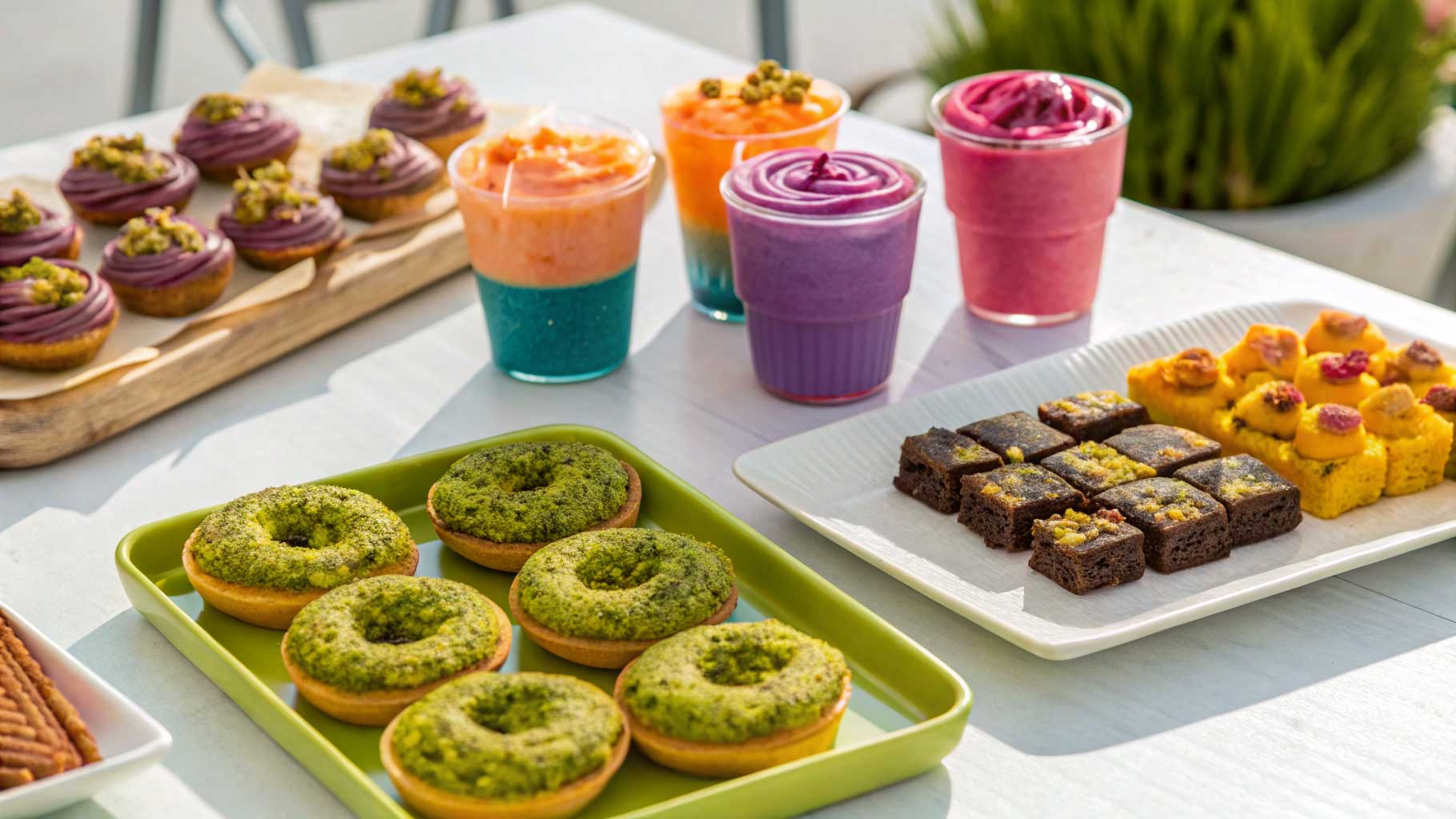
The owner doesn't need a trend dashboard. What's missing is a launch kit.
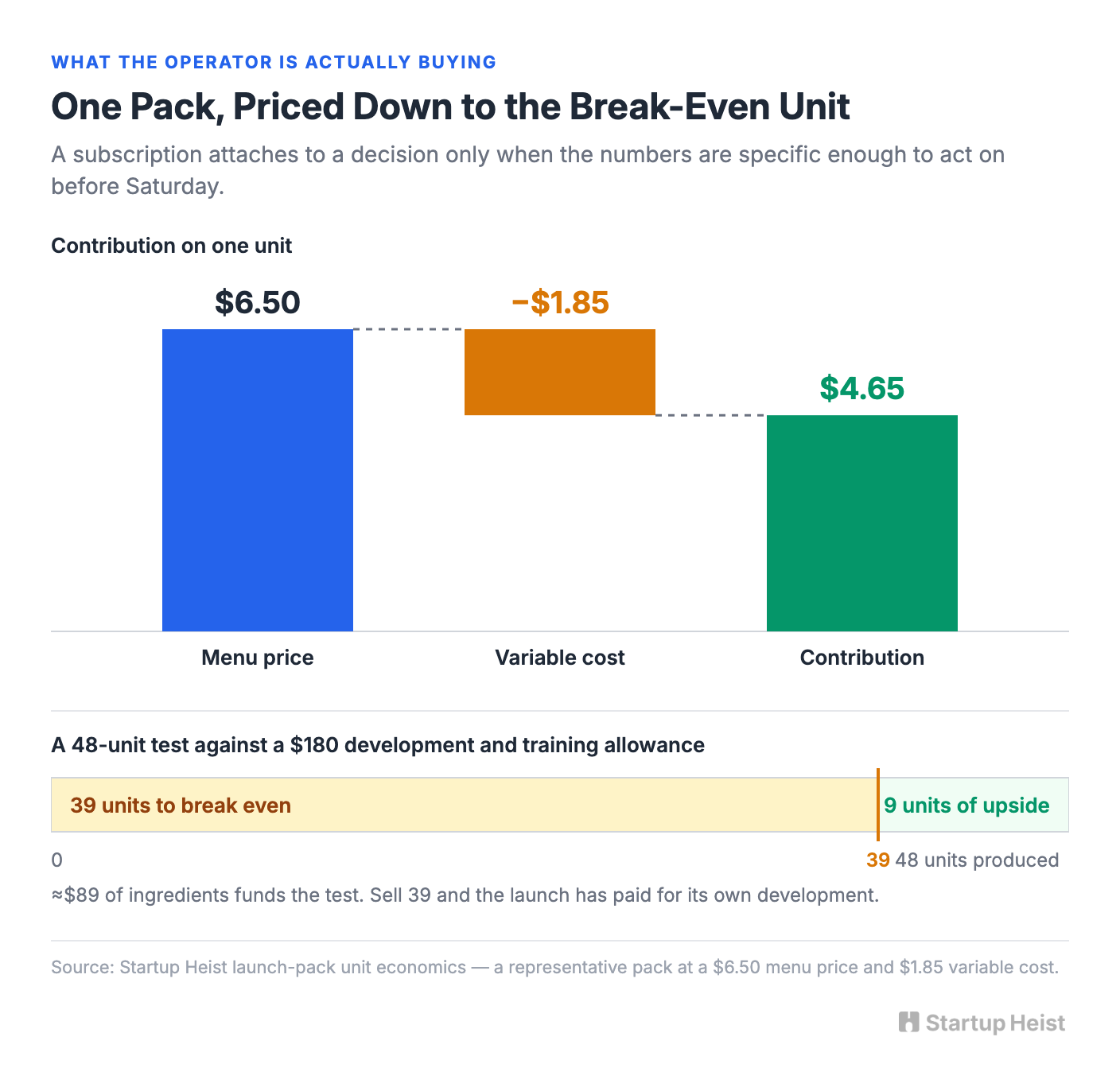
The opportunity is a subscription that turns early food trend signals into complete, ready-to-run limited-time offers for independent bakeries and cafés. The deliverable is the pistachio-cardamom croissant you can launch in ten days, with the tested batch formula, three sourcing paths, unit cost, recommended menu price, prep workflow, staff script, counter sign, and seven social posts. What the owner is buying is closer to an outsourced menu-development department than a trend feed, and the whole company sits in that distinction.
Here's the opportunity:
The money: 500 shops at $249 a month is $124K MRR. Checks carrying a limited-time offer run 26% higher, so one sell-out covers months of subscription.
Inside:
• Twelve-factor filter for which trends to run
• Launch-pack spec: formula, cost sheet, assets
• Pricing tiers and the distributor licensing play
• 90-day plan with a paid concierge pilot
The Market Is Small Enough to Own
The U.S. bakery-café industry runs roughly $17.8 billion across about 9,112 businesses, growing at a bit over 1% a year for the past five years. Steady, fragmented, thoroughly unglamorous.
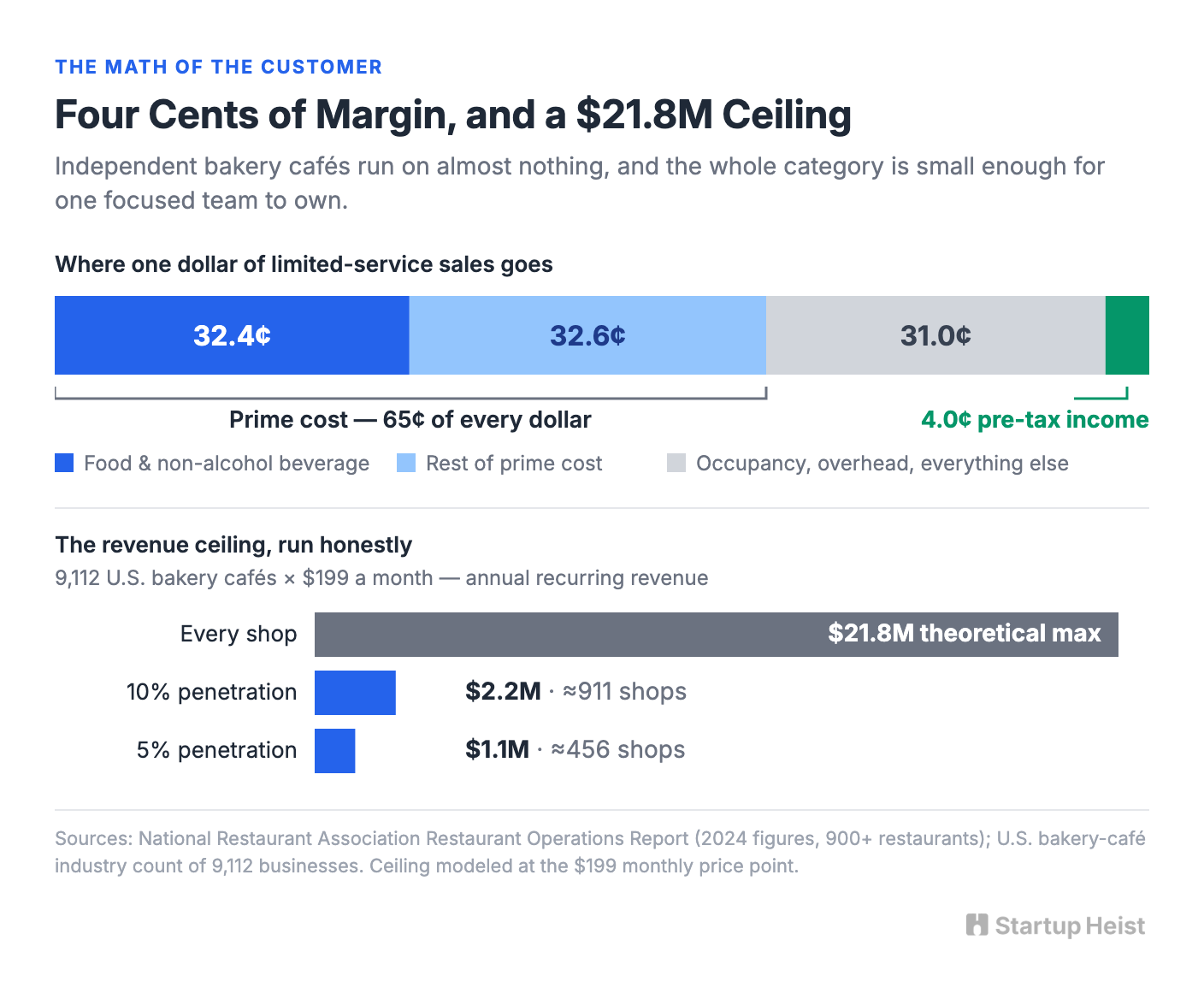
The economics leave no room for a failed experiment. In the National Restaurant Association's operations report covering more than 900 restaurants, limited-service operators posted a median pre-tax income of 4.0% of sales in 2024, food and non-alcohol beverage costs ate a median 32.4%, and prime costs took 65 cents of every dollar through the register. The input side keeps getting worse. USDA's July 2026 outlook projects food-away-from-home prices up 3.5% this year, sugar and sweets up 7.2%, nonalcoholic beverages up 3.9%, and farm-level wheat up 11.8%. A shop working on four points of pre-tax margin can't casually buy specialty chocolate, pistachio paste, custom packaging, and decorative toppings, train three employees, produce a hundred units, and then find out customers don't understand the product.
Run the ceiling honestly. If every one of those 9,112 bakery cafés paid $199 a month, the theoretical maximum is $21.8 million in annual recurring revenue. At 5% penetration you'd have roughly 456 customers and $1.1 million. At 10%, about $2.2 million.
No venture-scale software company lives in those numbers, and pretending otherwise is how founders talk themselves into building the wrong product. What lives there is a capital-efficient vertical business a small team can own outright, with an obvious second act in adjacent categories and supplier distribution. Five hundred retained customers and real commerce revenue is an excellent life. The ceiling only becomes a problem if you were planning to lie about it.
The LTO Is Already the Operating Rhythm
Bakeries understand seasonal products. Pumpkin in October, peppermint in December, heart-shaped everything in February. The play is running that rhythm faster and sharper.
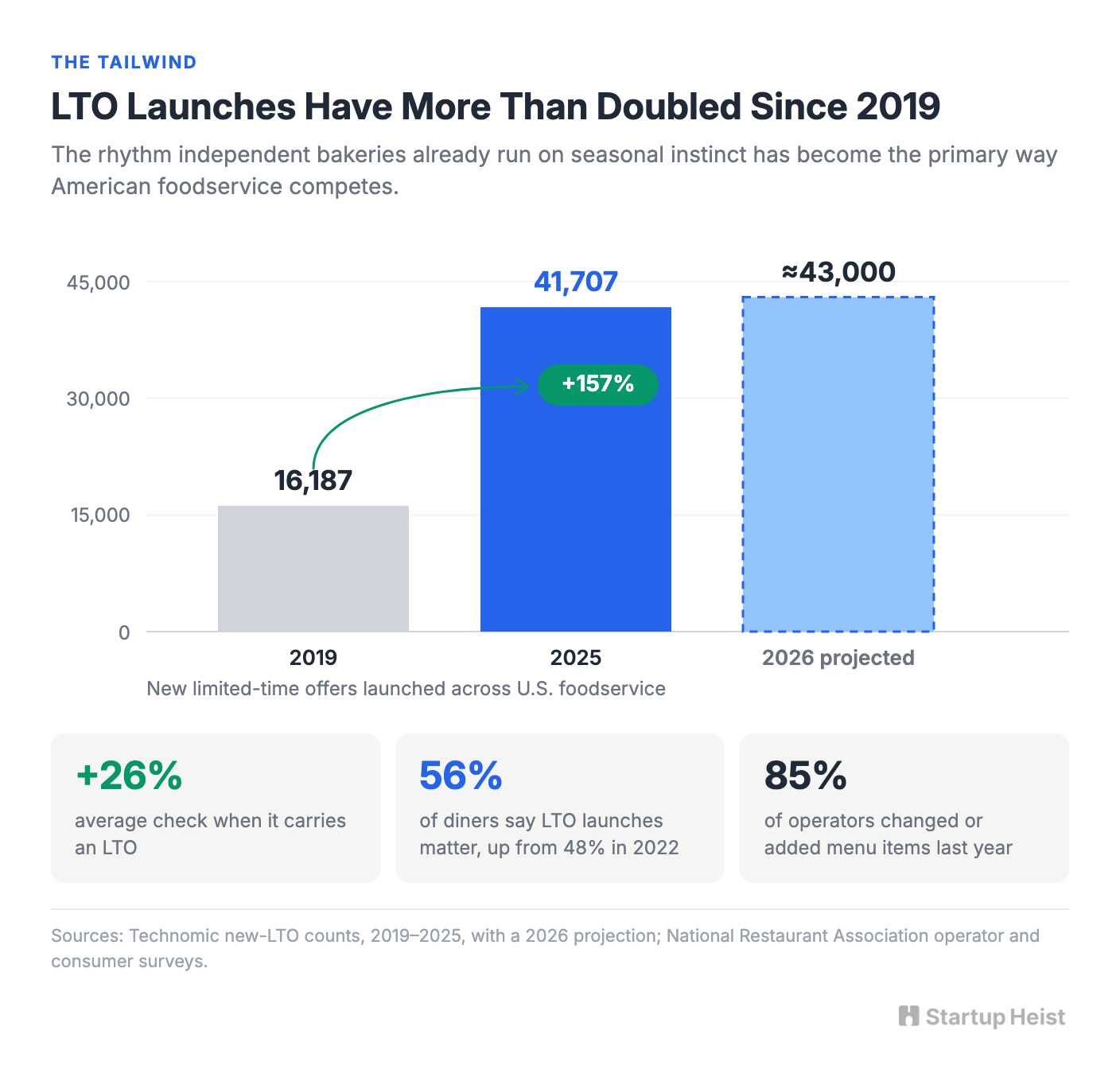
The volume shift is documented. Technomic counted 16,187 new limited-time offers across U.S. foodservice in 2019 and 41,707 in 2025, a 157% increase, with just under 43,000 projected for 2026. Eighty-five percent of operators changed or added menu items over the prior year. Consumer appetite moved with it: the share of diners who say LTO launches matter to them rose from 48% in 2022 to 56%. And checks containing an LTO run 26% higher than checks without one. A $249 subscription only has to justify itself against that lift, which is an easier argument than most software gets to make.
Social platforms set the tempo. Tastewise clocked chaos cakes climbing 45.36% on Instagram and pasta chips gaining 24.78% on TikTok. The specific trends matter less than the pattern underneath: attention accelerates months before the trade press finishes writing its annual forecast, and by the time a signal reaches an owner's phone, the executable window is already half spent.
Enterprise food trend intelligence solves the first half of that problem and restaurant marketing software solves the last half. Tastewise and Datassential sell signal to companies that already employ product developers. Popmenu sells websites, email, social posting, ordering, and reputation tools at $179 to $499 a month, which is excellent for promoting an item that already exists. Ingredient suppliers crowd the front end. Dawn Foods publishes an annual bakery trend report built on surveys of more than 3,000 global consumers, and Puratos runs a parallel program. Both are genuinely useful, and both stop in the same place: four named macro-trends, some inspiration photography, and a link to the catalog. Nobody hands the owner the formula, the cost sheet, and the Saturday.
The unclaimed middle is a single workflow: signal, commercial concept, sourcing, costing, production, launch assets, measurement. Building that workflow is the business.
What Actually Ships Every Month
The product is one or two fully developed LTO packages a month. Each answers five questions, and the order matters.
Unlock the Vault.
Join founders who spot opportunities ahead of the crowd. Actionable insights. Zero fluff.
“Intelligent, bold, minus the pretense.”
“Like discovering the cheat codes of the startup world.”
“SH is off-Broadway for founders — weird, sharp, and ahead of the curve.”


