


The AI CMO Everyone Else Is Afraid to Build
A four-person startup called Okara is running AI marketing agents for more than 120,000 businesses. Vercel's engineering case study on the company lays out the architecture: the system ingests a company's website, develops strategy and brand voice, then coordinates specialized agents across SEO, content, social, Reddit, and Hacker News, processing four billion tokens a day. A coding agent even opens pull requests for technical SEO fixes, with a human approving before anything ships. The whole package sells for $99 a month, or $66 a month billed annually.
The engineering is impressive. The price is the more important signal. When four people can assemble a horizontal marketing department and sell it for less than a gym membership, multi-agent orchestration has stopped being a moat. Every founder with API keys and a free weekend can wire up a content agent, an SEO agent, and a social agent. The ninth generic AI CMO will launch into a market that already yawned at the eighth.

The opportunity sits one layer deeper: take the same architecture into a market where generic agents can't safely operate. Law firms, med spas, financial advisers, insurance brokers. These businesses need content that follows jurisdiction-specific rules, passes platform policies, carries required disclosures, moves through an accountable approval chain, and traces back to signed clients. A generic agent creates liability the moment it touches any of that.
So here's the heist: a compliance-aware growth operator for one regulated vertical, priced at three to ten times the horizontal anchor, because the product is risk reduction and workflow integration rather than word count. The cleanest first move is small law firms.
The money: 100 firms at $499 a month is $50K MRR; 250 clears $1.5 million ARR. Ten paid pilots at $299 validate demand first.
Inside:
• Seven-part MVP scoped to Florida and Clio
• The rules engine that earns premium pricing
• Pricing ladder from $299 pilot to $1,499
• Audit-first outreach and shadow-mode GTM
The horizontal layer is already a commodity
Okara revealed what the base architecture now looks like: ingest positioning, generate strategy, split it across channel agents, draft assets, route important actions to a human, learn from performance, repeat. None of it is proprietary anymore. Model routing, tool use, retrieval, structured outputs, and sandboxed code execution are infrastructure you rent by the token. Coordinated draft generation has become cheap, and cheap capabilities get priced like commodities.
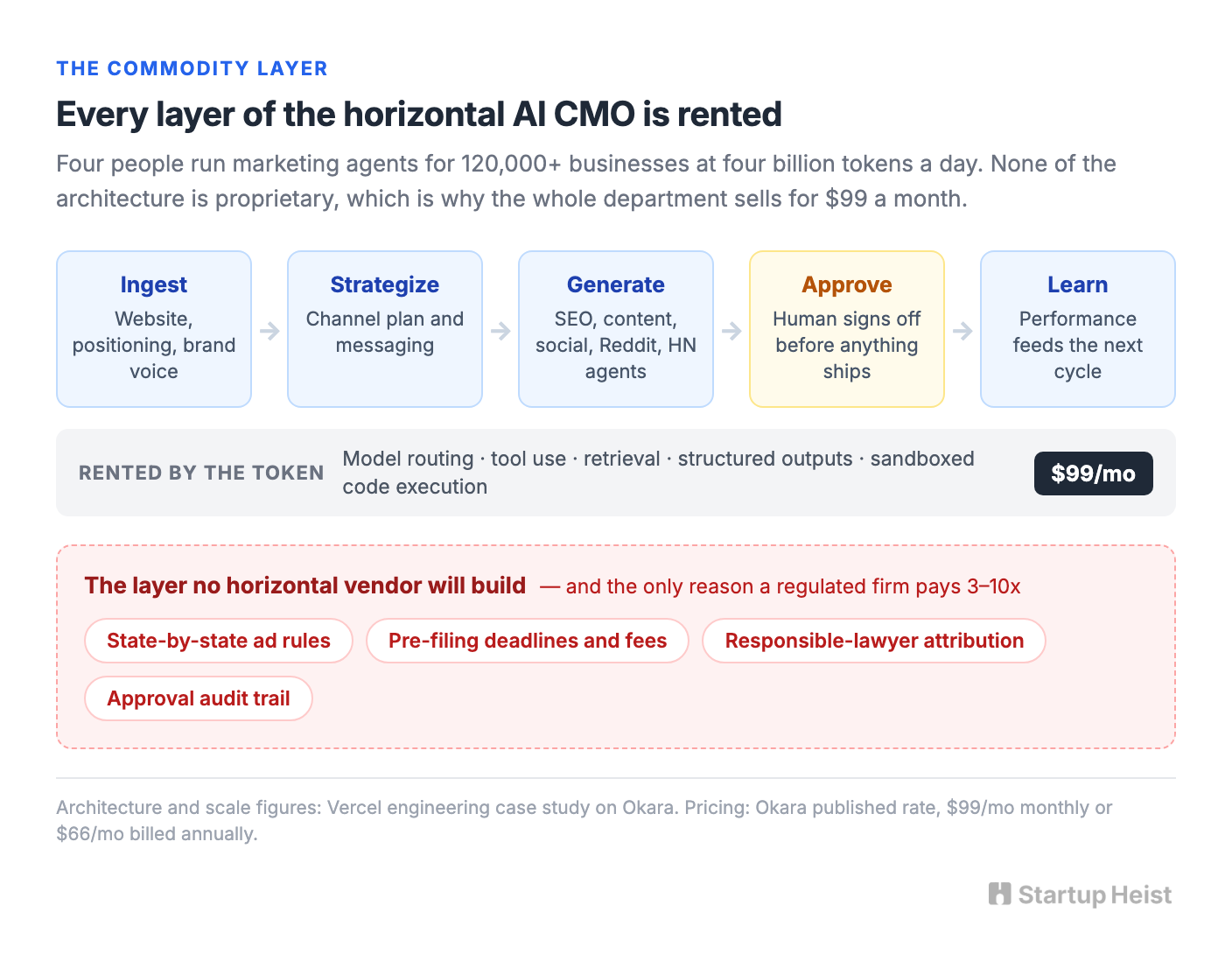
Horizontal providers have to serve thousands of business types, which forces generalized recommendations and generalized safety rules. A local law firm has the opposite problem. Before a single ad runs, someone must know which state's advertising rules apply, whether the message counts as advertising or solicitation, whether a phrase implies prohibited specialization, which attorney is named as responsible for the content, whether a testimonial or fee statement needs qualification, whether the ad must be filed with a bar authority before use, and whether last week's revised headline legally counts as a brand-new advertisement.
A $99 agent can produce ten headlines in seconds, but it can't answer those questions across 50 states and shifting platform policies, and no horizontal vendor will build the rules layer to try. The margin lives in that gap.
Why small law firms are the wedge
The U.S. had roughly 1.37 million active lawyers in 2025 and more than 165,000 law-office establishments with employees. You don't need the whole market. The target is consumer-facing firms with three to 20 attorneys, real lead volume, a practice-management platform already installed, and no marketing department. Family law, criminal defense, immigration, estate planning, bankruptcy, plaintiff-side work.
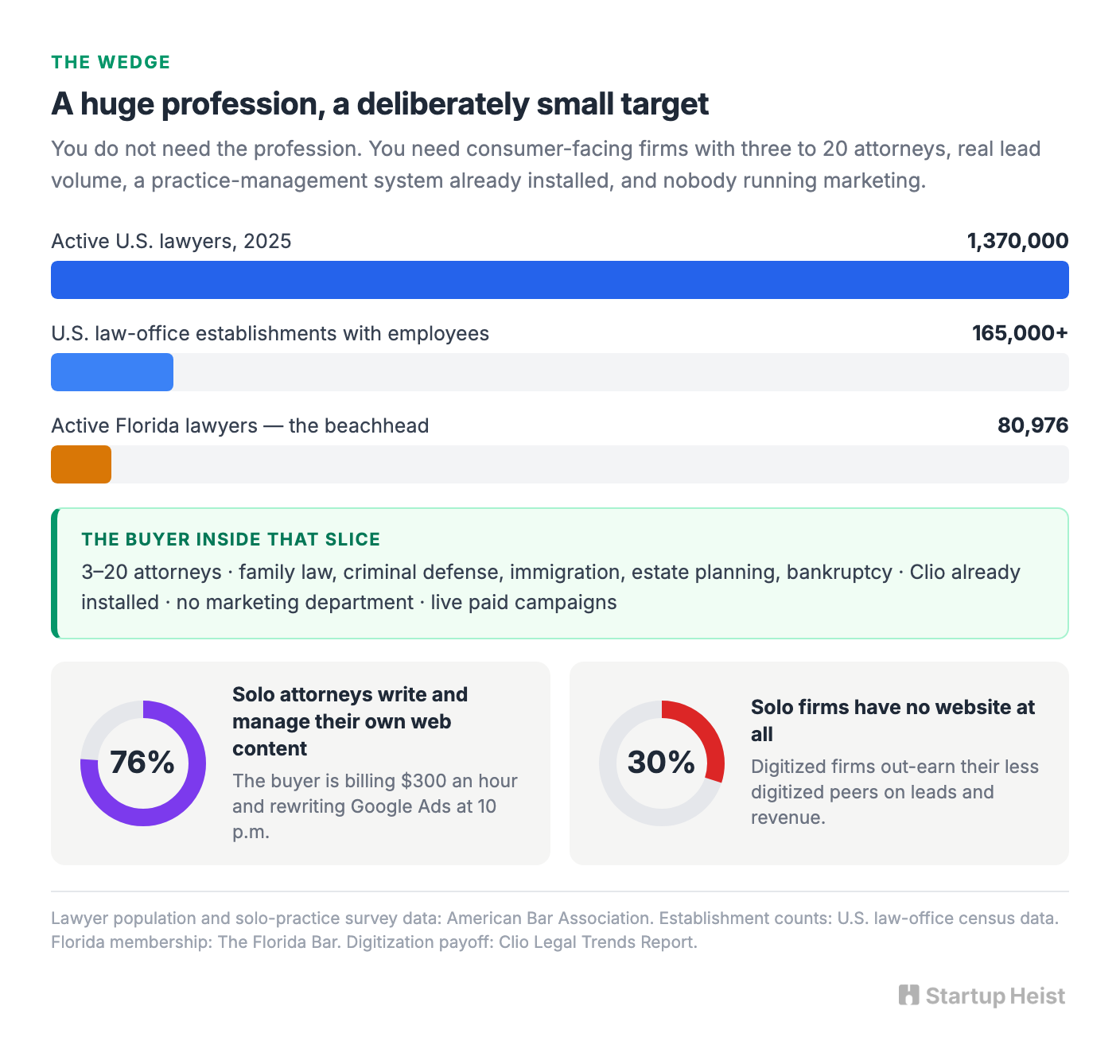
This market runs its own marketing at a startling rate. ABA survey data shows 76% of solo attorneys personally manage and write their own web content, and only 70% of solo firms have a website at all. The buyer is an attorney billing $300 an hour who is also rewriting Google Ads at 10 p.m., arguing with an agency about lead quality, and guessing which campaigns actually produced clients. Clio's Legal Trends research shows firms that adopt digital intake tools generate more leads and revenue than less digitized peers, so the payoff for fixing this is documented. The appetite is real, and so is the risk that keeps these firms cautious.
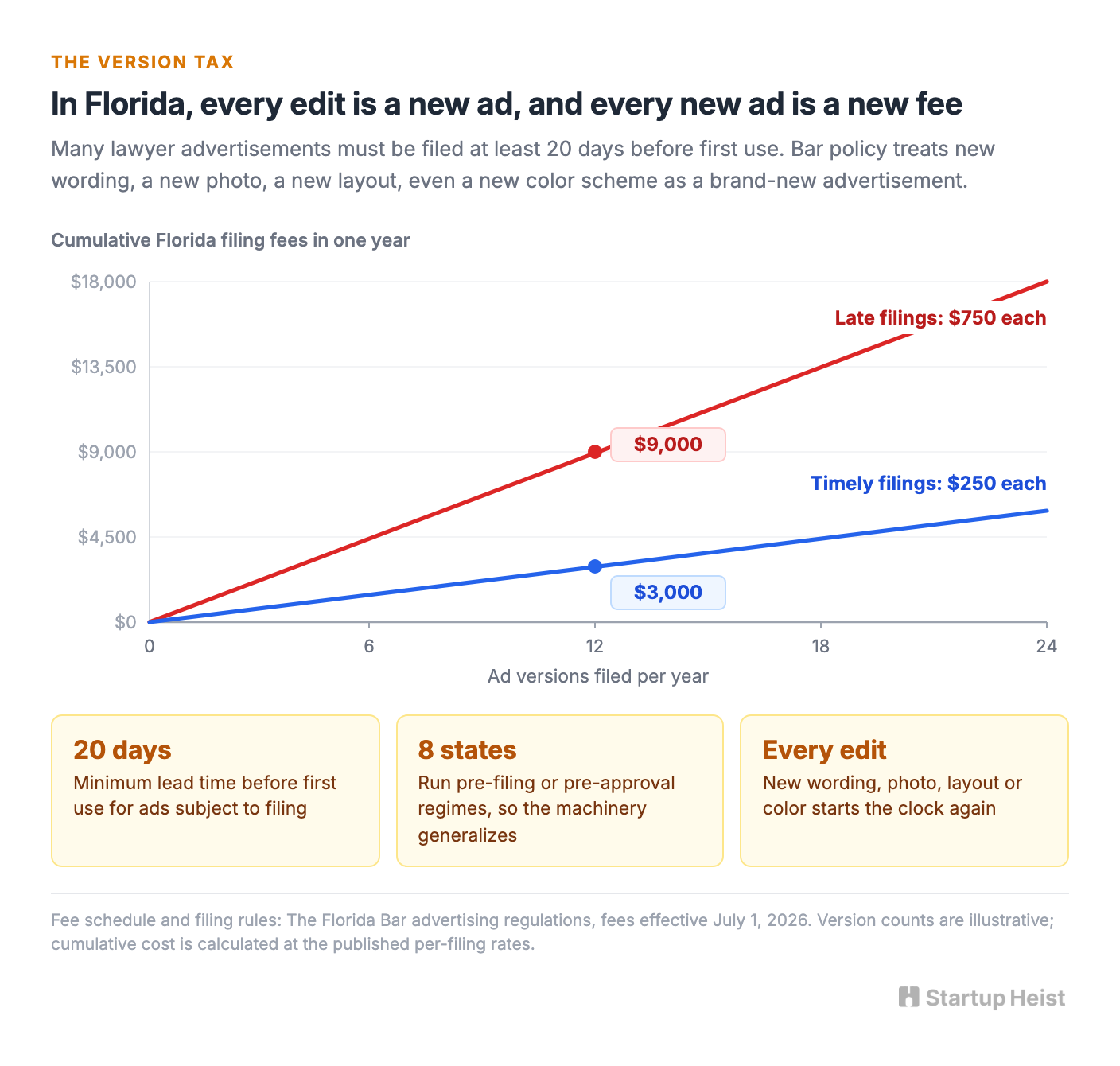
Florida shows how operational that risk gets. Under the Florida Bar's advertising rules, many lawyer advertisements must be filed at least 20 days before first use. Effective July 1, 2026, a timely filing costs $250 per advertisement and a late one costs $750. Bar policy treats virtually any change to an ad as a new advertisement requiring a new filing and a new fee: new wording, new photo, new layout, even a new color scheme. Behind the state rules sit the ABA Model Rules. Rule 7.2 restricts referral payments and requires a responsible lawyer to be named, Rule 7.3 regulates solicitation of people known to need legal help, and Rule 7.4 governs claims of specialization and certification. Florida alone has 80,976 active lawyers competing in loud local-service markets, and every ad they run carries deadlines, documents, fees, and version control. Seven other states run pre-filing or pre-approval regimes of their own, so this is a national pattern rather than one bar's quirk.
That's a recurring, expensive, paperwork-heavy process nobody enjoys, which is exactly the shape of problem software gets paid to solve.
Sell the guardrails
The fastest way to kill this opportunity is promising that AI will autonomously run a law firm's marketing. Lawyers will never hand an opaque agent permission to publish claims or handle client information, and the bar has told them exactly that: ABA Formal Opinion 512 makes lawyers responsible for understanding generative AI's limits, reviewing its output, and protecting confidential information, while Model Rule 1.6 requires reasonable efforts to prevent unauthorized disclosure.
Position the product as a compliance-aware marketing operations platform. It prepares, checks, routes, records, and measures campaigns while the firm keeps final approval. It does everything surrounding the approval click: researching opportunities, drafting channel assets, flagging potential rule violations with plain-English explanations, assembling filing materials, recording who approved what, syncing leads and signed matters from the CRM, and recommending the next move. The attorney stays responsible for what goes live. That constraint is the product design, and it's exactly what makes a premium price defensible.
The first product: Florida, Clio, two channels
Don't launch nationally, and don't start with eight agents. Choose one state, one software ecosystem, one buyer profile, and two channels. The credible opening wedge: compliance-aware paid-search and landing-page operations for Florida consumer law firms running Clio.
Unlock the Vault.
Join founders who spot opportunities ahead of the crowd. Actionable insights. Zero fluff.
“Intelligent, bold, minus the pretense.”
“Like discovering the cheat codes of the startup world.”
“SH is off-Broadway for founders — weird, sharp, and ahead of the curve.”


