


Meta Owns the Chatbot. You Can Still Own the Order.
The forty-tap problem
A reel lands. Forty people tap the WhatsApp button under an Instagram boutique's post, and within the hour the owner's phone is unusable.
One buyer wants the red kurta in medium. Another sends a voice note in mixed Hindi and English asking whether it can reach Pune by Saturday. A third sends a screenshot instead of a product name. Someone asks for a discount. Someone says they paid but doesn't include a transaction reference.
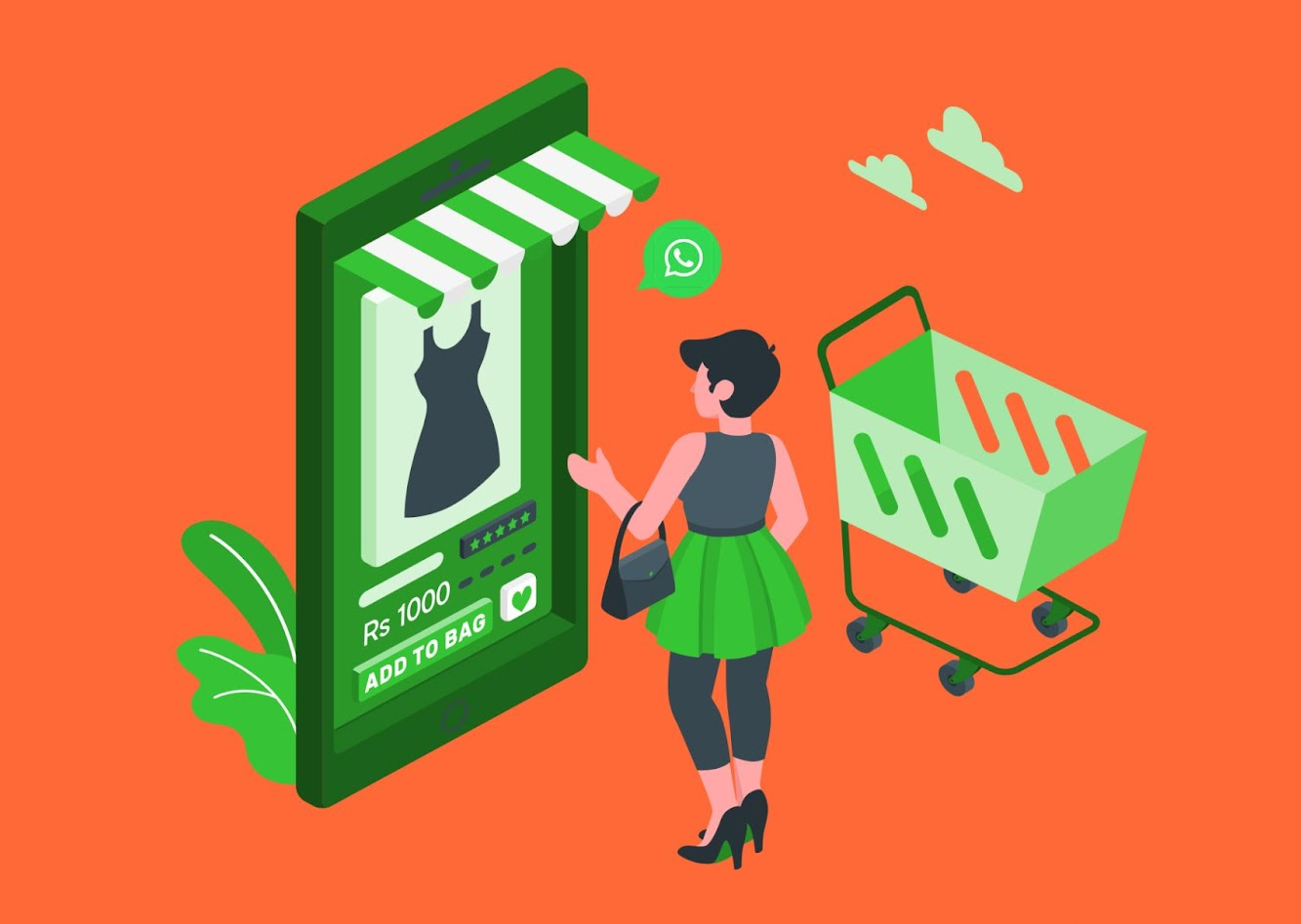
The owner is also packing yesterday's orders, shooting tomorrow's Stories, and trying to remember whether the last red medium was already promised to a customer who went quiet two days ago.
This is what conversational commerce actually looks like in India. Voice notes, screenshots, a Google Sheet, and a UPI QR code, with nothing resembling a checkout funnel anywhere in the sequence.
Here's the opportunity buried in that mess:
The money: 250 merchants at a ₹2,499 blended subscription is ₹7.5 million ARR, about $78,000. A thousand puts you near $313,000.
Inside:
• Seven-feature MVP scope, 4 to 8 weeks
• Three-tier pricing from ₹1,499 to ₹5,999
• The 90-day pilot-to-auto-send sequence
• Four moats that compound past the chatbot
The obvious fix is a storefront link. It organizes the catalog and solves nothing that matters. Buyers still ask before they buy, and the seller still has to interpret each message, verify stock, price the order, collect payment, and record what happened.
The better wedge sits inside the conversation: read the inquiry, check the merchant's real inventory, prepare an accurate reply, generate the payment request, and turn the thread into a recorded order.
Meta already shipped most of the obvious version of this product, which moved the opportunity rather than closing it.
A market that already runs on chat
India's e-retail market crossed $65 billion in gross merchandise value in 2025, according to Bain's work with Flipkart, growing around 20% a year against a projected $170 to $180 billion by 2030. The online shopper base has doubled in five years to roughly 300 million people.
Those numbers describe the formal market and undercount the behavior. Discovery happens on Instagram, where more than 200 million Indians are active and fashion is the top social commerce category, while the transaction completes in a chat thread no analyst is measuring.
Messaging does the selling. Meta cited a 2025 Kantar study finding that 91% of online adults in India message a business every week, the highest rate in the world and up from 86% three years earlier. Meta's click-to-WhatsApp ads route buyers from Facebook and Instagram straight into a thread, which turns the conversation into the landing page.
Payments caught up years ago. In June 2026 alone, UPI cleared 22.72 billion transactions worth ₹28.92 lakh crore. Collecting money is a solved problem for a merchant with a phone.
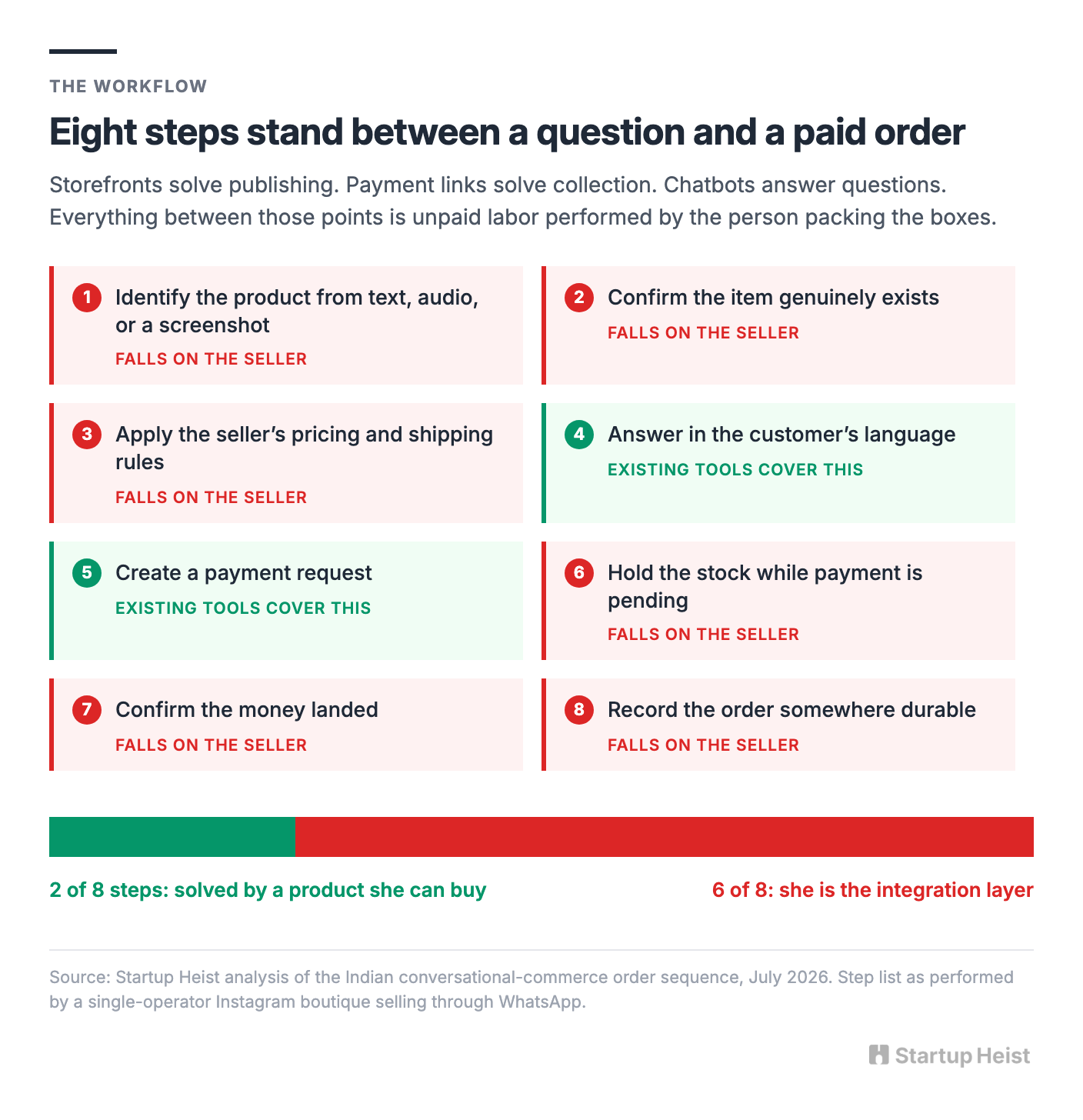
Storefronts solve publishing, payment links solve collection, and chatbots answer questions. The bottleneck is sales operations. Every order takes something like ten steps: identify the product from text or audio or a screenshot, confirm the item genuinely exists, apply the seller's pricing and shipping rules, answer in the customer's language, create a payment request, hold the stock while payment is pending, confirm the money landed, and record the order somewhere durable.
Most tools solve two or three of those steps. The seller is the integration layer for everything else, and that unpaid job is where a real product lives.
Meta is already standing in it
In May 2026 Meta announced Business AI for small businesses on WhatsApp in India, with rollout starting July 7. It answers questions, recommends catalog products, speaks India's native languages, hands difficult threads back to the owner, and Meta says it will soon complete UPI payments inside the chat. Setup runs from the WhatsApp Business app, no code required.
On June 3, 2026, Meta took the product global as Meta Business Agent, across WhatsApp, Instagram, and Messenger. Pilots in India, Mexico, and Brazil produced more than a million businesses running an agent before the worldwide launch.
The weak version of this startup is dead. Nobody should build "upload your catalog, train an AI on your FAQs, let it answer WhatsApp messages." Meta bundles that for free, and so do Interakt, AiSensy, WATI, and dozens of other WhatsApp Business API providers.
The surviving question is narrower and harder: what can a vertical software company know, connect, and execute that a general-purpose agent won't reliably handle for a one-person boutique?
Conversation quality isn't the answer. Meta's agent can tell a customer the red kurta comes in medium. Your product has to know whether the final red medium was reserved eleven minutes ago by someone who hasn't paid, whether Pune by Saturday is a promise she can keep, and whether the payment cleared. The defensible layer is everything standing behind the reply.
The pricing trap nobody is pointing at
Two changes to Meta's economics land within two months of each other, and together they reset the strategy.
Starting August 1, 2026, Meta bills its Business Agent on tokens for enterprise customers running on the Cloud API: $2.00 per million tokens, bundling AI processing and message delivery into one line. A typical interaction runs 20,000 to 25,000 tokens, roughly four to five cents a conversation. Merchants on the free small-business tier, meaning the WhatsApp Business app, Instagram Pro, and Meta Business Suite, keep the agent free with no subscription commitment. That free tier is exactly the segment this startup targets.
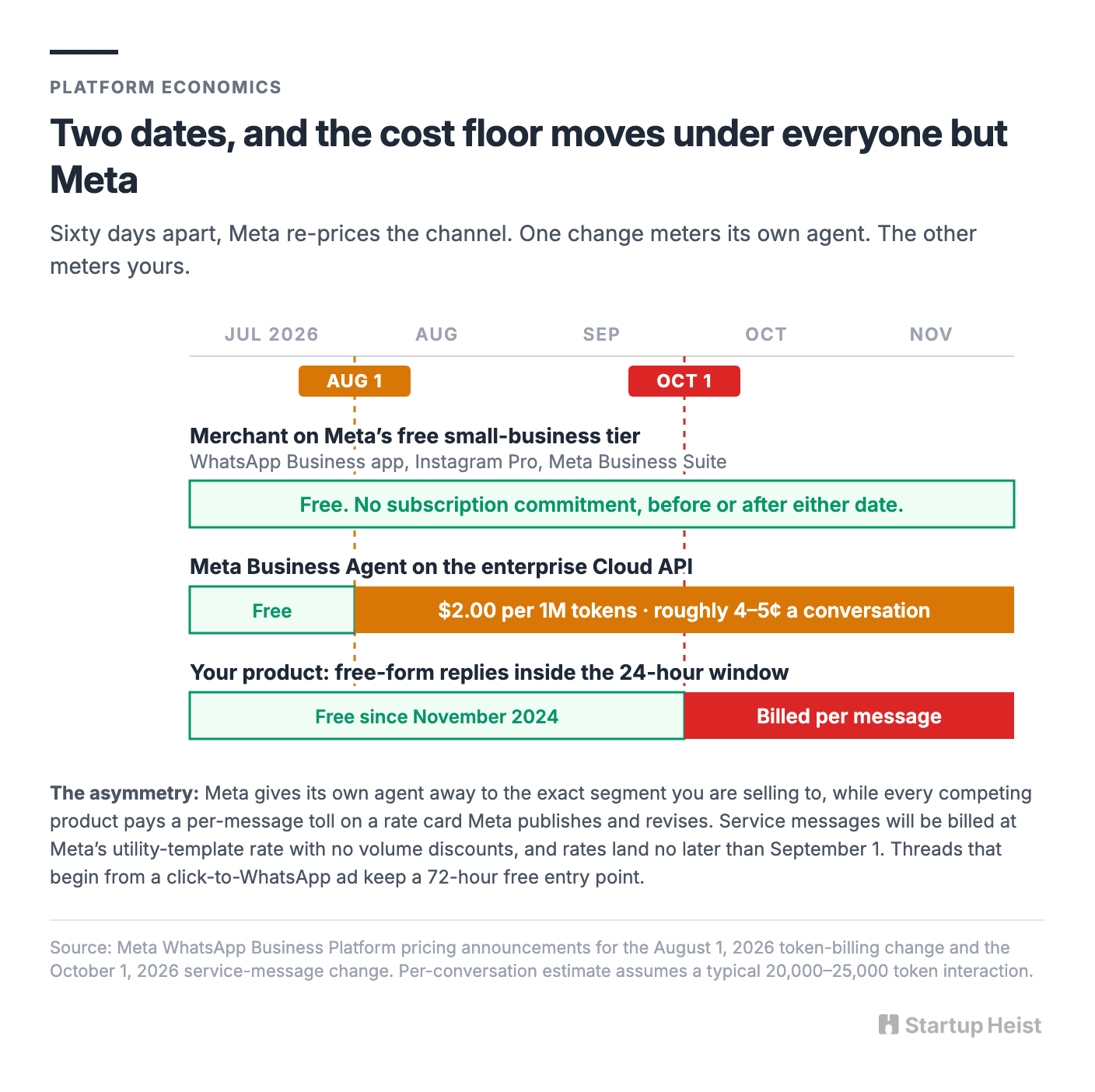
Starting October 1, 2026, Meta begins charging for service messages, the free-form replies a human or a third-party AI sends inside the 24-hour customer window. They've been free since November 2024. They'll be billed per message at the rate Meta charges for utility templates, with no volume discounts, and rates land no later than September 1. Conversations originating from a click-to-WhatsApp ad keep a 72-hour free entry point, so ad-driven inbound dodges the toll for a while. The general case is now metered.
Put the two dates together and the asymmetry is plain. Meta gives its own agent away to small merchants while every competing product pays a per-message toll on top of its own model costs, on a rate card Meta publishes and revises.
Any product whose value is measured in messages sent is competing on a cost structure its competitor controls. You have to sell something Meta doesn't meter.
Nobody at Meta is metering inventory accuracy, a reservation that expires in twenty minutes, payment reconciliation, or the order record. That's the business you're in.
Who's actually underserved
Meta owns the channel, the consumer identity, the catalog format, and now the default agent. It will be impossible to beat on price or language coverage for merchants whose needs are mostly FAQs and product recommendations.
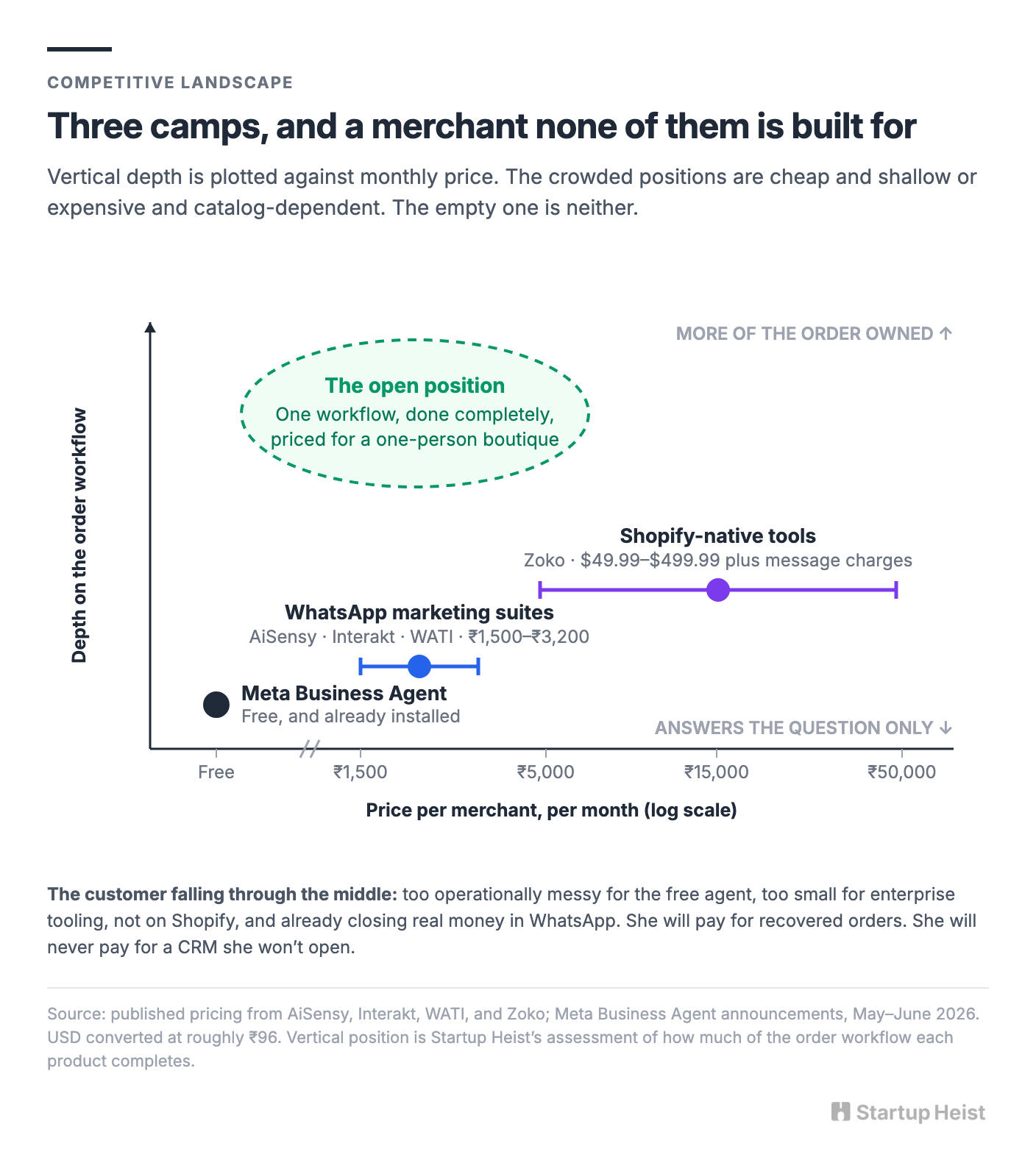
The WhatsApp marketing suites sit one layer up: AiSensy at ₹1,500 to ₹3,200 a month, Interakt pricing per conversation, WATI selling session top-ups, all of them bundling broadcasts, shared inboxes, campaign builders, and bot flows. Their breadth is the problem for a boutique that needs exactly one workflow to work perfectly. Above them, Shopify-native tools like Zoko run $49.99 to $499.99 a month plus Meta's message charges plus add-ons, and they assume a clean Shopify catalog the target merchant doesn't have.
Stack those and a specific customer falls through the middle. She's too operationally messy for Meta's basic agent and too small for enterprise tooling. She isn't on Shopify, she's already closing real money in WhatsApp, and her inventory lives in a spreadsheet. She'll pay for recovered orders, and she'll never pay for a CRM she won't open.
That's a narrow market, and it's one you can actually take.
Start with one vertical, and make it fashion
Three verticals qualify. Custom-gift sellers have the deepest workflow, since an order needs names, dates, spellings, and deadlines before it can be quoted, and that depth is also the implementation risk. Beauty resellers have the cleanest catalogs and the best repeat rates, and the worst liability the moment an agent starts making skin claims.
Unlock the Vault.
Join founders who spot opportunities ahead of the crowd. Actionable insights. Zero fluff.
“Intelligent, bold, minus the pretense.”
“Like discovering the cheat codes of the startup world.”
“SH is off-Broadway for founders — weird, sharp, and ahead of the curve.”


