


The Price Receipt
A shopper opens a grocery app and sees a box of cereal for $6.49.
That number came out of a chain longer than anyone at the company can hold in their head: wholesale cost, store location, inventory band, promotion calendar, loyalty status, delivery zone, competitor prices, a pricing model, a customer segment, shopping history, and somewhere three systems upstream, an attribute nobody on the ecommerce team remembers adding.
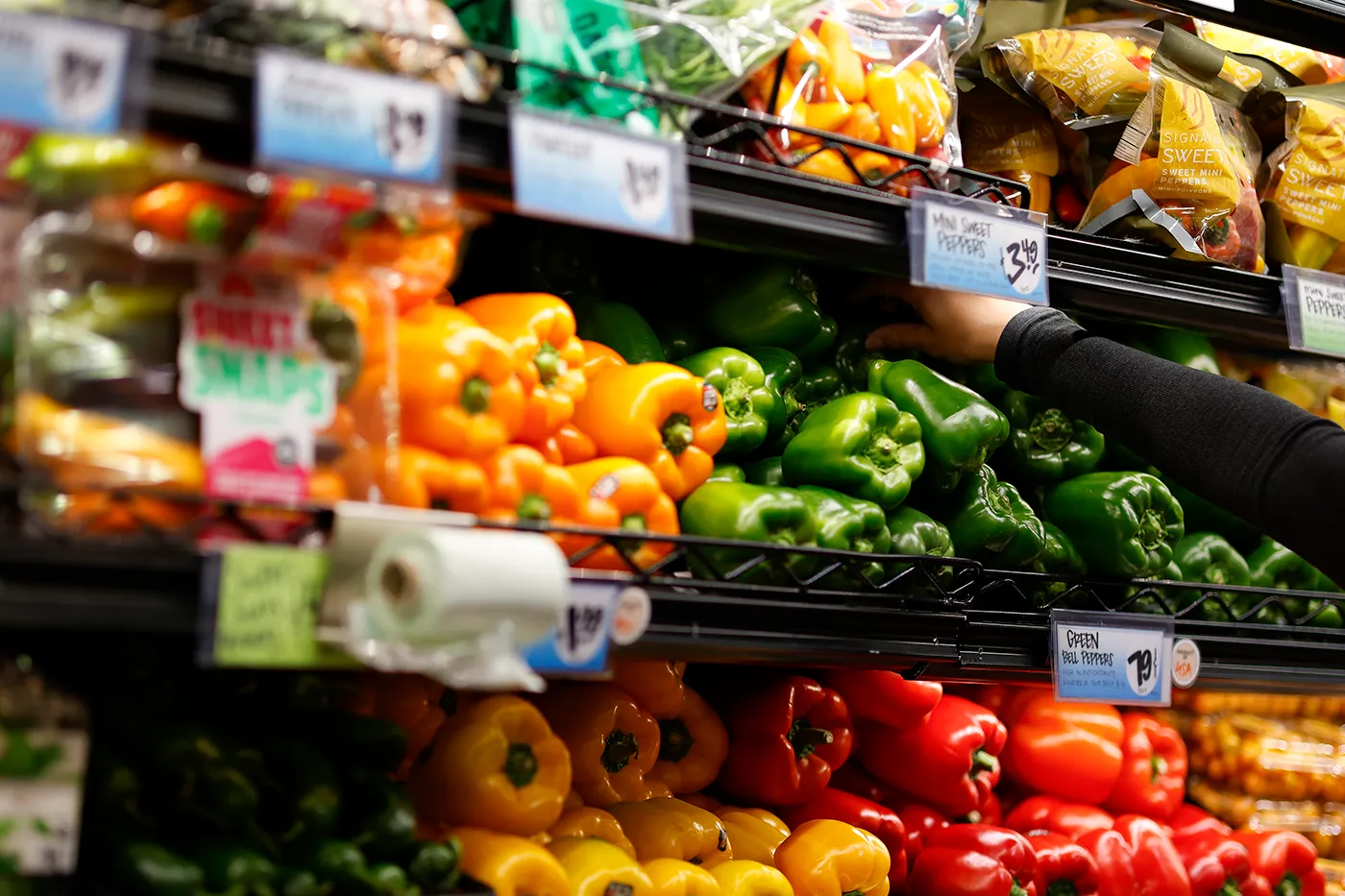
For years that chain was an engineering problem. Merchandising wanted better margins, engineering wired up more signals, and nobody had to explain the result to anyone. In four states it's now a legal question. Regulators want to know why the price appeared, and which pieces of customer data can be proven not to have touched it.
Very few grocers can answer that, and it usually has nothing to do with misconduct. Nobody ever built the system that would know.
The missing system is the business.
The money: Fifty regional grocers at $3,000/month is $150K MRR. Four states already regulate personalized pricing, and two of them switch on October 1, 2026.
Inside:
• Seven-piece MVP, eight to twelve weeks
• Four-tier pricing from pilot to vendor OEM
• 90-day plan: sell the audit before the SaaS
• Cold email that gets regional grocers talking
The deadline already passed in one state
New York moved first. Its Algorithmic Pricing Disclosure Act took effect on November 10, 2025, and any business that sets a price by algorithm using a consumer's personal data must post a specific sentence beside that price: "THIS PRICE WAS SET BY AN ALGORITHM USING YOUR PERSONAL DATA." The National Retail Federation sued to block it on First Amendment grounds and lost. The court found the compelled disclosure plainly factual, with no suggestion of wrongdoing. Penalties run to $1,000 per violation, and each instance can count separately.
Maryland went next. Governor Moore signed the Protection From Predatory Pricing Act on April 28, 2026, effective October 1, 2026. It covers food retailers operating establishments of at least 15,000 square feet plus third-party delivery providers like Instacart, and it bars using a consumer's personal data to set a personalized higher price on covered food. Exceptions cover cost differences, geography, supply, promotions, loyalty and rewards programs, subscriptions, pricing-error corrections, and consumer-consented data exchanges. The Attorney General enforces it, must issue a violation notice with a 45-day cure period, and can seek up to $10,000 per violation, $25,000 for repeat offenses.
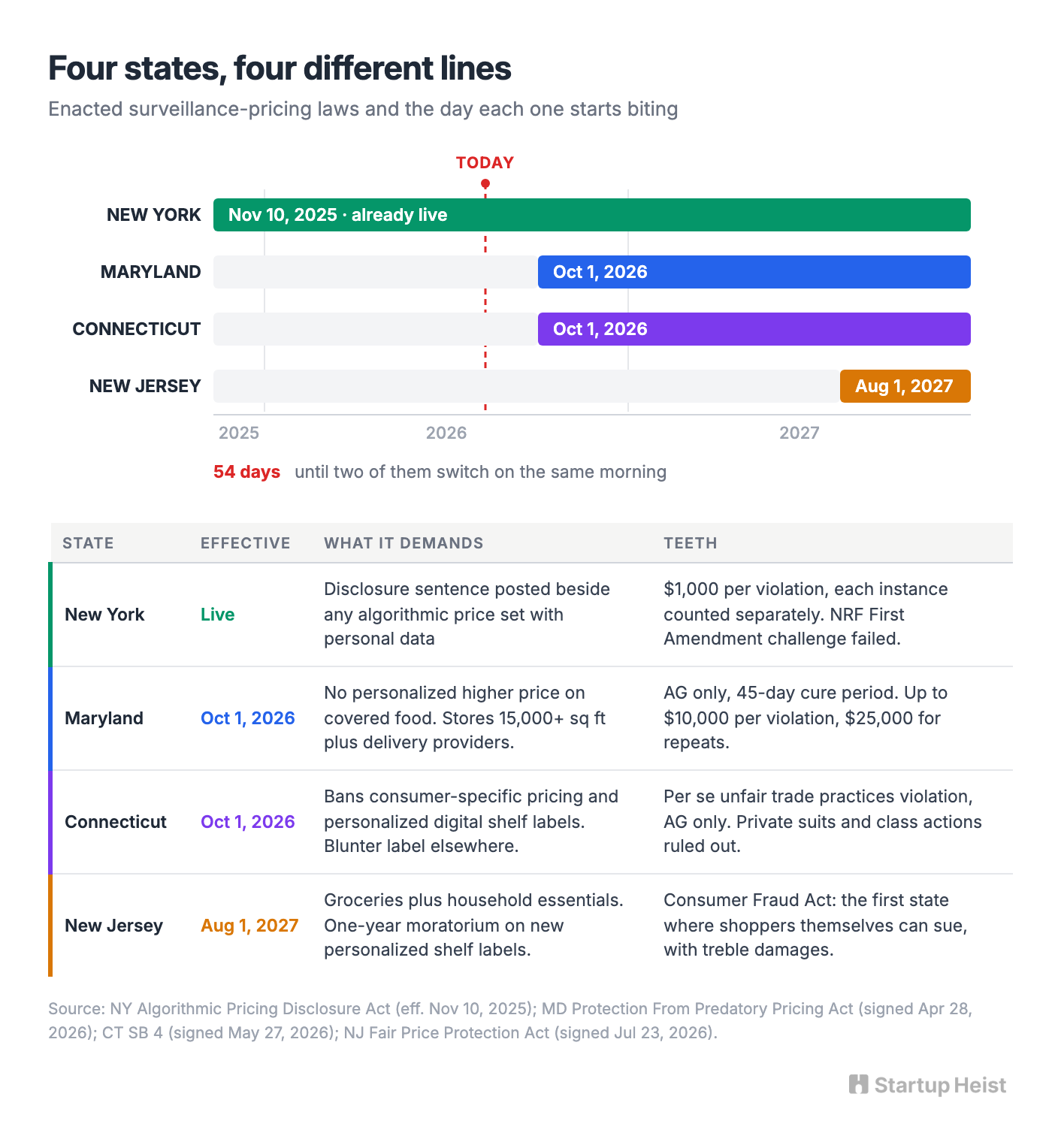
Connecticut signed SB 4 on May 27, 2026, and its surveillance-pricing section also switches on October 1, 2026. It bans consumer-specific surveillance pricing by retail sellers and third-party delivery services, bans digital shelf labels that use the technique for in-person sales, and where personal-data pricing continues elsewhere, requires a blunter online label: "THIS PRICE WAS INCREASED BY AN ALGORITHM USING YOUR PERSONAL DATA." Non-compliance is a per se violation of Connecticut's unfair trade practices act, enforceable by the Attorney General alone. The statute rules out private suits and class actions.
New Jersey signed the Fair Price Protection Act on July 23, 2026, with most provisions effective August 1, 2027. It covers groceries plus a long list of household essentials: paper products, cleaning supplies, health and beauty items, pet food and supplies. Ordinary loyalty programs and publicly disclosed discounts stay legal, as do honest cost-based differences, though the cost-based exception carries its own condition: a price can't change more than once in any 24-hour period. New Jersey also imposes a one-year moratorium on new electronic shelf label deployments that vary prices by personal data. Violations are unlawful practices under the New Jersey Consumer Fraud Act, which makes it the first state where shoppers themselves can sue, with treble damages and fee-shifting attached.
Then there's everything not yet law. More than 40 bills across at least 24 states addressed surveillance pricing in the 2026 session. California's AB 2564, introduced February 20, 2026, would carry civil penalties up to $12,500 per violation, tripled for intentional conduct. New York has already gone further than its own disclosure law: the One Fair Price Act cleared both chambers on June 10, 2026 and would ban surveillance pricing outright while preserving loyalty programs, coupons, and senior discounts. It sits on Governor Hochul's desk with a signing deadline of December 31, 2026.
Enforcement isn't waiting for new statutes. On January 27, 2026, California's Attorney General opened an investigative sweep across retail, grocery, and hotel companies, demanding documentation of how they use consumer information to set prices. The House Oversight Committee sent its own document demands on March 5, 2026, to Booking Holdings, Expedia, Uber, Lyft, and Instacart. The FTC issued an advance notice of proposed rulemaking on April 14, 2026 covering online food and grocery delivery fees, with personalized pricing disclosure folded into the proceeding.
Two of these laws switch on October 1, 2026, one has been live since November 2025, and demand letters are already in the mail.
Build the flight recorder, not the pricing engine
The instinct is to build a compliant pricing engine. Resist it. Grocers already own pricing engines, and replacing one is a two-year enterprise sale.
Build the black box that sits around whatever engine they have. Call it Price Receipt.
Every time a regulated price gets calculated, Price Receipt records what went in, what got blocked, which rule or model ran, which jurisdiction policy applied, what came out, and a tamper-evident hash of the whole thing. It never tells the retailer what to charge. Its whole job is to answer one uncomfortable question: show me why this shopper got this price.
The artifact looks like this:
```text Decision: pr_89144302 SKU: 18492 Jurisdiction: Maryland Channel: Grocery delivery
Base price: $6.79 Final displayed price: $6.49
Inputs evaluated: ✓ store_id ✓ wholesale_cost ✓ inventory_band ✓ promotion_id ✓ loyalty_program_status
Blocked / excluded: ✗ browsing_history ✗ inferred_income ✗ device_id ✗ customer_segment_142 ✗ precise_location
Pricing rule: grocery-web-v37 Promotion: SUMMER26-18 Policy pack: MD-PPPA-2026.10 Decision timestamp: 10:41:22.184 UTC
Receipt hash: 72c4... ```
The receipt gets created at the moment of the decision, which is what separates real evidence from a memo an engineer reconstructs six months after a subpoena arrives.
Pricing quietly became a data pipeline
The reason grocers can't answer the question is architectural.
The FTC's surveillance pricing study, drawn from orders it sent to eight pricing intermediaries in July 2024, found those intermediaries served at least 250 clients across groceries, apparel, travel, and financial services. Staff documented inputs ranging from precise location and demographics to browsing patterns, mouse movements on a page, and the products a shopper abandoned in a cart.
The vendors themselves are sophisticated and largely market-focused. Competera advertises a platform weighing more than 20 pricing and non-pricing factors: own-price and cross-product elasticity, cannibalization, competitor prices and stock, promotional activity, seasonality, weather, lifecycle stage, inventory, media reach. Revionics, one of the eight companies that received an FTC order, says flatly that it doesn't surveil consumers and recommends prices from market-level factors.
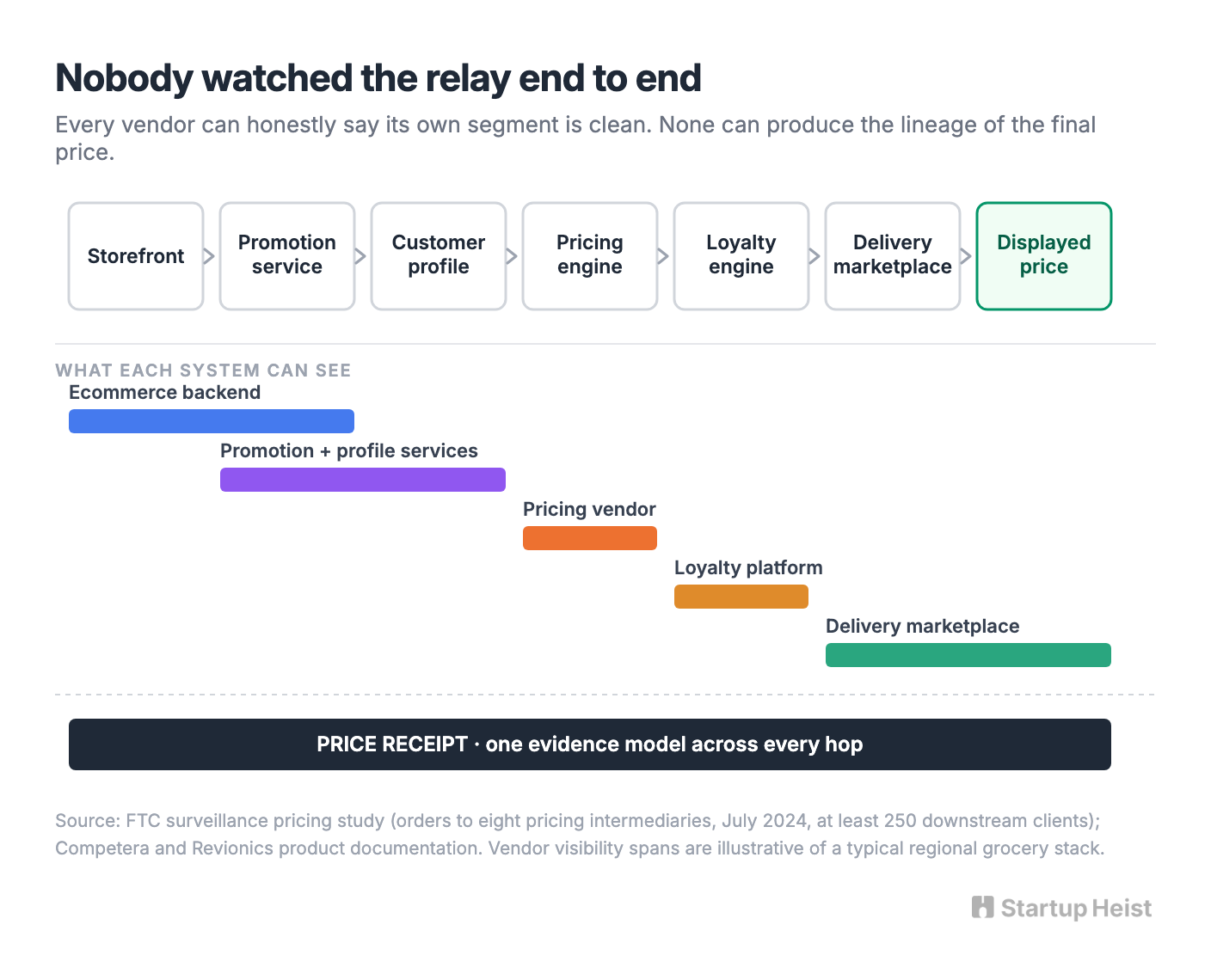
Take them at their word. It still doesn't help the retailer, because no single vendor sees the full chain. An ecommerce app asks a promotion service for a discount. That service queries a customer profile. A pricing API checks inventory and competitor data. A loyalty engine layers on an adjustment. A delivery marketplace adds its own fee. The number on the shelf label is the last step in a relay race nobody watched end to end.
Every participant can honestly say their piece is clean, and none of them can produce the lineage of the final price.
Groceries is the ugly perfect first market
The temptation is to pitch this as compliance infrastructure for dynamic pricing everywhere. Resist that for a year.
Unlock the Vault.
Join founders who spot opportunities ahead of the crowd. Actionable insights. Zero fluff.
“Intelligent, bold, minus the pretense.”
“Like discovering the cheat codes of the startup world.”
“SH is off-Broadway for founders — weird, sharp, and ahead of the curve.”


