


The Phones Are Gone. Now the Front Office Is the Bottleneck.
Schools spent two years figuring out how to get phones out of classrooms. Now they have to figure out where all the phone calls go.
The policy shift is real and it moved fast. National tracking in February 2026 counted 19 states with statewide bell-to-bell K-12 phone bans. By August 2026, Education Week's tracker put it at 28 states plus Washington, D.C. with bell-to-bell policies, and 38 states plus D.C. with some form of statewide restriction. Nine states crossed the bell-to-bell line in six months. Whatever the exact tally on any given week, the direction is settled.
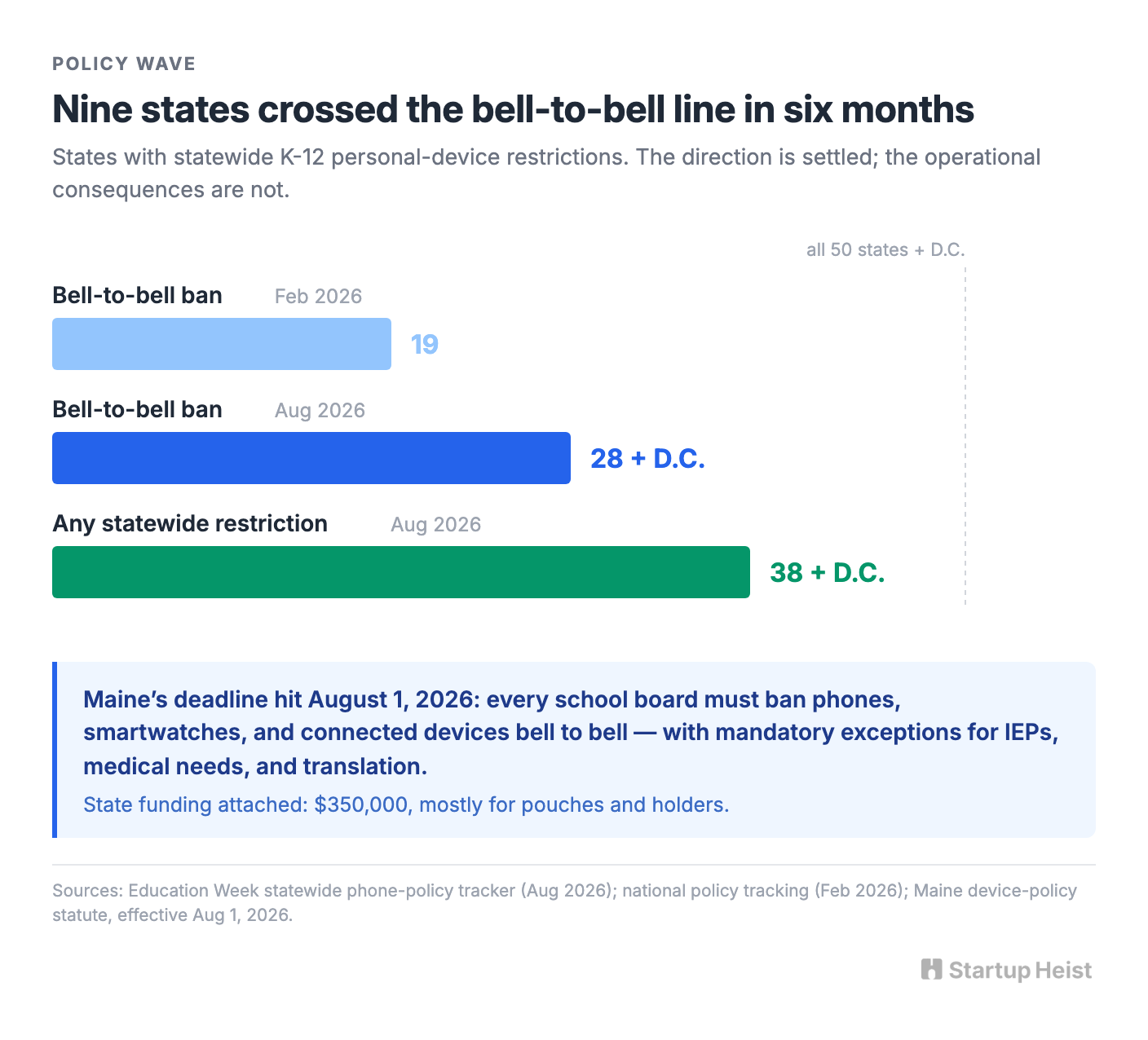
Maine shows what implementation looks like on the ground. As of August 1, 2026, every school board in the state must have a policy prohibiting student use of phones, smartwatches, and other internet-connected personal devices from the starting bell to dismissal. The law requires exceptions for IEPs, medical accommodations, and translation needs when no other option exists. The legislature put $350,000 behind it, mostly for pouches and holders.
Removing the direct parent-to-child channel doesn't remove the parent's need to communicate. It reroutes it. Penn High School in Indiana now tells families they can email their student or "contact the Main Office, and we will ensure messages are delivered when necessary." That sentence, in some form, is now sitting on thousands of district websites. Schools are training parents to call the office.
The phone ban solved one workflow by creating another one. The opportunity lives inside that second workflow, and the obvious version of it is already dead. Here's the version that isn't:
The money: Fifteen districts on $12,000 contracts is $15K MRR for a two-person team. ParentSquare shipped a feature against this exact problem in February 2026.
Inside:
• The four request types to ship first
• A four-level caller authentication ladder
• District pricing from $5K pilot to $30K/year
• The policy graph moat and the honest ceiling
The Signal Is Thin, and That Is Exactly Why the Window Is Open
Be honest about the evidence, because your first district will be.
RAND surveyed principals during the 2024-25 school year and found overwhelming support for phone restrictions: 86% reported a positive overall experience, and 70% pointed specifically to improved school climate. On the downside, 21% said parents were newly concerned about not having a direct line to their kids. Only 5% flagged increased burden on administrative staff acting as the parent-to-student relay.
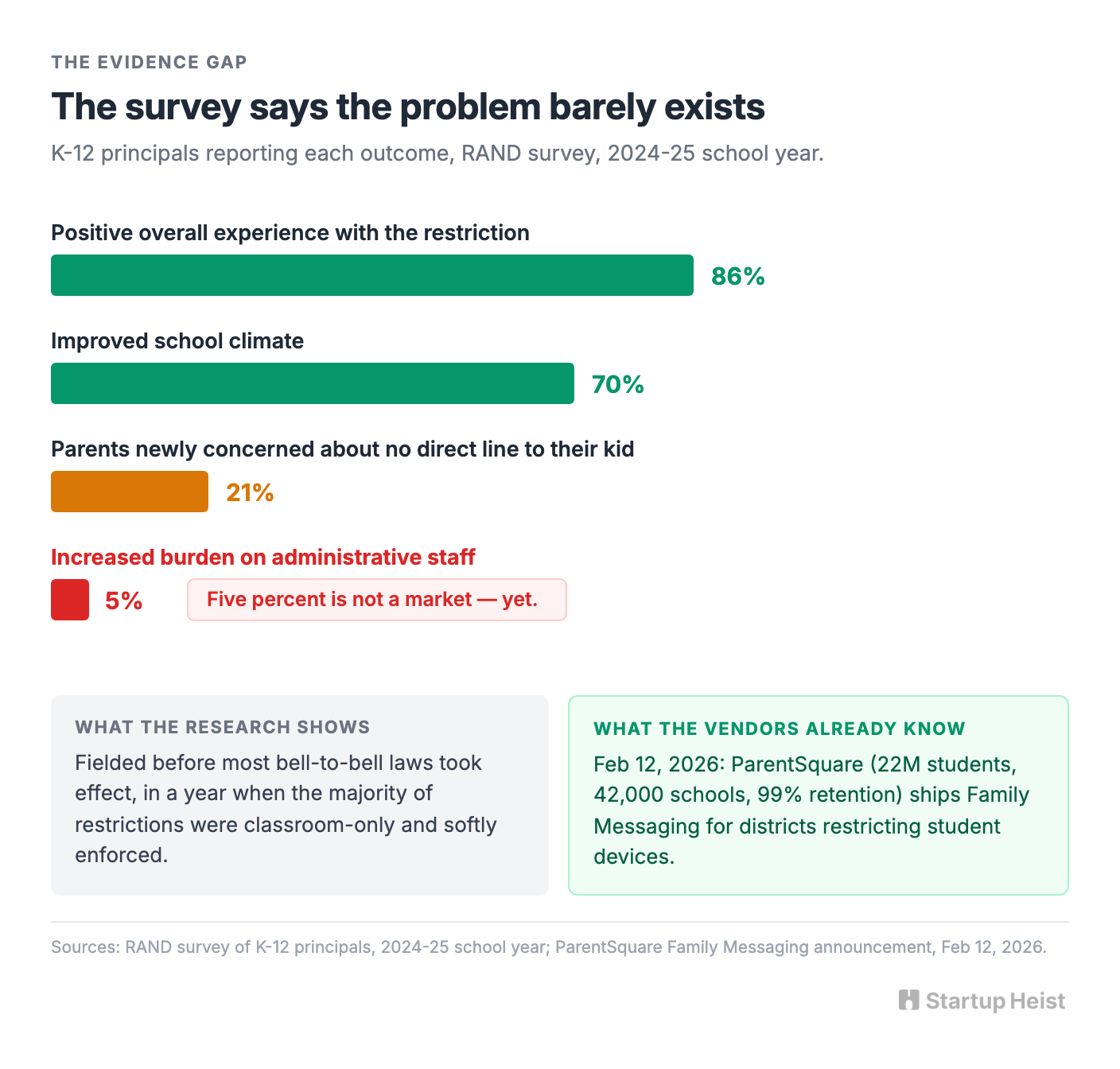
Five percent is not a market. But that survey was fielded before most bell-to-bell laws took effect, in a year when the majority of restrictions were classroom-only and softly enforced. It captures the world before the wave arrived.
The sharper signal came from the incumbent. On February 12, 2026, ParentSquare launched Family Messaging, built specifically for districts restricting student devices. Its announcement said front offices were absorbing the impact through increased calls, manual message relay, and informal workarounds that strain staff and disrupt operations. A company reaching 22 million students across 42,000 schools, with a 99% retention rate, doesn't ship a feature against a problem it made up.
The incumbent moved before the survey data caught up. The gap between what the research shows and what the vendors already know is the window you get to work in.
Do Not Sell the AI. Sell the Governed Workflow.
The lazy version of this idea is an AI receptionist for schools. That category is already commoditizing in public.
DigitalPhone.ai markets an AI receptionist specifically for schools that handles attendance reports, FAQ answering, department routing, and emergency-closure information, starting at $24 per month plus $0.35 per minute. Introva's Voca product answers front-office and attendance lines for districts. Goodcall, Retell, and a dozen general-purpose voice platforms ship school templates. Speech recognition and intent classification are commodities now, and a pleasant synthetic voice is something anyone can buy by the minute.
The adjacent markets are just as crowded, and they teach you something. Pikmykid, which says it serves 6,000-plus schools worldwide and explicitly markets eliminating office calls about dismissal changes, was acquired by school-safety company CENTEGIX on April 7, 2026. Onflo, the company formerly known as K12 Insight until its June 26, 2026 rebrand, runs a unified service desk for district departments and has held a three-year, $882,000 contract with the School District of Philadelphia since 2023. Every one of these companies is converging on the same idea from a different edge: capture the inbound request, route it, prove you handled it.
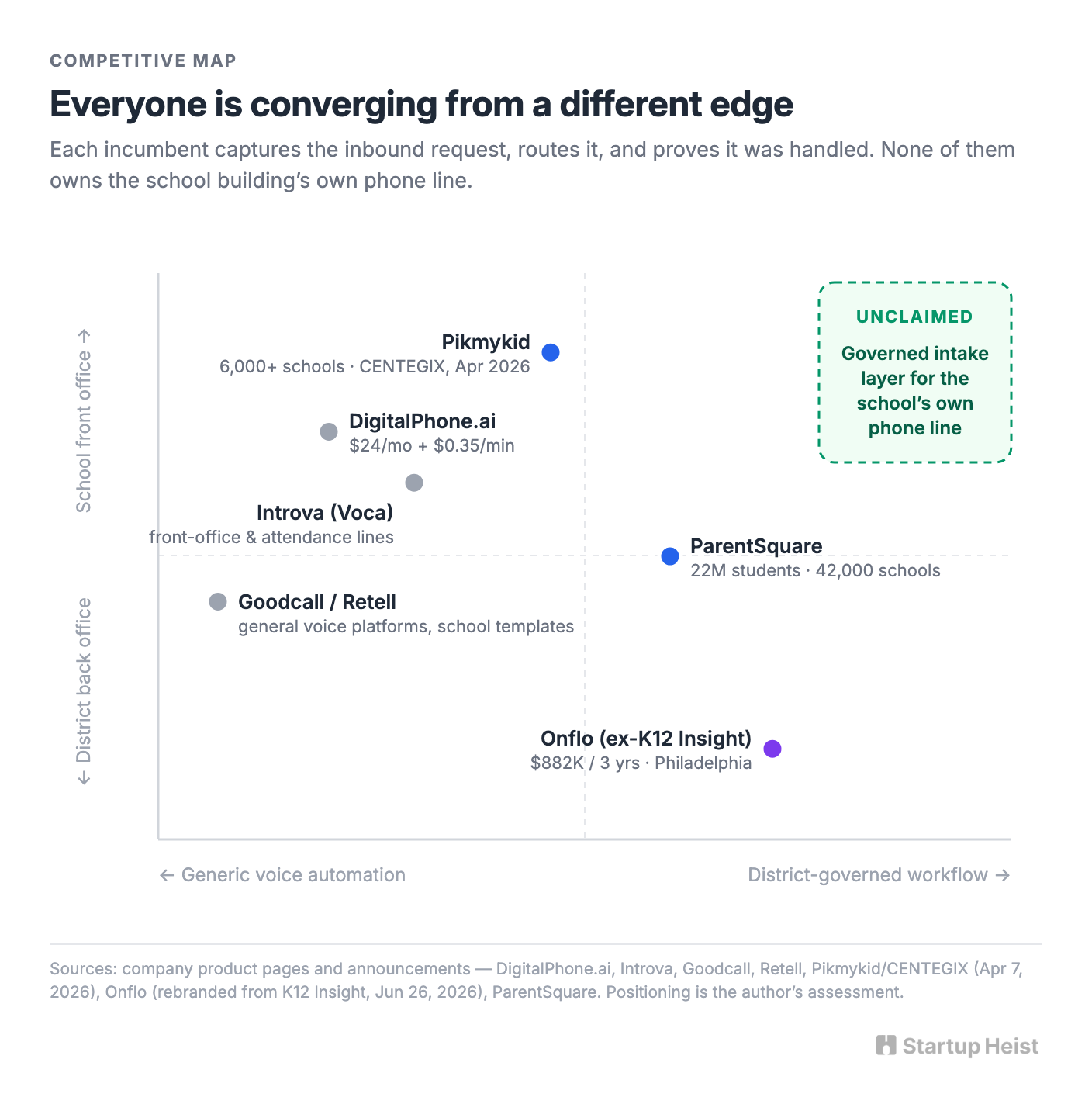
None of them owns the specific thing the phone bans just created: a governed intake layer for the school building's own phone line, wired to student-level workflows that nobody wants an AI making decisions about.
That's the product. Software that receives parent calls and web requests, understands what the parent needs, collects the right information, applies district-specific routing rules, creates an audit trail, and hands the request to the staff member who already owns the decision. It doesn't approve a pickup, rule on whether a child qualifies for a medical exception, or message a student on its own. It makes the humans responsible for those decisions much easier to reach and much harder to overwhelm, and that distinction is the whole business.
What Actually Hits the Office
An ordinary Tuesday morning at a middle school front desk sounds like this. My daughter is sick today. I need to pick up James at 1:30. Can you tell Maya that Grandma is getting her. My son's glucose monitor runs through his phone, what form do I need. What is the smartwatch rule. The bus never came. I speak Spanish, can somebody explain this policy. My kid forgot her pouch.
None of these is complicated. Together they are operational noise, arriving in a 40-minute window while a parent stands at the counter and a kid throws up in the nurse's office.
Build the layer everyone else assumes has already happened: the request has been received, understood, classified, documented, and safely routed.
The Four Workflows
Ship two channels, a forwarded phone number and a multilingual web form running the same logic, and exactly four request types.
Unlock the Vault.
Join founders who spot opportunities ahead of the crowd. Actionable insights. Zero fluff.
“Intelligent, bold, minus the pretense.”
“Like discovering the cheat codes of the startup world.”
“SH is off-Broadway for founders — weird, sharp, and ahead of the curve.”


