


Quiet Screen: Build the Buying Desk for TVs That Don't Watch Back
A smart TV is an advertising business with a panel attached, and a growing group of buyers wants the panel without the business. No manufacturer is going to build that television for them. Nobody has to. The opportunity is to become the trusted desk that tells people which screen to buy, how to set it up, and how to prove it stays quiet.
The Signal: 885 Comments Asking for Less
In early November 2026, a Hacker News user posted a short question: which TV do you recommend for privacy? They hadn't owned a television in years. They wanted something between 60 and 80 inches, 4K, at least 60Hz, and planned to feed it video from a streaming box. "I don't mind paying a premium," they wrote.
The thread climbed past 730 points and 885 comments, and the answers sprawled. Buy an LG OLED and keep it off the network. Boot it straight to HDMI 1. Block the telemetry at the router. Get a projector, since many are still "dumb HDMI to light converters." One commenter linked a Samsung commercial monitor sold without Wi-Fi for about $1,050, and another replied that it was the first concrete product they'd seen in a hundred comments.
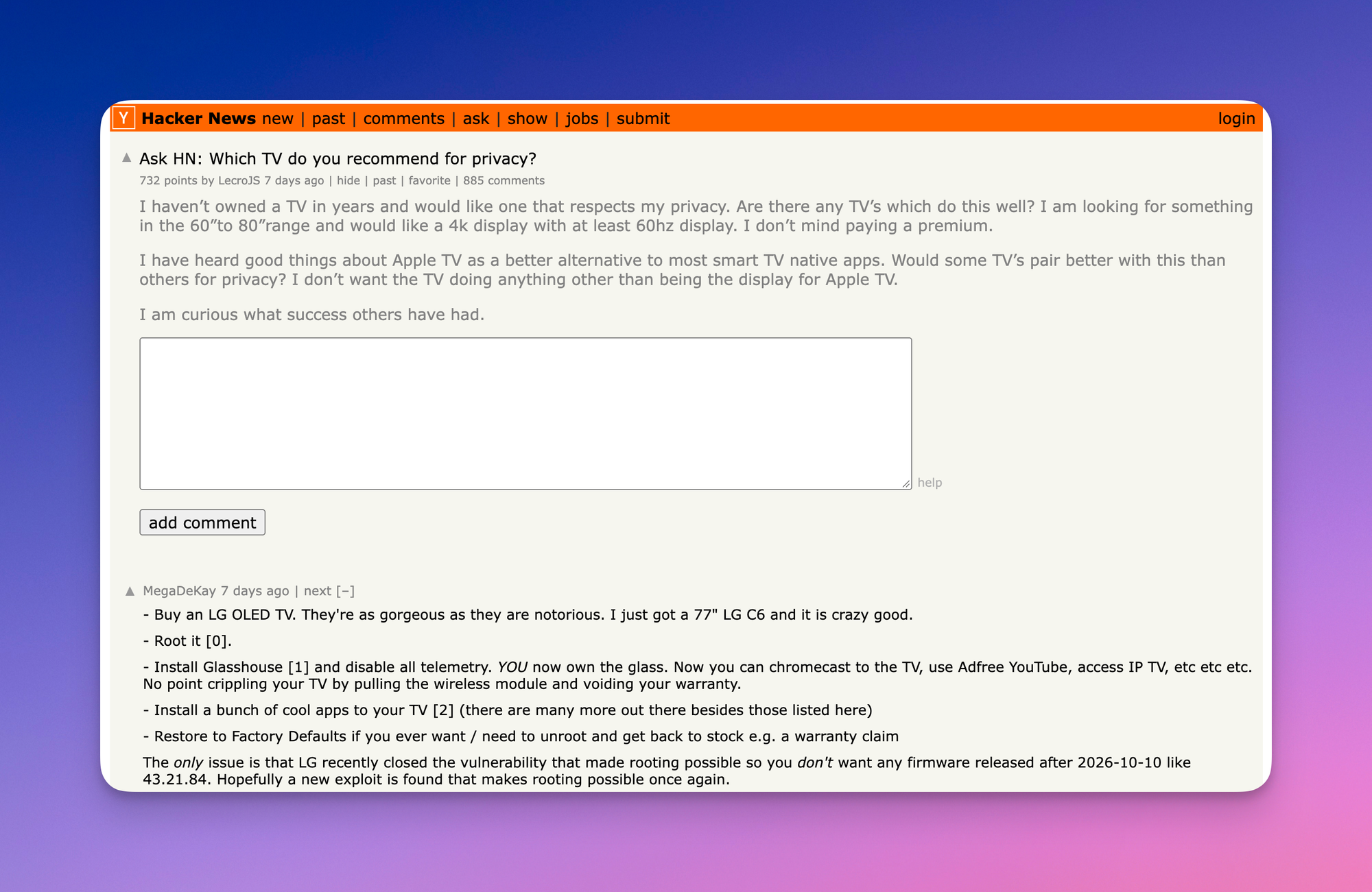
The reply pinpoints the gap. The thread held hundreds of technically fluent people and a willing buyer with a budget, yet almost nobody could name a specific model and say: buy this one, configure it this way, and here is the evidence it works. The request itself is unusual. This buyer wants manufacturers to take a feature away, and manufacturers have every reason to refuse.
Quiet Screen is built for the space between that request and the refusal.
The money: Roughly $5,000 a month in revenue at 10,000 visitors, mostly from $149 remote sessions, $399 home setups, and $849 office rooms, with affiliate commissions on top.
Inside:
• The five-check model report template
• Pricing ladder from a $19 guide to $849 rooms
• The law-office buyer and IT partner email
• A 60-day launch plan with a go/no-go gate
Why Your TV Is Cheap
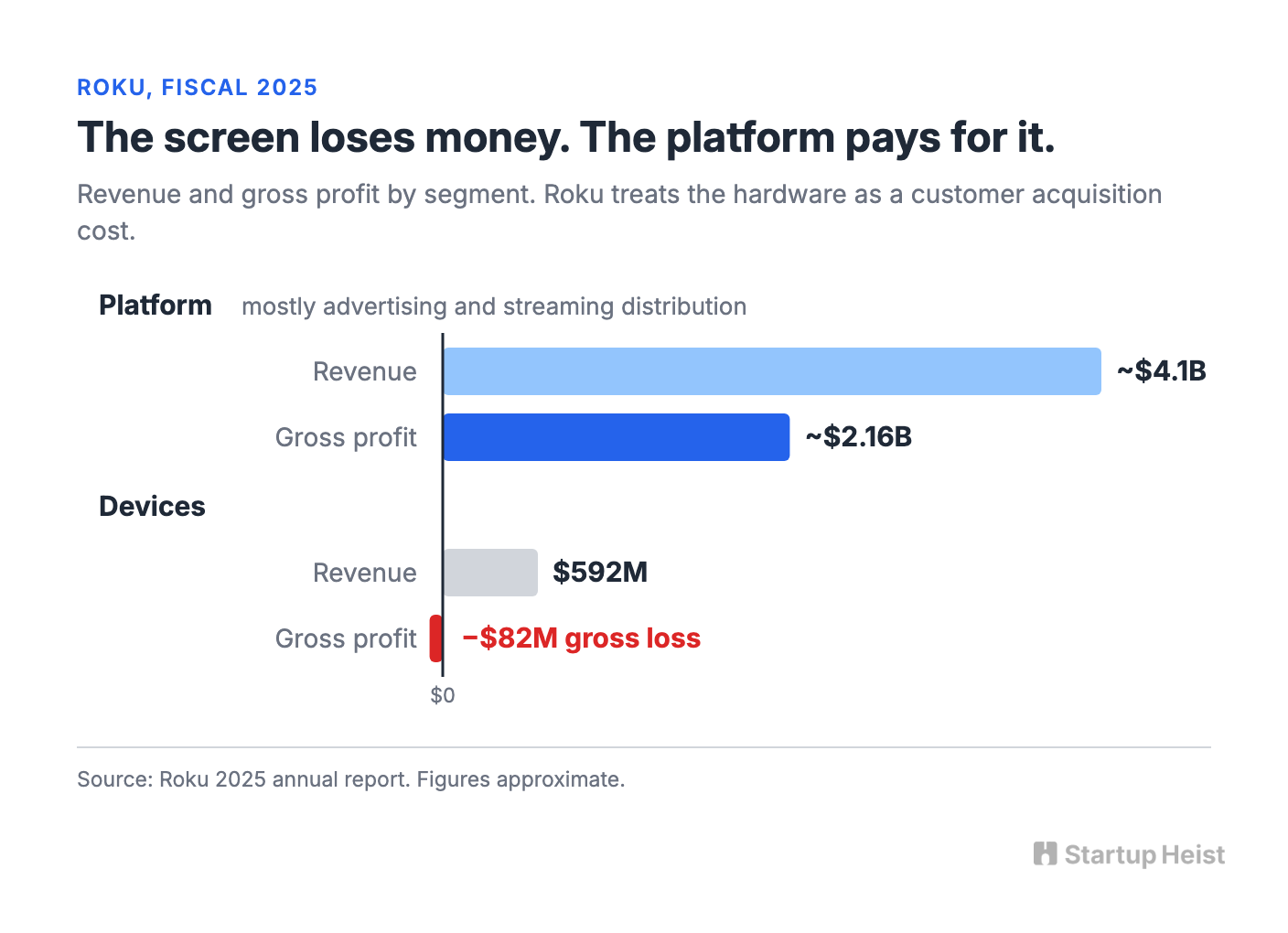
Roku's 2025 annual report shows the incentive in two lines. Platform revenue, mostly advertising and streaming distribution, came to about $4.1 billion and produced roughly $2.16 billion in gross profit. Devices brought in $592 million and posted an $82 million gross loss. Roku treats the hardware as a customer acquisition cost, which makes the screen in your living room a storefront.
Much of what makes that storefront valuable is automatic content recognition, or ACR. The television samples what's on screen, generates a fingerprint, and matches it against a database of known content. Because ACR works on the picture itself, it can see past the TV's own apps and identify what's playing through HDMI from a cable box, a console, or a streaming stick. Netflix knows what you watch on Netflix, while an ACR-enabled TV can know what you watch on everything.
Regulators and courts have been fighting over this for nearly a decade. In February 2017, Vizio paid $2.2 million to settle FTC and New Jersey charges that it collected viewing data from about 11 million TVs without consent. On December 15, 2025, the Texas Attorney General sued Samsung, LG, Sony, Hisense, and TCL over ACR practices. Samsung agreed on February 26, 2026 to require express consent from Texas viewers, and LG followed on May 11, 2026. The Sony, Hisense, and TCL cases remain open.
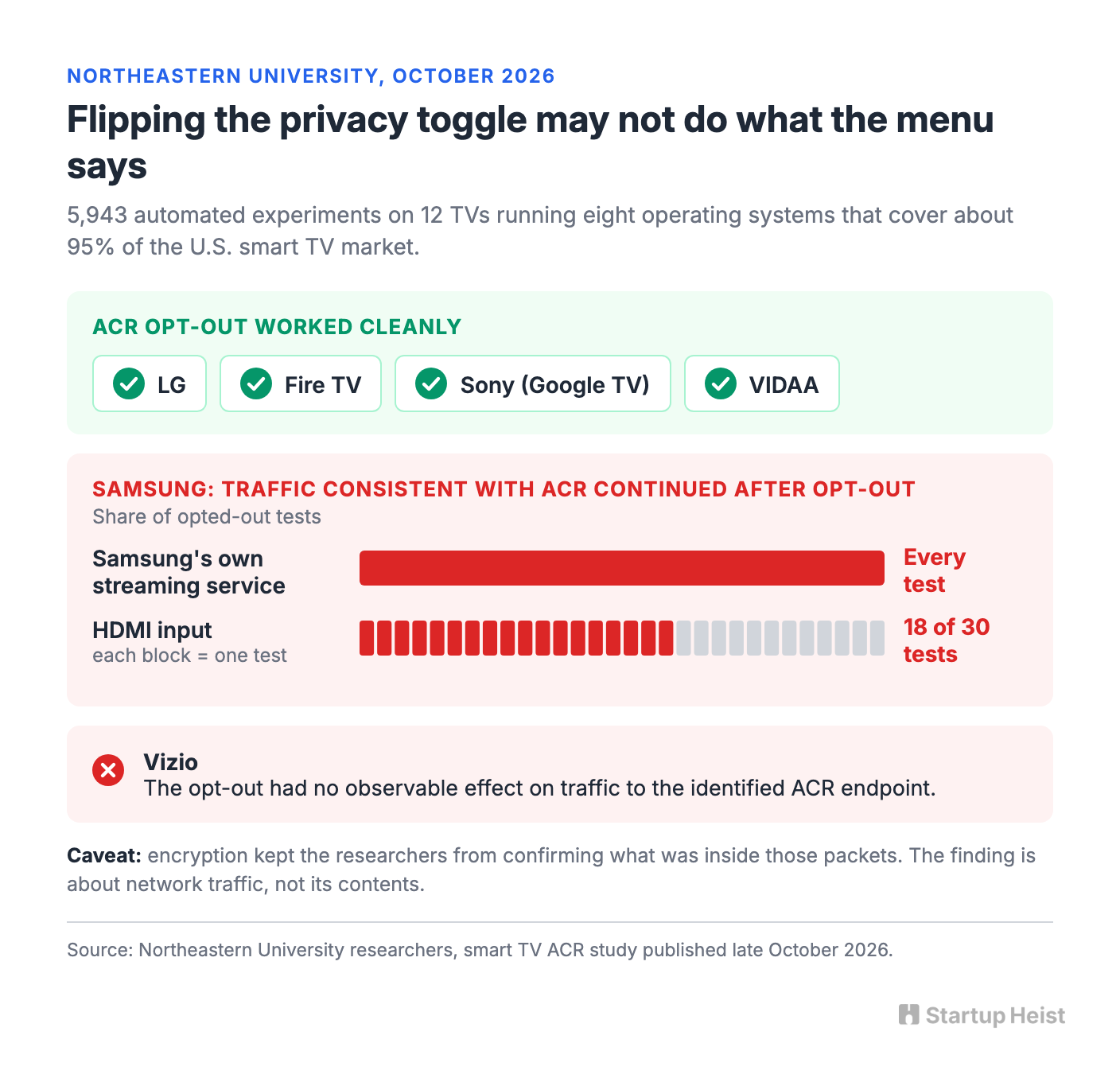
In late October 2026, Northeastern University researchers published the finding that turns a privacy story into a market. Across 5,943 automated experiments on 12 TVs running eight operating systems that cover about 95% of the U.S. smart TV market, opting out of ACR worked cleanly on LG, Fire TV, Sony's Google TV, and VIDAA. On Samsung, traffic consistent with ACR continued in every opted-out test of Samsung's own streaming service and in 18 of 30 HDMI tests. On the Vizio set, the opt-out had no observable effect on traffic to the identified ACR endpoint. The researchers note that encryption kept them from confirming what was inside those packets. They still established the commercially important point: on the tested sets from two of the biggest brands in America, flipping the privacy toggle may not do what the menu says.
The Supply Problem: Commercial Doesn't Mean Dumb
The obvious fix is a television without smart features. Those exist, mostly at the bottom of the market; Westinghouse still sells a 32-inch non-smart TV for about $150. Above 43 inches, true dumb TVs are close to extinct, and the survivors make real compromises on picture quality and warranty.
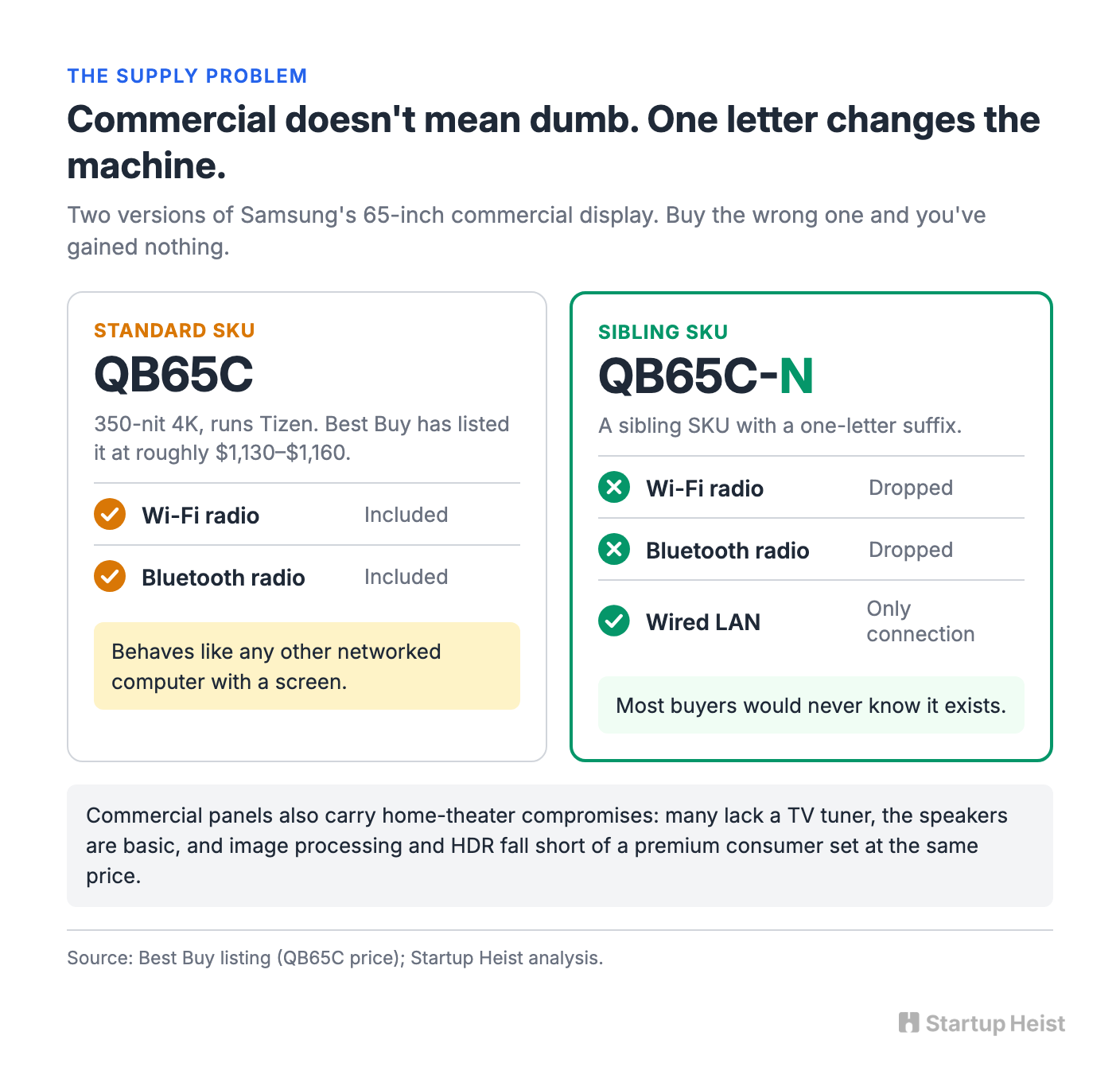
The sharper buyers on Hacker News went sideways into commercial displays, the digital signage panels used in lobbies, menu boards, and conference rooms. These are built to show external content for 16 hours a day. Best Buy has listed Samsung's 65-inch QB65C, a 350-nit 4K commercial display, between roughly $1,130 and $1,160.
Buy the wrong version, though, and you've gained nothing. The standard QB65C runs Tizen, Samsung's operating system, and ships with Wi-Fi and Bluetooth, so it behaves like any other networked computer with a screen. The QB65C-N, a sibling SKU with a one-letter suffix, drops the Wi-Fi and Bluetooth radios and connects only by wired LAN. Most buyers would never know the second one exists.
Commercial panels also carry home-theater compromises. Many lack a TV tuner, the speakers are basic, and image processing and HDR fall short of a premium consumer set at the same price. A buyer can spend $1,200 on a "private" display and end up with a worse movie night than a $600 LG kept offline. The right recommendation depends on the person, the room, and the exact SKU, and right now nobody is making it.
The Gap: Research Exists, Implementation Doesn't
Quiet Screen won't out-test the incumbents. RTINGS published a serious smart TV tracking study in July 2026, capturing traffic in Wireshark through a mirrored switch port and comparing behavior before and after ACR settings changed on Samsung, LG, Sony, and TCL sets. Ars Technica's December 2025 dumb TV guide already gives the core free advice: disconnect the TV and use an external streaming box. Northeastern published its ACR endpoint blocklist on GitHub. The knowledge is public.
The last mile is missing. A reader can absorb all of it and still be stuck on four practical questions: which exact model to buy, what else they need, how to configure it, and how to know it worked. RTINGS answers the first in general terms. Nobody answers all four for a specific room, with a specific streaming box, on a specific router, and then checks the result. Quiet Screen sells that answer as one finished outcome.
The Product: A Privacy-First TV Buying Desk
Quiet Screen's first recommendation for most households should be free: keep the TV you own and take it offline. A company willing to recommend a $0 fix earns the credibility to recommend a $1,200 panel later.
Every buyer fits one of three paths.
Unlock the Vault.
Join founders who spot opportunities ahead of the crowd. Actionable insights. Zero fluff.
“Intelligent, bold, minus the pretense.”
“Like discovering the cheat codes of the startup world.”
“SH is off-Broadway for founders — weird, sharp, and ahead of the curve.”


