


EdgeCase: The AI That Learns What Your Client Will Reject
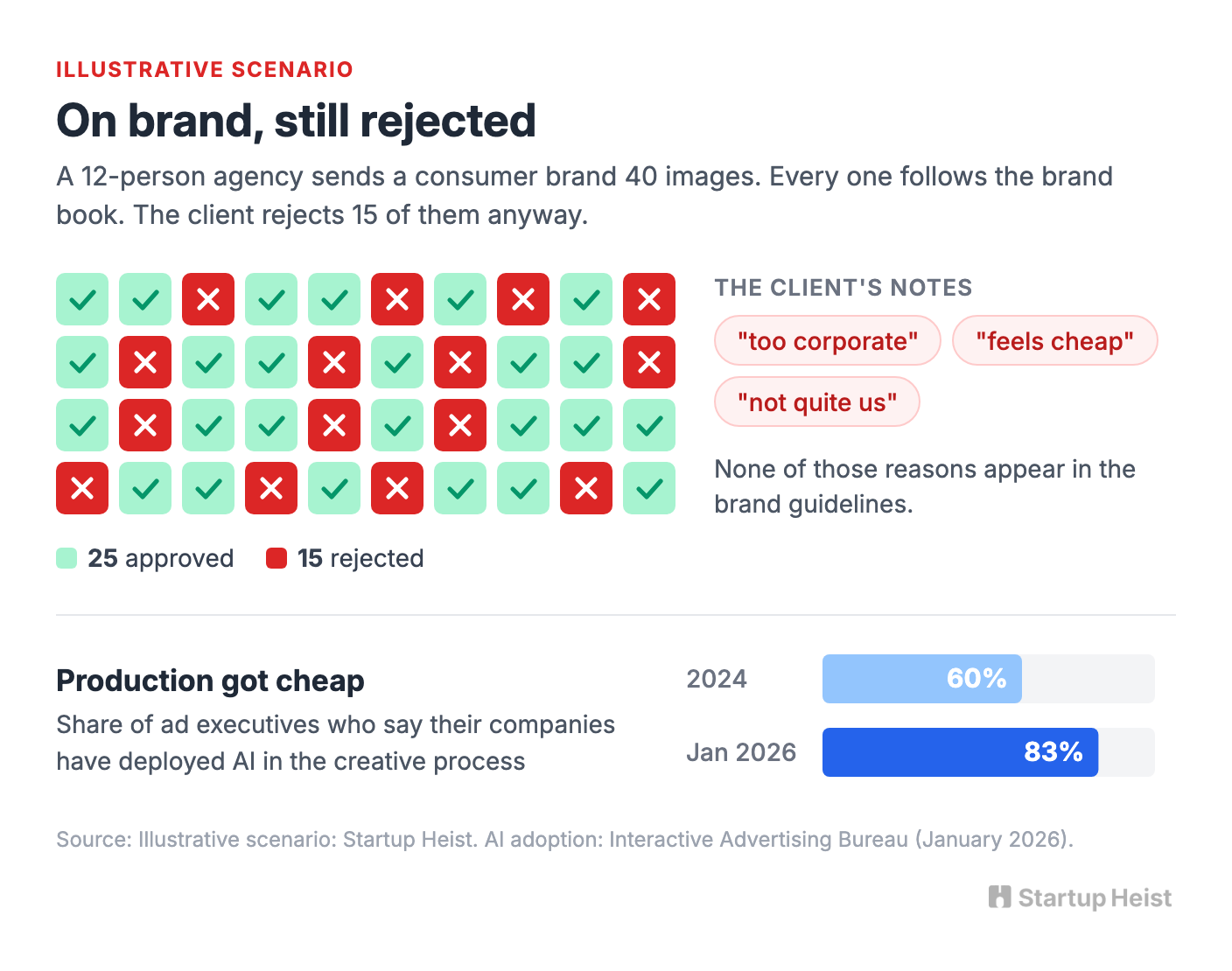
A 12-person agency sends a consumer brand 40 images for a spring campaign. Every one follows the brand book. The colors match, the logo sits where it should, the typography is clean. The client rejects 15 of them anyway, with notes like "too corporate," "feels cheap," and "not quite us."
None of those reasons appear in the brand guidelines. So the account manager books a call, the creative director translates the feedback, and the designers spend most of the next week redoing work that was technically correct. Then the approval round starts again.
Generative AI has made this worse. In January 2026, the Interactive Advertising Bureau reported that 83% of ad executives say their companies have deployed AI in the creative process, up from 60% in 2024. Production has gotten cheap while judgment is as expensive as ever, and every extra variation an agency can generate is another image someone has to decide whether to show.
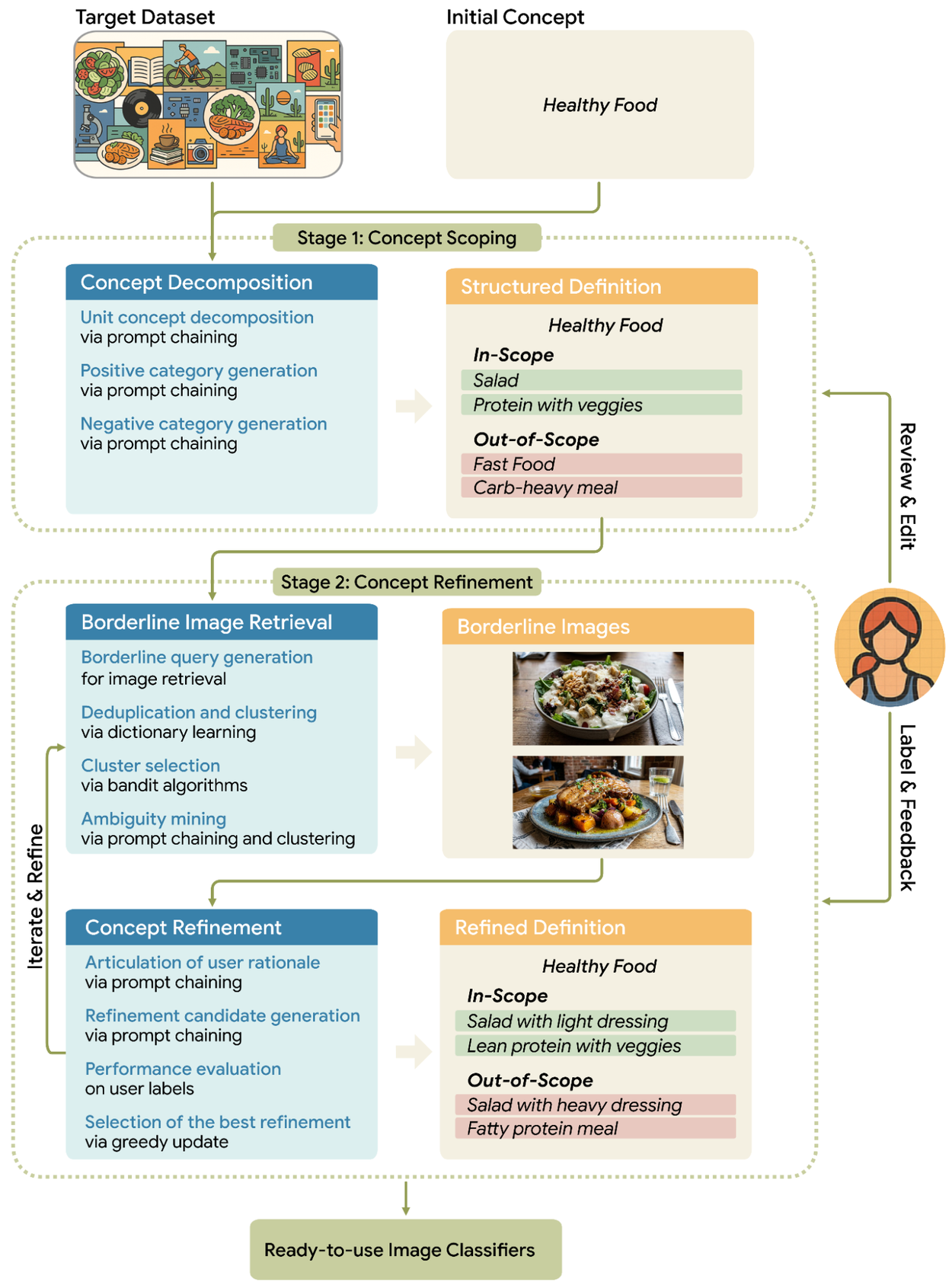
On November 4, 2026, Google Research published a technique built for exactly this kind of judgment. Called Agile Deliberation, it helps people define fuzzy, subjective categories by having them rule on borderline examples, and Google released the code as open source. It points to a narrow, buildable business: EdgeCase, a pre-flight screening tool for small creative agencies. Before a batch of images goes to a client, EdgeCase checks it against what that specific client has approved and rejected before, flags the assets most likely to trigger another revision round, and explains why.
Here's the opportunity:
The money: 100 agencies at a blended $179/month is $17,900 MRR. Model costs run about $5 a month for a heavy user, and one avoided revision round covers the $249 plan.
Inside:
• A 15-minute client taste exercise
• Six-part MVP and a four-layer AI pipeline
• Two pricing tiers plus a $149 paid pilot
• The historical-rejection audit as your demo
The bet is that agencies will pay a recurring fee to catch subjective rejections before the client does. The product wins by learning the decision boundaries of individual brands while leaving the creative director in charge.
Taste Is the Spec Nobody Wrote
Take a boutique hotel whose brief asks for photography that feels "sophisticated, intimate, and distinctive" and rejects "generic luxury." Is a perfectly made bed in soft morning light sophisticated or generic? Is a dim shot of a half-finished cocktail intimate or bleak? The answer depends on the client, and sometimes on the campaign, the season, and who's in the approval meeting that day.
Brand-management and brand-compliance software handles the explicit rules well: correct logo, consistent typography, no forbidden elements. The expensive disagreements come from rules nobody wrote down. A seasoned creative director learns them one rejected presentation at a time and keeps them in their head or scattered across email threads and comments on old decks.
When that account manager leaves, the knowledge walks out with them. A new designer joins the account and repeats mistakes the team already paid for. Whoever captures that implicit judgment in a form the whole agency can reuse before every presentation is selling something agencies already spend money trying to get.
What Google Actually Built
Standard AI classifiers start from a written definition. Ask a model to find "healthy food" and it applies its own idea of healthy. Google's researchers started from a different observation: people rarely hold a complete definition of a subjective concept. They discover it by running into hard cases.
Agile Deliberation works in two stages. First, it breaks a broad concept into sub-concepts, including what should count and what's explicitly excluded. Then it hunts for borderline images, the ones sitting right on the edge of the current definition, and asks the human to rule on them. Google's own example is a fruit smoothie, which forces a choice: healthy because it's raw fruit, or excluded because it's processed and sugary? Each ruling feeds an automatic prompt-optimization loop that refines the written definition and redraws the classifier's boundaries.
For a brand, the valuable part is that the process helps people name distinctions they didn't know they held. A client who says they hate "corporate photography" might discover, after a dozen hard cases, that they're fine with offices and what they actually dislike is staged handshakes. A designer can act on that rule.
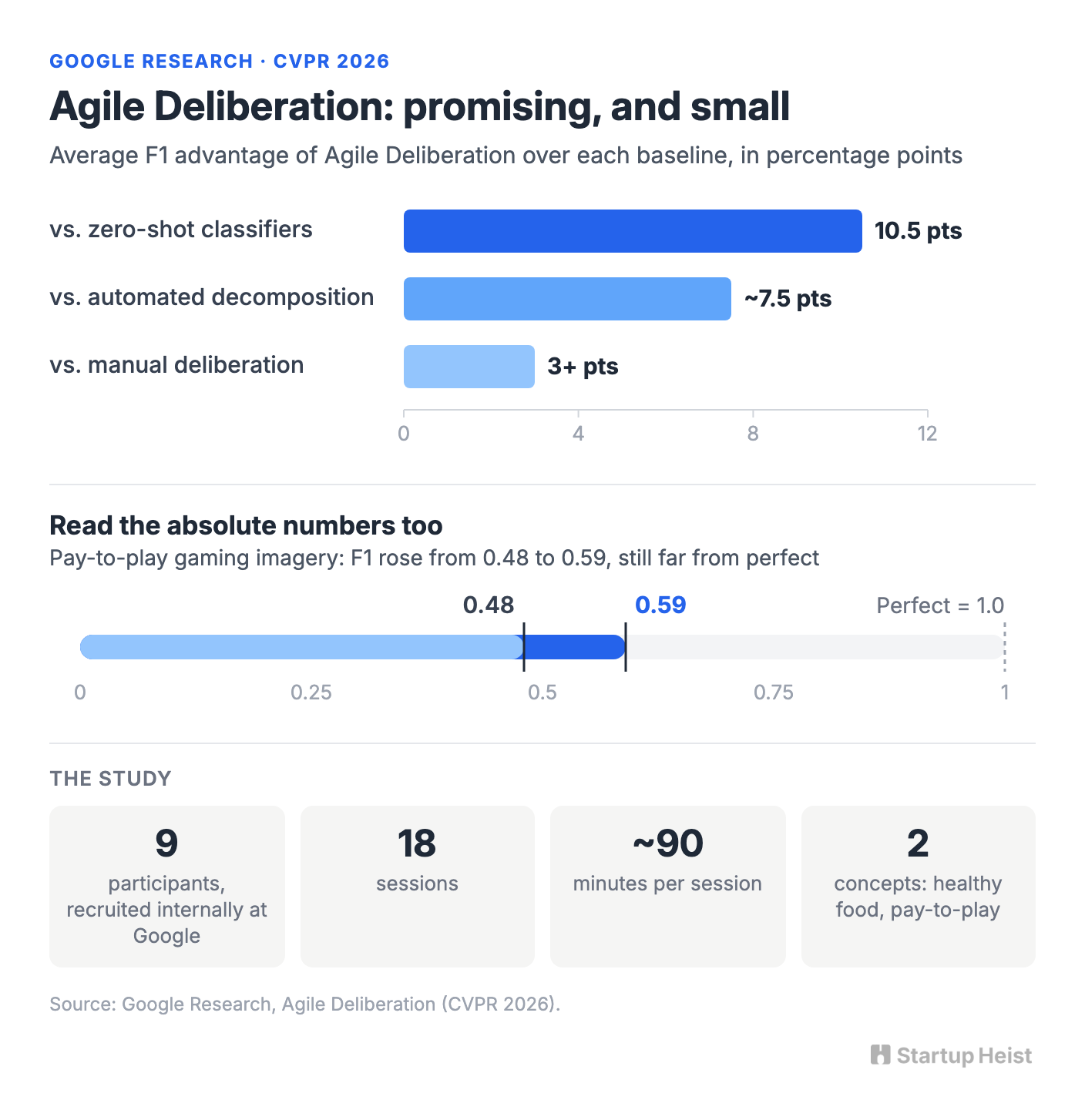
The evidence is promising and small. The paper, presented at CVPR 2026, tested nine participants recruited internally at Google across 18 sessions of roughly 90 minutes each, on two concepts: healthy food and misleading "pay-to-play" gaming imagery. Agile Deliberation beat zero-shot classifiers by an average of 10.5 percentage points of F1, beat automated decomposition baselines by about 7.5 points, and scored more than 3 points over manual deliberation. Participants reported lower effort, and every one preferred it to manual deliberation.
Read the absolute numbers too. On the pay-to-play concept, F1 rose from 0.48 to 0.59, a real gain that's still far from perfect. Google didn't test aesthetic preferences, creative agencies, or client approval. The opening for a founder is applying the mechanism to a commercial problem and proving it works there, with a product honest enough to show triage instead of verdicts.
The Field Is Crowded at the Edges
Online proofing tools own the creative approval workflow. Ziflow lists Standard and Pro plans at $199 and $329 a month billed annually, and its ReviewAI engine runs automated pass/fail checks against checklist criteria on its Enterprise tier. Filestage charges the same $199 and $329 on monthly billing, with AI review agents that check grammar, tone, and style on its Business plan. Both are excellent at routing client feedback and checking work against stated requirements, though neither learns a client's unstated taste.
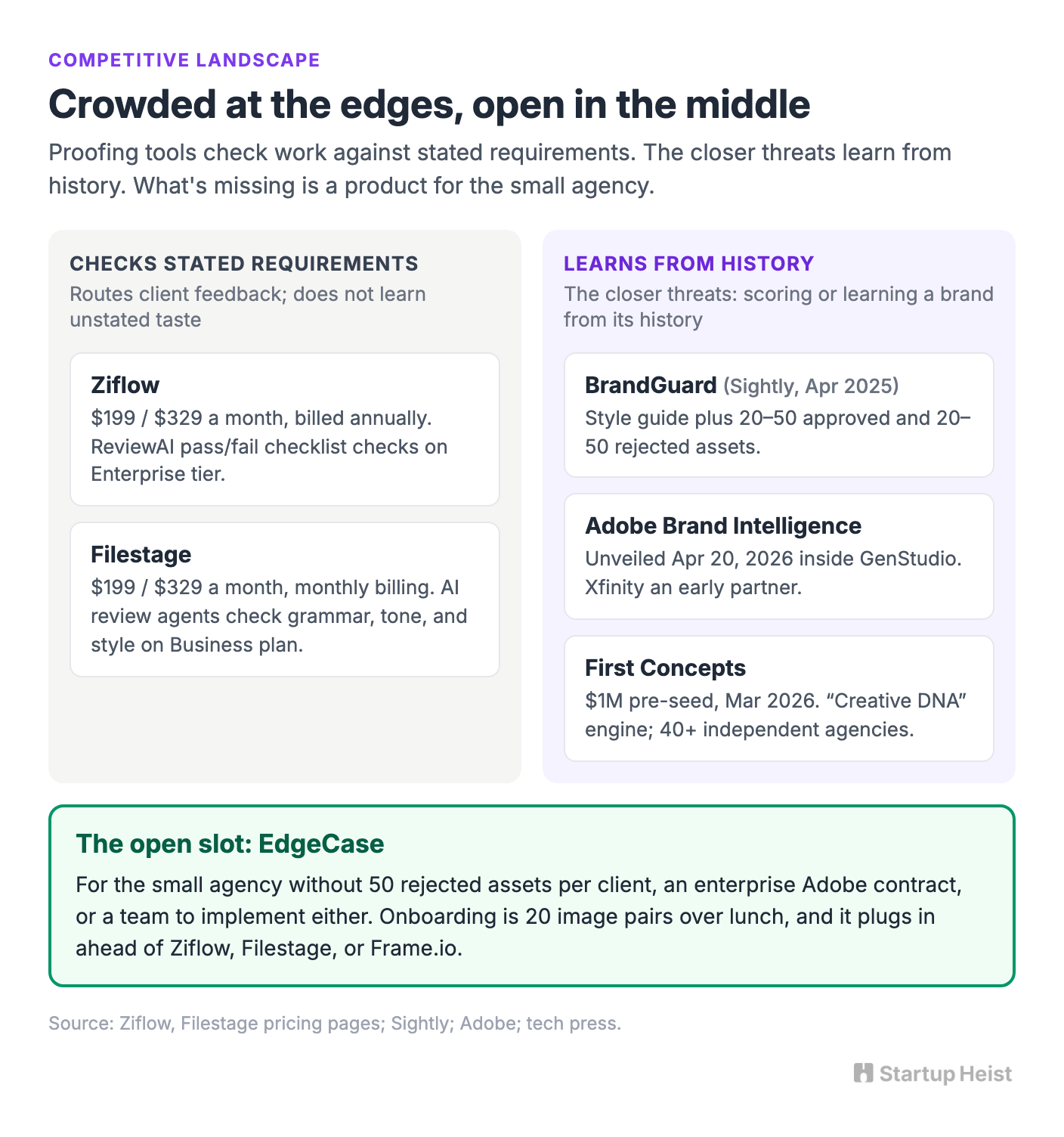
The closer threats learn from history. BrandGuard, whose technology Sightly acquired in April 2025, asks for a style guide plus 20–50 approved and 20–50 rejected assets, then scores new content, and it still markets directly to agencies. Adobe unveiled Brand Intelligence at Adobe Summit on April 20, 2026, a continuously learning engine inside GenStudio that builds an understanding of a brand from approvals, annotations, and review feedback, with Comcast's Xfinity as an early partner. In London, First Concepts raised a $1 million pre-seed round in March 2026 for a "taste-aware" operating system built around a "Creative DNA" engine, and says it works with more than 40 independent agencies, including Mother and R/GA.
So the concept has backers and buyers. What's missing is a product for the small agency that doesn't have 50 rejected assets per client, an enterprise Adobe contract, or a team to implement either. That shop can get a client to pick between 20 pairs of images over lunch. EdgeCase is built for it, and it should plug in ahead of Ziflow, Filestage, or Frame.io instead of competing with them.
How EdgeCase Works
Say an agency signs a specialty coffee roaster. The client hands over its brand guidelines, ten approved campaign images, and eight concepts it killed on earlier projects. EdgeCase reads the set and drafts a preliminary profile, treating it as a set of hypotheses: the approved work leans toward natural light, quiet compositions, candid activity, and restrained color, while the rejects share hard artificial lighting, exaggerated expressions, and glossy product staging.
Unlock the Vault.
Join founders who spot opportunities ahead of the crowd. Actionable insights. Zero fluff.
“Intelligent, bold, minus the pretense.”
“Like discovering the cheat codes of the startup world.”
“SH is off-Broadway for founders — weird, sharp, and ahead of the curve.”


