


ShelfVoice: Put Your Best Salesperson on Every Product Page
Big retailers are paying employees to market their products. Independent specialty stores have a more useful move available: capture what their best salespeople know and attach it to every product they sell.
On November 6, 2026, Foot Locker unveiled its holiday campaign, Joy to the Sole, and built it around George Jenkins, a 33-year company veteran and Foot Locker's Head of Stores. The centerpiece is "George's Picks," a gift guide that combines his sneaker expertise with recommendations from the store staff Foot Locker calls Stripers. The premise is that the people who sell the shoes all day know which ones you should buy.
Foot Locker isn't alone. On July 22, 2026, Gap Inc. opened its creator program to employees in offices, stores, and distribution centers across Gap, Old Navy, Banana Republic, and Athleta, who now earn commission and product for posting. The outside-creator version, launched in October 2025, had already produced nearly 30,000 posts reaching about 154 million users. In June 2026, Starbucks became the first brand to pilot TikTok's Custom Creator Network, sharing ad revenue with select baristas from its Green Apron Creators program.
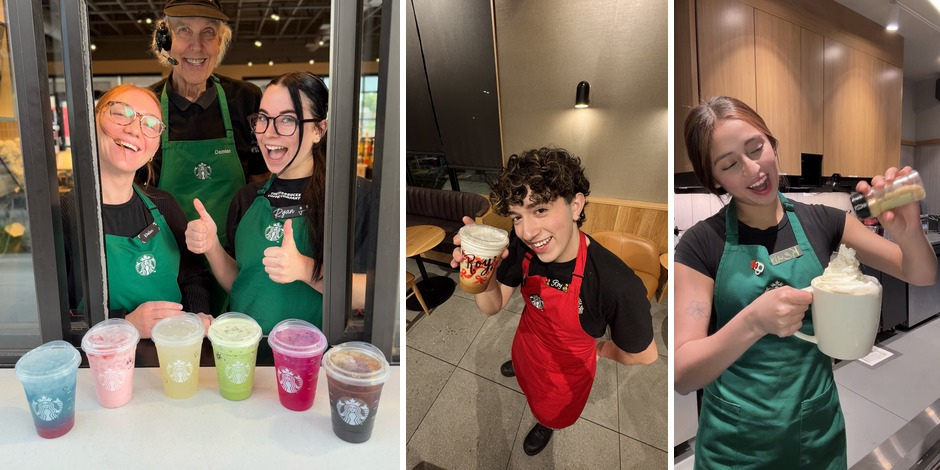
The largest retailers in the country have arrived at something independent shop owners have known for decades. Their staff explain products better than their marketing departments do.
Take a hypothetical independent running store with five employees. Its best salesperson has spent eight years fitting runners. She knows which shoes run narrow, which models suit a high arch, and which two near-identical pairs feel nothing alike at mile five. Customers drive across town to see her. Meanwhile, the store's website describes those same shoes with the manufacturer's copy, the same paragraphs that appear on hundreds of competing sites.
When she leaves, eight years of product judgment walk out with her, and almost none of it was ever written down.
ShelfVoice is a lightweight system that captures that expertise in short, structured videos and publishes it directly to the products a store sells. It keeps a store's best advice on the website when its best salesperson is off shift or off the payroll, and it's a credible small software business in its own right. Here's the opportunity:
The money: 250 stores at $149/month = $37,250 MRR, or $447,000 a year. In Japan, STAFF START credited store staff with ¥221.2 billion in sales in a single year.
Inside:
• Scan-to-publish MVP built on Shopify
• Pricing: $399 pilot, then $149/month
• Cold email and a ten-store pilot plan
• 90-day playbook from first sale to paid
Retail expertise is trapped on the sales floor
Specialty retailers win on something Amazon struggles to copy: a knowledgeable person who can tell you the difference. A running store explains why two cushioned trainers feel different. A bike mechanic names the compromise in an entry-level gravel bike. A guitar shop knows which beginner instrument is easier on the fingers. That knowledge matters most in the last minute before a purchase, and it has almost no distribution. An associate explains the same comparison from scratch, one customer at a time, and online shoppers get none of it.
ShelfVoice gets it onto the website. An associate opens the app on a phone and scans the barcode on a running shoe. The system matches it to the store's Shopify catalog and puts a specific prompt on screen:
"Who should choose this shoe instead of the Brooks Ghost?"
The associate taps record and answers for 20 to 30 seconds: "This is the one I'd have you try if you like the Ghost but want more room through the forefoot. It feels a little different underfoot, so I'd still try both on." ShelfVoice transcribes the answer, adds captions, attaches the clip to the right product, and sends it to the manager for approval. Once approved, it appears on the product page under Advice from our running specialists, and on a QR code beside the shoe wall.
Shoppers see the video. Underneath it, each answer is stored as a record: product, question, answer, alternatives mentioned, who said it, who approved it, and when it was last verified. Thirty seconds of video becomes a reusable unit of institutional knowledge, and that record is what ShelfVoice actually sells.
Why now: retailers have started paying staff to talk
Shoppers are already listening to store employees. Sprout Social's 2026 influencer marketing research, based on a survey of 2,250 consumers in the U.S., U.K., and Australia, found that 40% discover new products or services through employee-generated content every month. The same survey found that 61% believe companies should pay employees extra for that promotion.
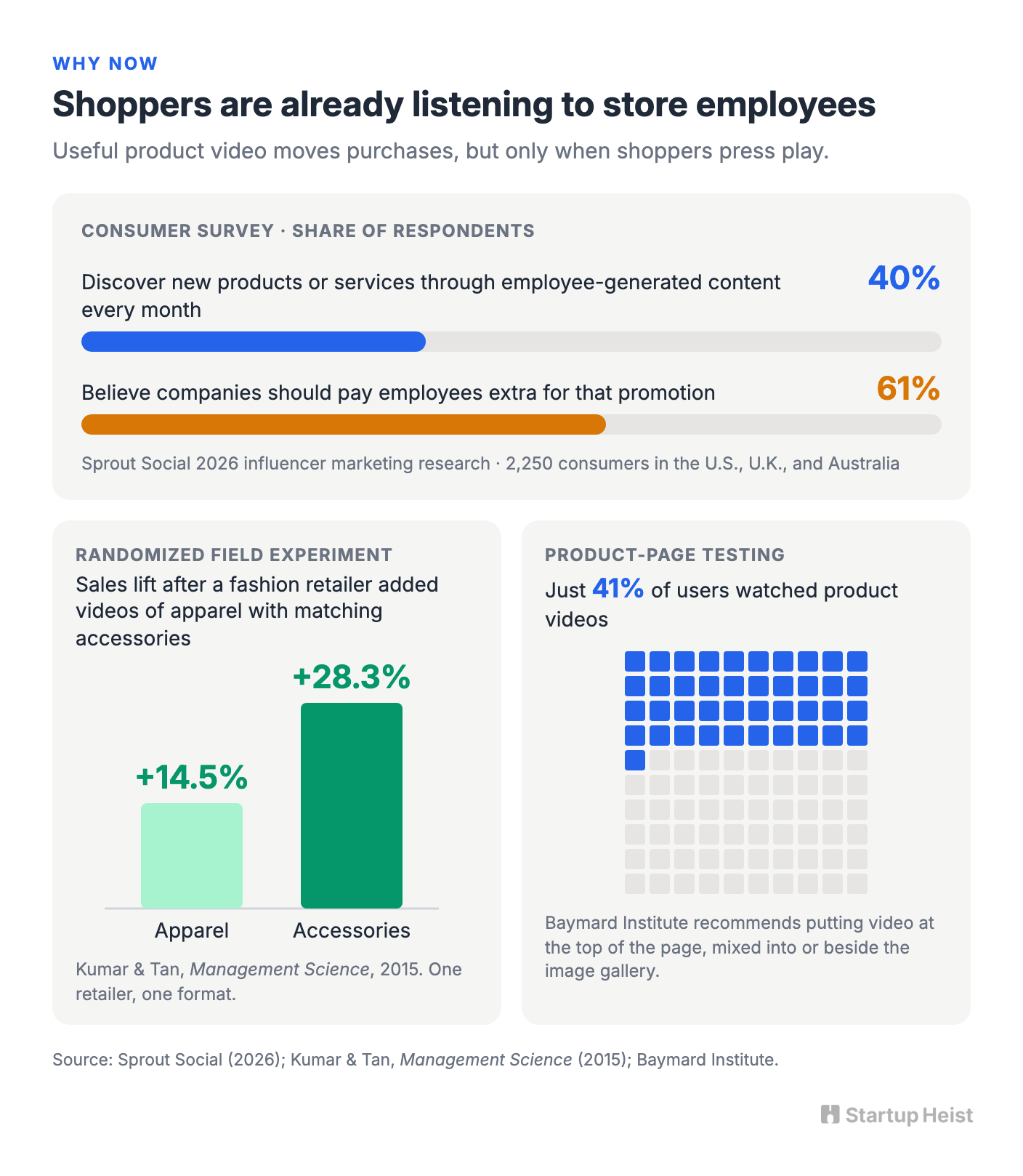
Social discovery and a product-page recommendation are different moments, and the evidence for the second is stronger. In a randomized field experiment published in Management Science in 2015, Anuj Kumar and Yinliang Tan added videos showing apparel with matching accessories to a fashion retailer's website. Apparel sales rose 14.5%, and accessory sales rose 28.3%. That's one retailer and one format, so you can't port the numbers to running shoes, but it is causal evidence that useful product video moves purchases.
Video only works if people watch it. In Baymard Institute's large-scale product-page testing, just 41% of users watched product videos, and Baymard recommends putting video at the top of the page, mixed into or beside the image gallery. A shopper who skips a brand introduction will still press play on an answer to a question she already has. "Introducing the New Balance 1080" reads like an ad, while "Is the 1080 too soft for faster runs?" reads like buying advice. ShelfVoice is organized around answered questions, and the rest of the design follows from that choice.
Japan already proved the model. America's independents are still unserved.
The strongest evidence that staff expertise sells comes from Japan. STAFF START, built by Tokyo-based Vanish Standard, lets store associates post content to their employer's ecommerce site and credits them for the online sales that follow. In the year ending August 2025, more than 302,000 staff accounts across more than 3,000 brands were credited with ¥221.2 billion (well over $1 billion) in sales through the platform, and the company estimates staff received about ¥1 billion in incentives. STAFF START announced its U.S. entry at NRF in January 2025, and we found no announced American customers since.
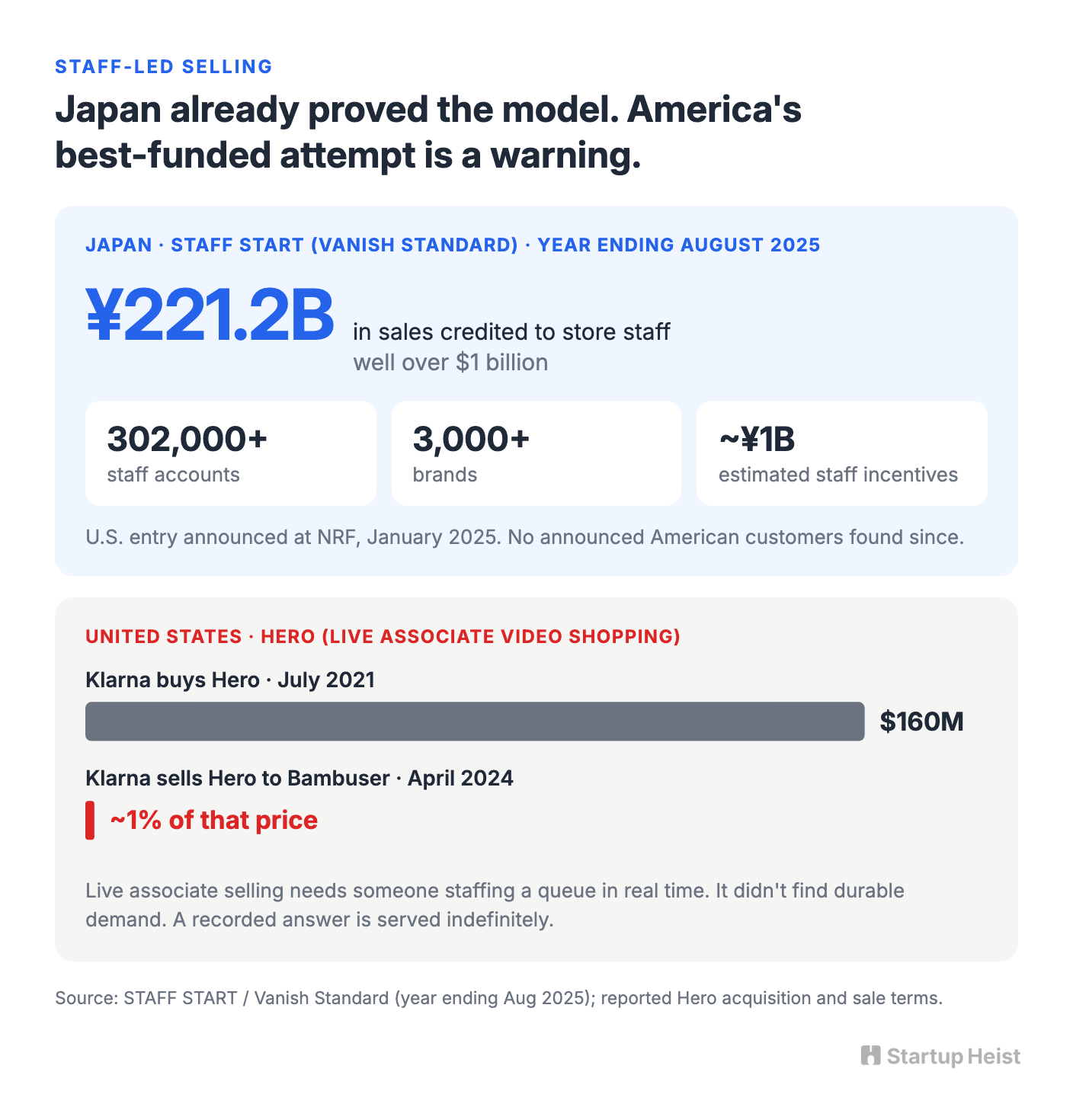
The American versions have chased larger retailers, and the best-funded one is a warning. Hero let associates at brands like Ted Baker and Faherty record SKU-tagged product videos and run live video shopping; Klarna bought it in July 2021 for a reported $160 million and sold it to Bambuser in April 2024 for roughly 1% of that price. Live associate selling, which needs someone staffing a queue in real time, didn't find durable demand, while a ShelfVoice answer is recorded once and served indefinitely. Creatable sells shoppable video to Ulta Beauty and Aéropostale under the pitch "a salesperson on every PDP." Whatmore's Video Answers builds product-page FAQs from videos a store has already tagged. Running Warehouse, an online-only running retailer, maintains a large library of staff shoe-review videos. All of this assumes a marketing team, a content library, or a studio, and a five-person running store has none of them. That gap is the wedge. ShelfVoice's job starts before any footage exists: the associate scans a shoe and answers one question, and the software handles everything between that answer and the customer who needs it.
The first market: independent running stores
Unlock the Vault.
Join founders who spot opportunities ahead of the crowd. Actionable insights. Zero fluff.
“Intelligent, bold, minus the pretense.”
“Like discovering the cheat codes of the startup world.”
“SH is off-Broadway for founders — weird, sharp, and ahead of the curve.”


