


The $800 Puzzle That Knows When You've Solved It
Turn about $30 of sensors into physical puzzles that recognize how they've been folded, bent, and assembled. Sell the finished experience to escape rooms first, then to the event agencies with bigger budgets.
An old folded map sits on a wooden table in an escape room, with no buttons, screens, or visible wires anywhere near it. The markings hint at a three-dimensional shape, so the players start folding along the creases, trying configurations until the edges line up.
Then the map glows and a hidden compartment clicks open. Nobody pressed anything. The object recognized its own shape.
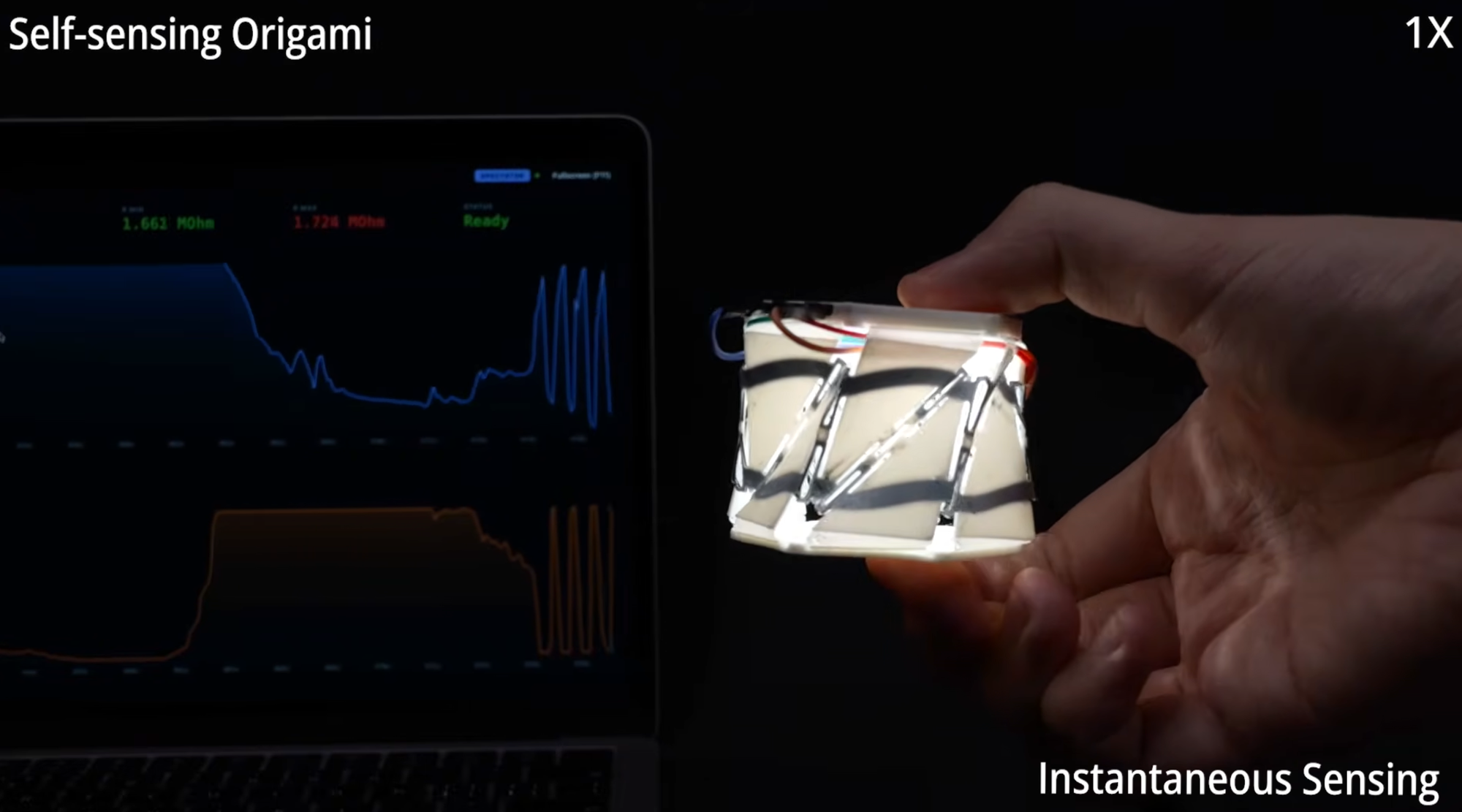
To the players, it's magic. The operator sees an $800 prop that resets in seconds and runs hundreds of games. The builder knows it's a $20 microcontroller, a handful of $2 magnetic sensors, some LEDs, and carefully designed hinges.
The business lives in the distance between how the puzzle feels and what it costs to make: a small fabrication shop that sells shape-sensing puzzles as finished, install-today props, starting with escape rooms and growing into event agencies. It's a specialty products business with a plausible path to six figures and a ceiling of a few hundred thousand dollars a year for a one- or two-person shop with a strong catalog. The electronics cost almost nothing. What's scarce is a product that works every time someone touches it.
Here's the opportunity:
The money: Hypothetically, ten $795 Folded Maps a month is $7,950 in monthly revenue and $3,350 in contribution. Incumbent catalogs already sell sensor puzzles from $337 to $1,757.
Inside:
• Full MVP spec for the fold-to-solve map
• Unit economics on a $795 prop
• Operator pitch email and pilot pricing
• Event-agency play and a 90-day plan
A Lab Demo You Can Build With Commodity Parts
On October 22, 2026, researchers from MIT's Computer Science and Artificial Intelligence Laboratory (CSAIL) and China's Tianjin University unveiled X-Hinges, design software for 3D-printing objects that sense their own movement. The sensors are printed into the object itself, using conductive filament in the hinges. The team showed an origami-style lamp that dims when you pinch it, a glove that records finger bends to teach a robot hand to grasp, and a shark-shaped game controller whose tail works as a joystick.
The research also shows why X-Hinges isn't a product yet. Every print lays out its electrical paths slightly differently, so two identical-looking objects give different readings, and the team needs a camera-based system to recalibrate each one. The pipeline also depends on a custom current-measurement board and a trained model to decode the signals.
A prop builder needs none of that. To know whether a map has been folded into the right shape, a Hall-effect sensor can tell when a magnet sits against it, a rotary sensor can read a hinge angle, and an RFID reader can identify which piece sits where. An ESP32 microcontroller, sold by Adafruit for $19.95, ties those signals together and fires a light, sound, or relay. Adafruit's Hall-effect sensors cost $2 each, or $1.50 in quantities of 50. You get a research-grade interaction from parts that never need calibrating.
Escape Rooms Already Pay for Electronic Magic
Escape-room players expect objects to behave strangely, and operators budget for the electronic props that deliver it. Escape Room Supplier, a Polish company that ships worldwide, sells a ready-to-play Jigsaw puzzle for $973.60: players arrange eight magnetic wooden shapes on a board that recognizes the finished pattern (output hardware sold separately). Its Gear Board lists at $1,757.64. US-based FrightProps sells electronic puzzle kits starting at $337.44 for Place the Objects, $448.41 for Patch Cable, and $567.45 for Simon Says.
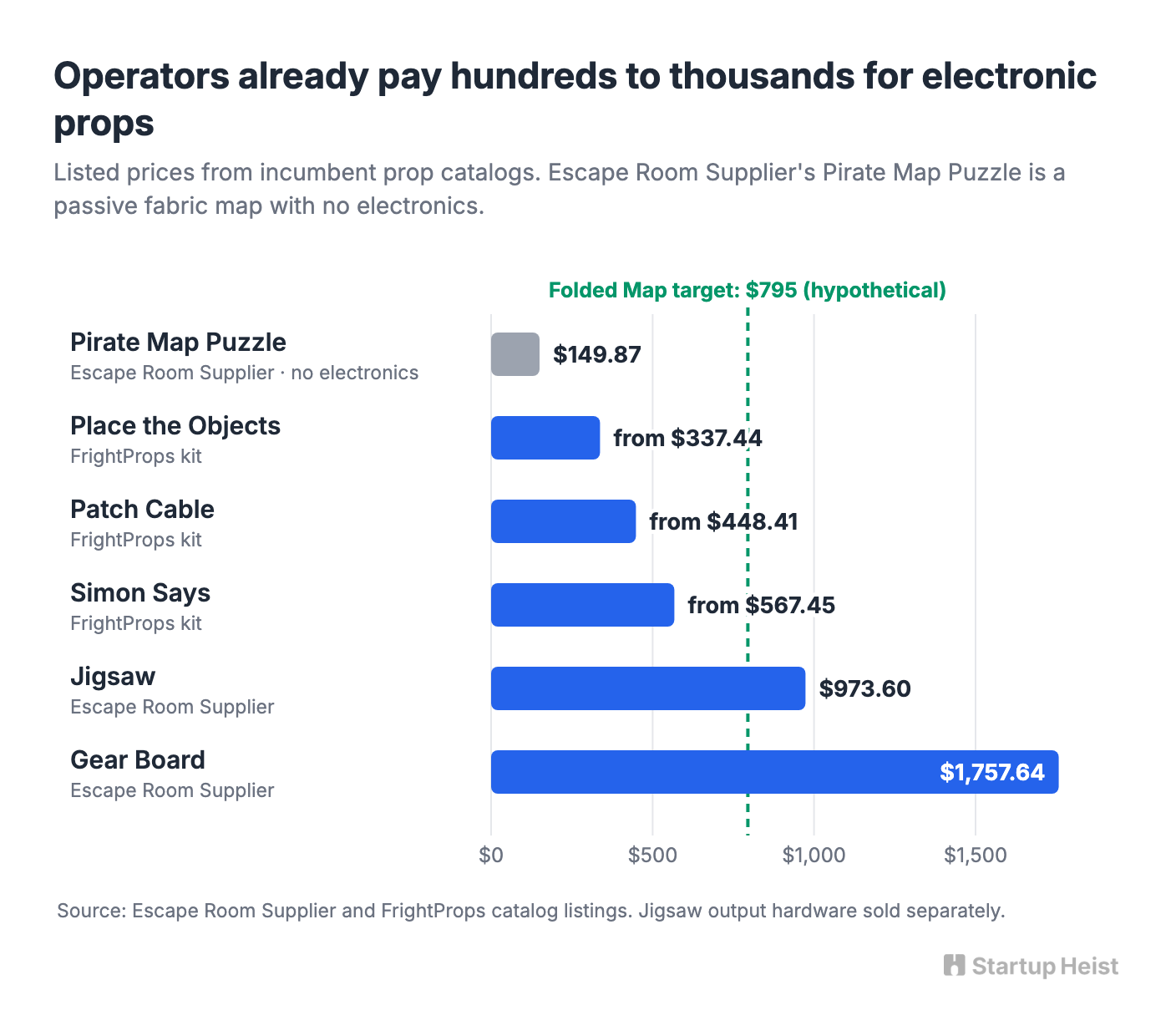
Operators pay those prices for the hours of fabrication, programming, and troubleshooting a finished prop saves them. The sensors inside are a rounding error. The same catalogs show the gap. Placement, contact, proximity, and sequence puzzles are everywhere, while Escape Room Supplier's $149.87 Pirate Map Puzzle is a passive fabric map with no electronics at all. Across the catalogs we examined, we found no turnkey prop built around an object that changes shape in the player's hands.
The catalogs are full of placement and RFID puzzles. The open lane is an object that knows when it's been folded, bent, or transformed.
The Buyer Can Build It Themselves
The US escape-room market is mature. Room Escape Artist's December 2025 report counts just over 2,000 facilities, about 7,800 games, and 1,450 companies, with roughly $300 million in annual revenue from about 40,000 bookings a week at around $150 each. The count has held flat since 2023: fewer than 200 facilities opened in 2025, and closures absorbed most of them. Your buyers are mostly budget-conscious owners refreshing tired games and building new rooms inside existing venues.
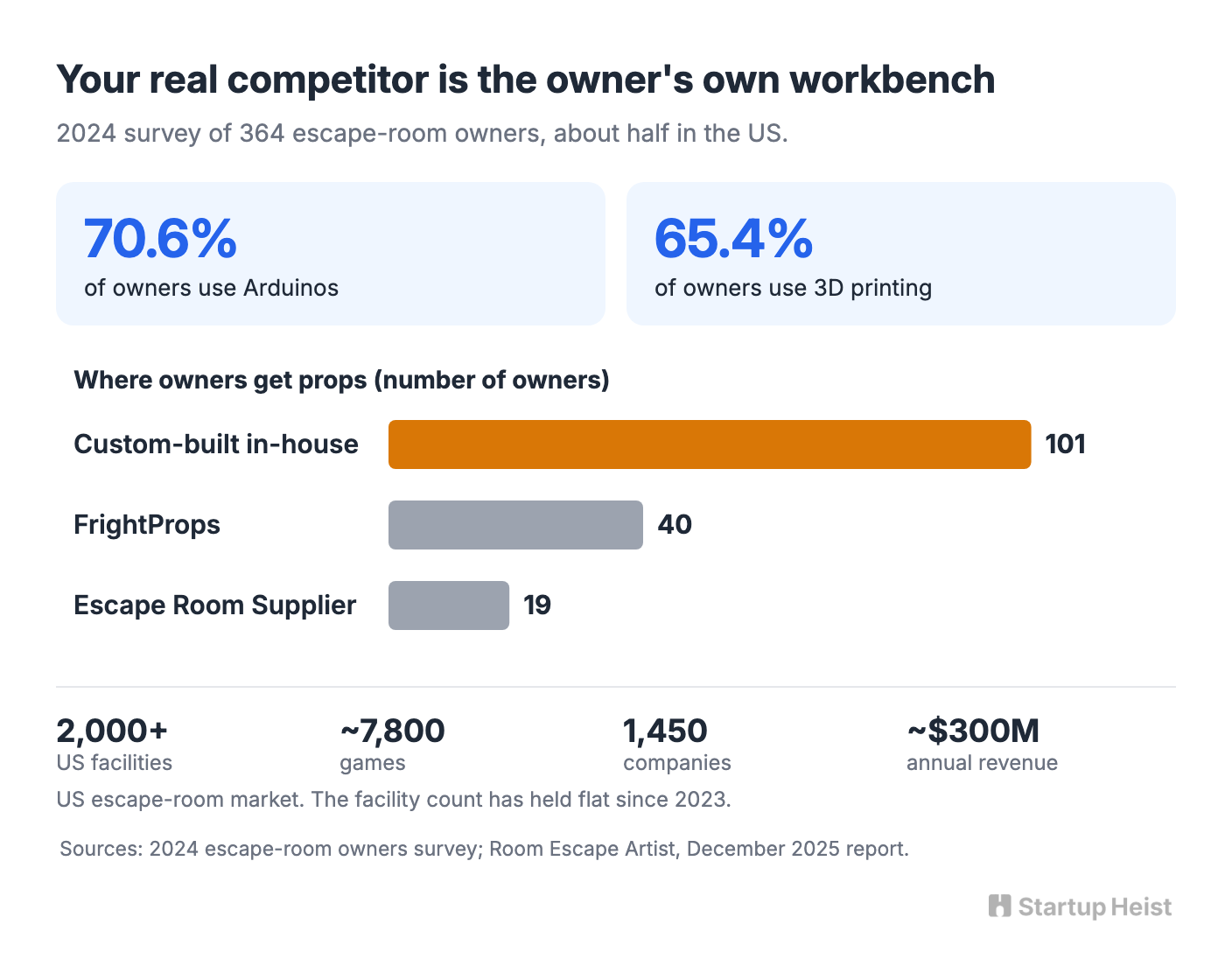
They're also handy. In a 2024 survey of 364 owners (about half in the US), 70.6% reported using Arduinos and 65.4% used 3D printing. Asked where they get props, the most common answer was "custom-built in-house," chosen by 101 owners, against 40 for FrightProps and 19 for Escape Room Supplier.
Your real competitor is the owner's own workbench. This buyer won't pay $800 for a clever tutorial. A beautiful prop that arrives assembled, installs in minutes, and survives thousands of players might earn that price, because workbench builds rarely match that reliability.
Three Products, One Flagship
Organize the catalog around physical interactions, and hold every product to three tests: players instantly understand what they can move, the correct solution produces a satisfying response, and normal handling can't break it.
Unlock the Vault.
Join founders who spot opportunities ahead of the crowd. Actionable insights. Zero fluff.
“Intelligent, bold, minus the pretense.”
“Like discovering the cheat codes of the startup world.”
“SH is off-Broadway for founders — weird, sharp, and ahead of the curve.”


