


The Seven-Day YouTube Heist: Turn Forgotten Fan Support Into a Repeatable Launch Ritual
YouTube built a button that lets small creators outrank big ones, then gave it a seven-day fuse. The opportunity is a $12–$19/month tool that gets a creator's fans to press it before the window closes.
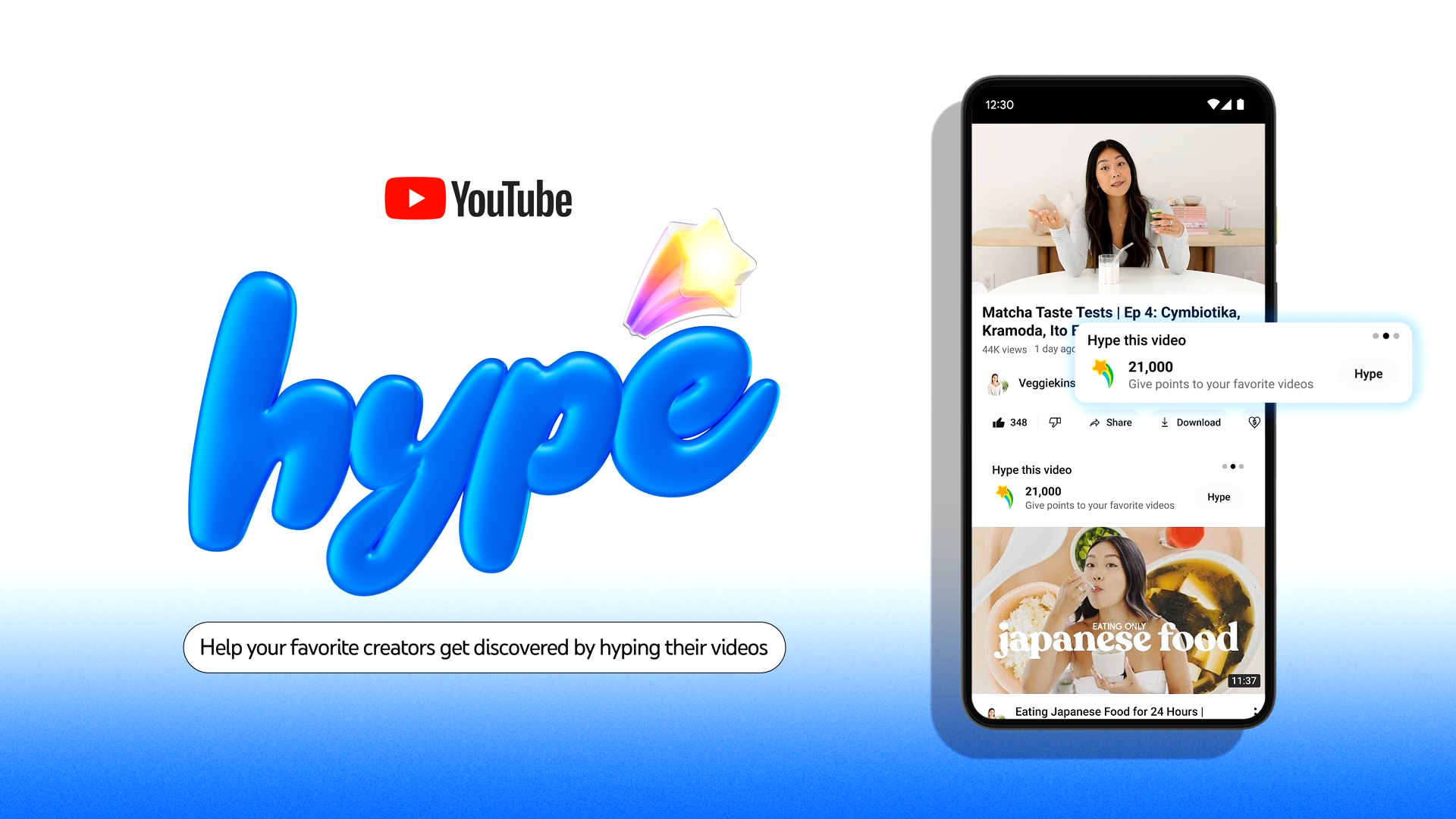
YouTube has a button that small creators badly want their viewers to press, and many viewers barely know it exists. It's called YouTube Hype.
When a viewer hypes a video, YouTube awards it points toward a country-specific weekly hype leaderboard. Smaller channels get far more points per hype, which gives a 20,000-subscriber woodworker a real shot at outranking a channel twenty times their size. The button has two limits: it only works during a video's first seven days, and each viewer gets three free hypes per week.
That combination produces a strange kind of waste. A creator can have thousands of loyal subscribers who would gladly support a new upload and still collect a handful of hypes, because fans don't know the feature exists, forget to use it, or find the video after they've spent their allowance on someone else. YouTube supplies the button, the points, the leaderboard, and the analytics. Nothing in YouTube Studio or the usual creator tools organizes a creator's most enthusiastic fans around the seven-day window.
Here's the opportunity:
The money: 300 creators at $15/month = $4,500 MRR, on infrastructure under $100 a month. Viewers have already hyped videos over 1 billion times.
Inside:
• Reset-aware launch calendar and reminder timing
• Ten-item MVP scope with a solo-builder stack
• Cold outreach email for your first 10 creators
• Pricing tiers and a 30-creator cohort scorecard
Hype Week turns each upload into a coordinated, seven-day fan-support campaign. A creator pastes a video link, gets a shareable campaign page, invites fans to opt in to launch alerts, and schedules reminders around YouTube's weekly reset. A dashboard shows participation, and an optional tracker reports whether the video lands on the leaderboard.
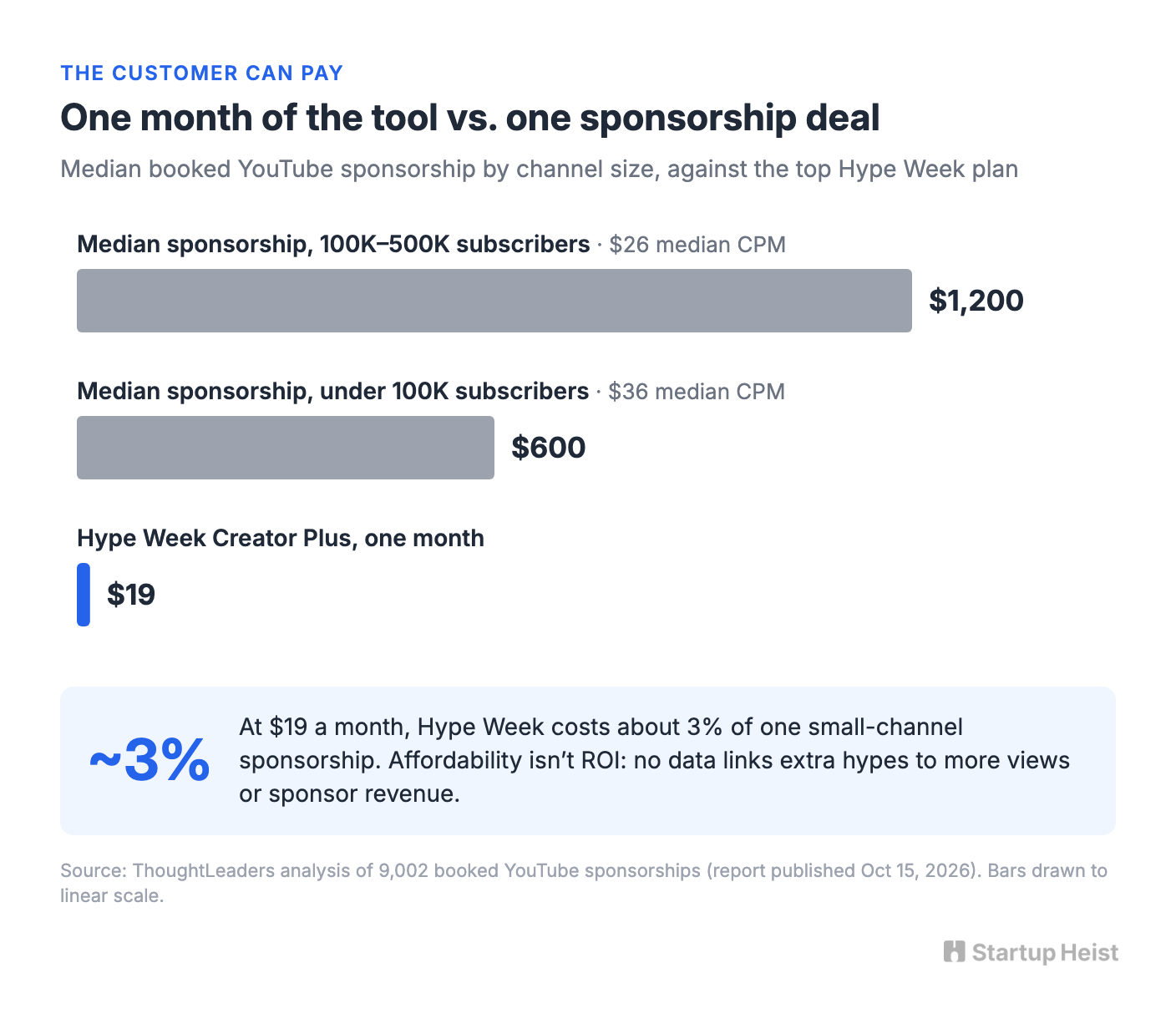
Charge $12–$19 a month. The goal is a focused micro-SaaS with a repeatable use case, cheap infrastructure, and a clear path to a few thousand dollars in monthly recurring revenue.
1. The Mechanic: A Weekly Competition Rigged in Favor of Small Channels
YouTube announced Hype in September 2024, tested it in Turkey, Taiwan, and Brazil, and rolled it out to 39 countries, including the United States, on August 26, 2025. At its Made on YouTube event in September 2026, the company said viewers had hyped more than 75 million unique videos over 1 billion times. This is an established feature with real usage behind it.
The rules define the customer:
- Channel eligibility: YouTube Partner Program members with 500 to 500,000 subscribers in supported countries.
- Video eligibility: Long-form videos in their first seven days. Shorts, made-for-kids content, and certain restricted videos don't qualify.
- Free allowance: Three hypes per viewer per week, refreshed Monday at 12:00 a.m. in the viewer's local time. A viewer can spend more than one on the same video.
- Leaderboard: Country-specific, built only from hypes by viewers in that country, with topic filters showing up to the top 50 videos per category.
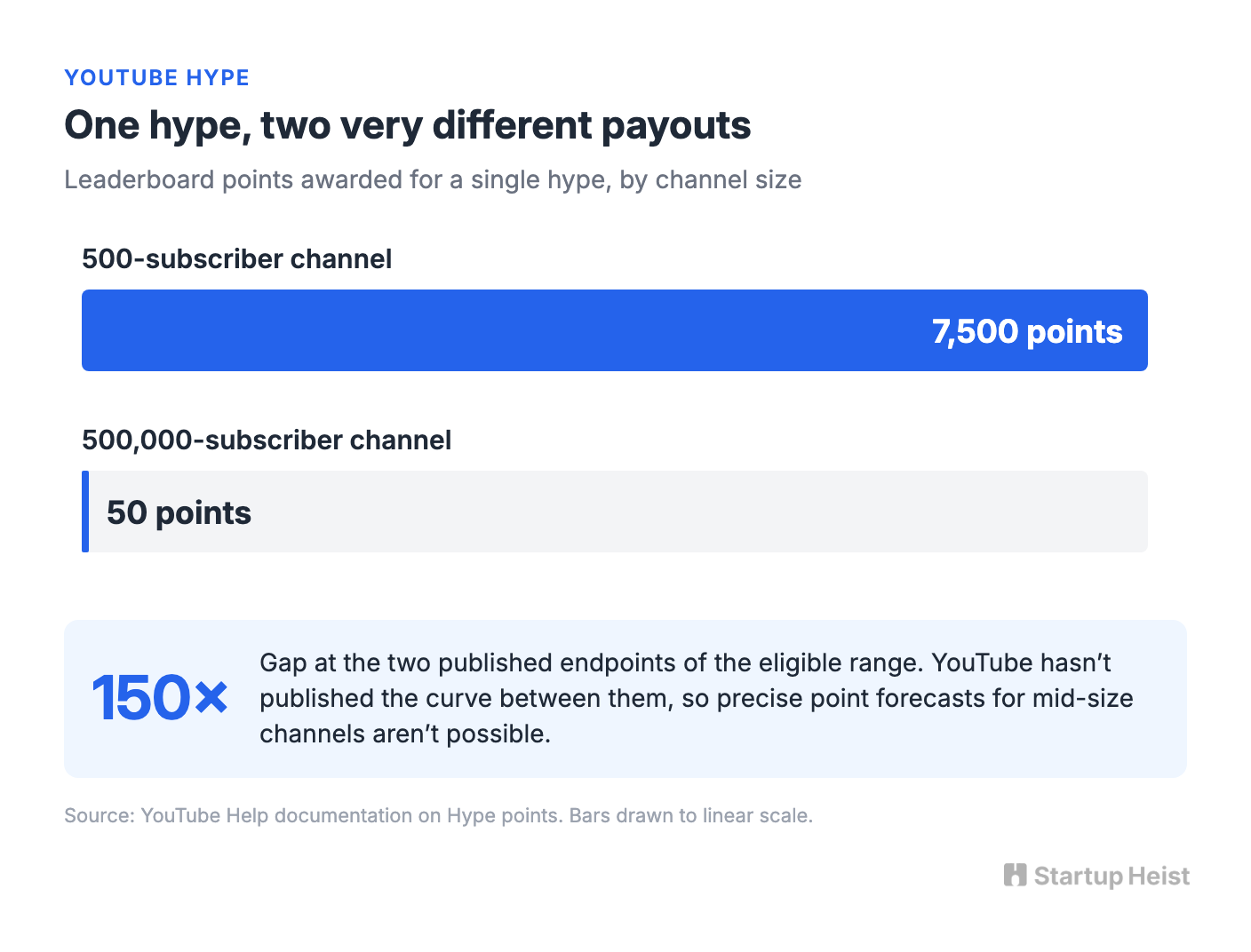
The multiplier is the hook. Per YouTube's own help documentation, one hype gives a 500-subscriber channel 7,500 points. The same hype gives a 500,000-subscriber channel 50 points, a 150-fold gap at the two published endpoints. YouTube hasn't published the curve between them, so no tool should promise precise point forecasts for a 60,000-subscriber channel.
Know the limit before you build. YouTube said at launch that hype doesn't feed its recommendation system or search results. A hyped video gains exposure through the leaderboard, a rank badge in its description, a "hyped" filter on the Home feed, and alerts to fans when it nears the rankings. None of that guarantees extra views. Hype Week sells better use of a legitimate, time-boxed feature, and saying so plainly becomes part of the pitch.
2. The Catalyst: Hype Now Pays Creators
On November 6, 2026, YouTube announced it was expanding Hype with Jewels to nine more markets: the United States, Canada, the United Kingdom, Germany, Ireland, Italy, Poland, Spain, and Turkey.
Viewers in those markets can now spend Jewels, YouTube's virtual currency, on paid hypes beyond their three free ones. Creators earn Rubies from that spending, which show up in YouTube Analytics and pay out through AdSense alongside other channel earnings. Anyone who hypes with Jewels during the first seven days gets their handle listed in a recognition section of the video description. To turn it on, creators must sign the Virtual Items Module, complete identity verification, and keep "Let viewers hype" enabled in Studio.
Hype is now a revenue line as well as a discovery mechanic, so a creator who ignored it before November has a financial reason to teach viewers what it does. Paid hypes also bring a new kind of competitor to the leaderboard, since a few big spenders can outscore a well-organized free campaign. Hype Week should promise to mobilize real fans and never promise a winning rank.
3. The Gap: Willingness to Support Doesn't Turn Into Timely Action
Watch how an independent YouTuber launches a video today. They upload, maybe post to Community, and drop a link in Discord. Some fans watch that night, others find it Thursday, and some see it after the window has closed. The creator says "give it a hype if you enjoyed it," and the message lands unevenly on people who may not know what a hype is.
Creators on Reddit's r/PartneredYoutube describe this pattern: viewers unaware they have hypes to spend, creators who forget to use the feature themselves, and confusion about where the button lives. The evidence is anecdotal, but it points to a clean product problem. Goodwill exists, and nothing converts it into action inside a seven-day window.
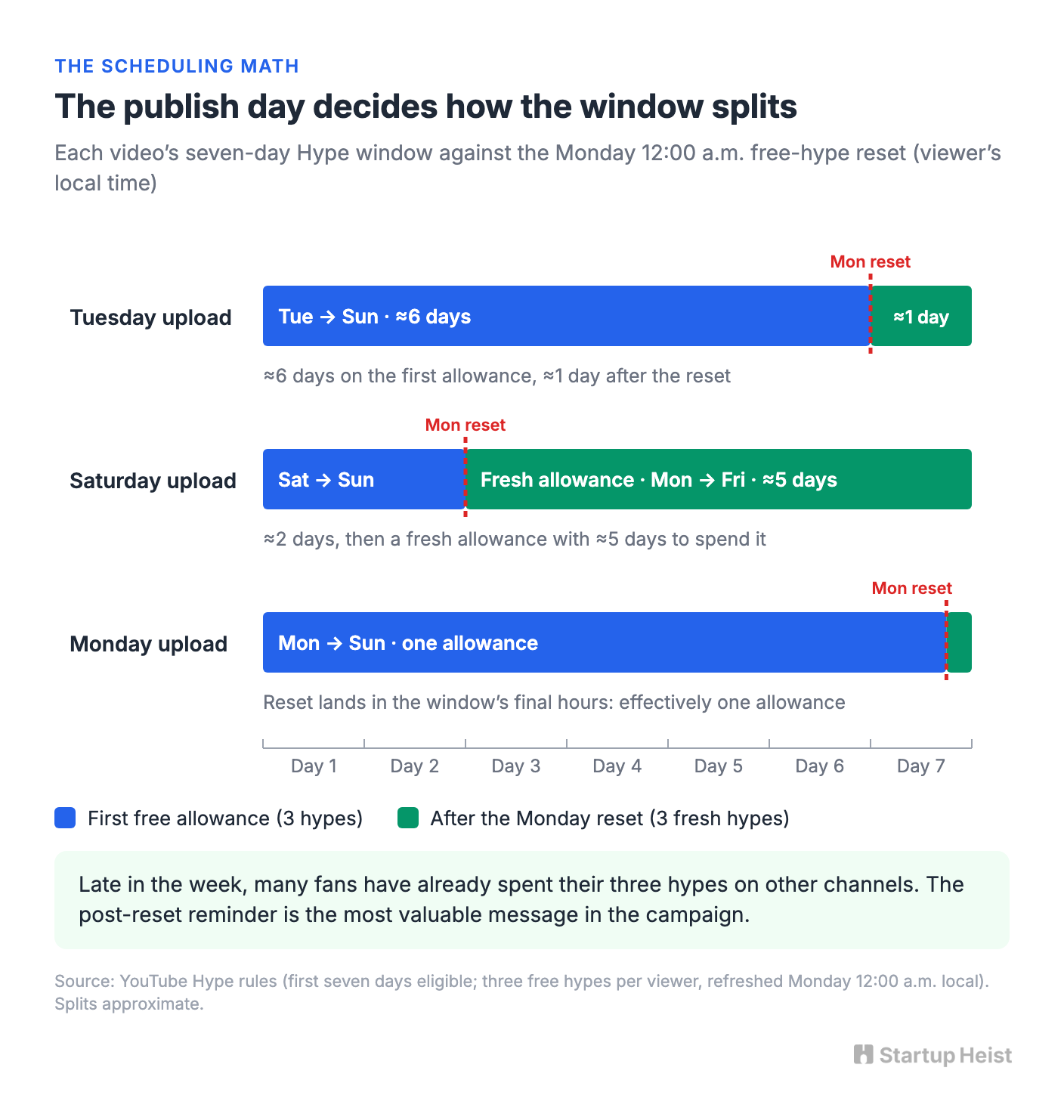
The scheduling math is where software earns its keep. Every seven-day window contains exactly one Monday reset, so each video gets two shots at a fan's allowance, and the publish day decides how the window splits. A Tuesday upload gets six days on the first allowance and roughly one day after the reset. A Saturday upload gets two days, then a fresh allowance with five days to spend it. A Monday upload is the worst case: the reset lands in the window's final hours, so it effectively gets one allowance. Late in the week, many fans have already spent their three hypes on other channels, which makes the post-reset reminder the most valuable message in the campaign. A tool that maps each video's window against each fan's local reset, and fires the right reminder at a civilized hour, is doing something a creator won't do by hand every week.
4. The Customer: Creators With a Community but No Team
Unlock the Vault.
Join founders who spot opportunities ahead of the crowd. Actionable insights. Zero fluff.
“Intelligent, bold, minus the pretense.”
“Like discovering the cheat codes of the startup world.”
“SH is off-Broadway for founders — weird, sharp, and ahead of the curve.”


