


YouTube Demoted the Clippers. Hire Them.
YouTube is cutting the reach of accounts that recycle other creators' videos. Podcasters, meanwhile, need a steady supply of Shorts on channels they actually own. The play: recruit experienced clippers, put them to work behind the original creators, and sell a managed Shorts desk for $1,200 to $2,500 a month.
The Opportunity
On October 1, 2026, YouTube announced a change to how Shorts get recommended. Channels identified as "primarily aggregating or re-uploading other creators' videos without significant changes" will likely see less distribution. There's no ban and no blanket demonetization, and YouTube's creator liaison even pointed would-be reposters to the Posts tab, where sharing a video sends viewers back to the original upload.
The change lands on a large, quiet industry. For years, independent operators have pulled moments from popular podcasts and livestreams, cut them into vertical short-form video, and uploaded them to their own accounts. Some get paid by the creators through clipping marketplaces; a September 28, 2026 tally of the 50 campaigns listed on Whop's Content Rewards board found a median payout of $1 per 1,000 views. Others monetize the audience themselves.
The workforce behind this clip farming is enormous. CreatorDB's census, published August 26, 2026, tracked 30 days of clips featuring six major streamers: IShowSpeed, Kai Cenat, N3on, Adin Ross, xQc, and CaseOh. It found:
- 9,941 clips posted by third-party accounts
- 1,820 distinct clipper accounts
- 1.68 billion YouTube views
- 260 million TikTok plays
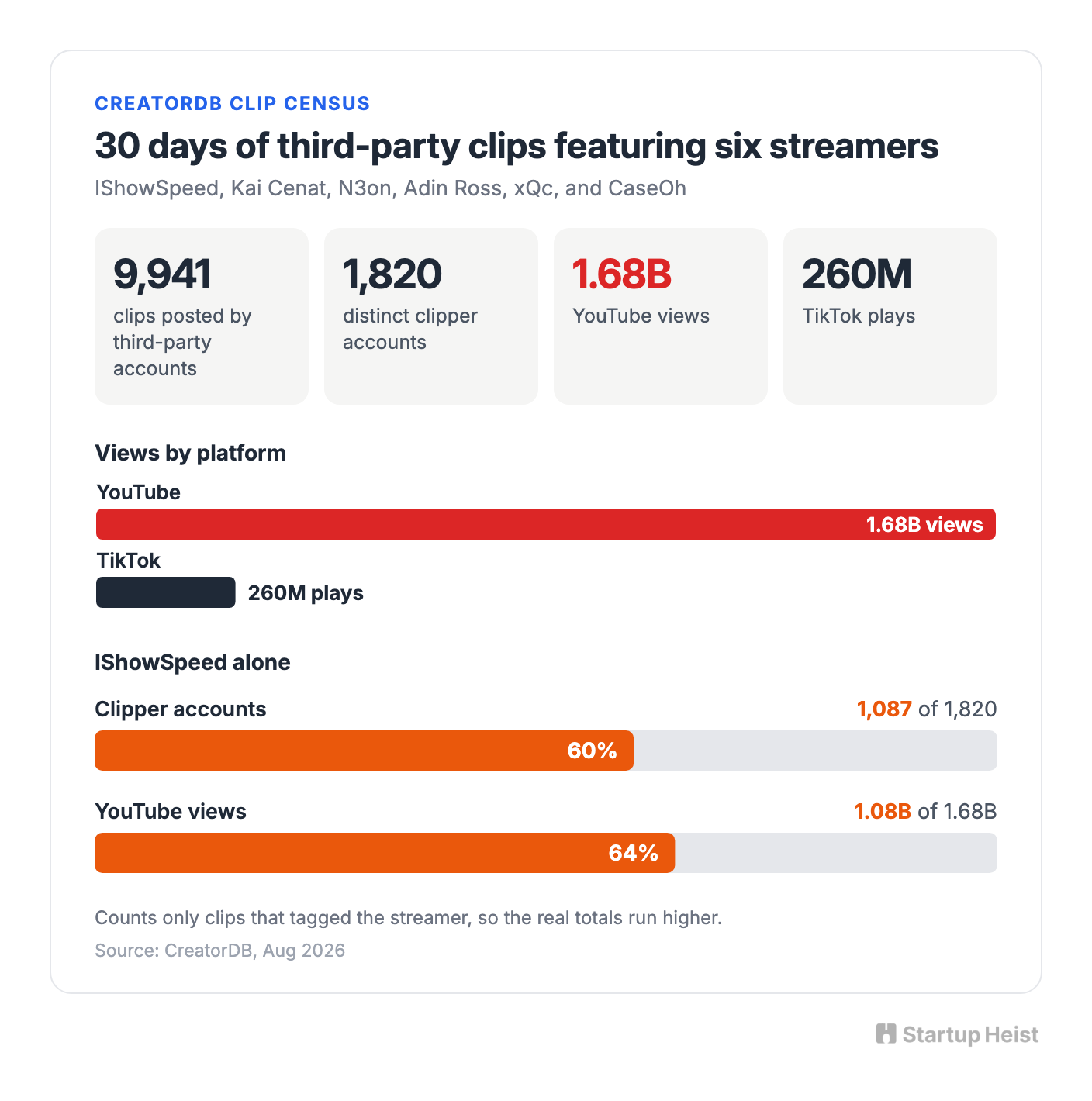
IShowSpeed alone drew 1,087 clipper accounts whose clips pulled 1.08 billion YouTube views in a month, and CreatorDB counted only clips that tagged the streamer, so the real totals run higher. Streamers sit far from the typical podcast, but the numbers prove that a big, distributed workforce already knows how to turn hours of footage into attention. YouTube just made that workforce's favorite distribution model a lot riskier.
So point the clippers at the creators' own channels. Call the business Clip Desk: a managed YouTube Shorts service for established video podcasters. The customer sends long-form recordings. Clip Desk finds the strongest moments, edits 20 Shorts a month, routes them for approval, publishes them to the customer's channel, and reports what worked. It's a familiar outsourced service, rebuilt around a shift in who gets to own the audience.
Here's the opportunity in brief:
The money: Ten podcasts on the proposed $1,900 Growth Desk plan is $19,000 MRR and roughly $8,000 monthly contribution. Comparable services charge $1,000 to $2,500 and leave posting to you.
Inside:
• Clipper recruiting pitch and paid test rubric
• Three-tier pricing and unit economics
• Clipper referral program plus cold email
• 90-day plan from two pilots to ten clients
Why the Timing Matters
YouTube made three moves that favor creators who post their own Shorts.
Originals get the reach. The October update extends a line YouTube drew in July 2025, when it renamed its "repetitious content" monetization policy to "inauthentic content" to target mass-produced uploads. This one governs distribution, and clips with real commentary or creative transformation still qualify. TikTok and Instagram clipping are untouched. Still, a clipper who spent years building a fan account now depends on a recommendation system that has announced its preference, and selling that skill as a service is the sturdier business. For the podcaster, clips under their own brand build their own subscriber base, and the library stays put when an editor leaves.
YouTube is paying for consistency. In October 2026, YouTube started an invite-only Shorts bonus pilot for YouTube Partner Program creators in six countries, including the U.S. Each invitation sets its own upload minimum, and the bonus is tied to validated engaged views. Invitations shared publicly, which YouTube hasn't confirmed, show terms like 16 public Shorts a month for a $300 minimum and up to $2,000 a month over three months, or 12 Shorts for up to $1,000. Nobody should promise a client a bonus for hitting 16. The signal still matters: YouTube is putting money behind steady cadence, and a desk that ships 20 scheduled Shorts makes cadence automatic.
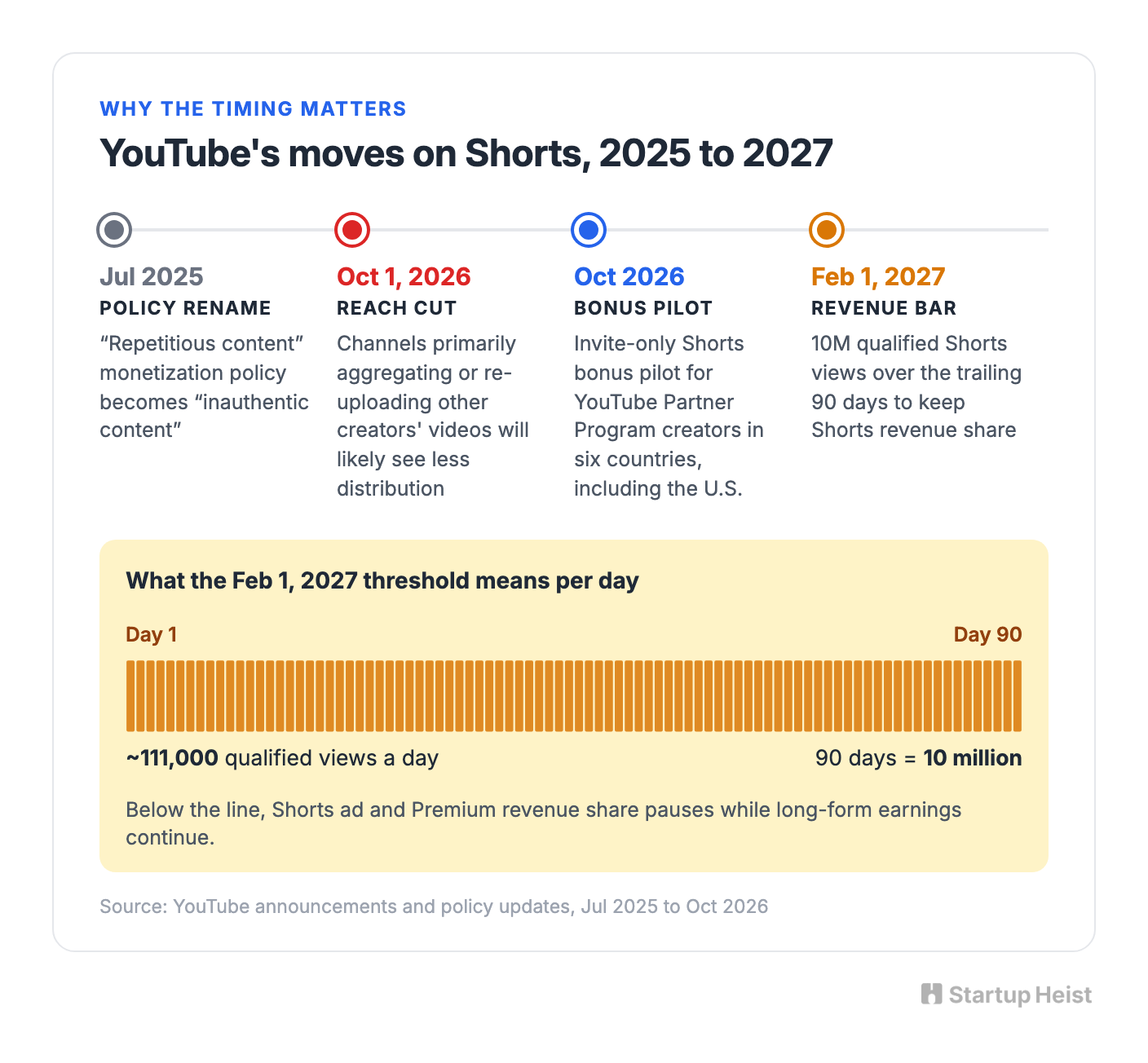
Shorts revenue is getting harder to keep. Starting February 1, 2027, channels need 10 million qualified Shorts views over the trailing 90 days to keep earning Shorts ad and Premium revenue share. Below that line, Shorts revenue pauses while long-form earnings continue. That's about 111,000 qualified views a day, a bar most mid-sized podcasts won't clear, so the threshold matters only for your biggest clients. For everyone else, the pitch is audience growth: subscribers gained and viewers pushed into full episodes.
The Real Customer Problem
Podcasting is a serious ad market. The IAB put 2025 U.S. podcast ad revenue at $2.9 billion, up 17.6% year over year, and that tally covers only traditional audio spend, a definition the IAB says is expanding as video becomes podcasting's leading channel. The more useful numbers concern discovery. Sounds Profitable's Podcast Atlas, released June 26, 2026 and based on a survey of more than 5,000 U.S. adults, found that close to nine in ten podcast listeners watch clips on social platforms, and 84% of clip viewers say clips have turned them into regular listeners at least sometimes. The behavior is self-reported, but the direction is clear enough to build a business on.
Consider a typical target: a show with 120,000 YouTube subscribers, four hour-long interviews a month, and sponsors already signed. Its Shorts feed is sporadic. Somewhere in those four hours sit 20 or 30 moments worth clipping: a sharp opinion, a strange story, a clean explanation of something hard. Someone has to find them, reframe the footage, tighten the pacing, caption, title, schedule, and watch the numbers. The host doesn't want that job. A full-time editor is overkill, freelancers need managing, and an AI clipping tool still leaves the host deciding what deserves to go live.
What the customer needs is 20 good Shorts appearing on schedule without managing anyone. That editorial responsibility, carried all the way through publishing, is what Clip Desk sells.
The Competition Is Already Here
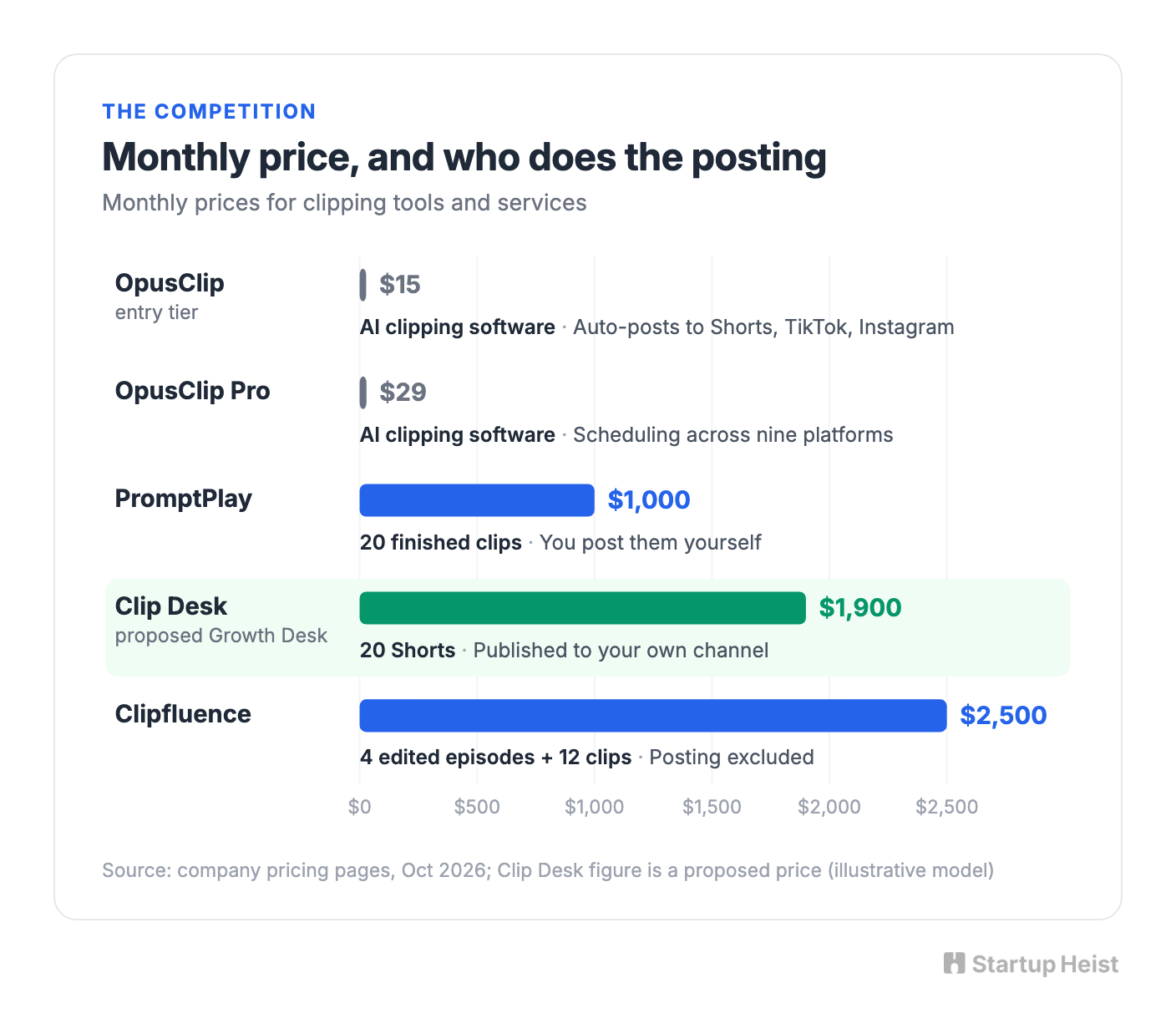
Clipping itself is turning into a commodity. OpusClip starts at $15 a month and auto-posts to Shorts, TikTok, and Instagram; its $29 Pro tier adds scheduling across nine platforms. Klap and a crowd of similar tools compete on the same automation. Podcast clipping services sit a tier above. Clipfluence charges $2,500 a month for four edited episodes and 12 clips, with posting excluded. PromptPlay sells 20 finished clips for $1,000 a month, and you post them yourself. A September 2026 pricing survey from PenguinClip put freelancers at $30 to $100 per clip and agencies at $80 to $200 or more.
Tools automate the cut and services hand over files, so the creator still holds the editorial calls or the posting. Twenty finished Shorts a month is already an easy purchase to understand, which means Clip Desk wins on operations or not at all.
| Alternative | What the creator gets | What stays on their plate |
|---|---|---|
| AI clipping software | Fast, cheap clip generation and posting tools | Editorial calls, quality control, strategy |
| Freelance editor | Editing capacity | Hiring, deadlines, approvals, publishing |
| Clipping service | Finished files on a monthly plan | Posting, linking, tracking results |
| Full agency | Broad production and management | A $2,000+ retainer, services they may not need |
| Clip Desk | Dedicated editor, managed approvals, publishing, monthly reporting | Final approval and strategic direction |
Plenty of agencies could offer the same thing. The opening is a narrow package for established video podcasters who want consistent Shorts without a big agency relationship, and that focus has to show up in the sales process, the turnaround, and the monthly report.
What Clip Desk Actually Sells
The core offer: twenty original-channel YouTube Shorts per month, produced and published from the customer's existing episodes.
Unlock the Vault.
Join founders who spot opportunities ahead of the crowd. Actionable insights. Zero fluff.
“Intelligent, bold, minus the pretense.”
“Like discovering the cheat codes of the startup world.”
“SH is off-Broadway for founders — weird, sharp, and ahead of the curve.”


