


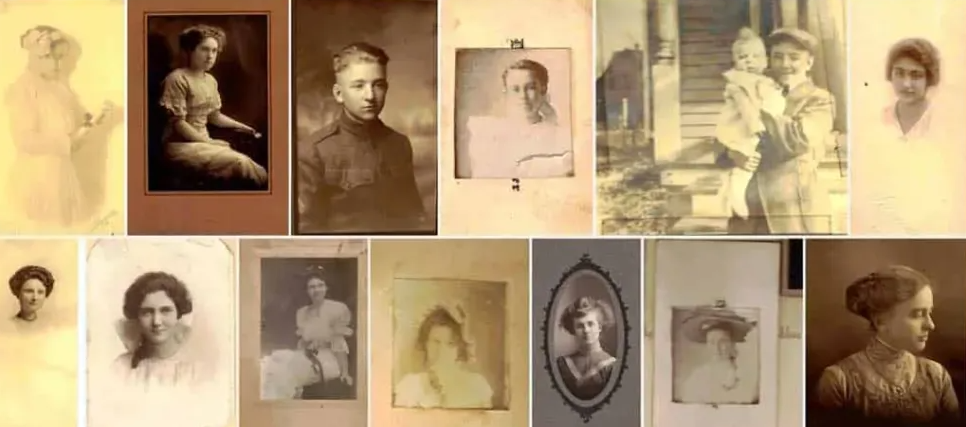
Somebody on Reddit built a genealogy blog around named vintage portraits. Photos more than 100 years old, each page tagged with a real person's name, their town, and the year. Nothing fancy. Just clean pages with old faces.
The result: roughly 3,000 visitors a day and north of $2,000 a month in ad revenue. The traffic is almost entirely long-tail search. Descendants Googling their great-grandparents, finding a face, and sticking around.
That's the lifestyle version — a solo side business idea built on public domain content and basic SEO.
Layer in a consumer SaaS product (a "Family Locker" at $8/month or a $79 one-time Family Pack), partner with archives sitting on millions of unindexed photos, and you're looking at $5K–$10K/month within a year as a solo operator.
With a small team and a repeatable ingestion pipeline, this becomes the open-web discovery layer that Ancestry structurally can't provide.
A massive, emotionally charged search layer exists on the open web — one that billion-dollar incumbents under-serve by design — and the right founder could turn it into an infrastructure business. Call it genealogy automation, call it a niche content startup idea, call it whatever you want. The wedge is real and the timing is now.
Why This Is Real
Ancestry.com generates over $1 billion in annual subscription revenue from more than 3 million paying subscribers. Blackstone bought the company for $4.7 billion in 2020 and is now exploring an exit at a rumored $10 billion valuation. In July 2025, Ancestry acquired iMemories, a media digitization company that has preserved over 100 million family photos, films, and videos for more than a million families. The market is moving toward visual, emotional, personal.
On the free side, FamilySearch added over 2.5 billion new searchable records and images in 2024 alone, pushing its total past 20.5 billion. More than 285 million visits hit the site that year.
Yet every major platform is optimized for logged-in research flows behind paywalls and account walls. The open web — where descendants actually start their search — is barren. Someone Googles "Margaret Sullivan Scranton 1905 photo" and gets nothing useful. The query intent is emotional, hyper-specific, and completely underserved.

Community sites like DeadFred (on the order of 80,000–100,000 unique old family photos across roughly 23,000 surnames) and AncientFaces proved the behavior exists. People actively hunt for named photos of ancestors online. But neither site was built as a scalable ingestion and distribution platform. They're early-2000s web utilities that still drive traffic because the demand is that persistent.
Meanwhile, supply is accelerating. The National Archives signed a multi-year agreement with Ancestry in 2024 to digitize tens of millions of previously unavailable records, with 65.5 million in the first phase alone. Local historical societies are receiving grant-funded scanning equipment. Digitized material is exploding. The discovery layer for "named person + photo" on the open web? Still a gap.
Genealogy is paywalled inside products. Discovery is free on Google. Incumbents are optimized for logged-in research flows. You'd be optimized for the "I Googled my great-grandfather once" flow. That's the wedge. A tiny blog with named pages can outperform generic "Victorian restoration" content by orders of magnitude — without those specific names attached, similar posts drop to roughly 50 visits a month — because the intent is so specific.
The Core Play: Search-Front, SaaS-Back
Build this on two specific, progressive tracks:
Unlock the Vault.
Join founders who spot opportunities ahead of the crowd. Actionable insights. Zero fluff.
“Intelligent, bold, minus the pretense.”
“Like discovering the cheat codes of the startup world.”
“SH is off-Broadway for founders — weird, sharp, and ahead of the curve.”


