


The Storage Drawer Is the New Creator Bottleneck
The creator economy spent a decade obsessing over cameras, lighting, microphones, distribution, editing suites, and monetization. Storage was an afterthought. A drive in the corner. Something an editor handled at 1am.
That part is breaking.

The creator economy now sits around $234 billion globally in 2026, with roughly 207 million people identifying as content creators and a much smaller professional tier producing weekly work for clients and audiences. The serious tier — YouTubers, podcast studios, wedding videographers, real estate media shops, post-production boutiques, course producers, agencies — is generating real volume. Every one of them is sitting on a drawer of unlabeled SSDs that has quietly become the operational backbone of the business.
Cloud workflows still buckle under multi-terabyte 4K and 8K footage. Buying drives forever isn't a system. The play is to become the managed storage department for creators big enough to suffer, but not big enough to hire IT.
Here's the opportunity.
The money: 50 studios at $799/month is roughly $40K MRR. 100 puts you near $80K. Iron Mountain runs this playbook for broadcasters; the SMB tier is wide open.
Inside:
• MVP scope for a managed video archive
• Four-tier pricing from $199 to $3K
• Studio wedge over solo creators
• Three compounding moats and a 90-day plan
Why Now
Three forces are colliding. Video resolution keeps climbing. Even creators publishing in 1080p shoot higher-resolution source for cropping, stabilization, reframing, and future-proofing. A ten-minute 4K project running ProRes can hit 40GB and well over 100GB on RAW. 8K turns the same project into 160GB. NVMe storage has become baseline for editing, not an upgrade.
Creator businesses are also turning into real production companies. The top tier has editors, producers, contractors, sponsors, clients, and publishing schedules. They don't look like hobbyists. They look like small media companies running on hardware purchased by hobbyists.
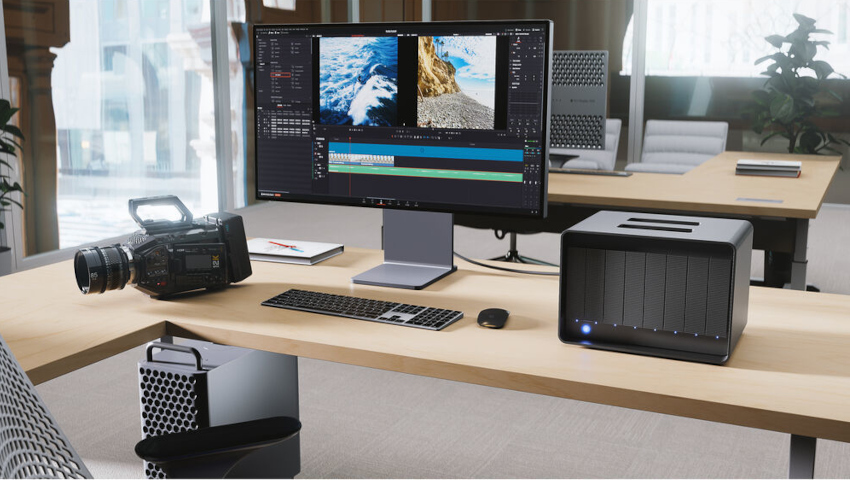
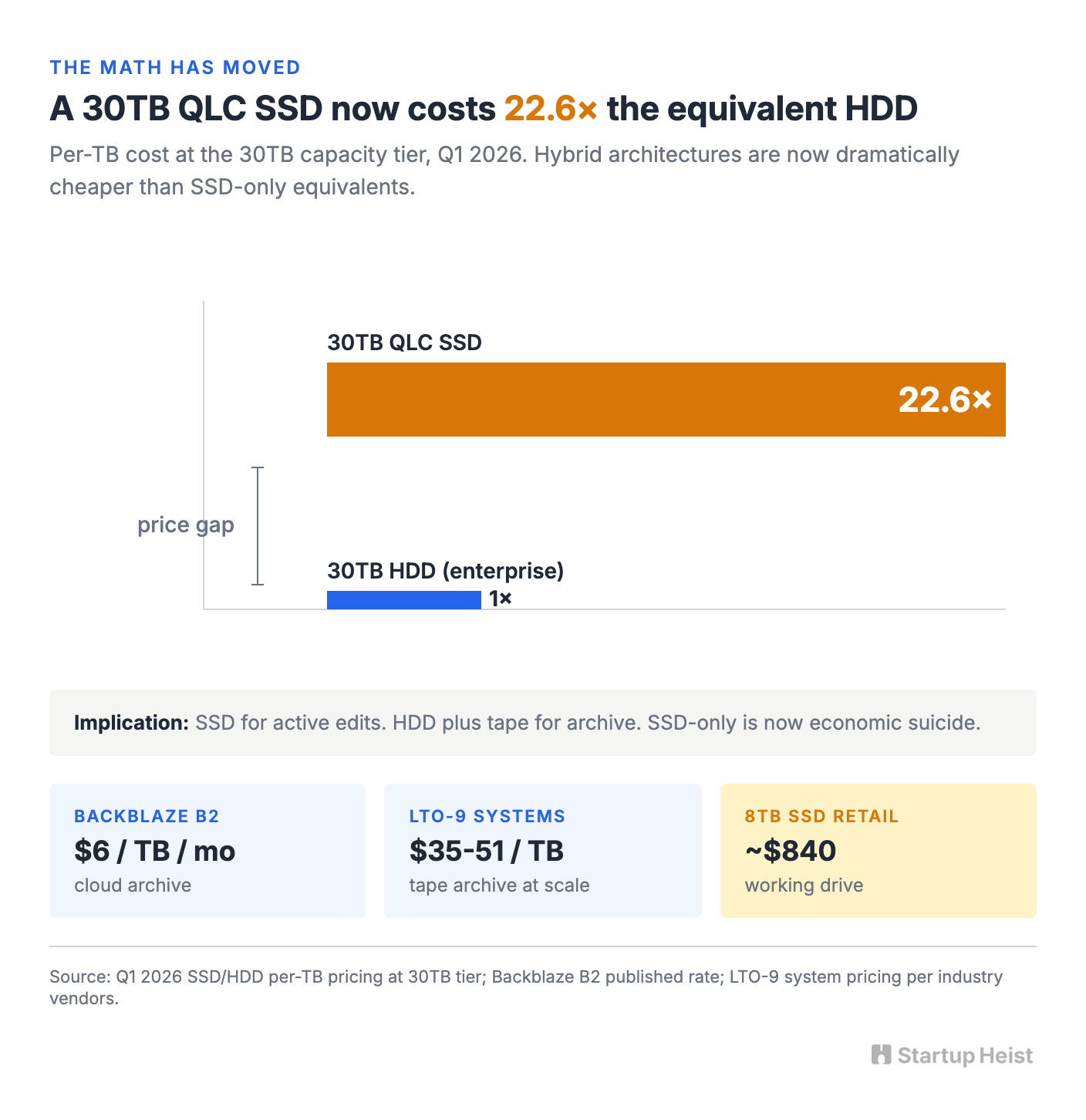
And storage economics flipped. On April 23, 2026, Seagate launched the LaCie 8big Pro5, an eight-bay Thunderbolt 5 RAID array using HAMR enterprise drives, scaling to 256TB and starting at $5,979 for the 32TB base. Professional creative storage is now its own infrastructure category. At the same time, the SSD-to-HDD price ratio has widened sharply. By Q1 2026, 30TB QLC SSDs cost roughly 22.6 times the equivalent HDD capacity. Hybrid architectures, with SSDs for active work and HDDs for archive, are now dramatically cheaper to deploy than SSD-only equivalents. The math has moved.
The pain is real, the market is large, and the category is still too unglamorous for most software founders to want it. Good. That's the room.
The Problem Hiding in Plain Sight
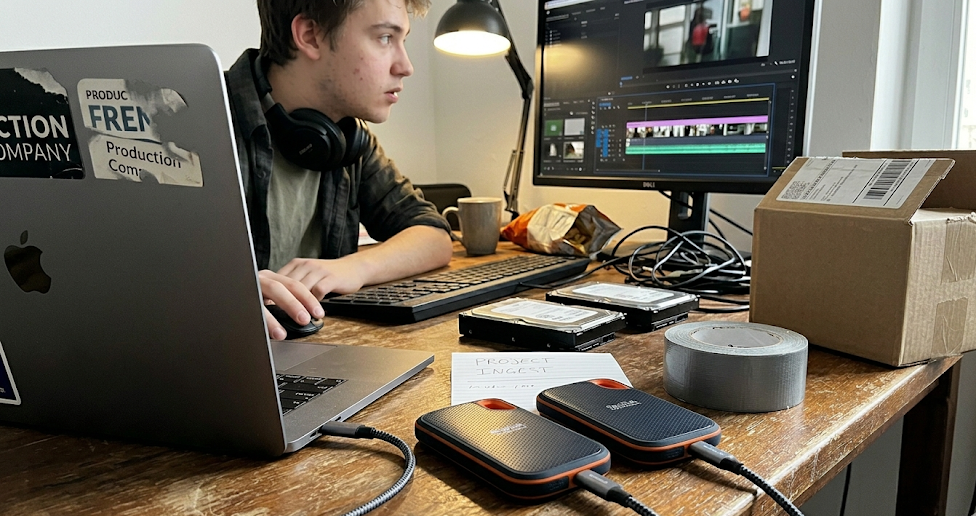
Every high-volume creator runs the same broken video storage workflow. They shoot. They dump footage onto an external SSD. They edit from that SSD because local storage is still the practical way to handle large video files. They back up to a second drive if they're disciplined. They upload selects or proxies to Frame.io, Dropbox, or a client portal. The project ends, and the question begins.
The footage can't be deleted. A client may come back six months later. A YouTube creator may need B-roll from an old shoot. A documentary team may have legal or insurance reasons to preserve source media. So the drives pile up. One says "Japan shoot March." Another says "Podcast clips maybe." Another is mystery duplicates. The creator doesn't have a media archive. They have an archaeological site.
Cloud software doesn't solve this. Editing large video files directly from the cloud is still throttled by bandwidth, latency, egress economics, and reliability. Frame.io is excellent for review and handoff, but its Pro plan tops out around 2TB at $15 per member per month, and its Team plan starts at 3TB for $25 per member per month, plus 2TB per added seat. Useful collaboration software, but not a permanent archive for a studio generating terabytes every month.
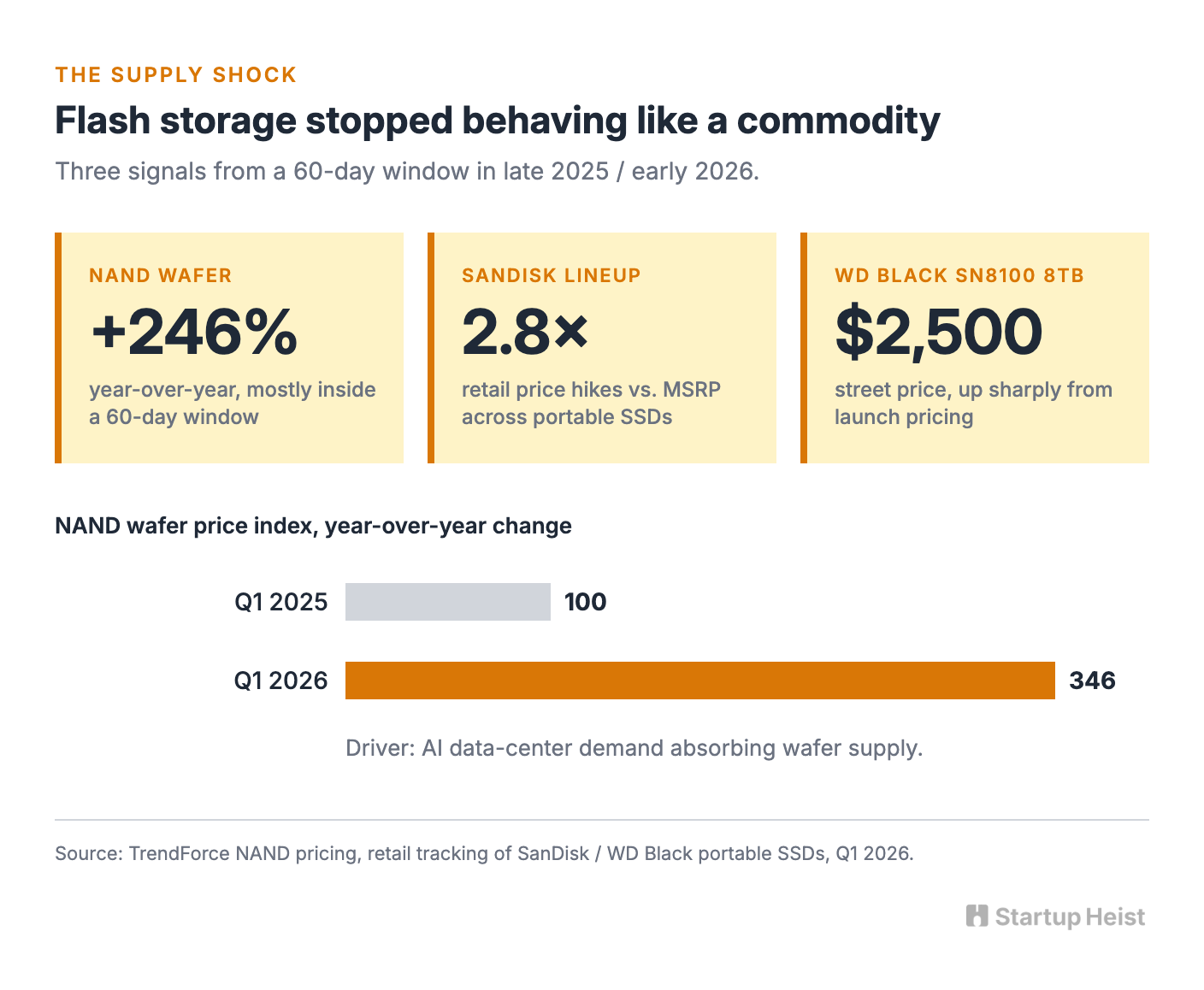
Buying more SSDs hurts more than it used to. The 8TB SanDisk Extreme Portable has hovered around $840 retail for the previous-gen model through 2026, and the broader SanDisk lineup has seen price hikes of up to 2.8x MSRP, with the WD Black SN8100 8TB clearing $2,500. NAND wafer prices have jumped roughly 246 percent year over year, mostly in a 60-day window driven by AI data-center demand. Flash storage has become a commodity that no longer behaves like one.
Creators need fast local storage for active work, cheap durable storage for finished work, retrieval without chaos, and zero desire to become storage administrators. There's a business sitting in that gap.
The Product: Fast Drives, Permanent Archive, No Drive Graveyard
The wrong version of this idea is SSD-as-a-rental. Pay $99 a month, we ship you an 8TB drive, send it back when full. Sounds clever. Loses money quickly, and creates serious liability. Drives are too expensive to amortize casually. Shipping eats margin. Drives get lost, damaged, or returned late. Worse, rotating used drives between customers introduces security risk no studio with NDA work will accept.
The right version is a hybrid post-production storage service. A creator subscribes. You ship them one or more encrypted 8TB working SSDs. They edit locally. When a drive fills up, they request a swap. You ship a fresh encrypted drive plus a return kit. They send the full drive back. You ingest the footage into managed cold storage, verify the upload, maintain redundant copies, and make the archive browsable in a simple dashboard. Retrieval happens three ways: download individual files or proxies, request a restored project folder shipped on SSD, or upgrade to a studio plan with on-site NAS or multi-drive rotation.
The positioning fits on a card: fast drives for current work, permanent archive for old work, no more drive graveyard. Backblaze B2 sells raw cloud storage at $6 per TB per month with free egress up to 3x monthly storage. You aren't trying to undercut that. You're wrapping it in a managed workflow creators will actually pay for, because they want fewer decisions, not another dashboard.
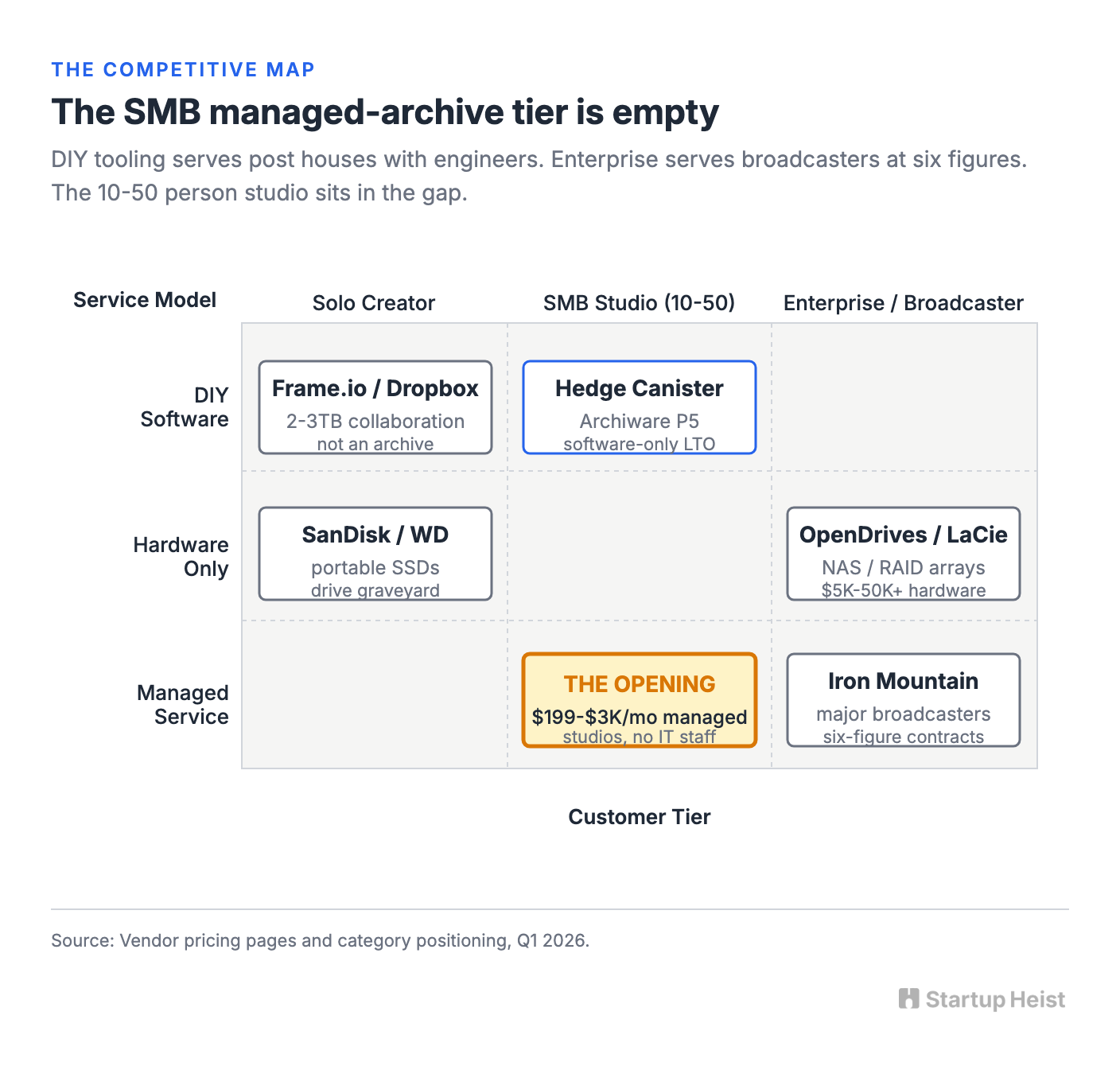
Adjacent tools cover slices of this problem. Hedge Canister sells DIY LTO archive software for post houses. Archiware P5 plays the same role for enterprise NAS-plus-tape setups. MASV moves large files between collaborators at $0.25 per GB. OpenDrives sells high-performance NAS to Hollywood post starting under $50K. Iron Mountain runs managed archives for major broadcasters and was just named Google Cloud's 2026 Partner of the Year for Media and Entertainment. None of them serve a 12-person video agency that just wants someone to show up, take the drives, and never lose anything. The DIY tier is software-only. The enterprise tier starts at six figures. The SMB tier is empty.
The Wedge: Studios, Not Solo YouTubers
The obvious customer is the solo creator drowning in SSDs. The obvious customer is also the wrong first customer. Solo creators are emotionally appealing and operationally messy. Some shoot constantly. Some upload monthly. Some abuse unlimited plans. Some treat your SSD like a rental car.
Unlock the Vault.
Join founders who spot opportunities ahead of the crowd. Actionable insights. Zero fluff.
“Intelligent, bold, minus the pretense.”
“Like discovering the cheat codes of the startup world.”
“SH is off-Broadway for founders — weird, sharp, and ahead of the curve.”


