


Apple Just Turned App Store Creative Into an Operations Problem
The heist: build the campaign operating system mobile agencies will need this fall, when one App Store promotion suddenly means dozens of assets, languages, placements, approvals, and review states.
On August 5, 2026, Apple published a two-paragraph note for developers with a boring headline: get ready for new creative assets on the App Store. It linked to a best-practices page and free design templates for Figma, Photoshop, and Pixelmator, and told everyone to start planning before the fall launch. It was a reminder rather than news. Apple announced the expansion back in June 2026, so the deadline has been sitting in plain sight for two months.
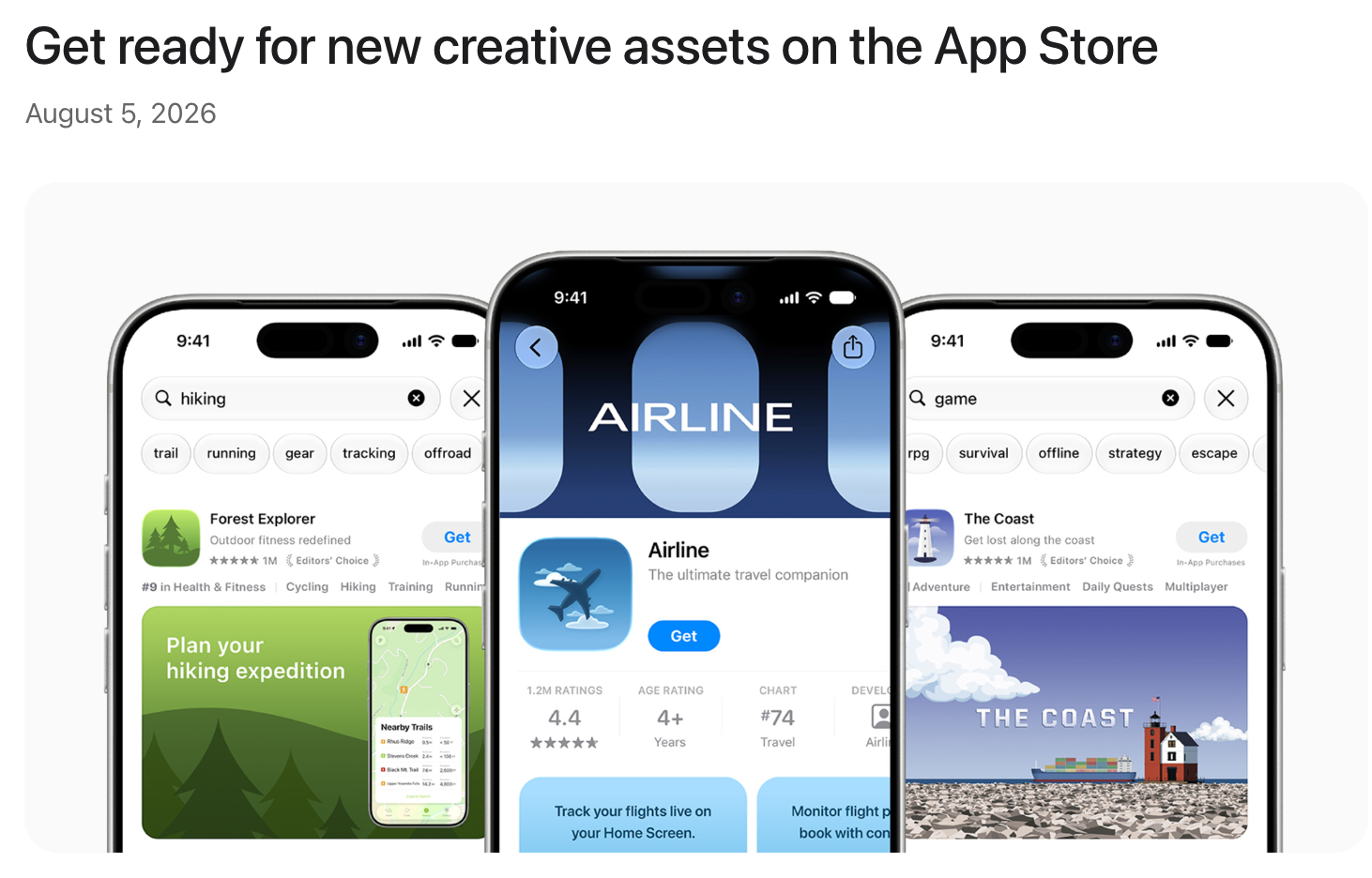
It reads like a design chore. New artwork required, add it to the Q3 queue, move on.
What Apple actually did was separate creative deployment from software deployment. That creates a coordination problem, and nothing in the current mobile marketing stack was built to hold it.
The opening is in the coordination layer:
The money: 60 agencies at $299 to $599 a month is roughly $25K MRR. Agencies already pay $1,000 to $5,000 monthly for creative production by hand.
Inside:
• Five-object data model and v1 module map
• Placement matrix that reads like a tower
• Apple's asset rules turned into preflight checks
• Three-tier pricing plus setup-fee logic
Apple unbundled creative from code
Apple's own materials spell out what ships this fall.
Creative Assets are rich images and videos that, unlike screenshots, do not have to show the app in use. They can carry a brand, a season, a feature launch, or new content. Apple's framing is that you can now "go beyond showing your apps and games in use," and it lists the placements as your product page header, search results, In-App Events, and more, across the App Store and the new Apple Games app.
Alongside them comes the Asset Library: one place in App Store Connect holding every image, video, app preview, and screenshot, with a record of where each one is eligible to appear. Assets get reused across custom product pages instead of re-uploaded, and can be tested through Product Page Optimization or pulled into an Apple Ads campaign.
The load-bearing detail is the submission flow. In Apple's WWDC26 session on the topic, the instruction is explicit: you submit creative assets standalone, without updating your version, and without declaring where you plan to use them. Approved assets then wait in the library. Apple's demo swaps a summer hiking header for an already-approved winter one and publishes straight to the App Store, with no new build and no second review. You can also upload and submit to the Asset Library through the App Store Connect API, which is the sentence anyone building software here should underline.
For a decade, App Store creative moved at the speed of engineering. A marketer wanted a new header, design produced it, it rode along in the next binary submission, and it went live whenever the release did. The mobile growth agency Phiture maps that old chain the same way: identify a creative change, design produces assets, assets go into the next app submission, engineering submits a build.
That chain is cut. Creative now moves on its own clock, which turns it from a deliverable into a campaign.
The matrix nobody has built a screen for
Treated as a graphics problem, this is bigger canvases, more sizes, more exports. The arithmetic says otherwise.
Apple supports 50 App Store localizations. A single app can hold up to 70 custom product pages, double the old ceiling of 35. In-App Events need media in two aspect ratios, 16:9 for the event card and 9:16 for the details page, can be published no more than 14 days before they start, and cannot run longer than 31 days. Creative Assets land in headers, search, and In-App Events, then get reused across the rest.
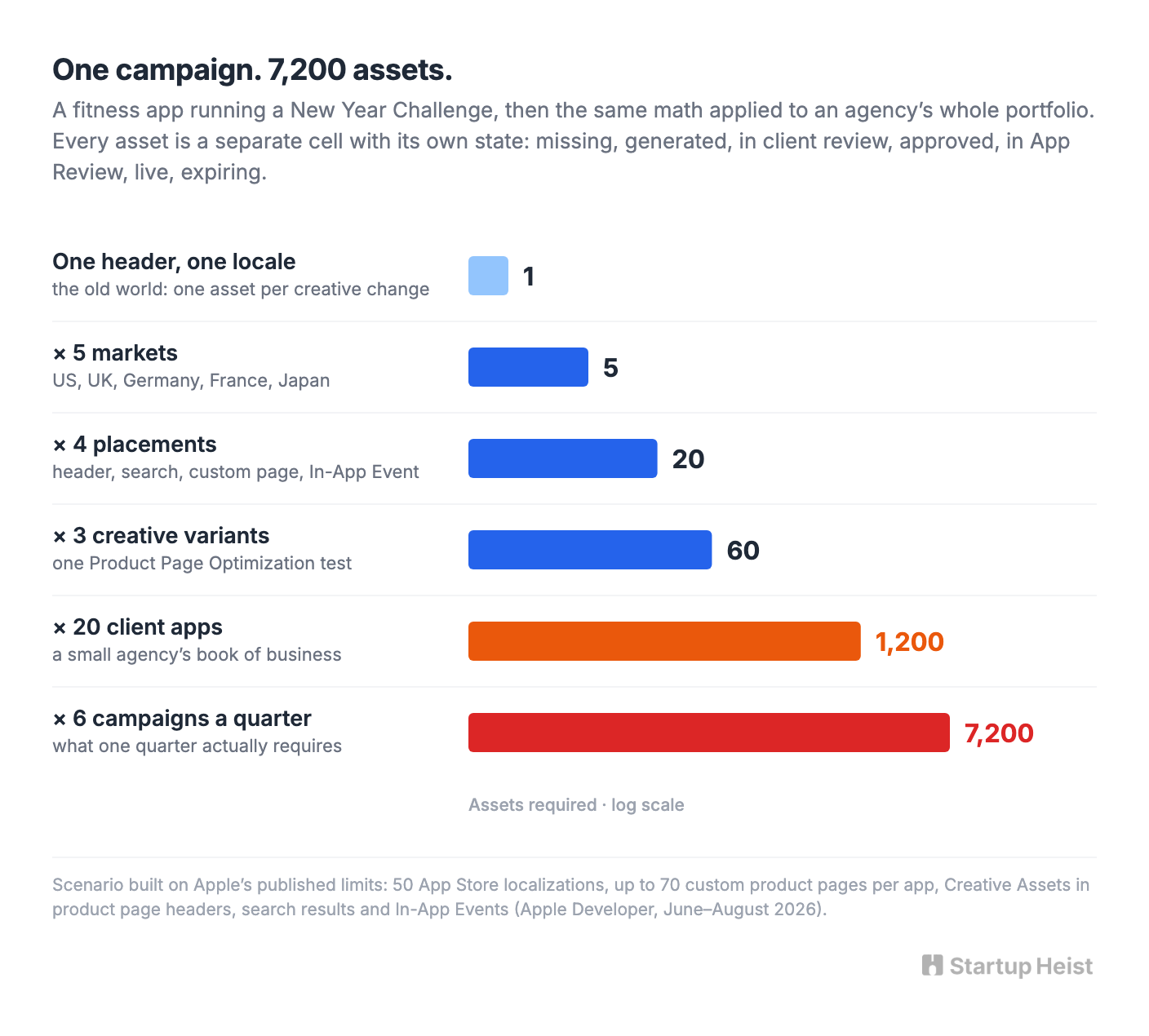
Now give one agency one client and one campaign. A fitness app. New Year Challenge. Five markets: US, UK, Germany, France, Japan. Four placements: product page header, search, one custom product page, one In-App Event. Three variants for a Product Page Optimization test.
What you're producing is a grid, and every cell in it carries its own state.
| Placement | EN-US | EN-GB | DE | FR | JA |
|---|---|---|---|---|---|
| Product page header | Approved | Approved | In App Review | Approved | Approved |
| Search results | Scheduled | Scheduled | Missing | Scheduled | Client review |
| Custom product page | Live | Live | Live | Live | Live |
| In-App Event (16:9 + 9:16) | Approved | Approved | Approved | Approved | 9:16 missing |
Some cells reuse one approved universal asset. Others need a different crop, or translated text that overflows the layout, or a signature stuck in the client's legal queue. One German variant came back rejected. The Japanese copy is on its third revision. The In-App Event dies on January 31, and the client expects the evergreen header restored the next morning.
Multiply that by twenty client apps and six campaigns a quarter. Nobody is holding that in Figma.
The floor is $19 a month, and the ceiling is six figures
Two markets already exist on either side of this problem, and the gap between them is the whole opportunity.
Below it sits App Store screenshot tooling, which is close to free. Screenshots.pro charges $19 a month for its Standard tier and $49 a month for Extended, which adds API access and the right to bill end clients. AppScreens sells its Scale tier for $180 a year with unlimited projects, up to 80 localization languages, and publishing into custom product pages and Product Page Optimization tests. If your pitch is "upload your brand, get every Apple dimension," you are competing against a $15-a-month product and Apple's own free Figma templates.
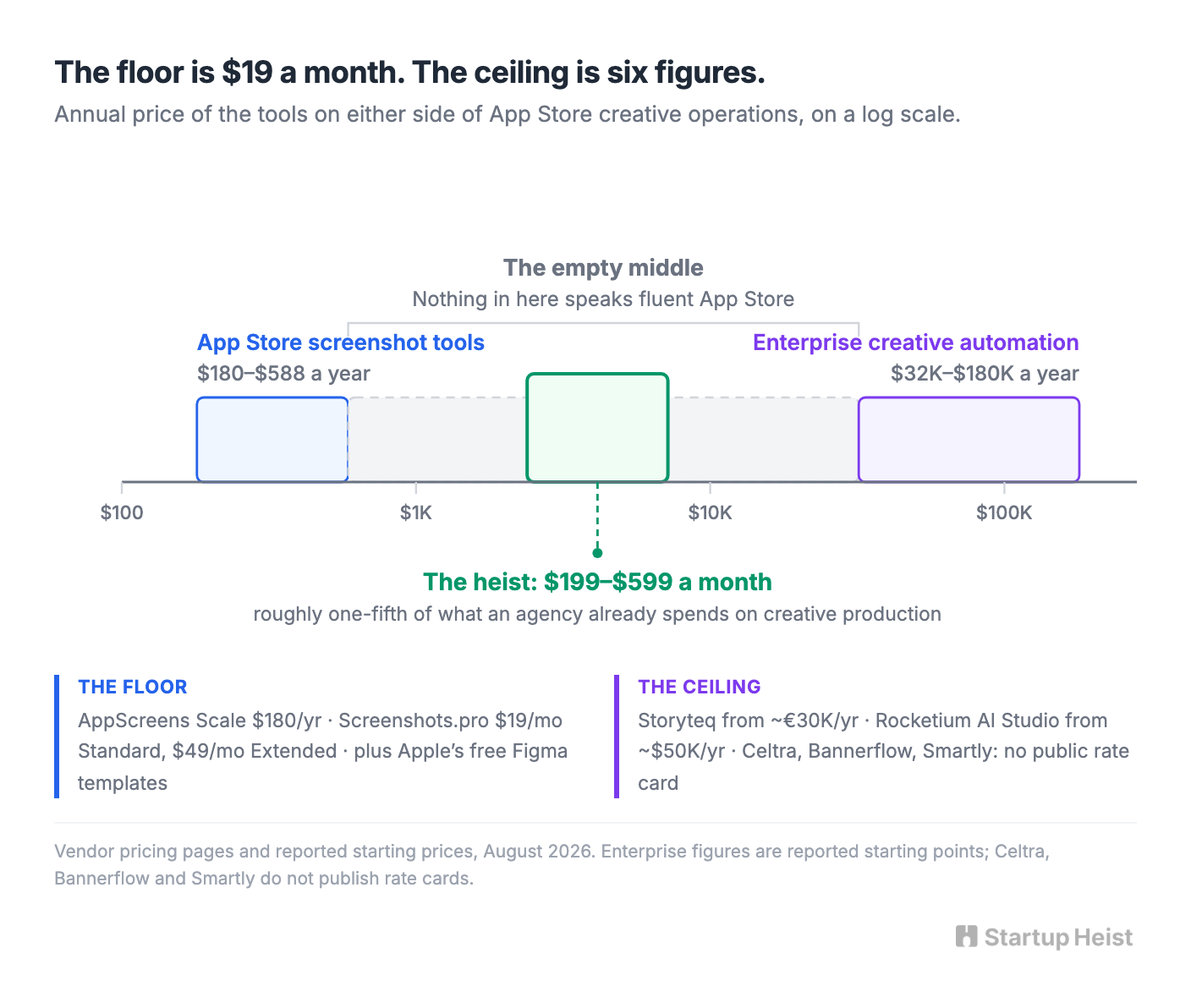
At the other end, enterprise creative automation is priced for the ad industry. Storyteq reportedly starts around €30,000 a year and scales well into six figures. Rocketium's AI Studio reportedly starts around $50,000 annually. Celtra, Bannerflow, and Smartly do not publish rate cards at all. These platforms already do the hard part of this job, turning one master template into hundreds of localized on-brand variants with approval routing on top. They just have no idea App Store Connect exists, and they are sold to global brand teams with six-figure budgets, not to a twelve-person ASO shop in Austin.
Between a $19 screenshot generator and a six-figure creative management platform, there is nothing that speaks fluent App Store.
The buyer already pays for this problem in hours
The money in mobile has shifted from acquisition to conversion, which is exactly the pressure that makes storefront creative worth coordinating.
Sensor Tower's State of Mobile 2026 put 2025 in-app purchase revenue at $167 billion globally, up about 10% year over year, with non-game apps outspending games for the first time on 21% growth. Downloads rose 0.8%, to just under 150 billion. Time spent hit 5.3 trillion hours. Growth is no longer coming from more installs, so it has to come from converting the traffic already arriving at the product page.
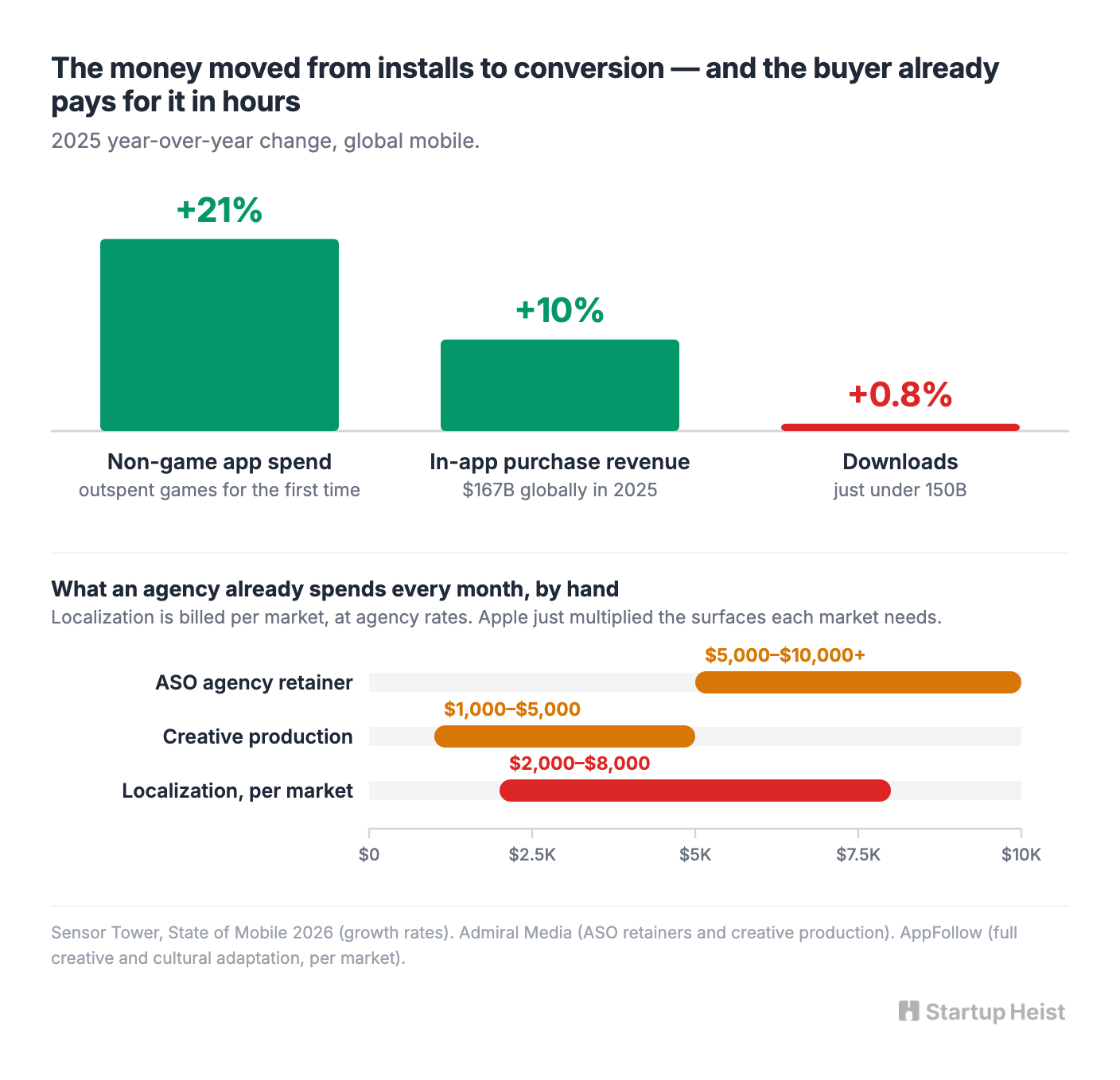
The tooling budget follows. AppTweak lists $79 a month for its entry app store optimization plan, $299 for Grow, and $549 for Grow Plus. SplitMetrics runs its store experimentation platform on quote-only enterprise pricing and advertises more than 30,000 experiments run on it. Admiral Media pegs full-service ASO agency retainers at $5,000 to $10,000 or more per month, with another $1,000 to $5,000 monthly for creative production on top, and AppFollow puts full creative and cultural adaptation at $2,000 to $8,000 per market.
AppFollow's number is the tell. Localization is already being billed by the market, by hand, at agency rates. Apple just multiplied the number of surfaces those markets need.
The product: CreativeOps for the App Store
Start with five objects and let everything else hang off them.
Unlock the Vault.
Join founders who spot opportunities ahead of the crowd. Actionable insights. Zero fluff.
“Intelligent, bold, minus the pretense.”
“Like discovering the cheat codes of the startup world.”
“SH is off-Broadway for founders — weird, sharp, and ahead of the curve.”


