


The $100 Particle Detector Needs a Teacher Ops Layer
On September 17, 2026, the University of Delaware announced the newest version of CosmicWatch, a desktop cosmic-ray detector that costs about $100 in parts. Spencer Axani, the assistant professor of physics who leads the project, put the old alternative plainly: "A typical undergraduate physics lab course uses a rack of electronics about the size of a small bookshelf to measure muons." CosmicWatch fits in your hand.
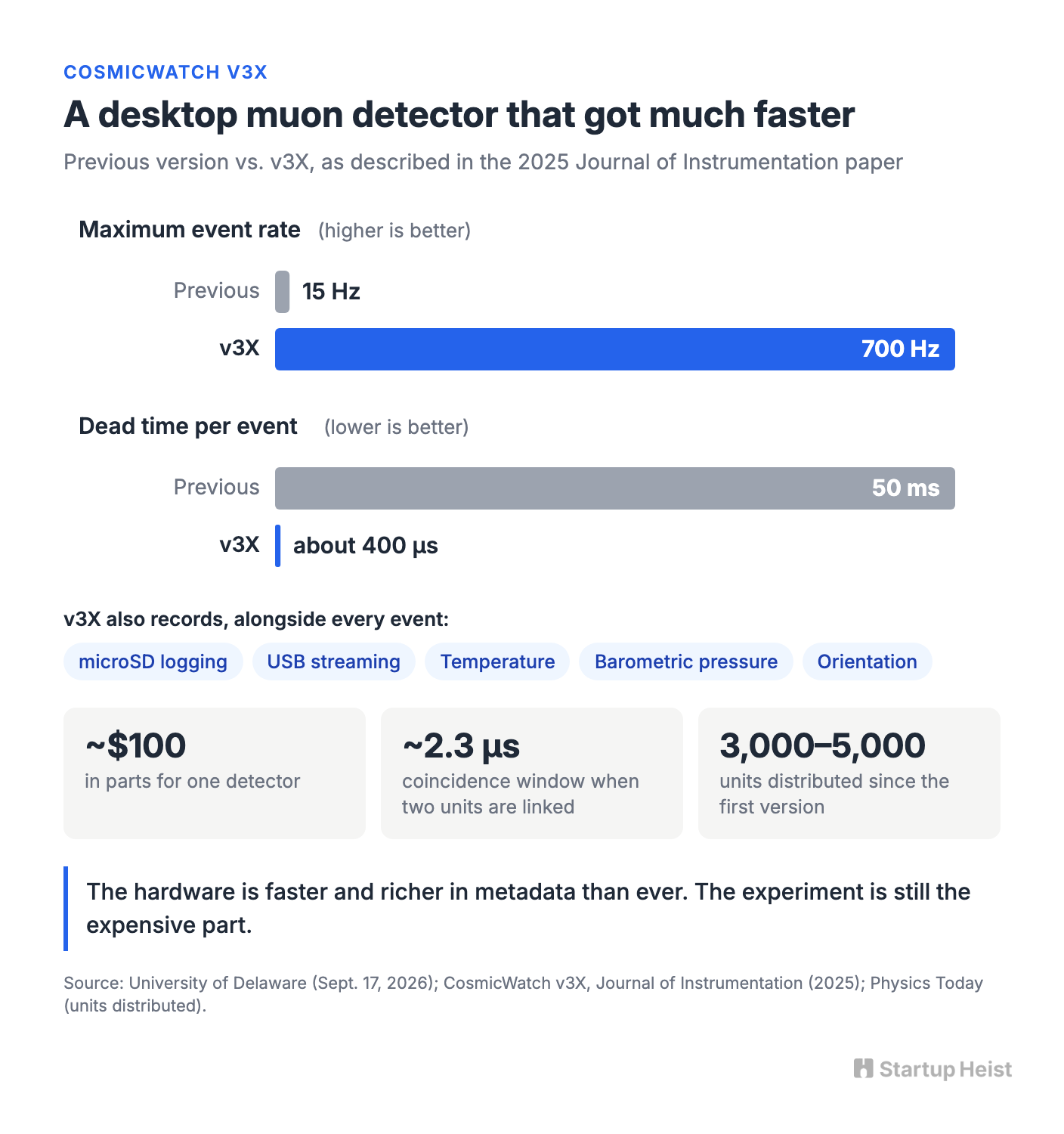
The device pairs a plastic scintillator with a silicon photomultiplier and a small board of electronics. When ionizing radiation passes through, it logs an event. Link two units with an Ethernet cable and the pair flags events that hit both within about 2.3 microseconds, which suppresses background radiation and picks out cosmic-ray muons raining down from the upper atmosphere. The v3X version, described in a 2025 Journal of Instrumentation paper, logs to a microSD card, streams over USB, and records temperature, barometric pressure and orientation alongside every event. Its maximum event rate jumped from 15 Hz to 700 Hz, and dead time per event fell from 50 milliseconds to about 400 microseconds. Physics Today puts the number of units distributed since the first version at 3,000 to 5,000.
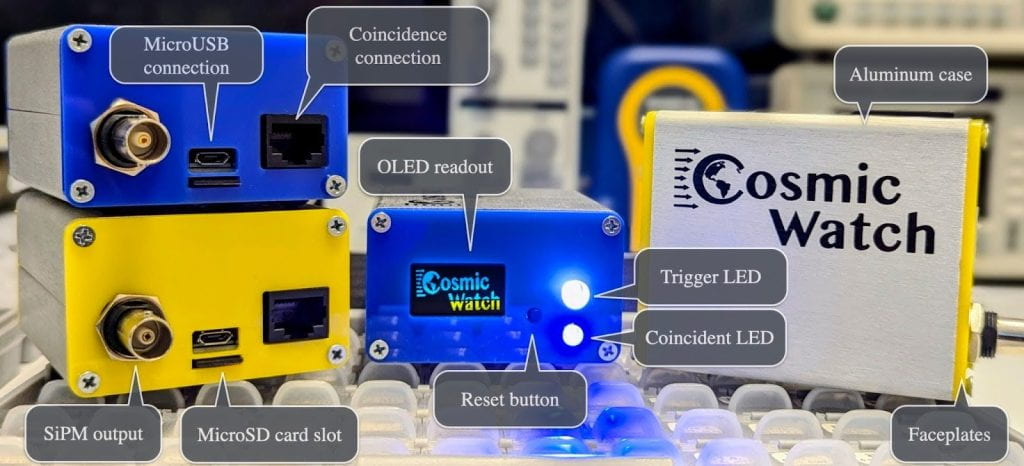
It's remarkable hardware, and the obvious ways to sell it are already taken. The design is licensed Creative Commons Attribution-NonCommercial, and the project's repository says commercial use and redistribution require the author's explicit permission. Fully assembled units already sell for $299, or $499 for a pair. QuarkNet, the national physics outreach program, has published a full Cosmic Watch lab suite for high schools. The open lane sits between the box and the bell: a teacher-ready operating layer for high school physics labs that guarantees the experiment works in class on Thursday morning. Think of a specialist business doing $5K-$15K a month, with services funding the early years and software renewals compounding behind them.
Here's the business in brief:
The money: 250 school renewals at $199/year plus bundles and onboarding comes to about $8,350 a month. Thousands of CosmicWatch units are already in circulation.
Inside:
• Detector Passport QA plus three guided labs
• Data-only entry product, no hardware needed
• Five-tier pricing, from $79 labs to $749
• 30-day plan and the founding-school email
The Detector Is Cheap. The Experiment Is Expensive.
On the CosmicWatch website, a teacher sees a $100 detector. Once the box is on the lab bench, the same teacher faces a stack of decisions. Is this unit working properly? What threshold should I set? Do students need singles or coincidences? Why does one detector read differently from the other? How long do we collect? What does this column mean? Are these counts actually muons? Can we finish in two class periods, and what do we do with the data afterward?
QuarkNet has documented this gap from the inside. When it built 48 Cosmic Watches to test in high school labs, its team wrote that for teachers planning a student activity, "reliability and ease of use are critical," and that the units had to be tested in schools before the construction process and documentation could be improved. At QuarkNet's Virginia Tech center workshop, held July 30 to August 1, 2025, physics teachers spent the sessions building and testing Cosmic Watches before they planned classroom activities, and workshops at the Rice and Hawaii centers featured the detector the same year.
Academic programs are built around access and scientific learning, which leaves room for a commercial product built around the teacher's time. Picture the lab from the teacher's side: the data file goes up at 7:45 a.m., and the teacher knows exactly what will happen during third period.
The Network Is the Wrong Startup
The seductive pitch is a nationwide map of school detectors, with students in Pennsylvania comparing readings against students in Colorado. The CosmicWatch team wants this too. The v3X paper describes plans for a citizen-science network to map Earth's ionizing radiation, with GPS and wireless expansion modules on the roadmap. The concept has a long track record. QuarkNet's Cosmic Ray e-Lab has let schools upload detector data to a shared portal for years, including schools with no detector at all, and it maps to every NGSS science and engineering practice. In Europe, HiSPARC had roughly 140 school-hosted stations across the Netherlands, the United Kingdom, Denmark and Namibia by 2019. The educational case is proven. Nobody has shown that teachers will pay a new vendor every year for prettier pins.
A naive network also teaches bad science. A single CosmicWatch detects all ionizing radiation, including local background, and its readings shift with threshold, orientation, geometry, optical coupling, shielding and weather. One physicist told Physics Today that classroom programs should "stress the student experience, and not to place expectations on scientific output," because atmospheric and environmental effects make significant results hard to reach. Put 200 poorly characterized detectors on a map and you get 200 incomparable numbers.
What schools would actually value is comparability, and that's a quality-control problem someone has to own before any map means anything.
The Market Is Real and Small
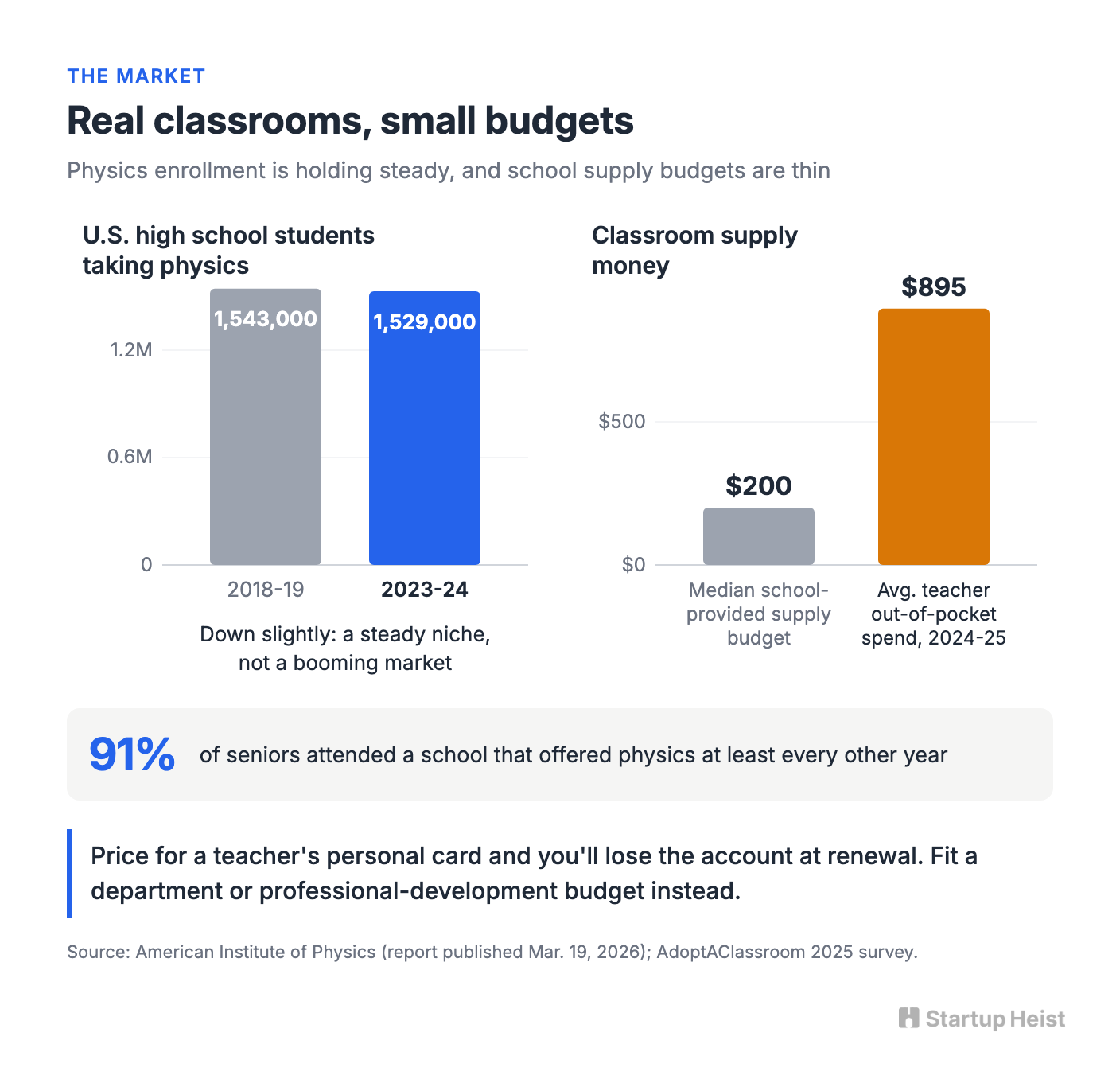
Skip the giant STEM-education TAM. The American Institute of Physics, in a report published March 19, 2026, counted 1,529,000 U.S. high school students taking physics in 2023-24, down slightly from 1,543,000 in 2018-19. Ninety-one percent of seniors attended a school that offered physics at least every other year. That's plenty of classrooms for a niche edtech business and zero evidence of a booming one.
Unlock the Vault.
Join founders who spot opportunities ahead of the crowd. Actionable insights. Zero fluff.
“Intelligent, bold, minus the pretense.”
“Like discovering the cheat codes of the startup world.”
“SH is off-Broadway for founders — weird, sharp, and ahead of the curve.”


