


The AI Onboarding Layer for Main Street
The next AI opportunity isn't another chatbot.
It's the person who walks into a fifteen-person HVAC shop, a busy med spa, a boutique accounting firm, or a thirty-person landscaping outfit and says: "You already pay for QuickBooks, Google Workspace, HubSpot, PayPal, DocuSign, Canva, your booking system, and a closet full of half-used software. I'm going to connect the pieces, install the workflows, train your team, and make AI useful by next Friday."
Anthropic just lit the runway for exactly that wedge.
Here's the opportunity:
The money: Thirty premium clients at $299 a month plus $3,500 setup is roughly $9K MRR and $105K in setup revenue. A solo founder business with room to compound.
Inside:
• First-vertical pick: med spa vs HVAC
• Five-workflow installed pack, ten-day delivery
• Template vs premium pricing model breakdown
• Six-week MVP plan and founder-batch GTM
On May 13, 2026, Anthropic launched Claude for Small Business. The release plugs Claude into the tools most SMBs already use (QuickBooks, PayPal, HubSpot, Canva, DocuSign, Google Workspace, and Microsoft 365) with fifteen prebuilt skills covering payroll, bookkeeping reconciliation, marketing campaigns, employee onboarding, and operational reporting. It rides inside Claude Cowork, the company's multi-agent knowledge-work surface. Starting May 14, Anthropic kicked off a ten-city training tour through Chicago, Tulsa, Dallas, Hamilton Township NJ, Baton Rouge, Birmingham, Salt Lake City, Baltimore, San Jose, and Indianapolis, offering free half-day workshops for 100 local owners per stop. The company also co-published a free AI Fluency course with PayPal aimed squarely at Main Street.
For a buyer most enterprise AI vendors have ignored, that's a massive distribution effort. It also exposes the gap.
Small businesses don't need more AI access. They need implementation. They need someone to decide which workflows matter, wire the tools together, write the prompts, set the permissions, build the human-approval steps, record the Loom videos, and come back every quarter to clean up the mess. Anthropic is shipping the engine. Nobody is shipping the install.
So here's the heist: build vertical-specific AI onboarding for one SMB category. "AI consulting" is too vague. "AI workflow automation" is too generic. The product is a pre-packaged small business AI implementation built around the tools that business already uses.
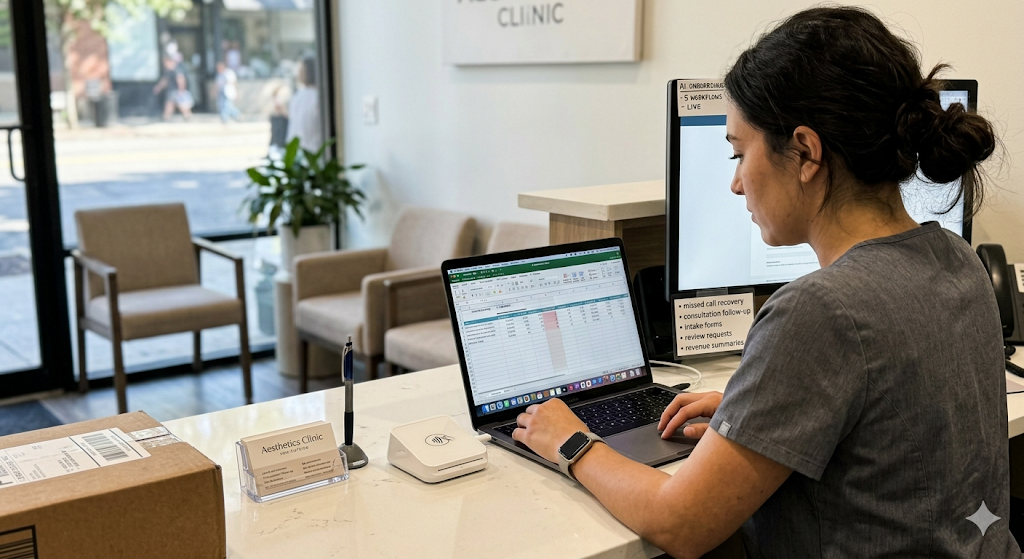
For med spas, that means missed-call recovery, consultation follow-up, intake form prep, review requests, no-show recovery, dormant client reactivation, and monthly revenue summaries. For HVAC contractors, it means quote follow-up, service reminder campaigns, invoice nudges, job-note summaries, technician-to-office handoffs, and emergency lead triage. For boutique professional services, it means client intake, proposal drafting, document chasing, renewal reminders, and meeting summaries.
The market isn't "AI." The market is operational drag. And operational drag is everywhere.
The Signal Is in the Money
The interesting number isn't adoption. It's conversion.
Salesforce reports 75% of SMBs are at least experimenting with AI, and 91% of small businesses using AI say it boosts revenue. The 2026 U.S. Chamber outlook adds a sharper edge: 83% of growing SMBs have adopted AI compared to 55% of declining ones. AI is now correlated with whether a small business is climbing or sinking. Owners have stopped asking what AI is and started asking what it should do for them on a Tuesday.
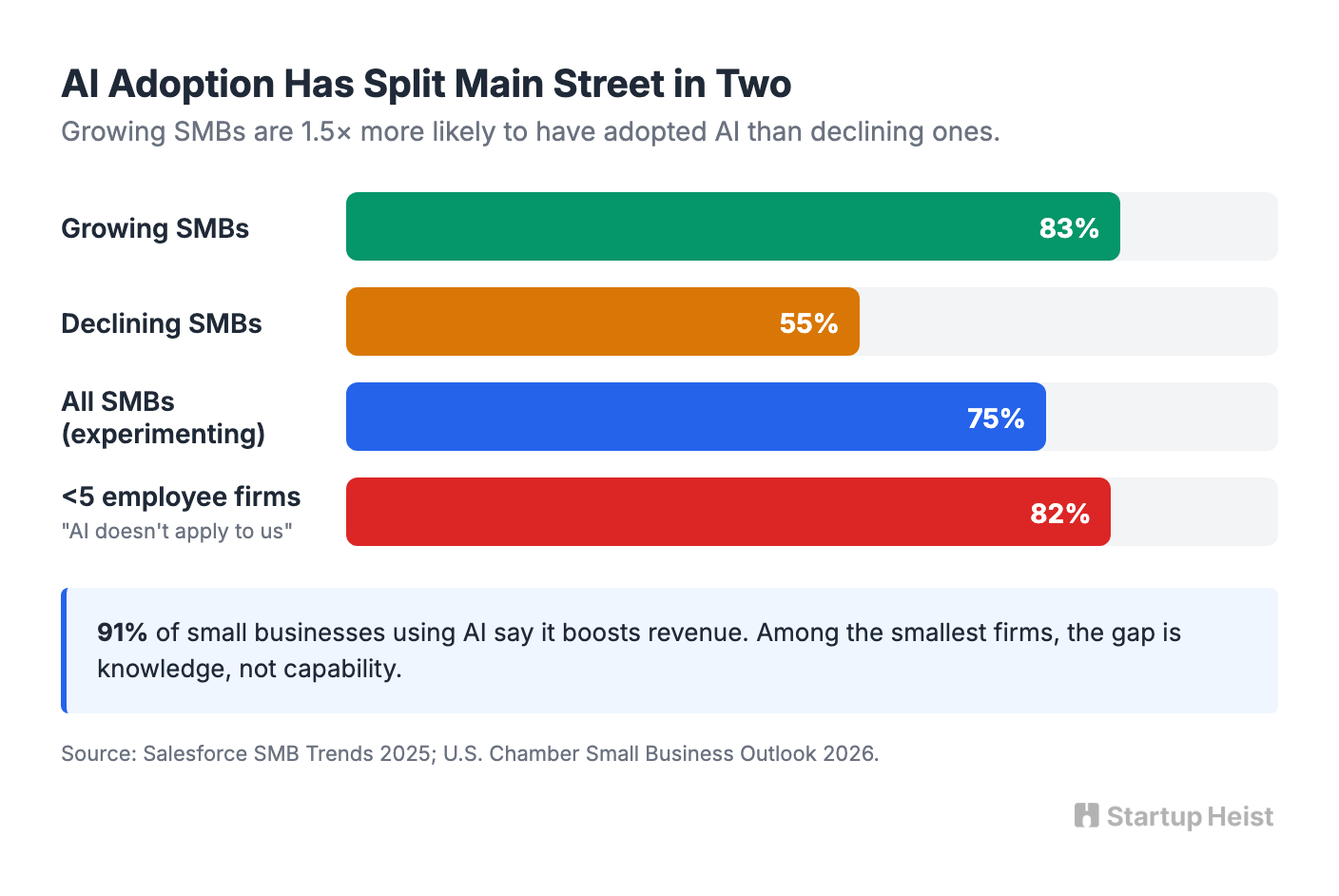
Adoption is uneven, though. Roughly six in ten cite cost as the top barrier. More than half cite lack of expertise. Four in ten cite data quality. Among very small firms with under five employees, 82% still believe AI doesn't apply to their work, which is a knowledge gap rather than a capability gap. Owners aren't lazy. They're running payroll and chasing invoices and onboarding the new tech and putting out fires in the back room. They don't have a free afternoon to evaluate three CRMs and an automation platform.
When a market has high interest and low implementation capacity, the early winner is rarely software. It's a packaged service that feels like software: installed in days, priced like a subscription, owned by someone whose job is to make it run.
Why the Big Labs Are Doing You a Favor
A solo founder shouldn't try to outbuild Anthropic, Google, Microsoft, or OpenAI. That's suicide.
The wedge is the last mile.
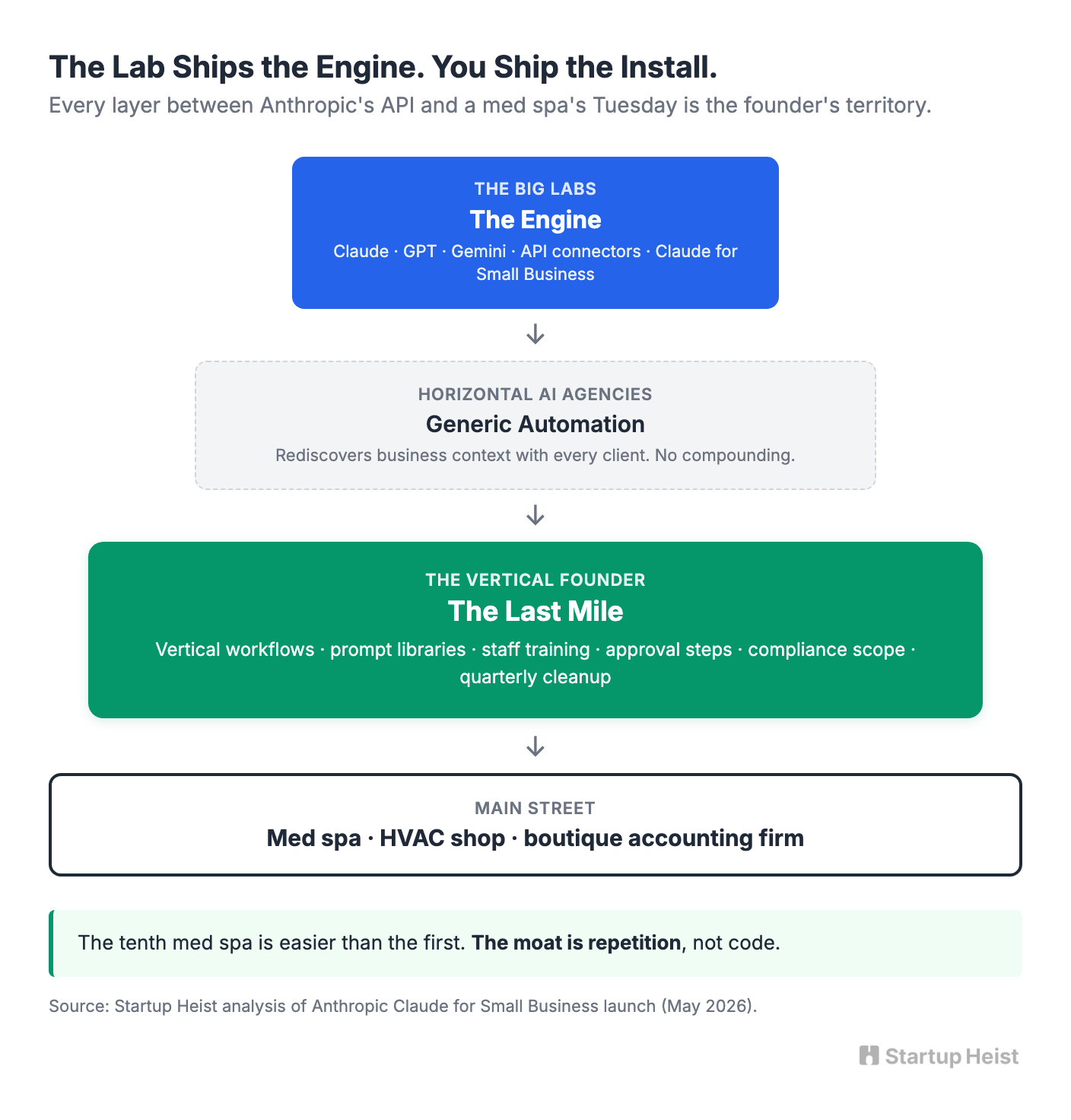
Claude can talk to QuickBooks, but it doesn't know how a specific med spa handles Botox consults, no-show deposits, review timing, contraindication forms, or the front-desk script when a lead calls during a treatment. Claude can read Google Workspace, but it doesn't know the HVAC owner's quoting process lives in a tangle of Gmail, ServiceTitan exports, technician notes scribbled on iPads, and the office manager's memory. Claude can generate copy, but it doesn't know which message to send two hours after the appointment, which to hold for three days, which to require human approval, and which to never automate because it brushes against protected health information.
That last-mile knowledge becomes the product. The AI lab supplies the engine. The founder supplies the playbook. A generic automation agency rediscovers the business context every time. A vertical AI agency gets faster with every client. The tenth med spa is easier than the first. The fiftieth HVAC contractor is easier than the tenth. The workflow library compounds.
The real moat isn't code. It's repetition.
The Best First Vertical
Three obvious candidates: med spas, HVAC contractors, and boutique service businesses.
The weakest is "boutique service businesses." It sounds appealing because it's broad, but broad is usually a trap. Workflows vary too much across law firms, bookkeepers, and consultants. The pain is real but isn't standardized. You'll drown in customization on the first ten clients.
Med spas are the cleanest fit. They're appointment-driven, high-touch, local-search-dependent, and already software-aware. They care about no-shows, intake forms, rebooking, reviews, treatment follow-up, and high-value consult conversion. Industry analysts at Software Advice report that medical spa buyers rank appointment scheduling, rescheduling, and follow-up as critical features, and that small-to-midsize spas need client management, staff management, scheduling, and payment processing in one operational flow. The stack is fragmented (Mindbody, Jane App, Vagaro, Boulevard, Zenoti, AestheticsPro, PatientNow, HubSpot, Mailchimp, Klaviyo, JotForm, Typeform, DocuSign, Twilio, Google Business Profile) and that fragmentation is exactly the job. Connect what they already use. Make it run.
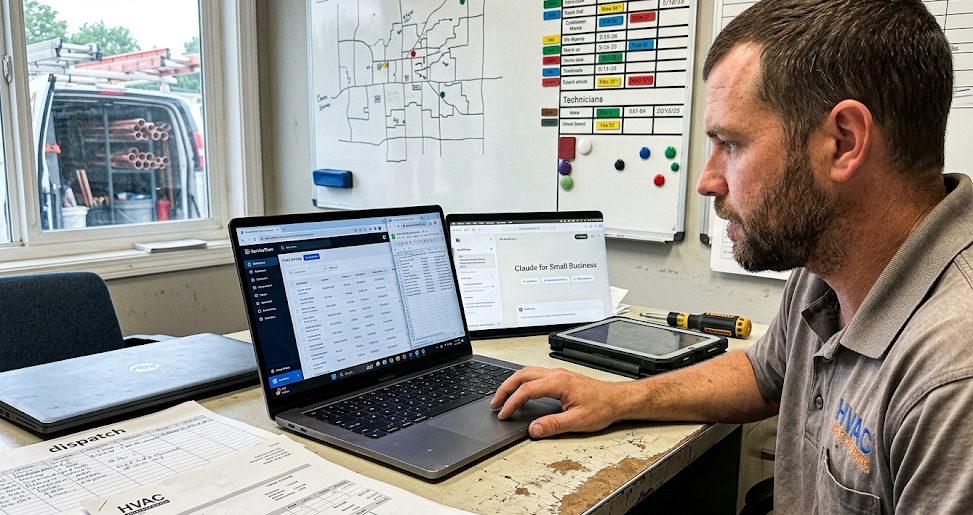
HVAC is the heavier opportunity. Average job value is higher, speed-to-lead matters more, and seasonal maintenance reminders convert. The challenge is operational complexity: dispatch, technician notes, emergency calls, parts inventory, invoicing, and field-service software all collide. HVAC rewards a premium implementation model. It punishes a lightweight template.
The cleanest move: med spas if you want a packaged template business. HVAC if you want higher-ticket custom implementation. Med spas have a better "workflow pack" shape. HVAC has a better "ROI guarantee" shape. Pick one.
The Product and the Pricing
The product shouldn't be "we help your business use AI." That sounds like homework. Sell it as an installed pack.
The Med Spa AI Front Desk Pack. Installed in ten business days. Works with the booking, email, SMS, intake, and CRM tools the client already uses. No platform migration.

Twenty workflows live in the long-term roadmap: new lead triage, missed-call response, consultation follow-up, appointment confirmation, 48-hour and same-day reminders, no-show recovery, intake form chase, pre-visit prep, post-treatment care, review request sequence, lapsed client reactivation, birthday and anniversary offers, treatment-interest tagging, monthly lost-lead report, staff FAQ assistant, Google review reply drafts, promotion copy, social caption drafts, and an owner dashboard summary.
Don't start with twenty. Start with five. New lead follow-up. No-show recovery. Intake form prep. Review requests. Lapsed-client reactivation. That's enough to sell, and enough to deliver in a week without setting your hair on fire. A med spa doesn't need an AI transformation. It needs to stop losing money in the cracks.
On pricing, the instinct to charge $499 setup plus $99 a month isn't terrible. It's also fatal. Too expensive to feel like a simple template, too cheap to support real custom work. That middle zone has killed more service businesses than any market downturn.
The data backs the split. Done-for-you AI intake services already run around $649 setup plus $59 a month for a single managed workflow, based on current market offerings. Full AI automation agencies routinely charge $2,500 to $15,000-plus for setup, with retainers between $500 and $5,000 per month. CFO-style breakdowns put a 1-to-2-workflow "starter" build at $1,000 to $3,500, a 3-to-6-workflow "growth system" at $4,000 to $12,000, and a 6-to-15-workflow "ops overhaul" at $12,000 to $35,000-plus. The honest market has two tiers. Pick one.
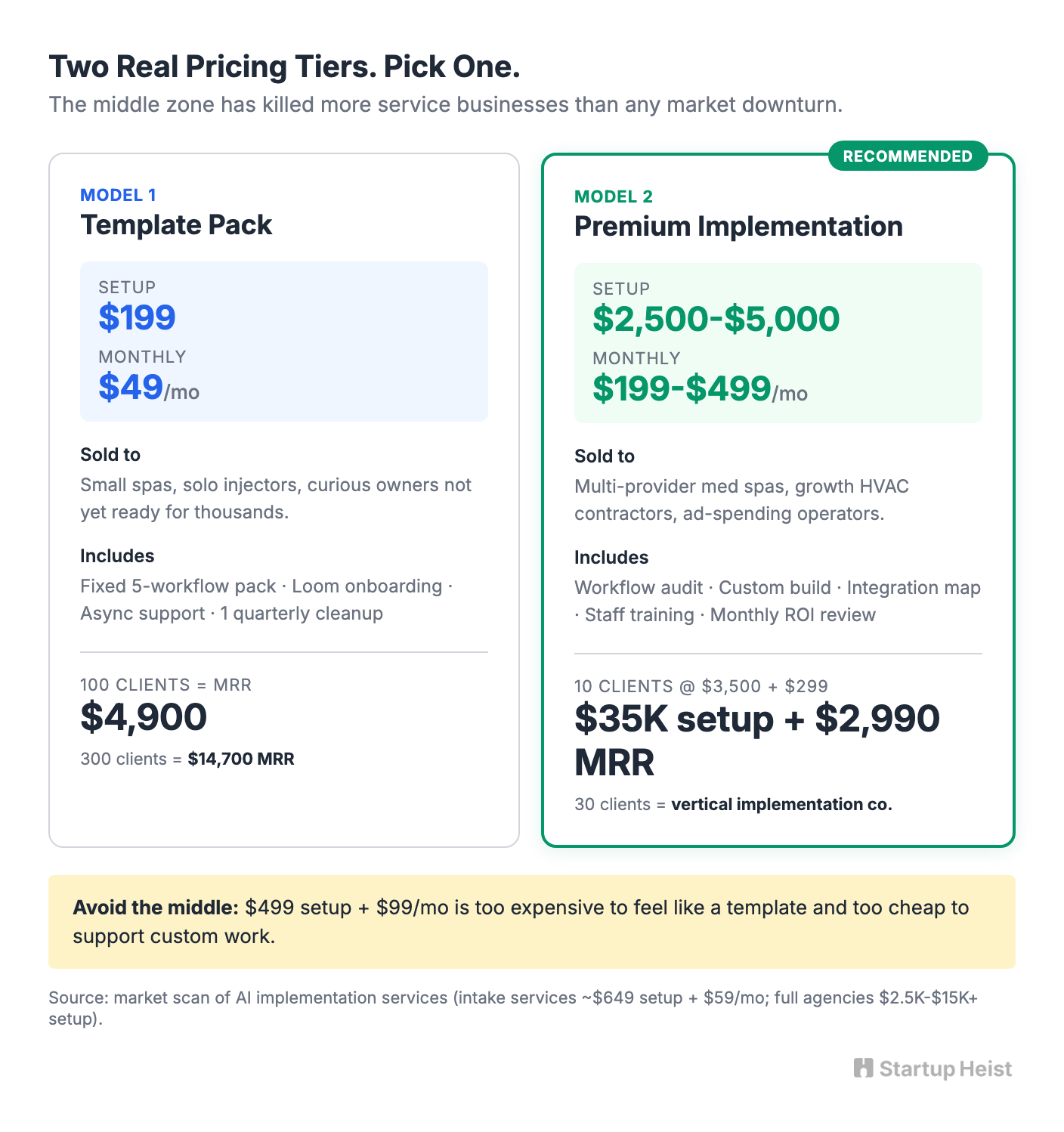
Model 1, the Template Model. $199 setup. $49 a month maintenance. Optional $99 growth tier. Optional $249 workflow add-on packs. Sold to small spas, solo injectors, beauty clinics, and curious owners who aren't yet ready to spend thousands. They get a fixed workflow pack, Loom onboarding, async support, and one quarterly cleanup. The pitch: "We install five AI-assisted workflows in one week so your front desk follows up faster, asks for reviews consistently, and stops chasing everything manually." One hundred clients at $49 a month is $4,900 in recurring revenue before add-ons. Three hundred is $14,700. Real money for a solo founder, but only if you behave like a product company: one vertical, five workflows, approved stack, no custom API work, no migrations, no medical decisioning, no unlimited support.
Model 2, the Premium Implementation Model. $2,500 to $5,000 setup. $199 to $499 a month monitoring and optimization. Optional performance bonus tied to measurable outcomes. Sold to multi-provider med spas, growth-minded HVAC contractors, local operators spending real money on ads, and businesses where missed leads or no-shows have an obvious dollar value. They get a workflow audit, custom implementation, integration map, staff training, monitoring, monthly reporting, and ROI review. The pitch: "We install the follow-up and recovery system your staff doesn't have time to build. If we don't save or recover at least fifteen hours a month or identify measurable revenue leakage, we keep working until we do." Ten clients at $3,500 setup and $299 a month is $35,000 in setup revenue and $2,990 MRR. Twenty makes a real small agency. Thirty to fifty makes a vertical implementation company with enough data to productize. Premium clients are also less demanding than cheap ones. The $49 customer is nervous, under-resourced, and often unclear about what they bought. The $3,500 customer has decided the problem is worth fixing.
If you can sell, the premium model is the better business.
The Six-Week MVP
Unlock the Vault.
Join founders who spot opportunities ahead of the crowd. Actionable insights. Zero fluff.
“Intelligent, bold, minus the pretense.”
“Like discovering the cheat codes of the startup world.”
“SH is off-Broadway for founders — weird, sharp, and ahead of the curve.”


