


The New Ad Buyer for ChatGPT's Context Layer
OpenAI just turned ChatGPT ads from an enterprise pilot into an open performance channel.
On May 5, 2026, OpenAI opened a beta self-serve ChatGPT Ads Manager to all U.S. advertisers, added cost-per-click bidding alongside CPM, and wired in a pixel with a Conversions API in active rollout for measurement. The original six-figure spend minimum, already cut to $50,000 in April, was removed entirely. Roughly 600 advertisers had been running campaigns through holding companies and ad-tech partners while everyone else waited for the front door to open. The pilot reportedly generated $100 million in ARR in its first six weeks, even at the old floor.
The interesting part isn't another place to buy clicks. It's the new primitive sitting inside the platform: targeting by conversation. Google trained advertisers to think in keywords. Meta trained them to think in audiences and creative tests. ChatGPT is asking advertisers to describe the moment in a conversation where their product belongs. OpenAI calls these descriptions "context hints." They sit at the ad group level and operate as semantic guidance rather than exact-match rules. A campaign doesn't bid on "project management software." It bids on the kind of conversation where a project management product would actually be useful.
That's a strange new skill, and most advertisers don't know how to write it yet. Here's the opportunity:
The money: 10 retainers at $1,500/month = $15K MRR, plus $20-30K per quarter in Launch Sprint fees from new clients before the optimization tail kicks in.
Inside:
• Launch Sprint scope and pricing tiers
• Four-phase moat: speed, vertical, intel, tools
• 30-day GTM and outreach template
• MVP stack and risk-pricing playbook
Why context hints are a different game
OpenAI's help docs describe context hints as the questions, needs, or situations a user might bring to ChatGPT, not standalone keywords. Selection considers context hints alongside landing page, ad title, and ad copy, with the system favoring relevance to the active conversation. Performance data flows back through the OAIQ pixel, which sets a 30-day first-party `__oppref` cookie, with a Conversions API in active rollout for server-side dedup. One thing prospects will ask about up front: under OpenAI's Answer Independence Principle, context hints affect ad placement only. They do not influence ChatGPT's organic, non-sponsored answers.
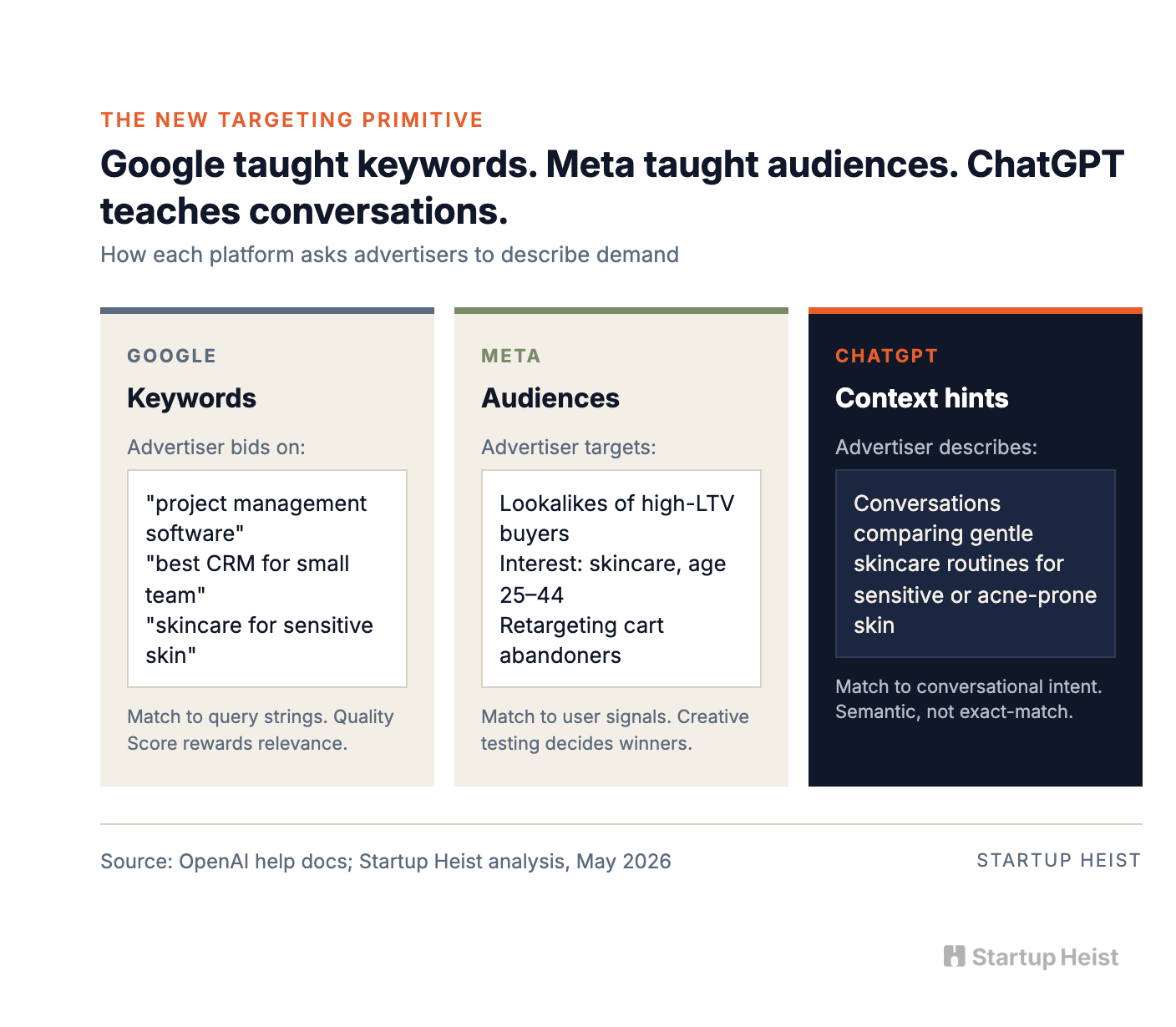
A weak advertiser writes:
People interested in skincare.
A strong advertiser writes:
Conversations where adults are comparing gentle routines for sensitive or acne-prone skin, asking about ingredient tradeoffs, looking for beginner-friendly products, or trying to choose a low-irritation daily routine.
The second version reads like copywriting, but it's closer to a blend of search strategy, customer research, objection mapping, and prompt engineering. ChatGPT's targeting engine parses intent, not phrases. The advertisers who win this surface will buy conversations the way Google advertisers buy keyword themes.
The expert-gap window
Every new ad platform creates a temporary expert gap. Early Google was about keyword structure and Quality Score. Early Facebook was about audience design and creative testing. Early TikTok was about native creative. ChatGPT's gap is conversational intent.
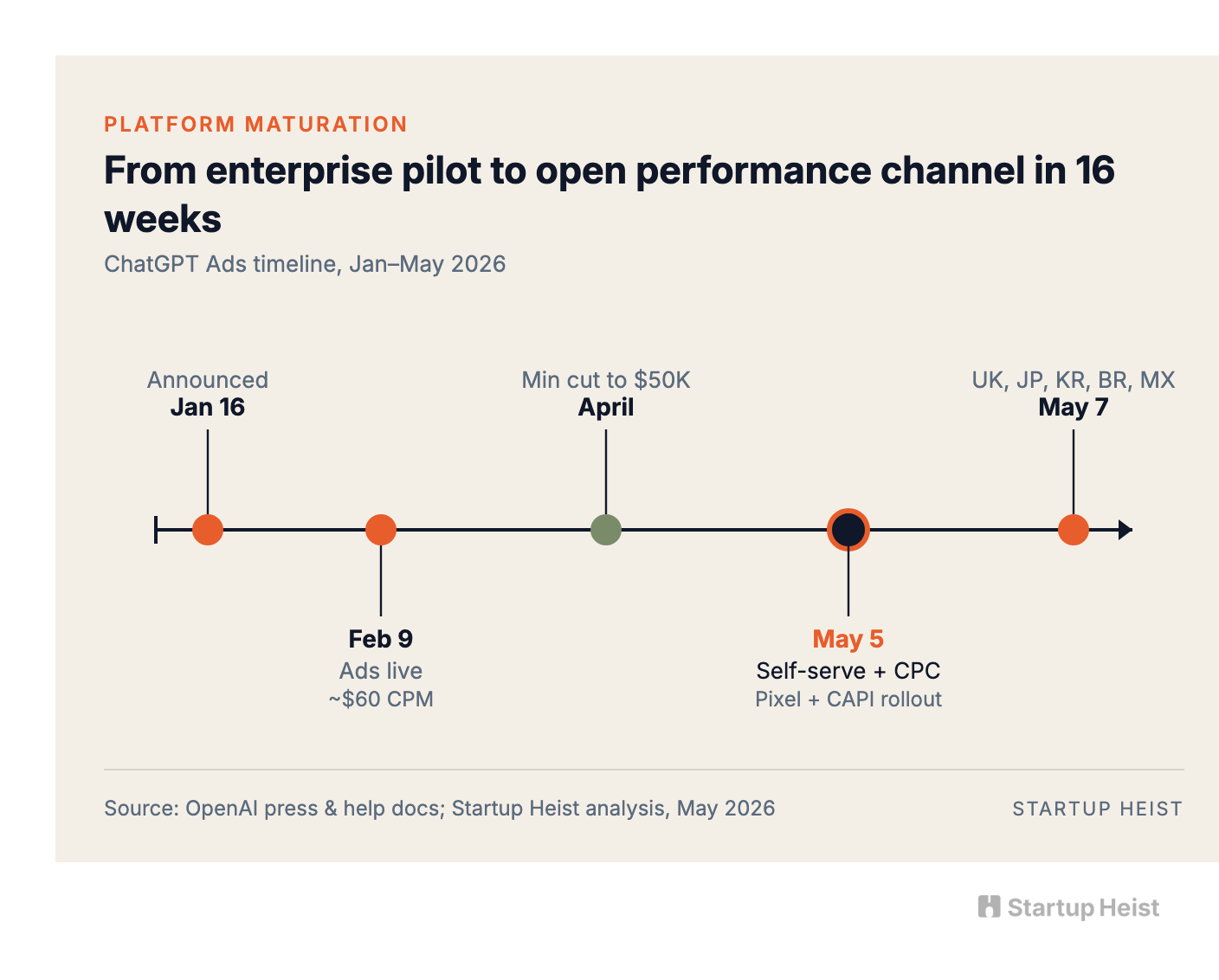
Two market signals confirm the window. OpenAI announced ads on January 16, 2026, with placements going live February 9 for U.S. Free and Go users at roughly $60 CPM. CPM eroded fast. By May, OpenAI had moved to CPC pricing, dropped the spend minimum, promised CPA bidding as the next step, and committed publicly to a $2.5 billion ad-revenue target. That's a platform deciding it wants performance buyers, not brand experiments. Two days after the U.S. self-serve launch, ChatGPT Ads Manager rolled out internationally to the UK, Japan, South Korea, Brazil, and Mexico. The window is roughly six months, not twelve.
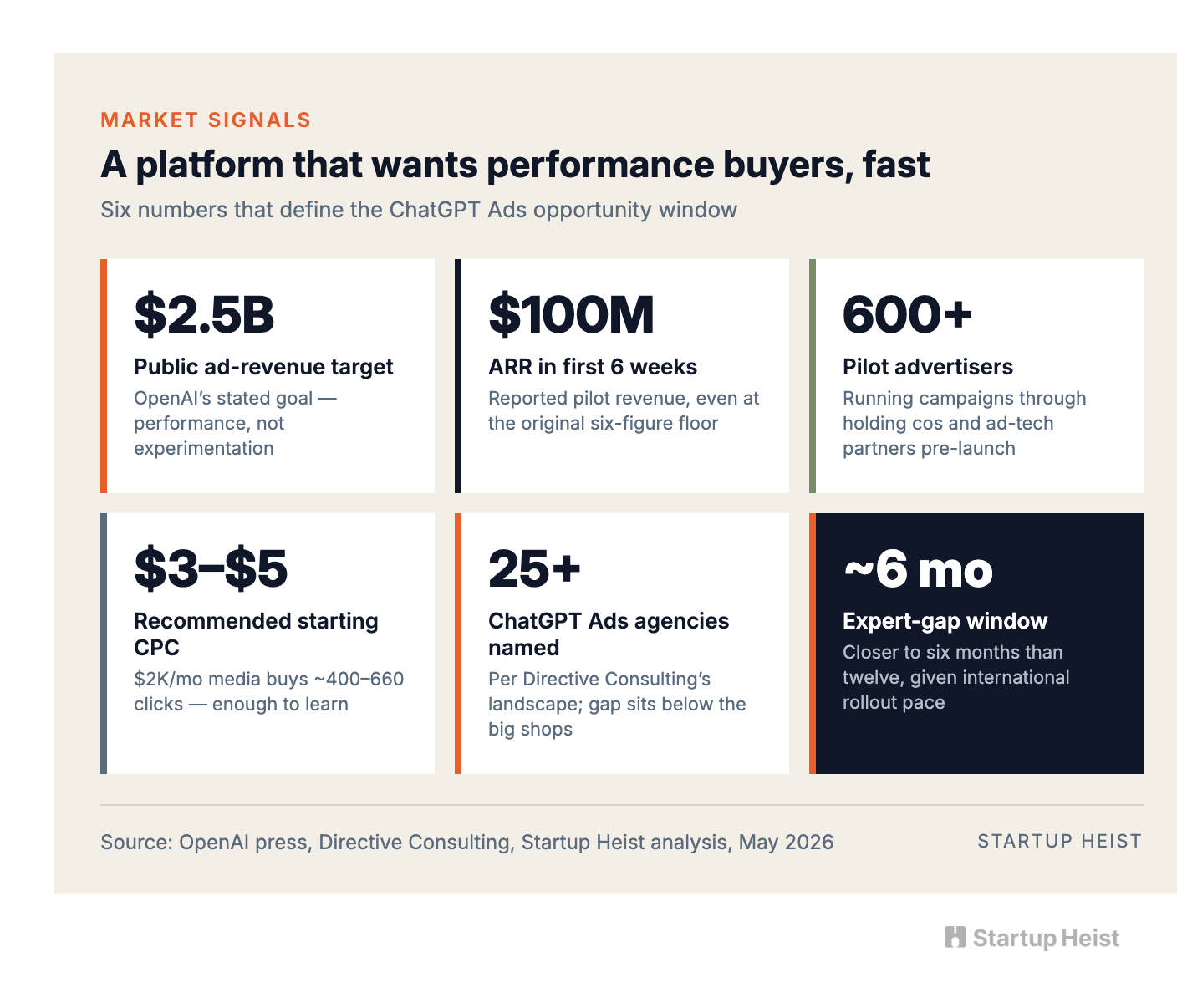
The agency landscape is the second signal, and denser than it looks. Directive Consulting alone has profiled 25 agencies positioning around ChatGPT Ads. The big shops will absorb Fortune 500 budgets. In-house growth teams at Series B+ companies will build internal playbooks. The gap sits below both: DTC brands and B2B SaaS companies that already spend $5K-$50K per month on Google, Meta, LinkedIn, or TikTok but can't justify a six-figure agency engagement to test a new channel. Those companies don't need a perfect new platform. They need a rational way to spend $2,000-$10,000 a month, learn whether ChatGPT traffic converts for their offer, and decide whether to scale before competitors catch up.
The opportunity
The right version of this business doesn't start with "we run ChatGPT ads for SMBs." That's mush. It starts with one of two narrow verticals.

Unlock the Vault.
Join founders who spot opportunities ahead of the crowd. Actionable insights. Zero fluff.
“Intelligent, bold, minus the pretense.”
“Like discovering the cheat codes of the startup world.”
“SH is off-Broadway for founders — weird, sharp, and ahead of the curve.”


