


The Creator Product Manager Hiding in the Comments
Most creator businesses don't die from a lack of attention. They die from a guess.
A fitness creator builds a 10-hour course when the audience would have paid $19 for a grocery template. A career coach spends six weeks coding a community platform when the comments were begging for a salary negotiation script. An 80,000-subscriber YouTuber ignores the same "can you make a checklist?" reply forty-three times, then wonders why the sponsorship treadmill feels like a job with worse benefits.

The gap between what creators build and what audiences will actually pay for is the opportunity. The play is a lightweight tool that turns audience requests into fast paid tests, landing pages, waitlists, preorders, limited-seat workshops, before the creator burns a quarter on the wrong product. It's the missing layer before the store: the deciding layer.
Here's the opportunity:
The money: 1,000 creators at $39/month average is $39K MRR for a solo founder. Micro-SaaS margins run around 41%, well above traditional SaaS.
Inside:
• Six-module MVP for comment-to-offer testing
• $199 productized audit as the fast wedge
• 4-8 week solo build plan, no API trap
• Four moats built on outcome data
The Shift Underneath the Stack
The creator economy is no longer a fringe software category. Estimates vary. Research Nester puts the global market at roughly $214 billion in 2026, while Coherent and Precedence land closer to $250 billion and $314 billion. Even the conservative number is large enough that a narrow workflow tool can sit on top of a real customer base.
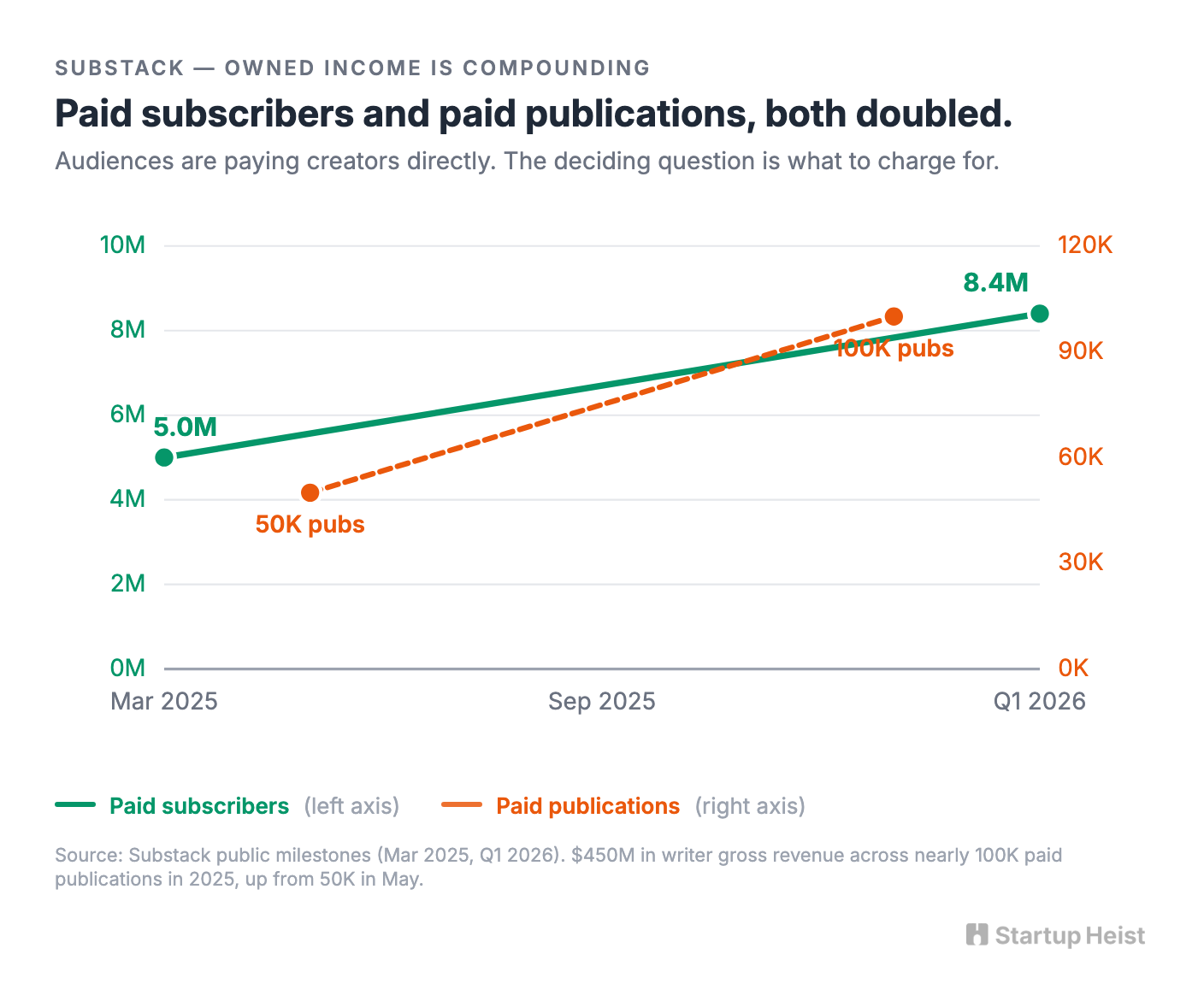
Behavior matters more than market size. Creators are migrating from rented income to owned income. Substack crossed 8.4 million paid subscriptions in Q1 2026, a 68% jump from the 5 million milestone in March 2025, and writers earned $450 million in gross revenue across nearly 100,000 paid publications in 2025, up from 50,000 in May 2025. Audiences are willing to pay creators directly.
Patreon's pricing pressure pushes from the other side. Creators who launched after August 4, 2025 sit on the standard 10% platform fee, before payment processing, currency conversion, and Apple's 30% iOS surcharge. Each fee schedule cracks the same door wider: own the customer, own the rail, own the offer. Owning the stack isn't the same as knowing what to sell.
The Crowded Selling Layer, the Empty Deciding Layer
A creator who decides to monetize has more storefronts than they have ideas. Stan Store starts at $29/month for Creator and $99/month for Creator Pro with no transaction fees beyond Stripe. Mighty Networks lists Community at $41/month annually with a 3% fee, scaling up through Courses, Business, and Growth tiers. Kajabi raised its prices in early 2026 and quietly retired its $89 Kickstarter plan from public pricing. The floor is now Basic at $179, Growth at $249, and Pro at $499 per month. Substack and Patreon round out the rented-income side.
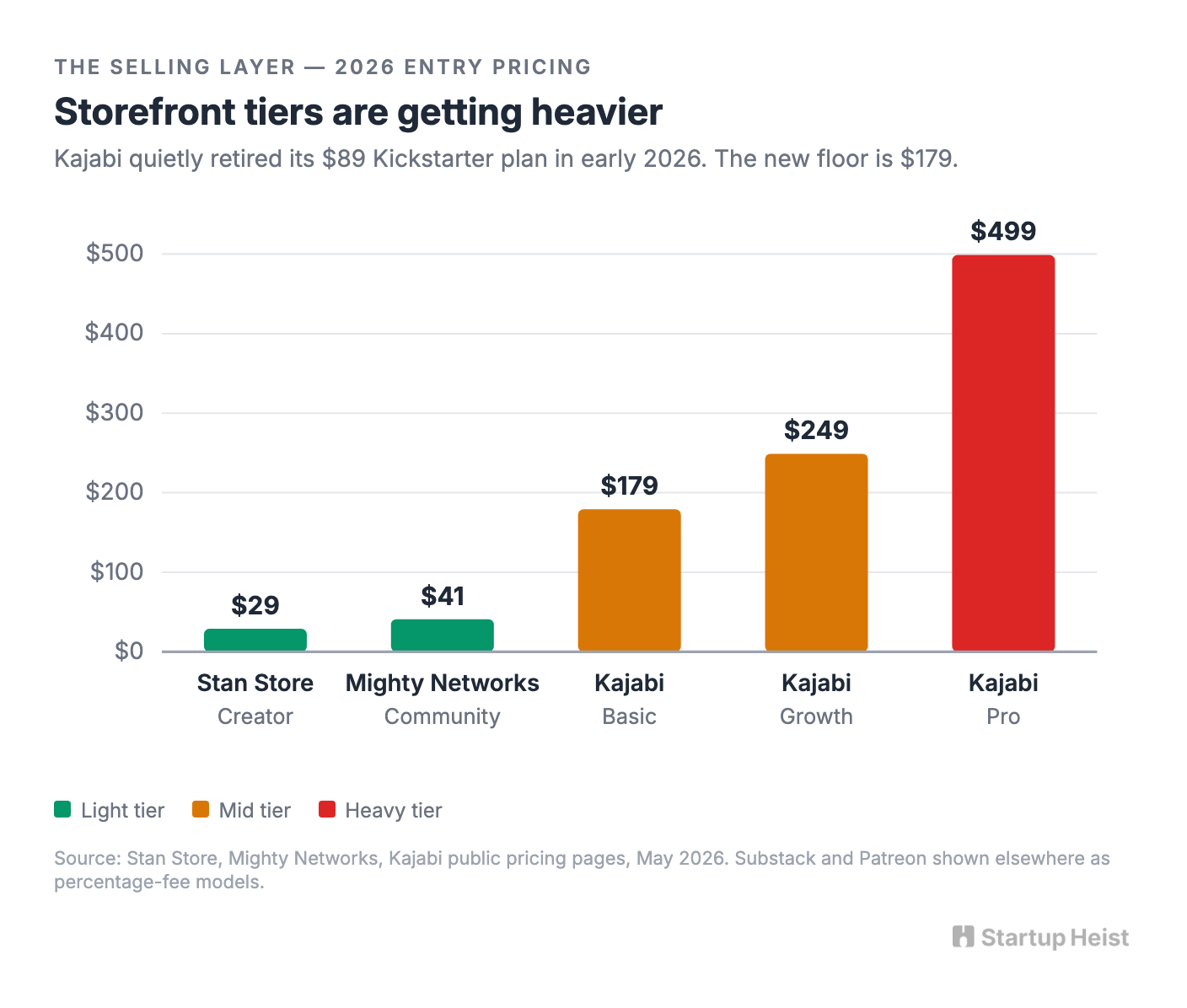
The selling layer is saturated and getting more expensive. The deciding layer, what should I actually put on the shelf, is still empty. Creators don't need another storefront. They need to know what product belongs there.
Audience Demand Is Visible. It's Just Unstructured.
Most creators sit on a daily flood of demand signal and don't see it as research.
It looks like:
"Can you share the template?" "Do you have a checklist for this?" "How would this work for real estate agents?" "Can you make a beginner version?"

Each comment is small. Collectively, it's a customer interview transcript. Brand teams treat this kind of language as gold. Product teams build roadmaps from it. Sales orgs price against it. Customer success teams package it into tutorials and upsells. Creators usually treat it as engagement to clear from the inbox.
The promise of the right product is operational, not magical. Connect your audience feedback, see what people keep asking for, test the smallest paid version this week. Less "AI product manager," more demand radar plus offer test. That distinction keeps the wedge sharp and prevents the founder from sliding into "AI builds your course," a bloated promise that loses the customer the moment it doesn't deliver.
Why the Existing Stack Doesn't Solve This
ManyChat already proved that creators treat comments and DMs as commercial surfaces. The comment-to-DM trick has captured hundreds of leads in 48 hours for thousands of creators, and the company crossed more than a million businesses across 170+ countries by 2026. ManyChat routes intent the creator already understands. It doesn't decide what to launch.
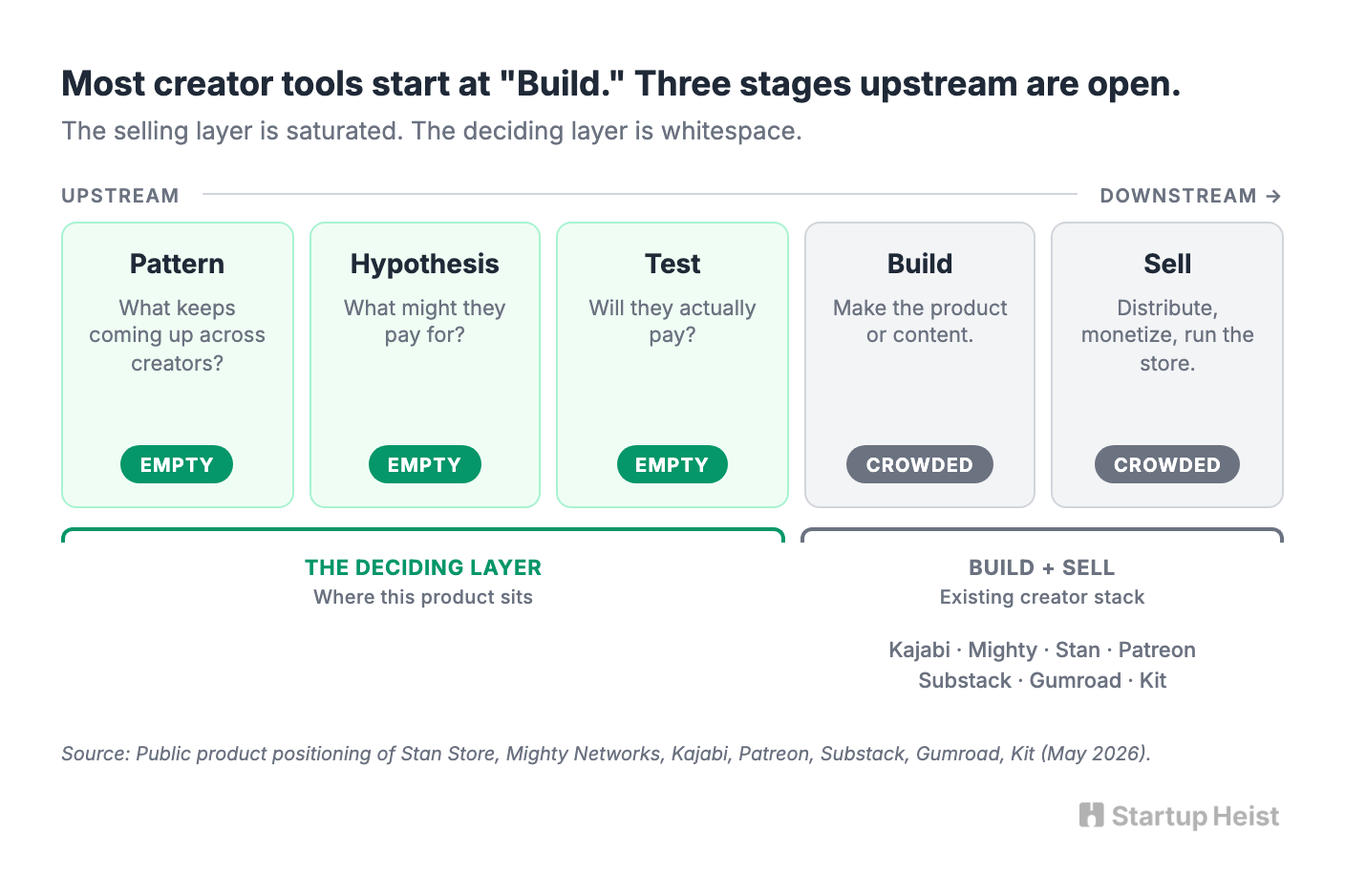
Stan Store, Kajabi, Patreon, Substack, Mighty, Gumroad, and Kit all sit downstream of the decision. They help once the creator knows what to sell. The whitespace is upstream: pattern, hypothesis, test, build, sell. Most creator tools start at "build." This product starts at "pattern." Sit beside the existing stack, not against it. Become the "what should I launch?" layer.
The Product: Comment-to-Offer Testing
The MVP is one workflow:
Unlock the Vault.
Join founders who spot opportunities ahead of the crowd. Actionable insights. Zero fluff.
“Intelligent, bold, minus the pretense.”
“Like discovering the cheat codes of the startup world.”
“SH is off-Broadway for founders — weird, sharp, and ahead of the curve.”


