


ADA Cure Desk: The Accessibility Panic Button for Small Businesses
There's a strange new opening in web accessibility, and it lives inside a 90-day clock.
For years, website accessibility has run as an awkward triangle. Plaintiffs' firms send demand letters. Small businesses panic. Vendors sell scanners, overlays, audits, or managed services. Somewhere in the middle sits the actual work: finding the failures, fixing what matters, documenting the change, and giving a lawyer a clean record of what happened. That middle layer is where the opportunity lives.
The play isn't another "make your website ADA compliant" widget. That market is crowded, legally exposed, and full of vendors making promises that crumble in court. The better business is narrower and more useful:
Build an accessibility remediation evidence SaaS for small businesses, web agencies, and small law firms that turns a demand letter into a prioritized fix workflow, implementation proof, and counsel-ready documentation.
You're not selling legal compliance. You're not promising a full cure. You're not pretending to be a magic shield. You're selling a dated remediation packet.
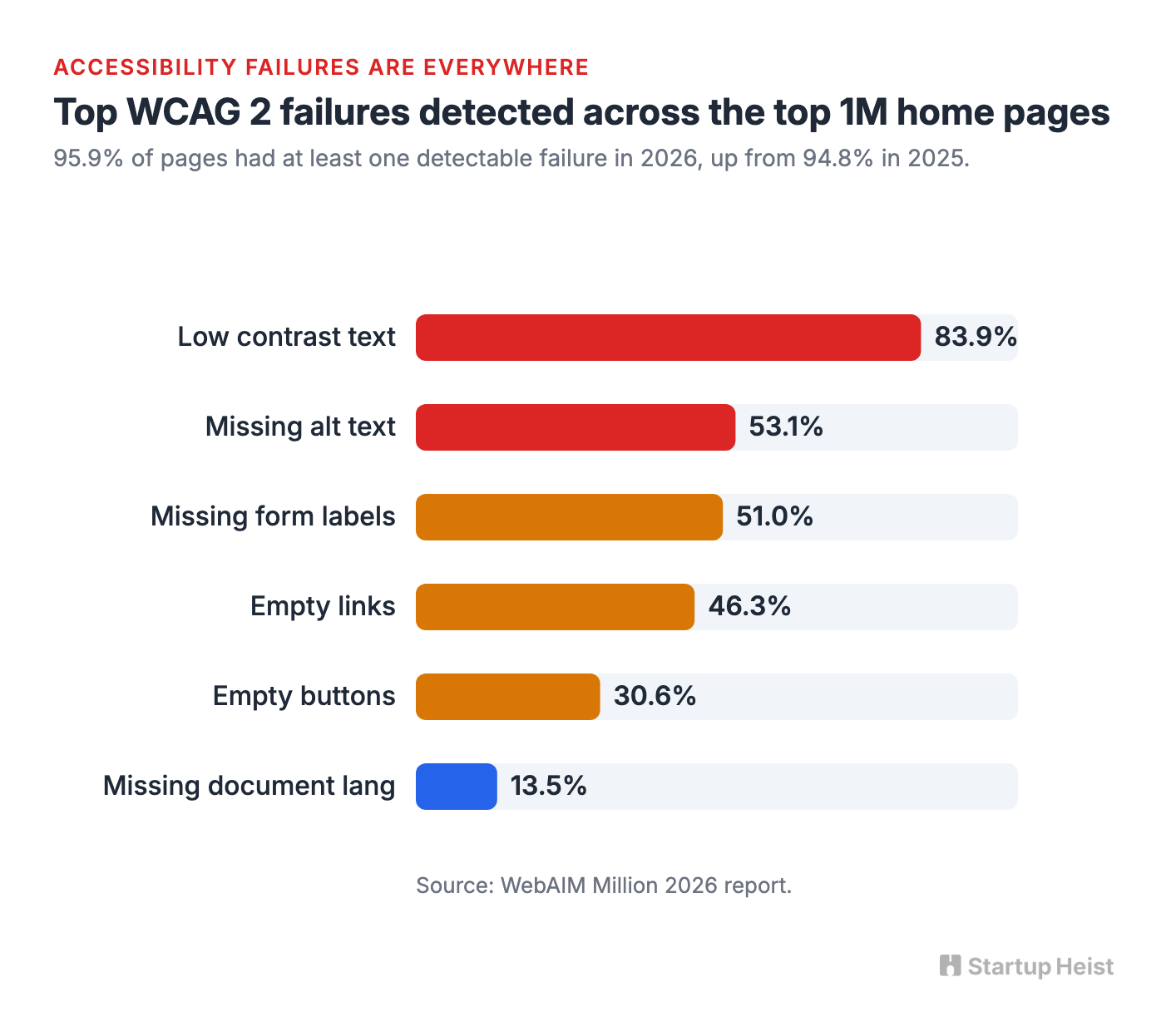
That distinction matters more than it sounds. WebAIM's 2026 Million report tested the top one million home pages and found detectable WCAG failures on 95.9% of them, up from 94.8% in 2025. The average home page now ships with 56 distinct accessibility errors, and 2026 reverses six straight years of gradual improvement. Pages keep getting heavier (1,437 elements on average, up 22.5% year over year), so the absolute volume of issues is climbing too. Because WebAIM only counts failures the scanner can flag with high confidence, the true rate of full nonconformance is even higher.

The legal environment shifted in the same direction. Missouri's Act Against Abusive Website Access Litigation takes effect August 28, 2026, with a 90-day cure period and fee-shifting if a plaintiff pushes a case forward after a defendant has made substantial good-faith remediation efforts. Utah's SB 68 is already live, effective May 6, 2026, with a 30-day attempt-to-cure window, a 90-day cure window, and a new cause of action that lets defendants or the state attorney general pursue abusive plaintiffs for sanctions and punitive damages. Georgia's version cleared the legislature in April 2026 and is awaiting the governor's signature, with similar cure-period mechanics and treble attorney's fees on the table.
The job to be done changed with those laws.
The old job: "I got sued. Call a lawyer."
The new job: "I got notice. What exactly do I fix, who fixes it, how fast can I prove it, and what can my lawyer use?"
A software workflow is hiding inside a legal panic. Here's the opportunity:
The money: A solo founder with 10 agency partners, 10-20 emergency packets a month at $500-$1,500, and a small monitoring base lands at $7K-$30K MRR.
Inside:
• Five-module MVP for SMB ADA cure work
• Dual pricing: emergency sprint plus monitoring
• Channel-led GTM through agencies and law firms
• Five moats inside the remediation workflow
The Mispriced Moment
Most accessibility companies sell prevention. Monitoring, scanning, overlays, audits, managed compliance: useful at the right scale, but it doesn't match the moment a small business owner picks up the phone with a demand letter in hand.
The owner isn't shopping for a "digital accessibility platform." They're asking: Am I being sued? How much will this cost? What do I send my web guy? What does my attorney need? Can I fix this before it gets worse? That's incident response, and the accessibility market doesn't sell incident response.
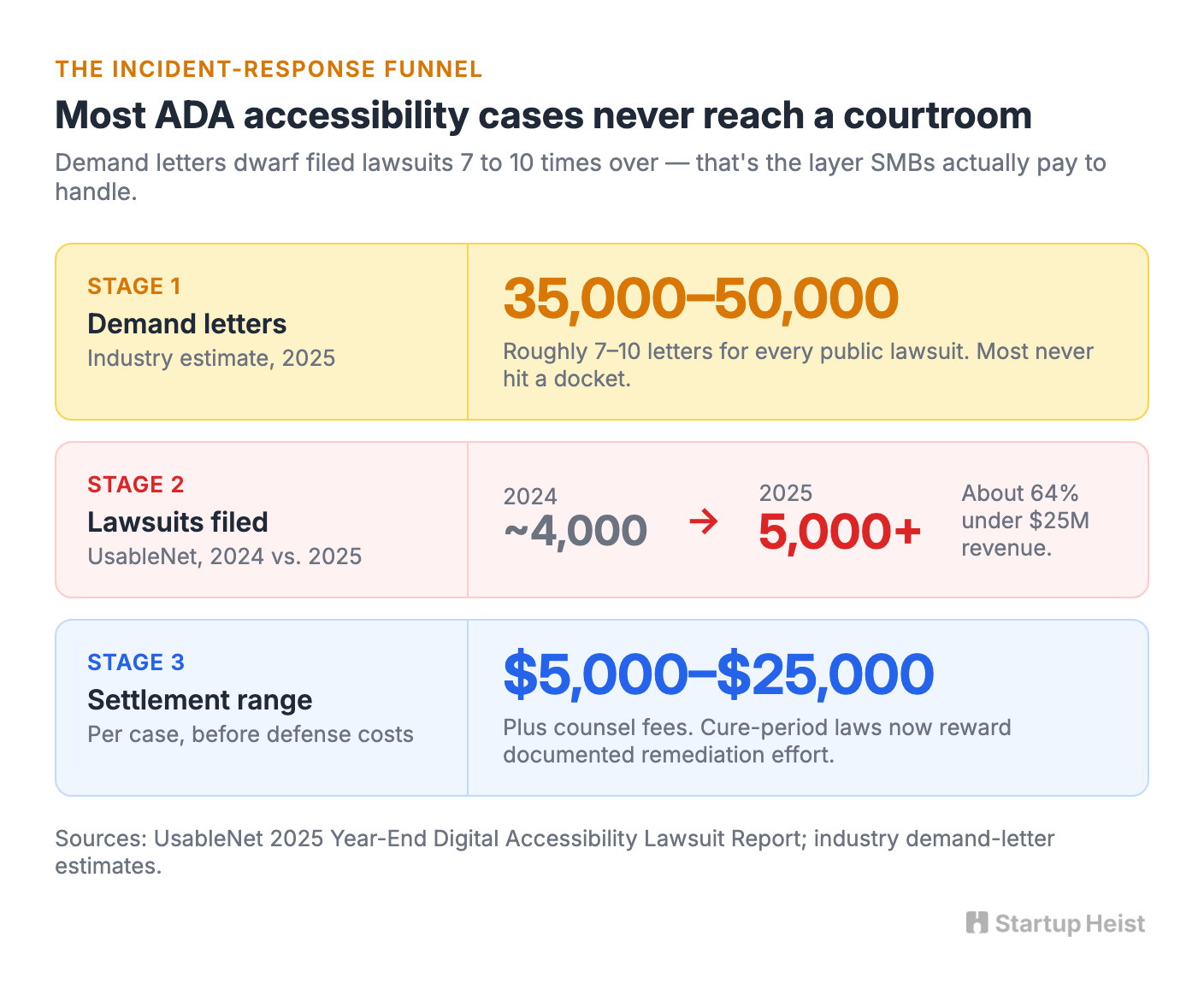
Cybersecurity built this stack a decade ago: tools for security posture, plus separate tools for incident response, breach triage, evidence collection, timelines, remediation logs, and reports for insurers and counsel. Web accessibility never built the SMB equivalent. UsableNet logged more than 5,000 digital accessibility lawsuits filed in 2025, up from roughly 4,000 in 2024, and industry estimates put demand-letter volume at 35,000 to 50,000 (seven to ten letters for every lawsuit that hits a public docket). About 64% of sued companies report under $25 million in revenue. Settlement ranges run $5,000 to $25,000 before defense costs. The owner rarely understands WCAG. Counsel understands the legal process but not the code. The agency knows how to fix obvious issues but doesn't know how to package the work into a record opposing counsel will accept. That gap is the heist.
What You Actually Build
The product positioning:
Turn an accessibility demand letter into a prioritized fix plan, developer task board, and timestamped remediation evidence packet for your counsel.
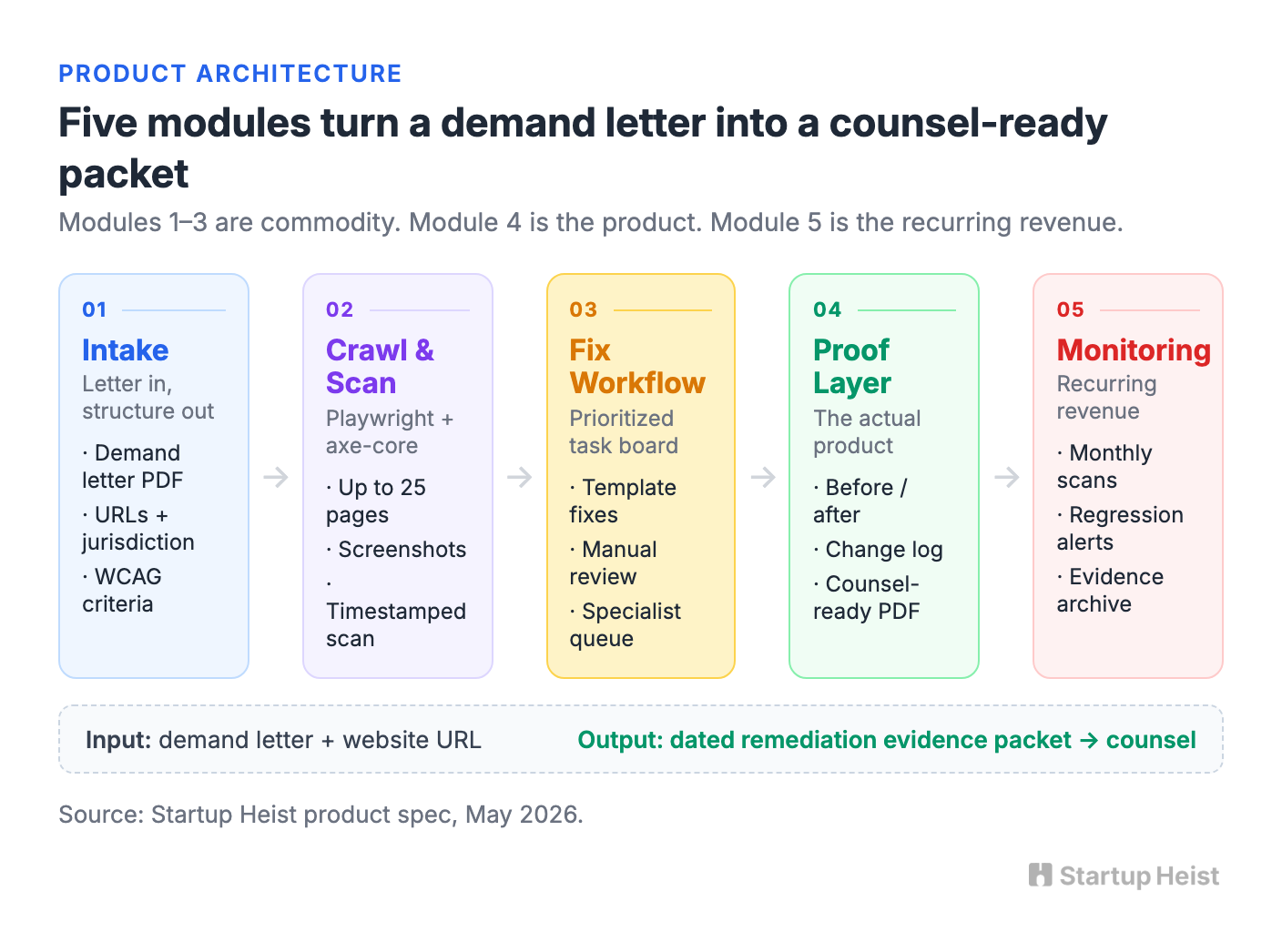
Five modules sit underneath. Demand-letter intake parses the letter and extracts dates, alleged issues, named URLs, referenced WCAG criteria, and jurisdiction. Site crawl and scan runs Playwright and axe-core across 25 pages and any URLs named in the letter. Prioritized fix workflow sorts issues into fast template fixes, manual review items, and counsel/specialist review, with a developer-facing task board. Proof layer is the actual product: before screenshots, change log, after screenshots, rescan results, counsel notes, and a timestamped export. Monitoring kicks in after the sprint with monthly scans, regression alerts, and a ready-for-counsel archive.
A scanner says "here are problems." The proof layer says "here is what we found, what changed, when it changed, and what remains unresolved." Under Missouri's, Utah's, and Georgia's cure-period laws, that documented effort is what triggers the rebuttable presumption that any later claim is abusive. The packet is the artifact. Lead with the incident, not the monitor. Every existing vendor sells the monitor.
The obvious customer is the panicked small business owner. The better customer is the person who picks up the phone when that owner calls: local web design agencies, freelance WordPress and Shopify specialists, small business law firms, accessibility consultants, SEO shops, hosting providers serving SMBs, chambers of commerce, and insurance brokers with small commercial books. Panic buyers can pay, but they're expensive to acquire at the exact moment of need. Agencies and small firms already have the trust and the inbound. They get the call first. They use the product repeatedly, on every client case. The strongest initial positioning may be: "A white-label remediation evidence desk for agencies and small firms handling ADA website demand letters." That reads more credibly than a SaaS tool telling a frightened business owner to upload their lawsuit.
Market Size: Not Venture-Scale by Default, but Very Real
This is probably not a default billion-dollar SaaS company. That's good news.
Independent forecasts put the website accessibility software market at roughly $475 million in 2025, growing toward $980 million by 2032 at a 10.9% CAGR. The venture-scale slice is already crowded with overlay vendors, enterprise platforms, and big-firm consulting practices. The unclaimed slice is narrower: SMBs with active demand letters, agencies managing remediation, attorneys needing structured evidence, and ongoing monitoring after the fix.
A reasonable mid-case version of this business (50 agency partners, two emergency cases each per month at $750 average software/service fee, plus 500 monitored sites at $49/month) clears roughly $100,000 a month before specialist review costs. A solo-founder version with 10 agency partners, 10 to 20 emergency packets a month at $500 to $1,500, and a small monitoring base lands at $7,000 to $30,000 a month. Neither is a moonshot. Both are a clean secondary grab in a painful, regulated, recurring mess.
Why Existing Players Leave the Opening
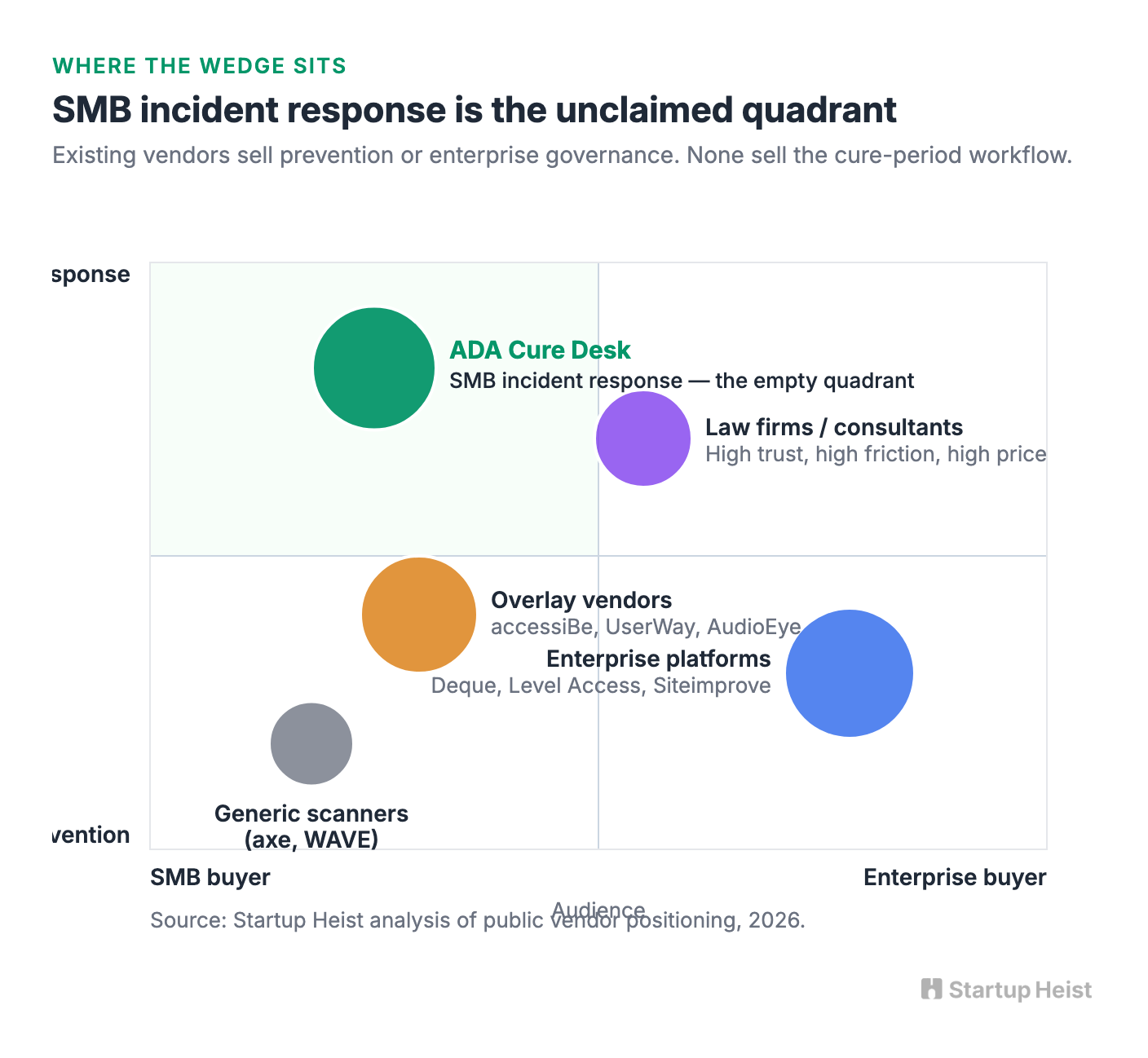
The accessibility vendor map is louder than it is competitive at this wedge.
Overlay companies (accessiBe, UserWay, AudioEye, EqualWeb) sell easy installation and the implicit promise of legal cover. That promise is breaking in public. The FTC finalized a $1 million order against accessiBe in April 2025 and barred the company from claiming its automated tool can make any website WCAG compliant. UserWay is in litigation that survived a motion to dismiss after a flower-shop client got sued anyway. Overlay-using sites appeared in more than 800 lawsuits across 2023 and 2024, and 2025 filings increasingly call out widgets while alleging unresolved code-level barriers. Enterprise platforms like Deque, Level Access, Siteimprove, and TPGi sell scanning, governance, and managed audits at price points calibrated for Fortune 500 buyers. Accessibility consultancies and law firms sell expertise: valuable, expensive, high-friction. Generic scanners are cheap and useful but don't solve the workflow problem.
A local restaurant doesn't need a six-month enterprise program. A solo dentist can't interpret a scanner report. A Shopify merchant won't pay a law firm to coordinate every technical fix. A local agency knows how to patch theme issues but doesn't know how to package the work for counsel. The product wins by being operational rather than authoritative: "we help your team identify issues, organize remediation, document changes, and prepare a review packet for counsel." The wording is less marketable. It's also the only version that holds up when a demand letter turns into a complaint.
MVP Scope
A solo technical founder familiar with browser automation can ship a credible MVP in 4 to 8 weeks. Stretch to 8 to 12 weeks if accessibility workflows are new.
Unlock the Vault.
Join founders who spot opportunities ahead of the crowd. Actionable insights. Zero fluff.
“Intelligent, bold, minus the pretense.”
“Like discovering the cheat codes of the startup world.”
“SH is off-Broadway for founders — weird, sharp, and ahead of the curve.”


