


The AI Authenticity Survival Kit
A new kind of anxiety is loose in classrooms and entry-level cubicles. Students are using AI constantly. Junior workers are using AI constantly. Their schools and employers know. Nobody seriously expects the old world to come back, and the rules are still half-written.
A college junior can brainstorm an essay in ChatGPT, polish a paragraph in Grammarly, hunt sources in Perplexity, summarize notes in Notion AI, and reshape an argument in Claude. Then they hit submit into a system that may quietly run that essay through an AI detector like Turnitin or GPTZero. If the score crosses a threshold, the conversation pivots in seconds, from "tell me how you thought about this" to "did you cheat?"

This is the wedge. The market response so far has been ugly. A swarm of "humanizer" tools (Undetectable AI, HIX Bypass, StealthGPT, priced anywhere from $15 to $35 a month) sell a single promise: paste in AI text, get back something that slips past Turnitin AI detection, GPTZero, and Copyleaks. It's a race to the bottom, ethically and commercially.
The smarter play sits on the other side of the wall. Build a paid AI Authenticity Survival Kit: a course, template library, and update newsletter for students and early-career professionals who want to use AI without getting falsely flagged, blowing past unclear policies, or losing control of their own work. It's the playbook universities should have shipped two years ago and mostly haven't.
Here's the opportunity:
The money: $4-8K MRR within the first year from SEO and creator affiliates, $10-25K plausible at scale once the policy database, parent funnel, and B2B training kick in.
Inside:
• Six-component MVP build, six weeks
• Three-tier pricing with $49 review upsell
• SEO library targeting panic searches
• Four moats that compound into B2B
The new normal: heavy use, heavy enforcement, no clear rules
Three forces collided in 2025, and the smoke hasn't cleared.
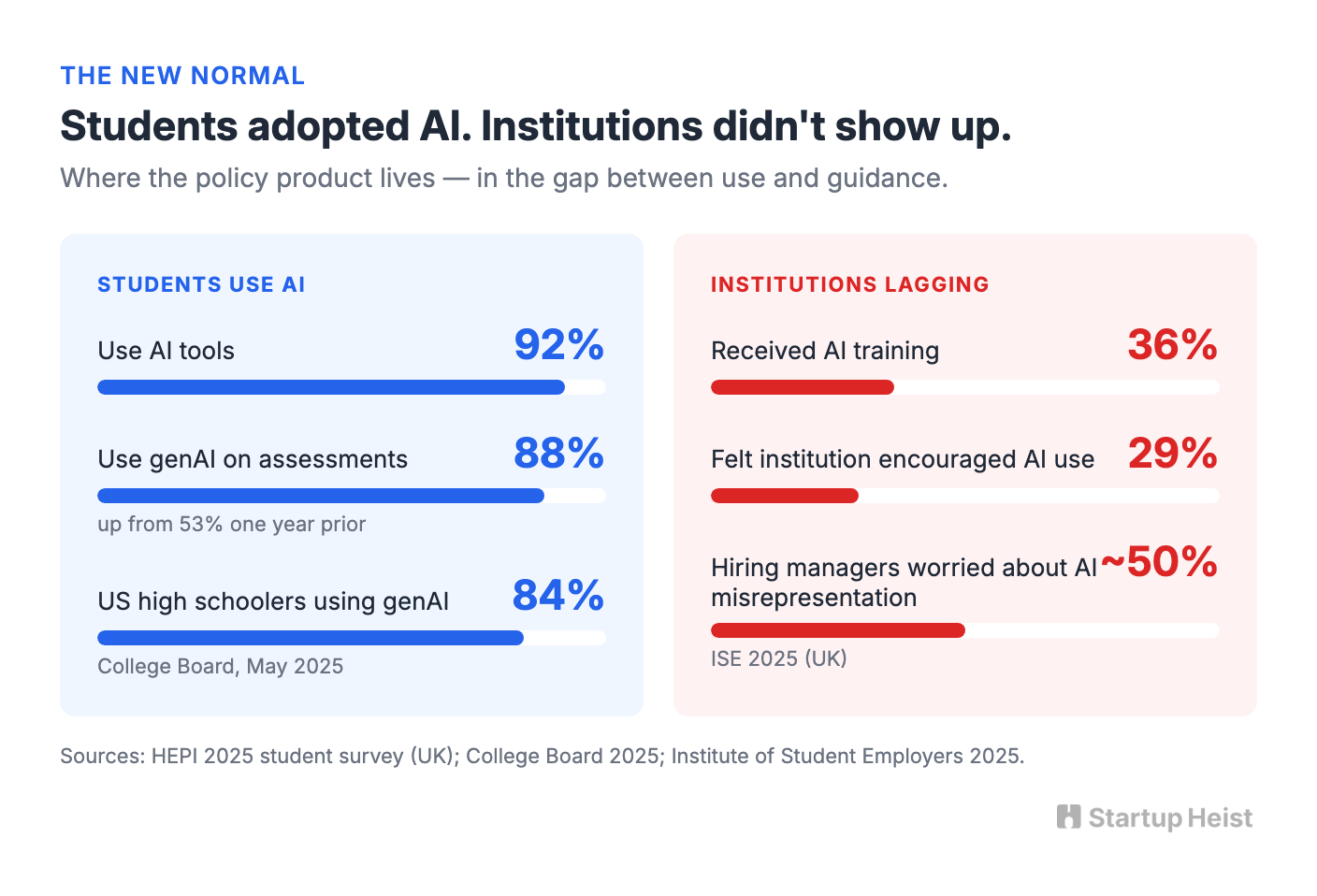
AI use went from optional to everywhere. The Higher Education Policy Institute's 2025 student survey found 92% of UK university students using AI tools, with 88% turning to generative AI for assessment work. That second number had climbed from 53% just a year earlier. Only 36% of students said they'd received any AI training from their institution. The same wave is breaking in U.S. high schools: College Board research found 84% of American high schoolers had used generative AI for schoolwork by May 2025, up from 79% in January, with 69% naming ChatGPT specifically.
Detection became infrastructure. Grand View Research pegs the global AI content verification market at $3.83 billion in 2024, growing at a 21.1% compound annual growth rate. Turnitin, GPTZero, Copyleaks, Originality, and Pangram are now embedded in school systems, hiring portals, content marketplaces, and HR pipelines.
The policy layer never caught up. A student can use Grammarly's AI rewrite in one class and be referred to academic integrity for it in another. An intern can clean up a draft in ChatGPT and discover three weeks later that the firm forbids any external LLM use on client work. Only 29% of students felt their institution actively encouraged AI use, even as the institution built out detection. The product lives in that gap.
The detector is not a judge
The current debate sits on a clean binary: human work or AI work. That binary is already dead.
A serious student uses AI to explain a concept, generate practice problems, summarize a dense chapter, surface counterarguments, test whether a thesis holds, or scrub a draft for clarity. None of that is outsourcing the assignment. Detectors don't understand any of it. They read patterns in the final text and assign a probability score. A score is a guess.
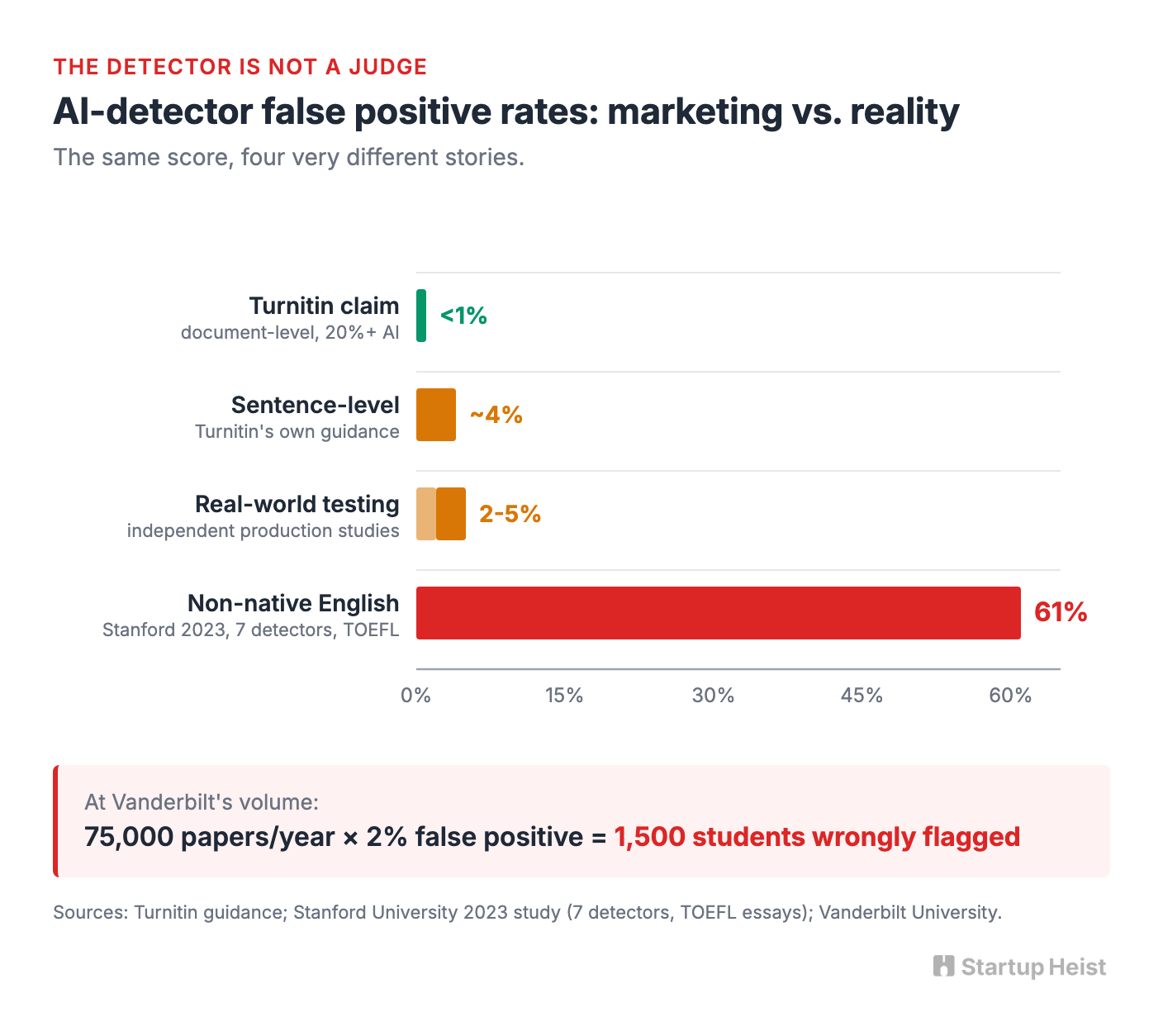
The guess is shakier than the marketing admits. Turnitin's own guidance pegs document-level false positives at under 1% when the report shows 20% or more AI writing, but the sentence-level false positive rate sits around 4%. A 2023 Stanford study of seven major detectors found they flagged 61% of TOEFL essays written by non-native English speakers as AI-generated. Independent testing in production tends to land between 2% and 5% false positives. Vanderbilt processed about 75,000 student papers in a year. Two percent is 1,500 students wrongly flagged.
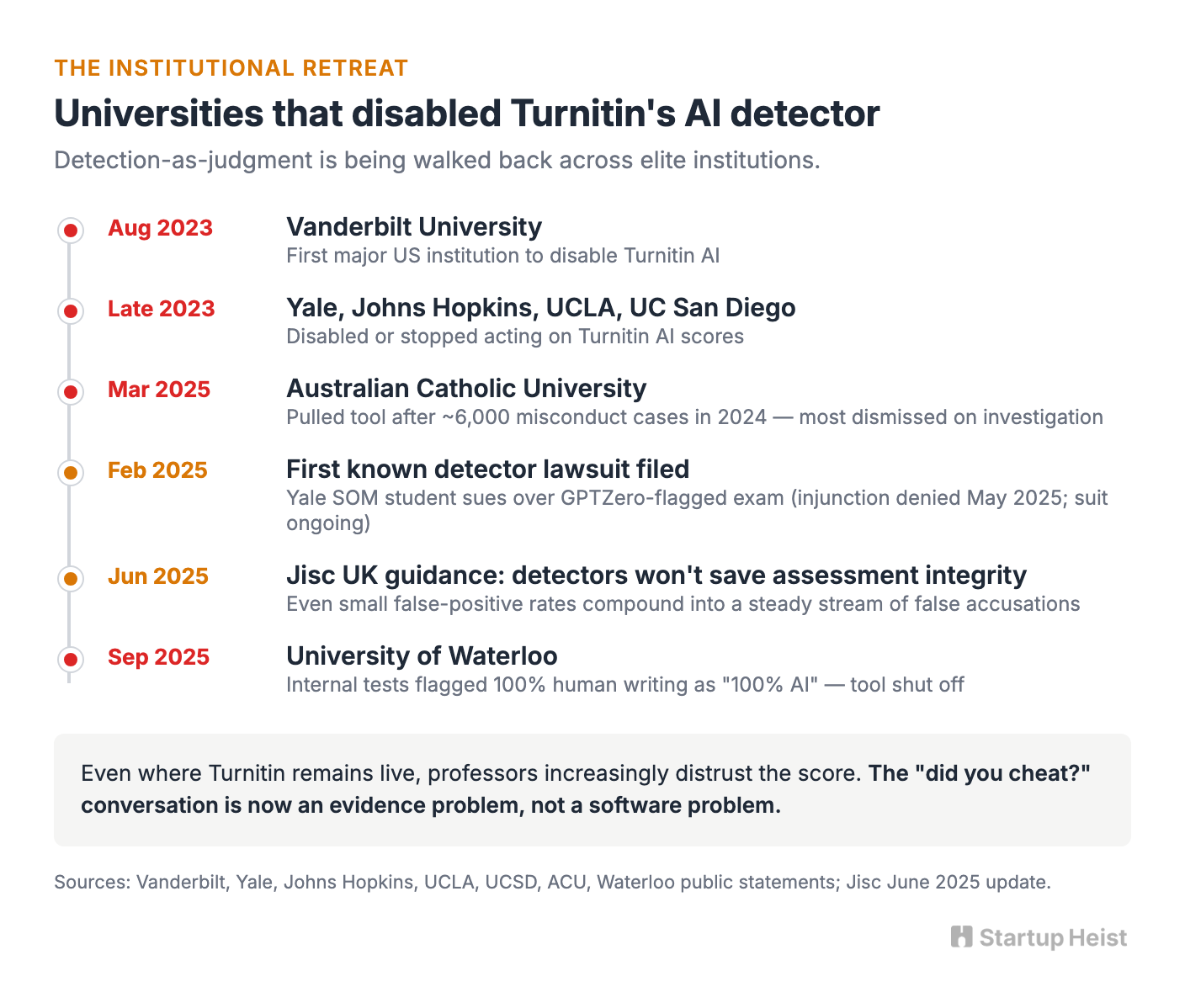
Institutions noticed. By the end of 2025, Vanderbilt, Yale, Johns Hopkins, UCLA, UC San Diego, the University of Waterloo, and Australian Catholic University had each disabled Turnitin's AI detector or stopped acting on its output. Waterloo's internal testing flagged 100% human writing as "100% AI-generated" before the university shut the tool off in September 2025. Australian Catholic University pulled the plug in March 2025 after recording nearly 6,000 AI-related academic misconduct cases in 2024, most of which fell apart on investigation. In February 2025, the first known lawsuit landed: a Yale School of Management student sued the university over a final exam flagged by GPTZero. A federal judge denied his motion for an injunction in May 2025; the suit is ongoing. Jisc's June 2025 update on AI detection in UK higher education was blunt. Detectors will not save assessment integrity, and even a small false positive rate, multiplied across thousands of submissions, becomes a steady stream of false AI cheating accusations.
The customer: anxious strivers, not cheaters
Two segments matter at launch. They share an emotional state, quiet panic about being miscategorized, and they have money.
College students in writing-heavy majors are the first wedge. Business, communications, psychology, education, public policy, pre-law, the humanities, social sciences, nursing programs with reflective writing, and most international student programs flow essays through detectors. Consequences scale with stakes: GPA, scholarships, graduate admission, internship offers, visa status. International students are the sharpest pain point, since the same Stanford finding that put a 61% false positive rate on non-native English writing also describes a population paying full tuition with the most to lose.

Early-career professionals are the second wedge, and probably the better commercial bet. Interns, analysts, junior marketers, consultants, and entry-level knowledge workers are now expected to be AI-fluent while living inside ambiguous corporate AI policy. A 2023 BlackBerry survey found 75% of organizations were implementing or considering banning ChatGPT at work, with confidential-information protection the primary driver. Samsung famously cut off employee ChatGPT access after engineers pasted source code into it. Apple, JPMorgan, Amazon, Deutsche Bank, Wells Fargo, Bank of America, Citigroup, and Goldman Sachs all restrict external LLMs. The UK's Institute of Student Employers found that nearly half of hiring managers were concerned graduates using AI in selection processes were misrepresenting their abilities, and concerns about written communication in candidates jumped from 28% in 2024 to 46% in 2025.
A junior employee sits in the middle of that tension: use AI to keep up, don't get caught, don't paste anything sensitive, don't let your writing sound too generic. A field guide is worth real money to that person.
The product: an authenticity playbook, not an evasion tool
The offer in one sentence: a one-time $59 kit that teaches students and early-career professionals how to use AI responsibly while reducing the risk of false accusations, policy violations, and quiet over-reliance.
Five working names worth testing on a landing page:
- AI Authenticity Survival Kit
- The AI Assessment Playbook
- Stay in the Clear
- Human Work, AI Tools
- The AI Use Defense Kit
Avoid "bypass," "undetectable," "cheat," and "humanizer." Those words bring cheap clicks and poison every adjacent ambition.
The kit has six components, each engineered to feel useful before the next deadline.
1. A short course on how detectors actually think. Plain English. Statistical predictability, stylistic consistency, why detectors are probabilistic and not judicial. Headline lesson: a detector doesn't know who wrote anything; it infers patterns and assigns a score. Twelve short video lessons, two and a half hours total, Loom-quality production. The buyer doesn't need cinema. They need clarity before Sunday night.
2. A workflow library for allowed and gray-area uses. Cover the cases students actually face: research planning, concept explanation, outline generation, source discovery, argument stress-testing, revision support, citation checks, clarity passes, interview prep, portfolio drafting. Each workflow specifies what AI can help with, what the user must do personally, what to save as evidence, when to disclose, and what never to paste directly into a final submission.
3. The authorship trail system. This is the moat in miniature. Most students can't prove their work is theirs because they don't preserve the trail. The kit teaches a lightweight process: save first notes, keep rough outlines, log prompts, track source decisions, write a one-paragraph "process note" after each work session, use Google Docs revision history, screenshot major reasoning steps, keep a short disclosure summary if the assignment requires one. A real paper trail beats a magically humanized final draft every time.
4. False-positive response templates. This is where the product becomes urgent enough to buy at midnight. Email templates for asking a professor to clarify the specific concern, requesting a calm meeting, walking through writing process, sharing draft history, citing permitted AI use, appealing a detector-only accusation, and documenting the student's side without sounding defensive. The customer isn't buying information. They're buying language for a scary moment.
5. Assignment and workplace checklists. For students: before using AI, before submitting, before disclosing, when the school bans AI, when the school allows it with citation, when policy is unclear. For early-career professionals: before using AI on client work, on writing samples, on confidential data, on analysis sent to a manager, or on anything posted publicly.
6. The update newsletter. The frontend kit is a one-time purchase. Recurring revenue lives in a $9-15 monthly membership covering policy changes at named schools, detector updates, dispute case studies, new AI disclosure language, workplace AI etiquette, and content provenance standards. Static prompt packs decay in months. A living policy product feels safer the longer it runs.
Why this beats the humanizer market
Humanizers are easy to understand, easy to copy, and easy to undercut. They compete on bypass rate, word limits, and screenshots of detector dashboards. The customer asks one question: "Does it pass?"
Three problems follow. The product is brittle: detectors update on quiet schedules, models change, schools change rules, and a "99% human" claim can collapse in a week. The brand ceiling is low: a company known for helping students hide AI use will never win institutional partnerships, never sell to writing centers, never get a calm front-page feature in a parent magazine. The customer is low-trust: buyers who arrive purely to evade detection refund, charge back, and blame the tool when caught.
The Authenticity Kit climbs the trust stack. The position is direct: you can use AI heavily, but you need to know where the line is, how to keep your own thinking inside the work, and how to prove it if questioned. That position rides the regulatory and platform tide instead of fighting it. The Coalition for Content Provenance and Authenticity (C2PA) is moving toward becoming an ISO standard. TikTok joined C2PA in May 2024 and became the first major social platform to attach Content Credentials to AI-generated content uploaded from other platforms. The world is heading toward more disclosure, more provenance, more visible labels. A product that teaches people to live cleanly inside that world has a tailwind.
The MVP: six weeks, under $100 a month in stack costs
Software is the wrong first build. This is a trust, education, and distribution business before it's a technology business.
Unlock the Vault.
Join founders who spot opportunities ahead of the crowd. Actionable insights. Zero fluff.
“Intelligent, bold, minus the pretense.”
“Like discovering the cheat codes of the startup world.”
“SH is off-Broadway for founders — weird, sharp, and ahead of the curve.”


