


The Heist: Every viral video has a back office nobody talks about. The creator economy spent a decade glamorizing the face on camera and almost no time productizing the labor behind it.
This is a startup idea hiding inside a staffing problem, and it's buildable right now with a concierge MVP and light software.
Rachel Kisela spent a year as Lead Video Editor at MrBeast, the first woman to hold that role in the channel's history. She led editing teams on videos reaching tens of millions of viewers while MrBeast became the most-subscribed YouTuber on the planet. Then she went back to freelancing and built a six-figure editing business working with creators like HopeScope and Bunny Hedaya.
Kisela didn't just build a freelance practice. She built EditHers, a Discord community of around 200 female editors and 100 creators, including Airrack, Smosh, Marques Brownlee, Linus Tech Tips, and Pokimane. The community exists because the creator hiring market is still organized through referrals, DMs, and private backchannels instead of real infrastructure.
When a market starts building its own informal guilds, the underlying labor market is large enough and messy enough to support a real business.
EditHers is a signal.
The real play: a vertical labor operating system for creator businesses — a micro SaaS idea with marketplace economics that could define a new product category.
Start with one role. Standardize work scopes. Benchmark rates. Verify quality. Route payment. Editors are the best wedge because they sit closest to output, deadlines, retention, and channel performance. The long game reaches into thumbnail designers, clip strategists, script researchers, motion designers, podcast producers, newsletter ghostwriters, and eventually full creator staffing pods.
The Size of What's Hidden
The creator economy hit $250 billion in 2025. Goldman Sachs projects $480 billion by 2027. More than 200 million creators are active worldwide, with some estimates pushing toward 275 million. Influencer marketing alone reached roughly $32 billion in global spend in 2025, up about 35% year-over-year, with U.S. creator economy investment hitting $37 billion and expanding at four times the rate of the broader media industry. Brands report average returns of $5 to $6 per dollar spent on influencer marketing. This is a demand side that already treats creator output as a P&L lever, which supports paying for stable labor rails rather than ad-hoc hires.
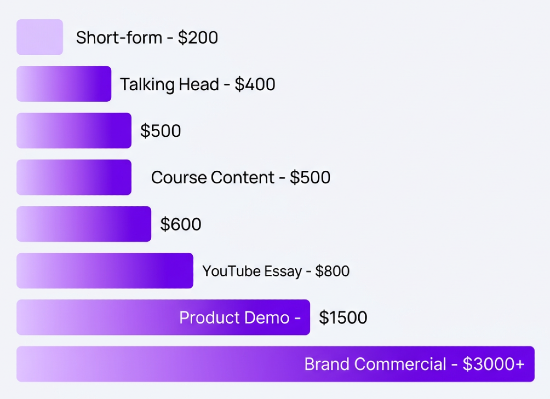
Freelance YouTube video editor rates in the U.S. range from $30 to $60 per hour, with experienced specialists commanding $100-plus. The average U.S. freelance YouTube editor earns around $36 per hour. A creator publishing weekly long-form plus shorts is spending $2,000 to $5,000 per month on editing alone, before thumbnail design, scripting, or motion graphics. Scale that across tens of thousands of creator businesses publishing regularly and you have a multi-billion-dollar labor market with no operating system.
Three forces make this buildable right now.
Creator businesses are maturing past the solo phase. A channel at 200K subscribers publishing two long-form videos and five shorts per week is already managing multiple contractors, revision cycles, and quality standards with zero infrastructure. These are media business ideas being executed by people who still hire through Instagram DMs.
Brand spend is forcing professionalization. 86% of U.S. marketers at companies with 100-plus employees now run influencer campaigns. Creators have become media operations with brand obligations that demand reliable staffing.
Platform dynamics are multiplying output requirements. A single piece of long-form video now spawns five to ten derivative assets across Shorts, Reels, TikTok, and podcast clips. MrBeast launched Vyro, a clipping marketplace where fans earn roughly $3 per 1,000 views for repurposing his long-form content into shorts. Vyro is strong evidence that even the largest creators are externalizing key content workflows instead of staffing them in-house. When the biggest creator on earth outsources repurposing labor to fans, the gap speaks for itself.
The Gap Nobody Has Closed
The market gap isn't "finding freelancers on the internet." YT Jobs is a YouTube-focused job board. Contra offers commission-free contracts, invoicing, and freelancer discovery; it's raised just under $45 million and grown to over a million professionals. Upwork and Fiverr cover the broad horizontal layer. None of these products behave like a creator labor OS. They're search-and-message systems. They don't standardize a "weekly long-form YouTube editor package," a "3-shorts-from-1-podcast workflow," or a "thumbnail testing sprint." They don't create shared rate intelligence tied to creator-specific deliverables. And they don't turn dark reputation — private referrals, hidden Slack threads, off-platform testimonials — into portable market credibility.
The creator economy needs labor standardization more than talent discovery. The job title "editor" barely means anything in creator land. One editor cuts multicam podcasts. Another is a retention strategist rebuilding structure, hooks, pacing, captions, and B-roll logic. Another is a shorts factory. Another is a channel operator in disguise. Scopes are fuzzy, revisions are chaotic, rates are opaque. Anyone who has browsed YT Jobs can see the problem: wildly varied responsibilities lumped under one title.
Those are the exact conditions from which valuable vertical marketplaces get built. The best version of this company looks less like AngelList for creator editors and more like Rippling for creator labor, starting with editors.
The Playbook: Four Layers Deep
Layer 1: Standardized Scopes
The wedge should be opinionated from day one. The product should force structure into a market that currently runs on vibes.
A creator doesn't post "need editor." They choose from productized workflows:
Unlock the Vault.
Join founders who spot opportunities ahead of the crowd. Actionable insights. Zero fluff.
“Intelligent, bold, minus the pretense.”
“Like discovering the cheat codes of the startup world.”
“SH is off-Broadway for founders — weird, sharp, and ahead of the curve.”


