


The Wedding Vendor Concierge That Couples Would Actually Pay For
Most AI wedding tools still behave like interns. They generate checklists, suggest themes, draft a few emails, and then leave the hardest part to the couple: finding real vendors, comparing wildly inconsistent packages, chasing replies, and figuring out whether any of the quotes are actually good. The better wedge is outcome-first vendor sourcing: one intake form, one flat fee, and three bookable proposals that already fit the couple's date, budget, city, and style.

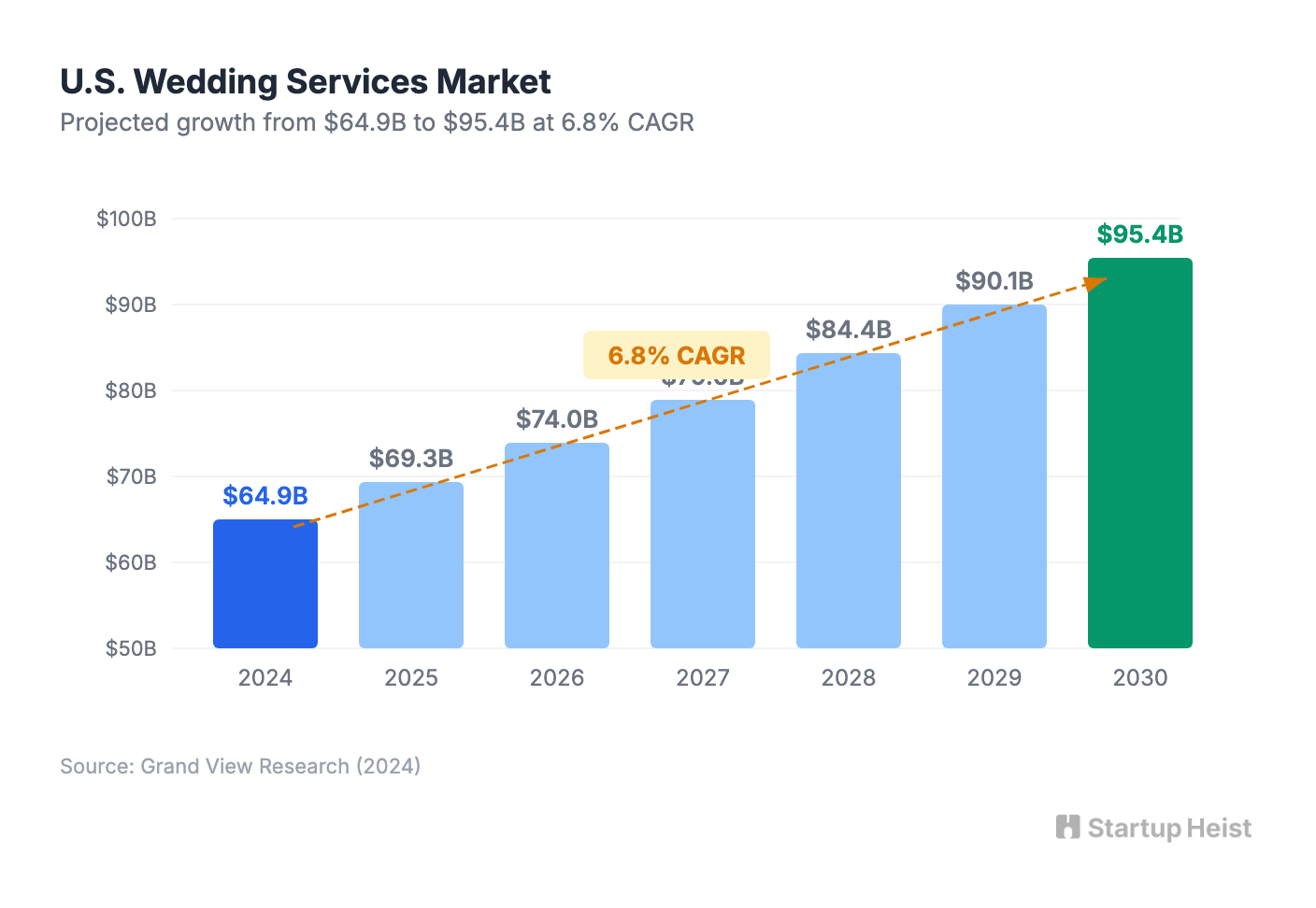
The U.S. wedding services market was worth $64.9 billion in 2024 and is projected to reach roughly $95.4 billion by 2030, according to Grand View Research. The Knot's 2026 Real Weddings Study pegs the average wedding cost at $34,200. These are not small discretionary purchases. Couples are making dozens of medium-to-large buying decisions under emotional pressure, and vendor procurement is where the real friction lives.
Photography alone is expensive enough to support a paid sourcing layer. The most-cited national average for a wedding photographer is about $2,900, though a 2025 survey of working professionals put the real figure closer to $5,800 for a full package. A service that saves a couple ten hours of outreach and helps them avoid one bad-fit vendor can charge $99 per category. This is not a "save me 80%" product. It is a "don't make me run procurement for my own wedding" product.
That gap is wide open.
The money: Photography-only MVP at $99 per search. A solo founder serving 200 couples per month clears $20K MRR before expanding categories.
Inside:
• Why incumbents can't build this
• Photography-first MVP playbook
• Vendor outreach templates that convert
• The data moat behind the service layer
Why Nobody Has Built This Yet
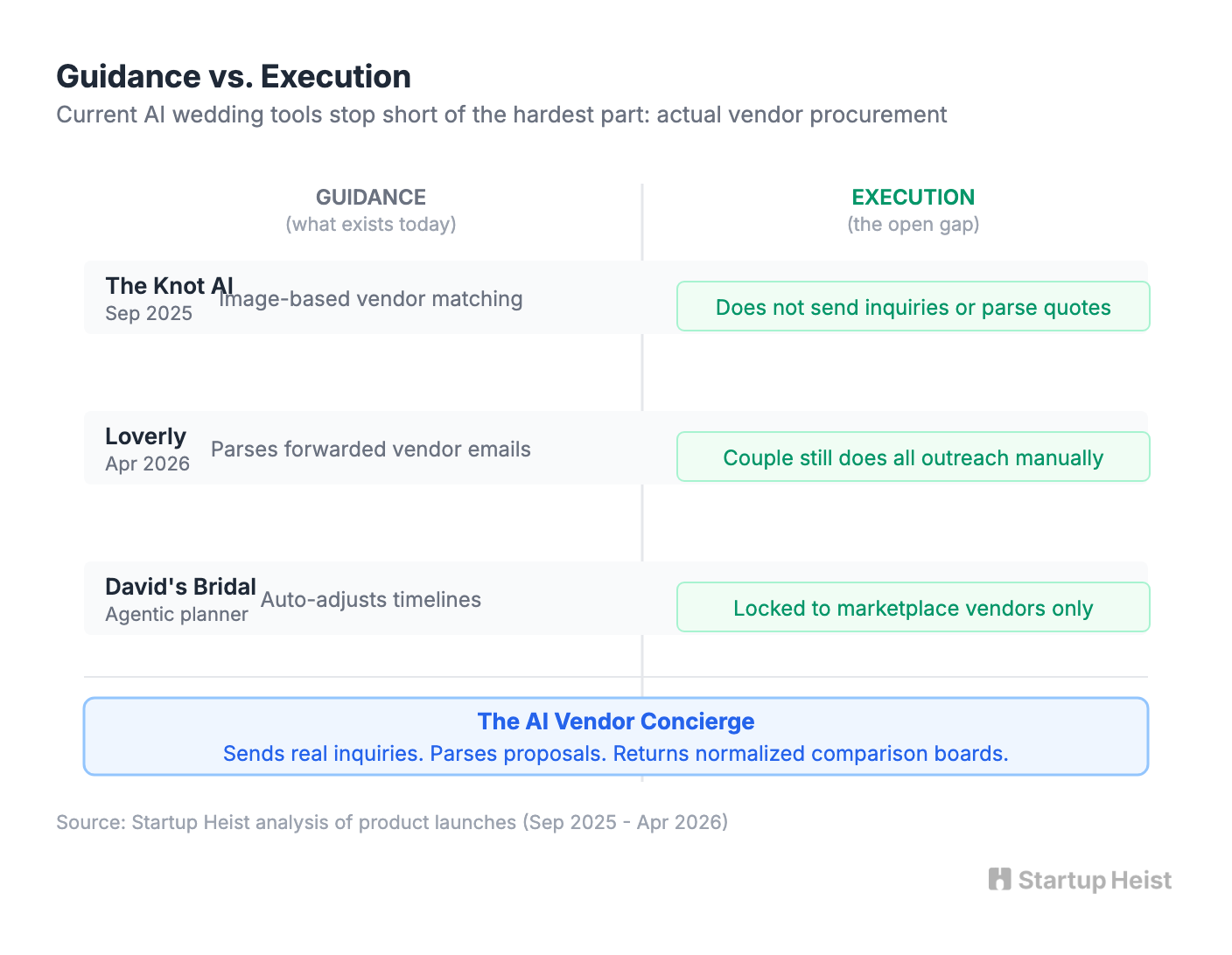
More than half of U.S. couples now use at least one AI tool during wedding planning. The Knot launched AI vendor matching in September 2025, scanning a million images to recommend local vendors. Loverly shipped an assistant on April 3, 2026 that parses forwarded vendor emails into a structured dashboard. David's Bridal rolled out an agentic planner that auto-adjusts timelines and recommendations. All useful. None of them send real vendor inquiries, parse messy PDF packages, or return normalized proposals a couple can actually compare.
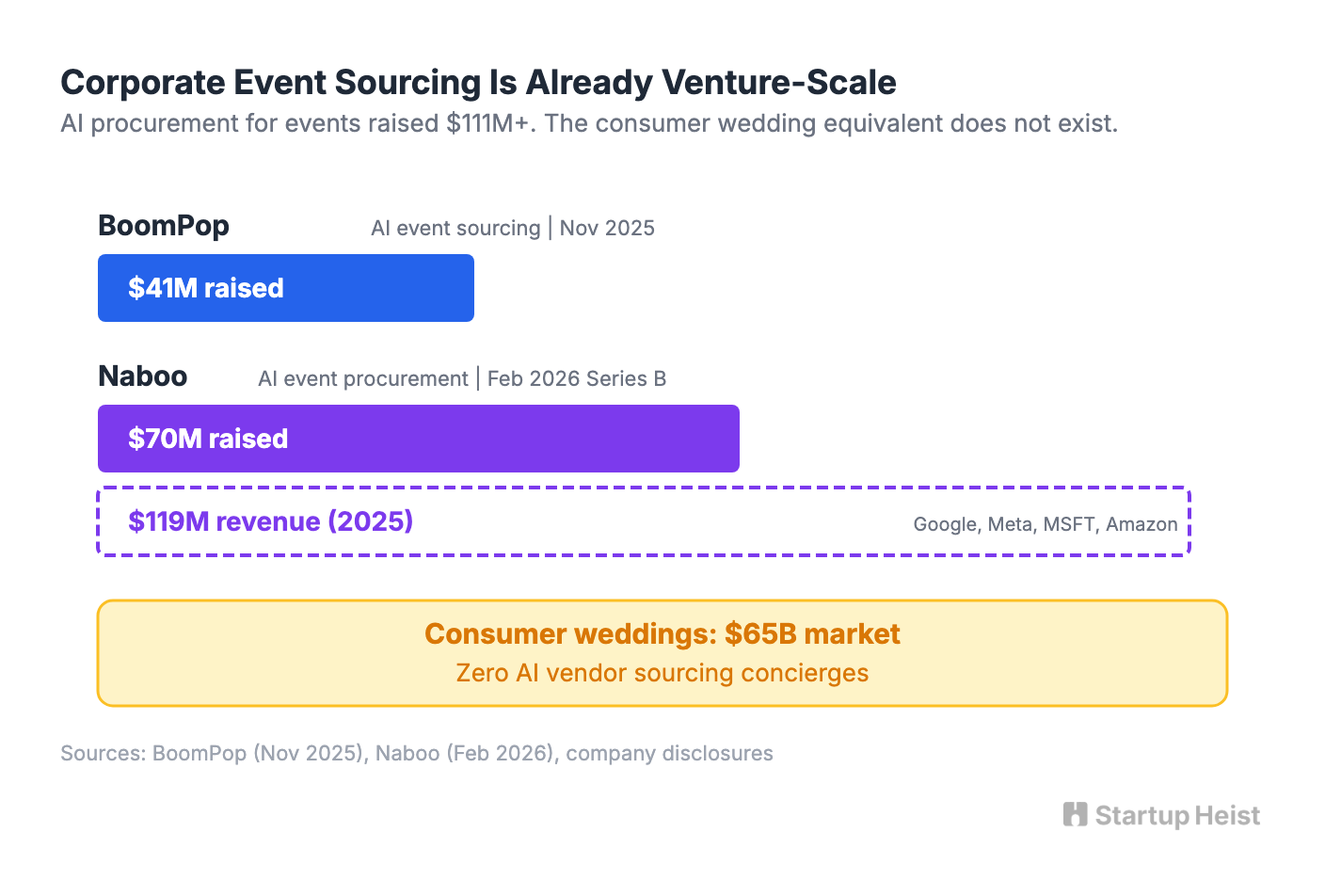
The pattern is consistent: guidance without execution. And the corporate event world already proved demand for exactly this problem. BoomPop raised $41 million in November 2025 for AI-powered event sourcing. Naboo closed a $70 million Series B in February 2026 for AI event procurement, posted $119 million in revenue in 2025, and counts Google, Meta, Microsoft, Amazon, and HubSpot among its clients. Weddings are the consumer version of the same problem: vendor discovery and proposal handling are repetitive, expensive, and structurally messy.
Incumbents have not solved this because of a structural conflict. A marketplace wants leads to stay inside its network. David's Bridal charges vendors $49 to $119 per month for directory access, which limits the pool. A concierge wants the best outcome across the whole market. The couple does not care whether the photographer is a marketplace partner or a solo operator with a terrible website. They care whether the person is available, in budget, and good. The right product works like a vendor-neutral RFP normalizer for one life event.
The Right Tone: Concierge, Not Negotiator
The product should not be framed as a hardball negotiator. Wedding vendors are relationship-driven. Aggressive price-cutting is frowned upon; better outcomes come from scope adjustments, timing flexibility, or package changes. The winning product sources, normalizes, and lightly optimizes offers without acting like an arrogant robot lawyer.
The workflow: collect the couple's inputs once, identify vetted local vendors, send a standardized inquiry, parse every reply into a structured comparison layer, follow up for missing details, ask for realistic concessions where appropriate, and return three credible options the couple could actually book.
More believable, more defensible, and less likely to get your sending domain blacklisted by every photographer in Los Angeles.
Start With Photography, Not "Weddings"
Photography is the cleanest first category. Preferences can be captured in structured inputs: documentary vs. editorial, hours needed, second shooter, travel radius, engagement session, turnaround time. The offer is reasonably parsable: coverage hours, add-ons, gallery delivery, overtime rate, travel fee, deposit terms. Compared with florists, photography has fewer custom moving parts. Compared with venues, the contracts are less legally loaded.
You are not launching "AI Wedding Concierge." You are launching "Get 3 wedding photographer options that actually fit." Cleaner promise, faster conversion.
The MVP Playbook
Keep the first version brutally narrow. Wedding photographers only. Three to five major metros. Three bookable proposals or a transparent refund policy. Polite procurement tone. Agent-assisted, human-supervised automation.
The workflow:
Unlock the Vault.
Join founders who spot opportunities ahead of the crowd. Actionable insights. Zero fluff.
“Intelligent, bold, minus the pretense.”
“Like discovering the cheat codes of the startup world.”
“SH is off-Broadway for founders — weird, sharp, and ahead of the curve.”


