


The AI sidecar for America's 58,000 independent vet clinics
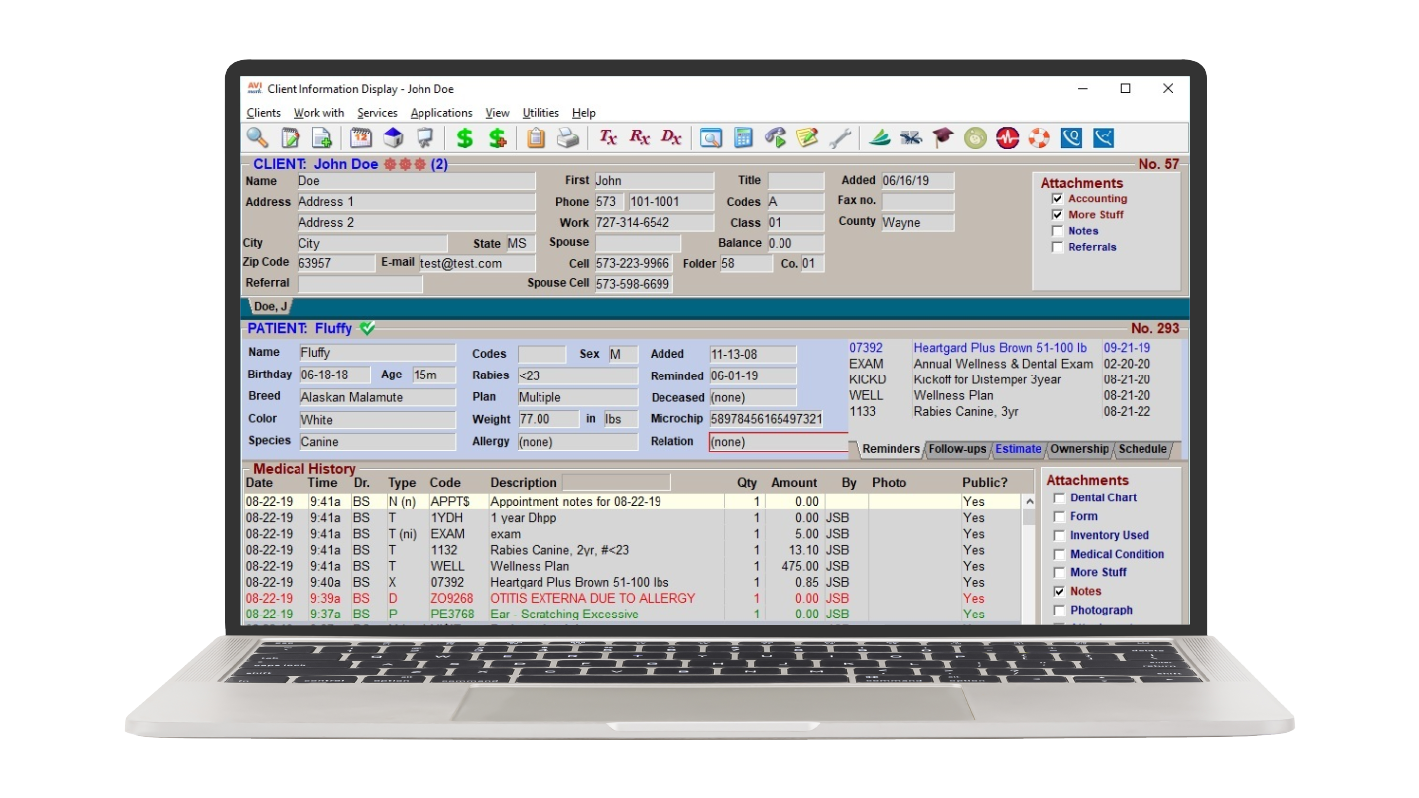
Most veterinary software still looks like an accounting system with a stethoscope taped to it.
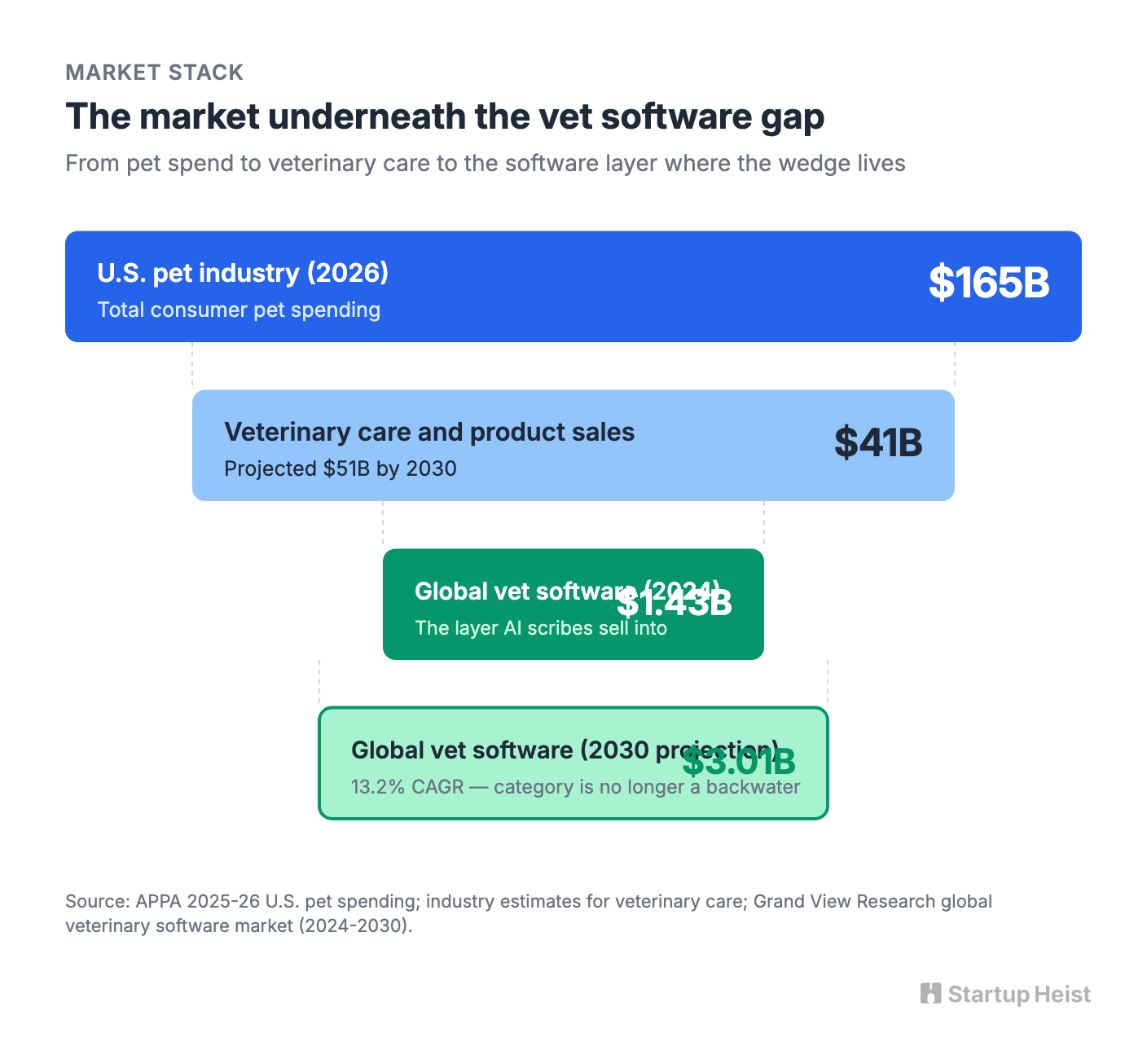
The market underneath that gap is enormous. U.S. pet spending reached $158 billion in 2025 and is projected at $165 billion in 2026, with veterinary care and product sales running past $41 billion annually and on track for $51 billion by 2030. IBISWorld counts 57,920 veterinary services businesses operating in the U.S. in 2026. It's a large, fragmented, emotionally high-stakes market served by a huge number of clinics still running legacy practice management systems and after-hours charting.
Most founders try to build the next veterinary operating system. That's a three-year project of rebuilding billing, inventory, scheduling, reminders, reporting, and lab integrations, at the end of which you're competing with incumbents who already own the workflow. The narrower opening is the one worth taking.
Here's the opportunity:
The money: 300 clinics at ~2.5 vets each and $120 ARPU per seat clears $90K MRR. Digitail just raised $23M chasing the broader platform.
Inside:
• Three-feature MVP that ships in weeks
• Per-vet pricing ladder from $99 to $699
• Cold-call GTM with script and email
• Five-layer moat around trust and workflow
Documentation during the exam. Species-specific medication safety. Client communication immediately after the visit. Every incumbent still does those three things badly, and every independent vet feels each of them acutely every single day.
Build there.
Why this category exists now
Veterinary medicine has the same structural problem human medicine had before AI scribes took off. Clinicians are doing expensive cognitive work, and a meaningful slice of their day is consumed by documentation, formatting, and repetitive explanation. AI scribe vendors in the category now publicly report saving veterinarians 8 to 10 minutes per SOAP note and upward of 10 hours per DVM per week. At a solo clinic, that's essentially a second half-day of capacity.
The software market around these clinicians is growing. Grand View Research puts the global veterinary software market at $1.43 billion in 2024, reaching $3.01 billion by 2030 at a 13.2% CAGR. Other analysts publish different totals and slopes. The exact number matters less than the direction. Veterinary software is no longer a backwater.
The installed base tells the more important story. Server-based systems still run more than half of U.S. practices, and Avimark (owned by Covetrus) and Cornerstone (owned by IDEXX) remain the dominant entrenched products. Academic and industry reports have been tracking the same three-horse race (Avimark, Cornerstone, Impromed) for nearly two decades. The core system of record is old, sticky, and not getting ripped out this year or next. Even in cloud, the two PIMS giants already hold about 79% share through IDEXX's Neo and ezyVet and Covetrus Pulse, which means any new platform play runs straight into their distribution.
That shapes the startup pattern. Don't replace the PMS. Sit beside it. Make the vet faster. Export cleanly.
Why the window is open right now
Timing is good, though not because the category is empty. It's good because the market just started to wake up and the incumbents and AI-scribe pioneers are already getting pulled toward platform consolidation, which leaves the sharpest, cheapest wedge for independents wide open.
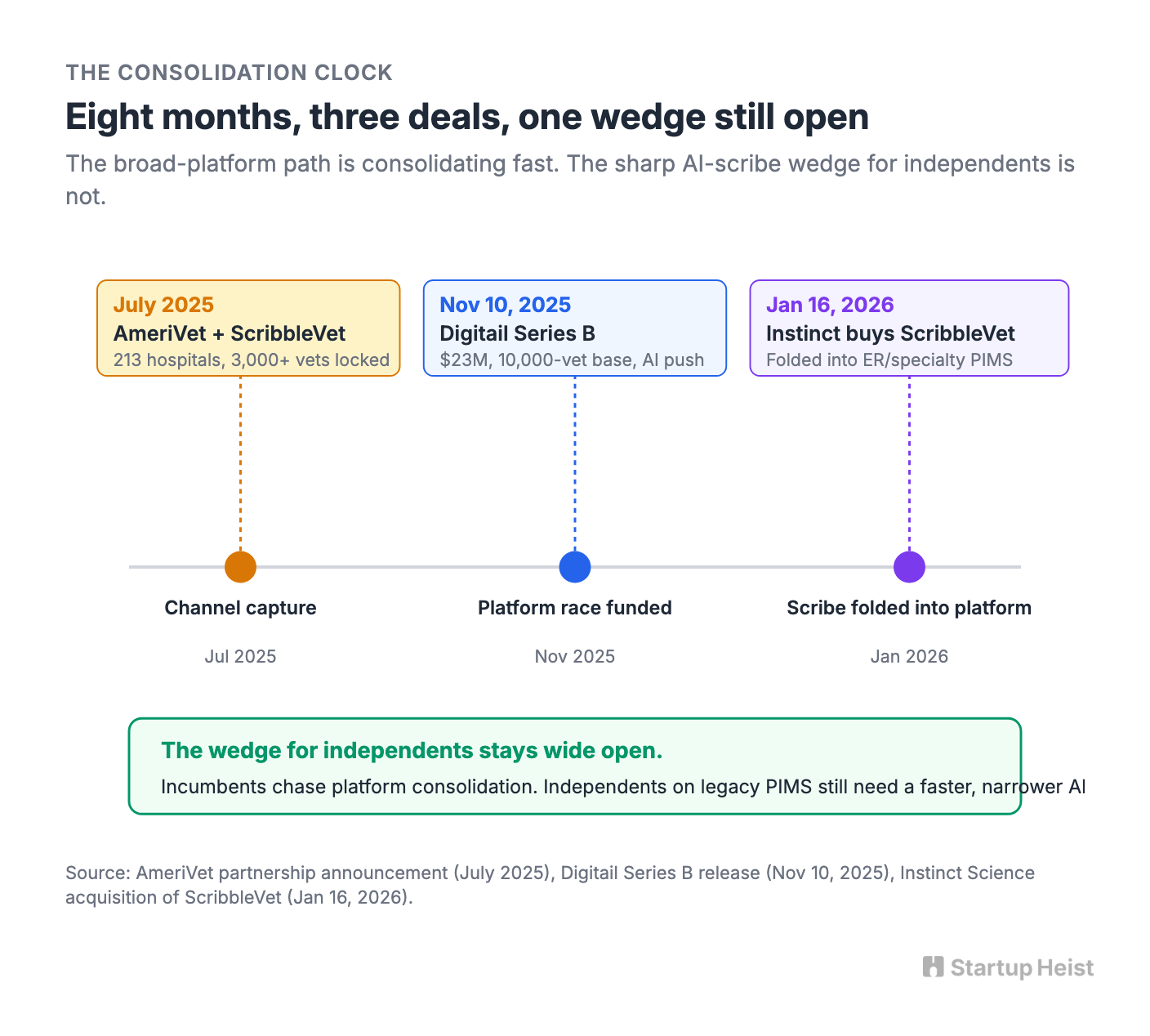
On November 10, 2025, Digitail raised a $23 million Series B led by Five Elms Capital, pushing total funding past $37 million and explicitly earmarking the capital for AI workflow expansion across its 10,000-vet customer base. Two months later, on January 16, 2026, Instinct Science acquired ScribbleVet and announced it as "the first AI scribe powered by Plumb's," folding the product into an emergency and specialty PIMS rather than keeping it as a standalone tool for small independents. VetRec has pushed in the same direction, expanding from SOAP generation into a broader "D.A.V.I.D. AI Agent" and PIMS-transfer integrations. The category is clearly consolidating toward clinical intelligence platforms. The sharpest wedge for independents is not.
Practice ownership is shifting at the same time. Corporate consolidators now own roughly 25 to 30% of U.S. veterinary practices by count, up sharply over the past few years, and corporate groups control an estimated 75 to 80% of all specialty and emergency hospitals. That consolidation also carries distribution risk for new entrants. AmeriVet's July 2025 partnership with ScribbleVet locked in 213 hospitals and more than 3,000 vets in a single deal, which means corporate channels can be closed to a newcomer before the newcomer ever reaches scale. The independents left on legacy tooling are being squeezed at the same time they're losing access to those bulk agreements.
When a market consolidates like this, independents rarely buy giant transformation projects. They buy small tools that let them survive without adding headcount. That's where this business lives.
The wedge: AI scribe plus veterinary trust layer
The right version of this business is narrower than founder instinct wants it to be. Do three things only. Voice-to-SOAP during or right after the exam. Vet-specific drug interaction and medication sanity checks. Auto-drafted client updates by SMS or email. Skip inventory, scheduling, payments, a full PIMS, AI for the whole practice. Just solve the part the doctor feels every day.
The product promise should be blunt enough to fit on a billboard. Talk for 45 seconds after the visit, get a usable SOAP note, a medication cross-check, and a client-ready summary before the next room. Vets will buy that.
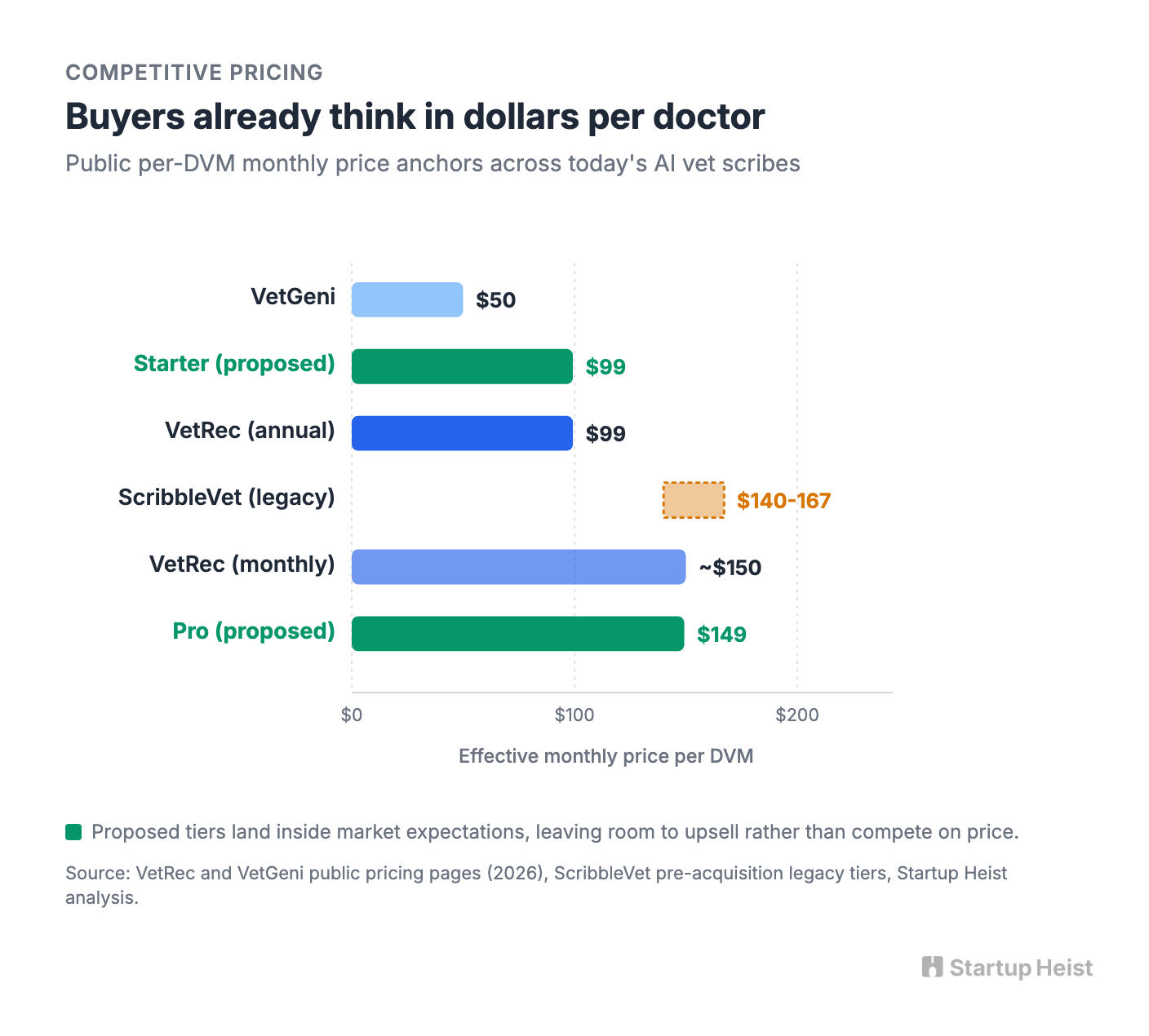
Pure transcription is already a crowded category. As of 2026, the field includes VetRec, ScribbleVet (now Instinct-owned), VetGeni, Scribenote, CoVet, Bittsi, HappyDoc, ScribVet, Digitail, and a handful of adjacent players. Public pricing anchors expectations low. VetRec lists $99 per DVM per month on annual billing (roughly $150 monthly), with support staff included. VetGeni publicly starts at $50 per month per doctor. ScribbleVet's legacy tiers worked out to roughly $140 to $167 per DVM at a typical small clinic before the Instinct acquisition. A generic "we also do SOAP notes" product gets buried here, and the instinct to price flat at $399 per clinic leaves real money on the table.
Having AI isn't the opening. Having veterinary-specific confidence is.
Human-medical tools don't natively understand species context, dose ranges, breed-specific considerations, or the practical reality that vets have to translate clinical reasoning into something an anxious owner will actually follow at home. That gap is the product. The real moat isn't a smarter model. It's better veterinary prompting and note structure, a clinician approval loop, species-aware medication checks, and a licensed reference layer. Plumb's is the best-known veterinary drug monograph product, and Instinct has now tied it exclusively to ScribbleVet. A new entrant should license Plumb's where possible, but build the broader trust stack around the Merck Veterinary Manual, WSAVA guidelines, and species-specific formularies. That layered reference foundation is defensible in a way generic transcription never will be.
Who actually buys this
This is a focused vertical SaaS for small U.S. clinics. The buyer profile looks like this:
- 1 to 5 doctor small-animal practices
- Independent hospitals still on Avimark, Cornerstone, or another legacy PIMS
- Clinics where doctors chart after hours
- Practices too small to justify a full platform migration
You're not selling AI transformation. You're selling fewer hours finishing records, cleaner notes, fewer medication mistakes, better client follow-through, and a more professional post-visit experience. That's a much easier purchase than any platform play.
Pricing: follow the market, then undercut on value
The category has taught buyers to think in per-clinician dollars rather than per-clinic. Fight that and you lose the first meeting. Match it and you get the seat, then expand. Follow this price table closely to start:
Unlock the Vault.
Join founders who spot opportunities ahead of the crowd. Actionable insights. Zero fluff.
“Intelligent, bold, minus the pretense.”
“Like discovering the cheat codes of the startup world.”
“SH is off-Broadway for founders — weird, sharp, and ahead of the curve.”


