


The next wave of legal AI software won't be won by the flashiest drafting demo. It'll be won by the software that explains where the money went.
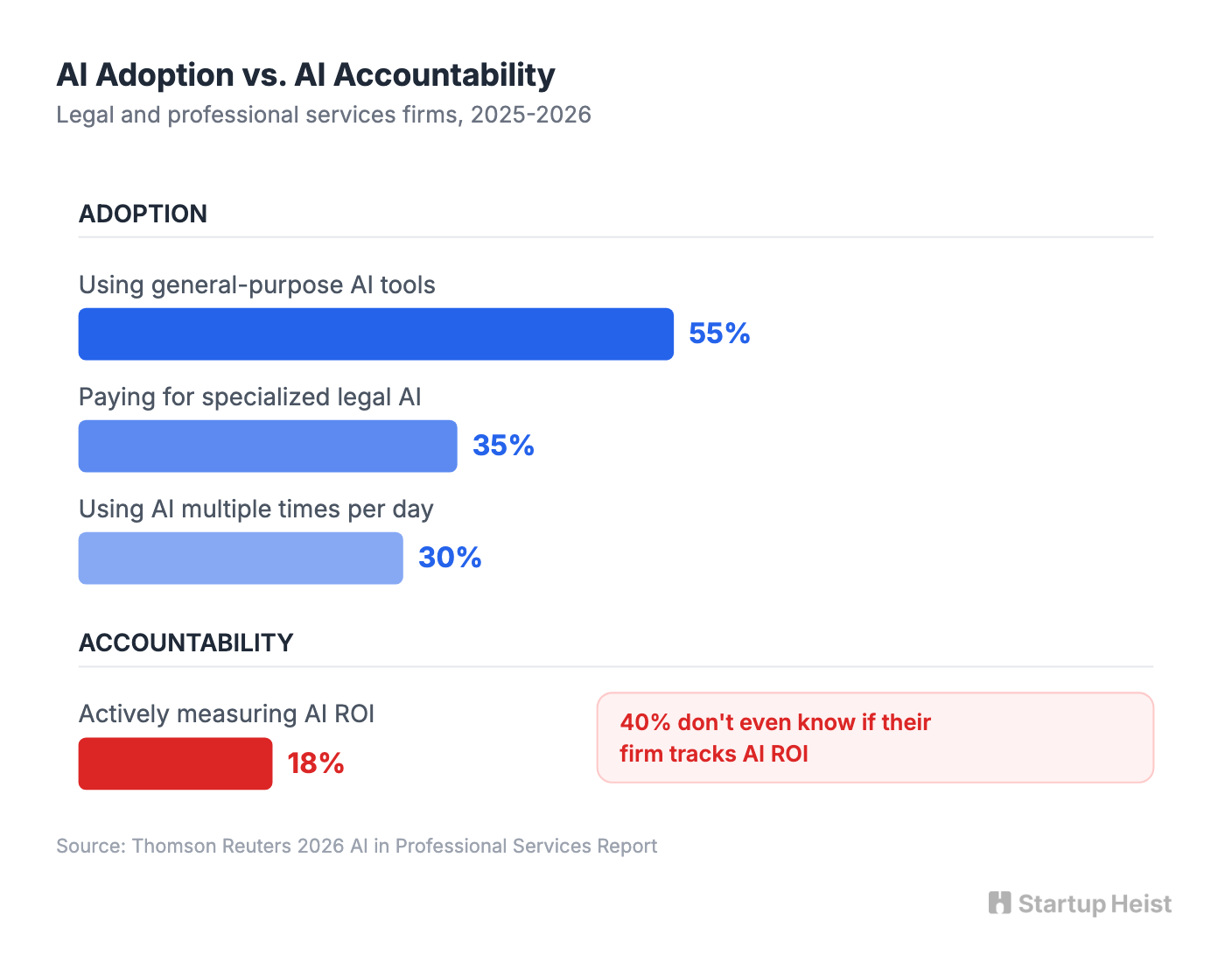
Law firms and accounting firms have crossed the AI adoption threshold. Thomson Reuters' 2026 AI in Professional Services report shows 55% of firms using general-purpose AI tools, 35% paying for specialized legal products, and 30% of professionals using AI multiple times a day. The usage is real. But most firms can't answer basic questions about it: which matters are consuming the most AI spend, which tasks should run on a cheaper model, and when a client asks what AI contributed to a bill (as ABA Formal Opinion 512, issued July 29, 2024, suggests they increasingly will), who at the firm can explain it clearly?

The measurement gap is enormous. Only 18% of organizations measure AI ROI at all, and 40% of respondents don't even know if their firm tracks it. Organizations with a formal AI strategy are more than 3x as likely to achieve positive ROI. The difference comes down to knowing what you're spending, where, and whether it's working. Most firms are flying blind.
The money: 20 mid-market firms at $3K-$5K/month gets you to $60K-$100K MRR. No direct competitor occupies this niche as of Q1 2026.
Inside:
• Matter-level AI spend attribution
• Model routing and budget rules
• ABA 512-compliant billing narratives
• 90-day build plan and go-to-market
Build a vertical AI cost governor for mid-sized law and accounting firms. A billing-native control layer that attaches AI usage to client, matter, engagement, task code, and user; applies routing and budget rules; and generates invoice-ready legal AI billing narratives that explain what AI did, what humans reviewed, and why the charge is reasonable. Turn AI from an invisible overhead line into a governed, attributable operating cost.
Why the Timing Is Right
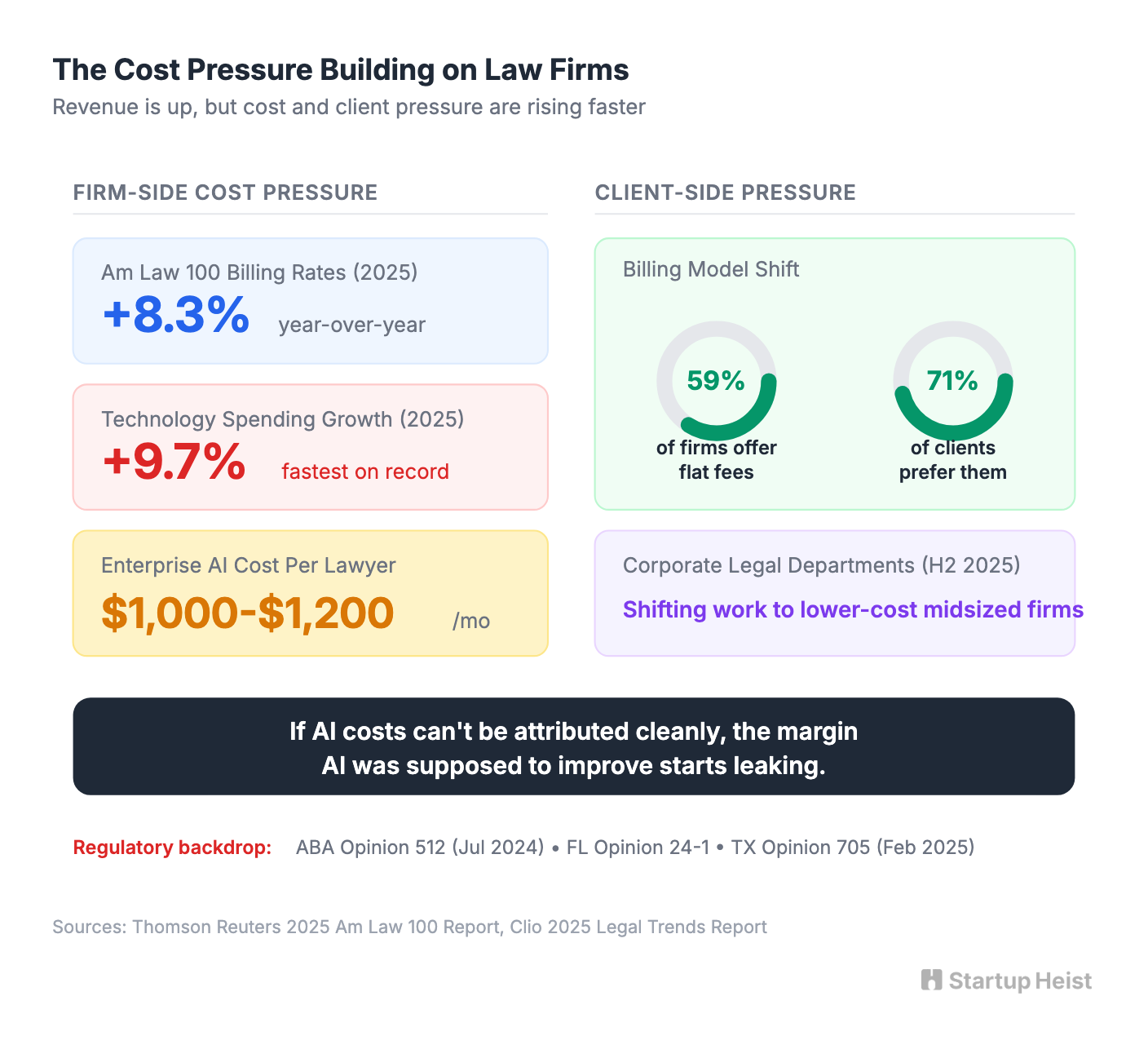
Billing rates at Am Law 100 firms rose 8.3% in 2025. Firms are still profitable. But that stability is sitting on a structural shift. Technology spending jumped 9.7% in 2025, the fastest real growth the legal industry has experienced, driven largely by AI seats running $1,000 to $1,200 per lawyer per month at enterprise scale.
Clients are pushing back. Corporate legal departments shifted work toward lower-cost midsized firms in the second half of 2025. "AI discounts" are appearing in 2026 RFPs. And the billing model itself is changing: Clio's 2025 Legal Trends Report shows 59% of firms now offer flat fees alongside or instead of hourly billing, with 71% of clients preferring flat fees. Once a firm moves even part of its work away from hourly billing, cost per matter becomes critical. If AI costs can't be attributed cleanly, the margin AI was supposed to improve starts leaking.

The regulatory pressure is accelerating too. ABA Formal Opinion 512 requires lawyers to secure informed consent before using client information in AI tools and disclose AI involvement when it affects the basis for a fee. That's the national standard. At the state level, Florida's Opinion 24-1 mandates disclosure when AI impacts billing. Texas issued Opinion No. 705 in February 2025 with similar requirements. The AI governance obligation for legal billing is becoming multi-jurisdictional, and most firms don't have a consistent disclosure story.
The Governance Gap
Horizontal observability vendors already track tokens by user, feature, and request. Traceloop's OpenLLMetry has roughly 7,000 GitHub stars and instruments AI calls using the OpenTelemetry standard. But law firms don't think in "cost per feature." They think in client, matter, engagement, task code, write-off risk, and realization rate. The existing tools speak infrastructure. Firms need tools that speak legal operations.
The vertical players are consolidating, not expanding into AI attribution. BigHand sells matter pricing software and reports that 70% of firms using matter budgets see realization improve by 9% or more. Apperio, which connected over 250 firms to real-time spend analytics, was acquired by PERSUIT in May 2025. Both prove buyers care about matter-level financial governance, but neither owns AI usage attribution, model routing, or billing narratives. As of Q1 2026, nobody is building a dedicated AI cost management layer for law firms. The gap is real and unoccupied.
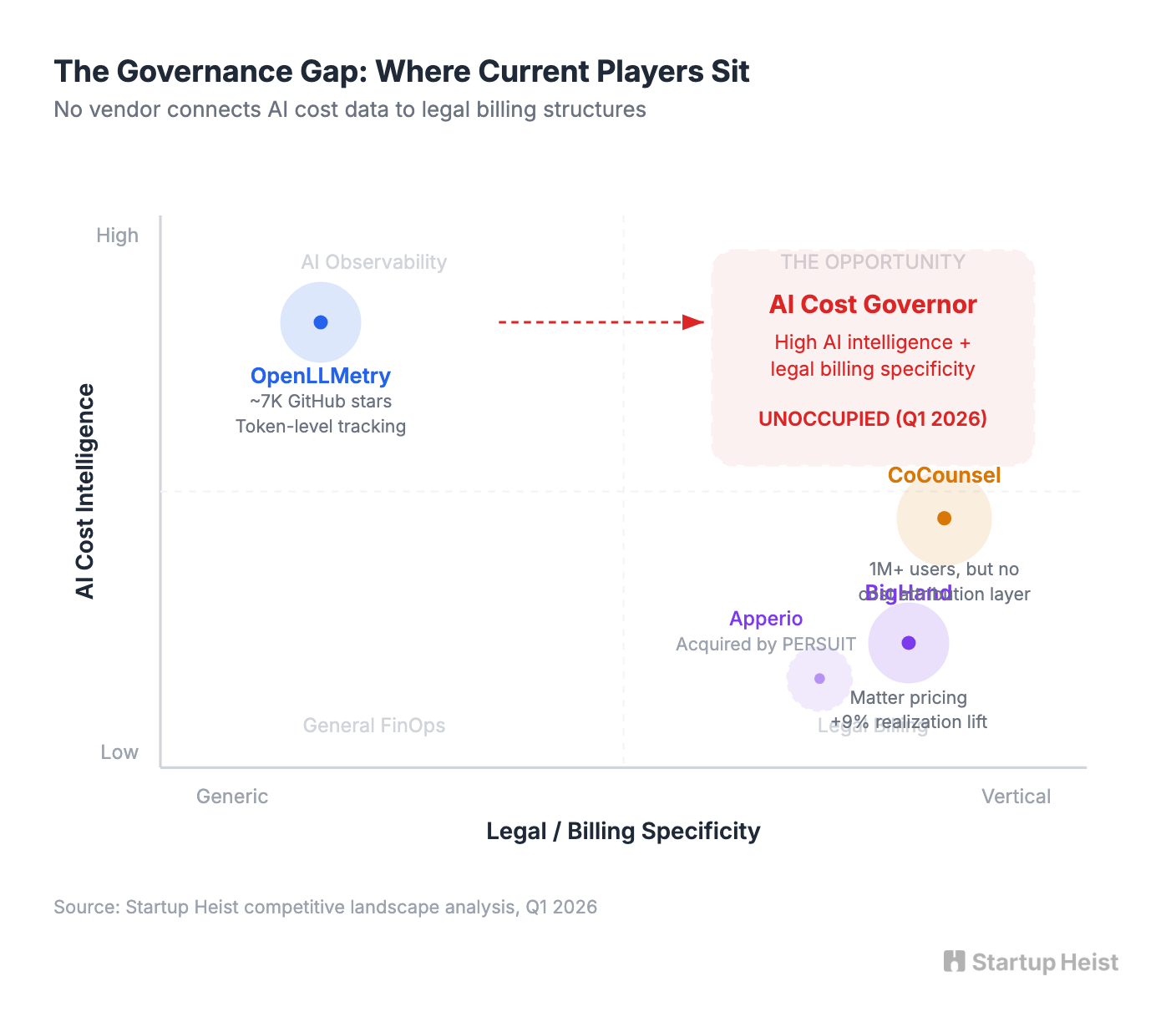
Nobody sits between the AI tool and the billing system. The firm that closes that gap doesn't need to replace existing tools. It needs to fill the blind spot they all share: what did AI cost on this matter, and how do we explain it on the invoice?
What the Product Does
The MVP is a governed ledger. Four layers, each building on the last.
Layer 1: Capture. An API proxy sits in the path of AI usage, recording model, token counts, latency, user, and application source for every request. OpenTelemetry-style instrumentation provides the engineering pattern.
Unlock the Vault.
Join founders who spot opportunities ahead of the crowd. Actionable insights. Zero fluff.
“Intelligent, bold, minus the pretense.”
“Like discovering the cheat codes of the startup world.”
“SH is off-Broadway for founders — weird, sharp, and ahead of the curve.”


