


The Boring Channel Arbitrage
In January 2026, YouTube terminated sixteen channels in a single enforcement wave. Between them they held roughly 35 million subscribers, 4.7 billion lifetime views, and an estimated $10 million in annual advertising revenue. The largest was an AI animation channel with nearly six million subscribers. Across the preceding six months, YouTube's automated systems removed something on the order of 130,000 channels for the same offense: mass-produced content assembled with no meaningful human contribution. CEO Neal Mohan had named AI slop a platform priority in his January 2026 annual letter, and the terminations were the proof.

The wave wasn't indiscriminate, and the pattern in what it killed is worth more than the warning. Everything that died was competing for cheap attention: brainrot compilations, synthetic animation, recycled listicles narrated by a text-to-speech voice. YouTube CPMs in those categories were already terrible. The niches where advertisers pay most per viewer went untouched, because almost nobody was building there.
The gap is real. So is the trap sitting inside it, which has already swallowed a lot of people who read the same CPM chart you're about to read.
The short version:
The money: A channel at 125,000 monthly views stacks ads, two sponsors, affiliate, and a paid briefing into roughly $8,250 a month.
Inside:
• Three repeatable formats and a 12-video test
• Five-stage ladder from ads to owned products
• A 90-day launch plan for the first videos
• Expert and sponsor outreach templates
The gap the purge left behind
Advertising rates on YouTube are set by auction, so the price of a viewer measures how many advertisers want that particular person. Wealth managers, insurers, and lenders crowd the same finance audience and bid each other up. A thousand teenagers watching Minecraft draw a much thinner field.
The spread is enormous. Industry CPM tracking for 2026 puts finance content at $15 to $50 per thousand ad impressions, insurance at $12 to $38, legal at $10 to $35, and tax and accounting content aimed at self-employed viewers at $15 to $30. Gaming and general entertainment sit at $1 to $8. A finance channel can earn ten times what a gaming channel earns on identical view counts.
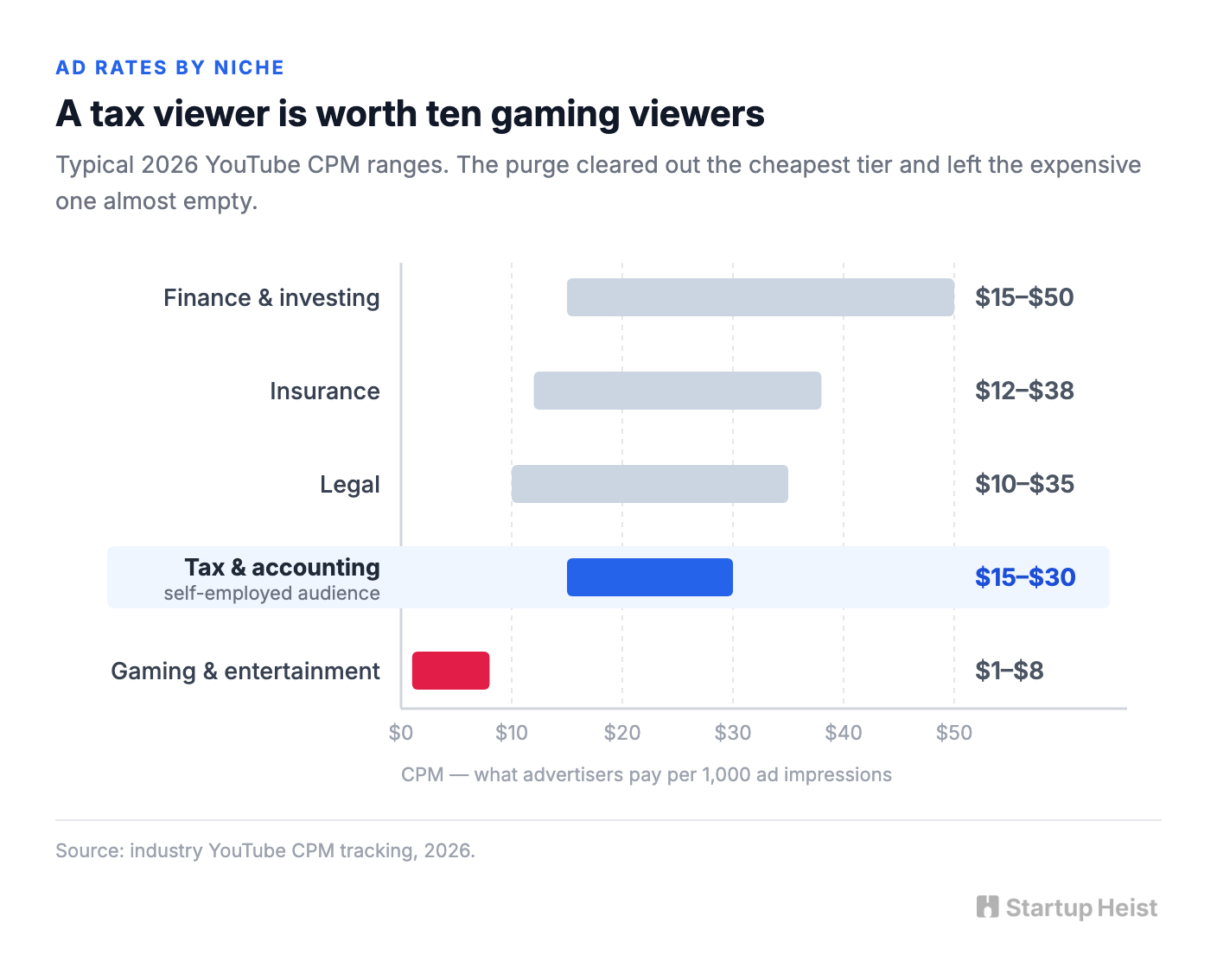
Every "highest paying YouTube niches" article on the internet says exactly this, which is why the obvious conclusion has already been tried at scale and mostly failed. That conclusion arrives in one sentence: use AI to mass-produce faceless videos in high-CPM niches and collect premium ad revenue. Using AI is fine. Mass-producing is what got 130,000 channels deleted.
YouTube rewrote the rule in July 2025, renaming its "repetitious content" policy to "inauthentic content" and declaring mass-produced and templated material ineligible for monetization. Generic narration over interchangeable stock footage stopped being a low-quality strategy and became a platform risk. Faceless channels have been hit hardest since, and creators caught in the collateral damage report that the recommendation system now favors a human presence.
What survives that filter is a small professional publication that happens to distribute through YouTube, using AI for the mechanical work and human judgment for everything else.
The CPM trap
A $35 CPM does not mean you earn $35 per thousand views, and nearly every plan built on high-CPM niches quietly assumes it does.
CPM is what advertisers pay per thousand ad impressions, before YouTube takes its cut. YouTube keeps 45% of watch-page advertising revenue and pays creators 55%. Plenty of views never carry an ad at all: a viewer with an ad blocker, a Premium subscriber, a video the auction skipped.
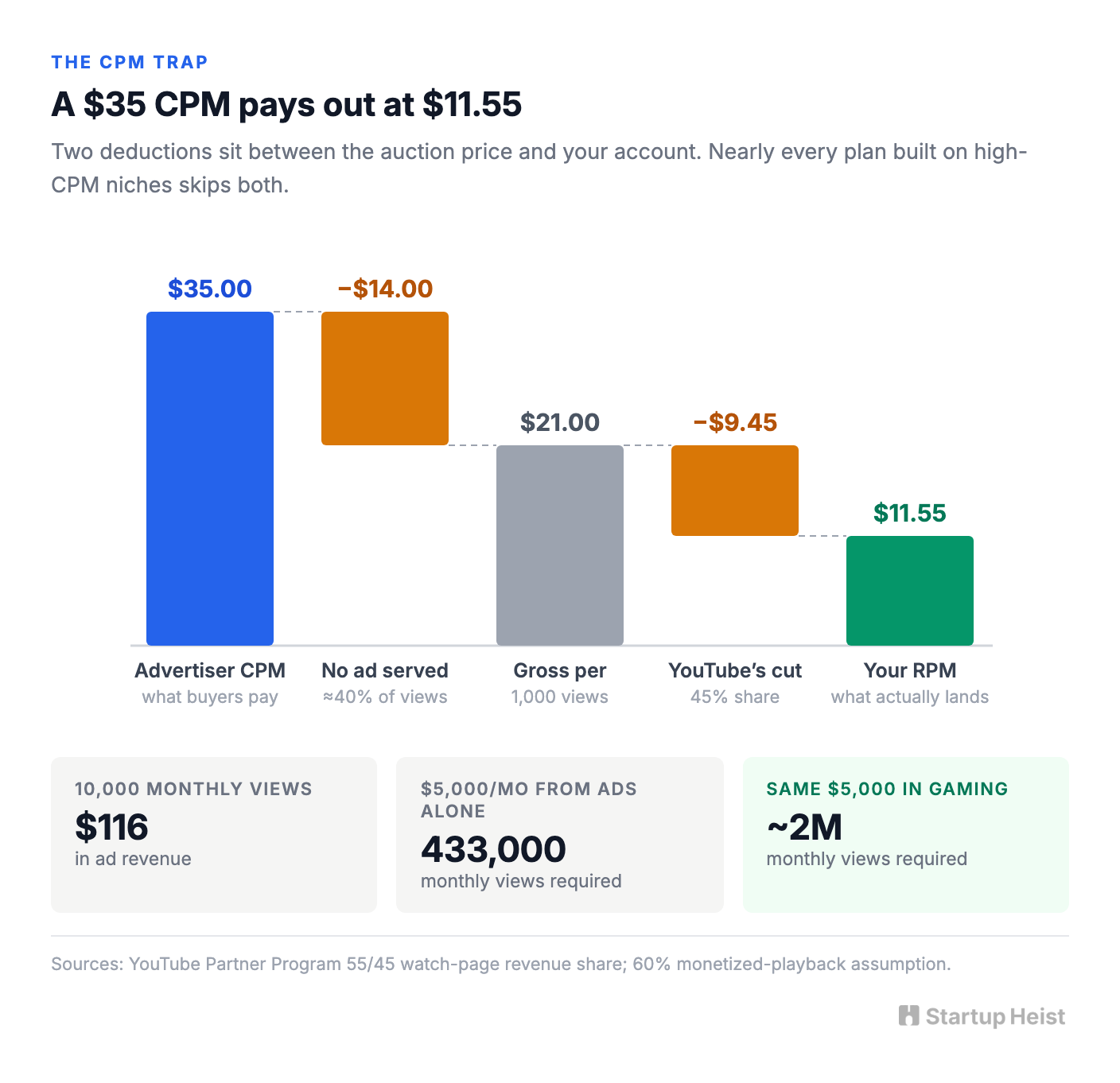
RPM is the number that lands in your account. On a channel where a $35 CPM is realistic:
- Advertiser CPM: $35
- Share of views that produce a monetized playback: 60%
- Creator share: 55%
$35 × 0.60 × 0.55 = $11.55 RPM
Real performance swings around that in both directions: some playbacks carry multiple ads, U.S. viewers monetize differently from international ones, and December advertiser demand can be double January's.
Ten thousand monthly views at an $11.55 RPM produces about $116. Earning $5,000 a month from advertising alone would take roughly 433,000 monthly views. Still a far better deal than entertainment, where the same $5,000 might require two million views, and still the weakest of the four or five revenue lines a channel like this should eventually run. The durable version stacks YouTube ads, direct sponsors, affiliate revenue, an email list, and owned products. Established channels almost universally build revenue off-platform for a structural reason: ad revenue is the line you control least.
Why tax is the wedge
Three categories look attractive at first glance: small-business tax, insurance education, and small-company M&A. Only one is a sane place to start.
Insurance carries the richest advertiser demand and the heaviest regulatory load. State regulators license anyone who sells, solicits, or negotiates insurance, and the rules governing sales and marketing vary jurisdiction by jurisdiction. M&A viewers are extraordinarily valuable and extraordinarily scarce; the audience for SBA acquisition financing and quality-of-earnings reports will never produce tax-channel volume. Both make sense as second acts once an audience exists.
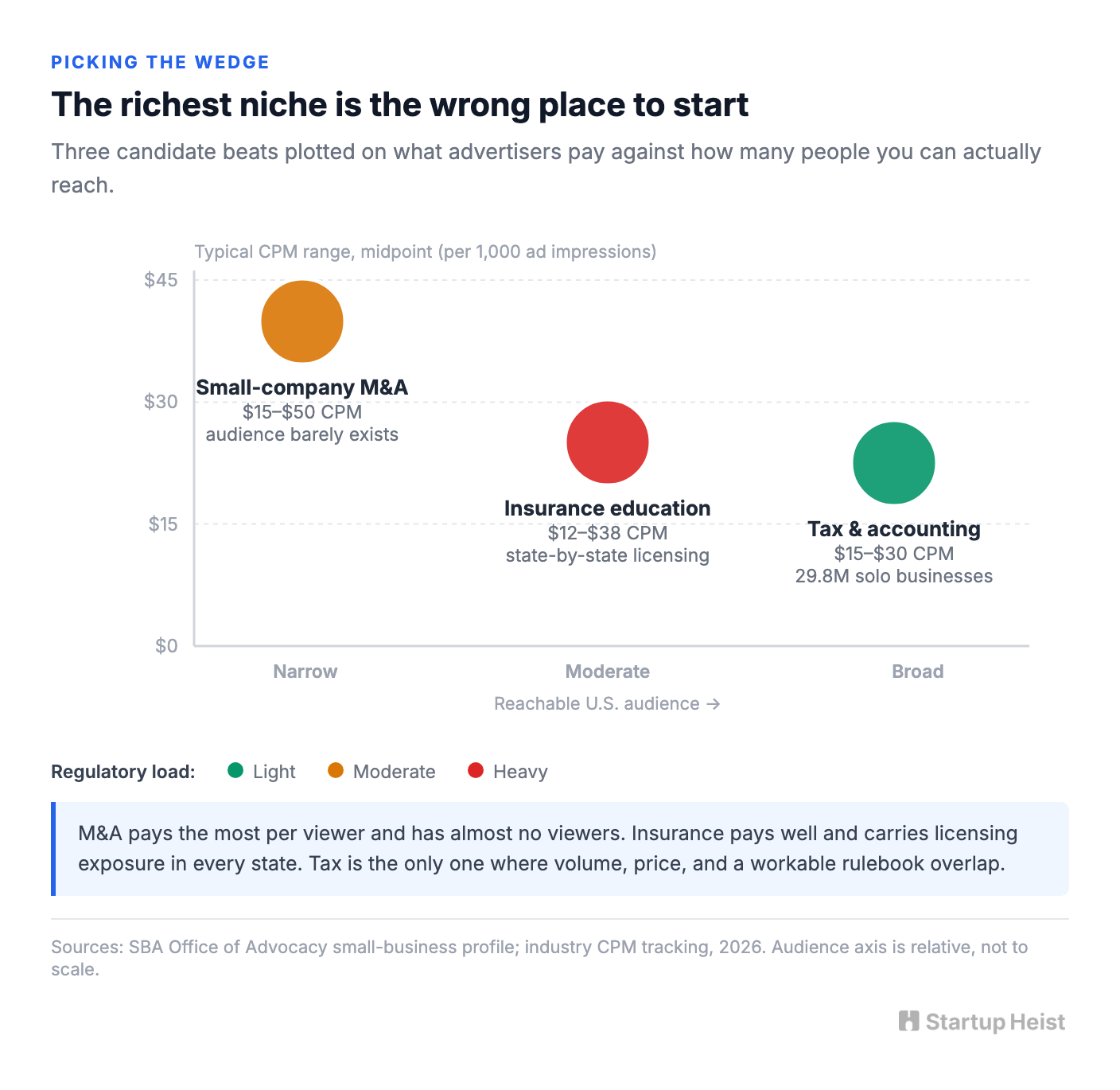
Tax wins the opening because the audience is enormous, the calendar generates topics on its own, and the rules keep changing in ways that cost owners real money. The SBA's Office of Advocacy counts 36,207,130 small businesses in the United States, of which 29,811,495 have no employees at all. That's 82% of the total: freelancers, contractors, agency owners, landlords, e-commerce operators, and solo practices, all facing decisions they don't fully understand every year.
And 2026 is an unusually loud year:
- Section 179 expensing caps at $2.56 million, phasing out dollar-for-dollar above $4.09 million of qualifying property and gone entirely at $6.65 million. SUVs between 6,000 and 14,000 pounds cap at $32,000.
- One hundred percent first-year bonus depreciation is permanent for qualifying property acquired after January 19, 2025.
- The state and local tax deduction cap is $40,400, phasing down 30 cents on the dollar above $505,000 of modified AGI to a $10,000 floor around $606,333.
- The employer-provided childcare credit now covers 50% of qualified expenses, capped at a $600,000 credit, for businesses under $32 million in average annual gross receipts.
Every one of those is a decision with money attached: a landscaping company weighing a truck purchase in December against January, an agency owner wondering whether an S corp election is worth the payroll headache. Advertisers pay a premium to reach people in exactly that state.
Who already owns this ground
The small-business tax niche isn't empty, which is the part the CPM articles leave out. Karlton Dennis has built past a million subscribers explaining tax strategy, and Mark J. Kohler has been at it for decades. LYFE Accounting, Navi Maraj, and a long tail of CPAs and enrolled agents run competent channels with real audiences. Almost every one is a practicing professional using YouTube as the top of a funnel for their own firm, course, or coaching program. The content is often genuinely good. It also exists to convert you into a client.
So the opening is specific. Nobody is running this beat as an independent publication. There's no Morning Brew for owner-operator tax, no outlet that can say "this strategy is being oversold on TikTok, and here's the math" without a book to sell at the end of the sentence. Editorial independence is a product feature in a category where every other voice is selling something, and it's the only thing here that a competitor can't buy with a better editor and a bigger budget.
The channel: Owner's Tax Desk
Call the concept Owner's Tax Desk. Its reader is narrow on purpose: the owner-operator running a real business who wants to make a better financial decision this quarter.
Unlock the Vault.
Join founders who spot opportunities ahead of the crowd. Actionable insights. Zero fluff.
“Intelligent, bold, minus the pretense.”
“Like discovering the cheat codes of the startup world.”
“SH is off-Broadway for founders — weird, sharp, and ahead of the curve.”


