


The Compliance Stack Nobody Wants to Build
On June 30, 2025, New Jersey Governor Phil Murphy signed P.L. 2025, c.72 into law, ending the state's decades-long requirement that public entities publish legal notices in newspapers. Starting March 1, 2026, every municipality, county, school district, fire district, authority, and commission in New Jersey must publish the full text of legal notices on its own official website, free of charge. Each entity needs a dedicated legal-notices page with a conspicuous homepage link, an online archive retained for at least one year, and proof-of-publication records.

The timing was deliberate. The Star-Ledger, New Jersey's largest daily newspaper, ceased printing in February 2025. The infrastructure that carried legal notices for generations was already gone, and the state needed a statutory alternative before municipal compliance fell through the cracks.
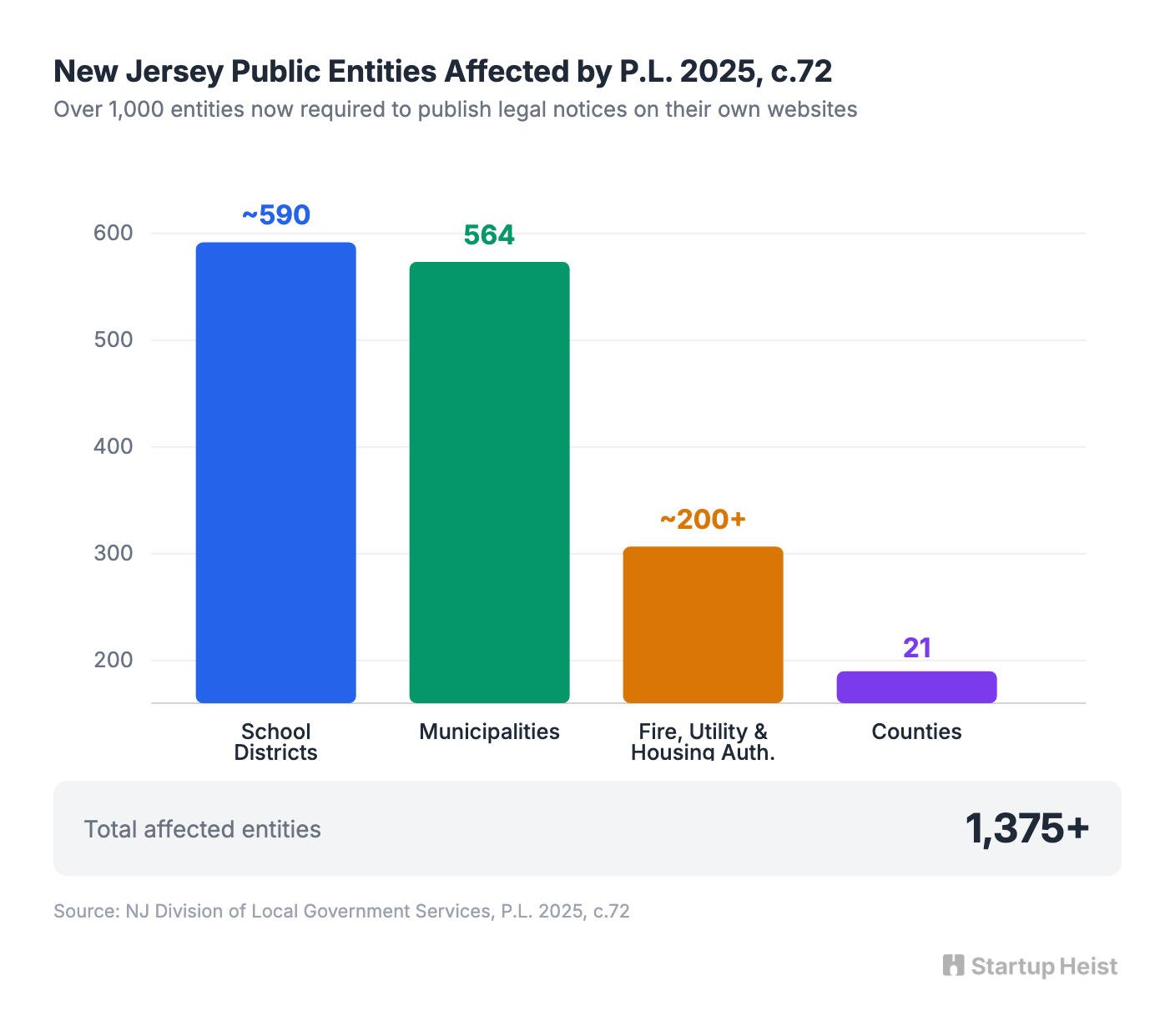
That deadline passed a month ago. Over a thousand public entities in New Jersey are now on the hook, and many still don't have a compliant system in place.
The money: 100 entities at $2,000/year = $200K ARR. Over 1,000 NJ public entities are affected, with no dedicated SaaS product in market.
Inside:
• Five-component MVP scope and build order
• Channel-first GTM through resellers
• Three-tier public-entity pricing model
• Multi-state expansion playbook
Why This Wedge Works
Other states have moved public notices online. Florida passed HB 7049 in 2022, but that law was opt-in and conditional, giving agencies the choice to publish on county websites only if it cost less than newspaper placement. Colorado and Tennessee have reform efforts underway. New Jersey's version is mandatory and the most prescriptive: current-notice pages, homepage links, archive requirements, and a transitional mandate requiring twice-monthly ads in eligible online news publications throughout 2026 directing the public to the new notice locations.
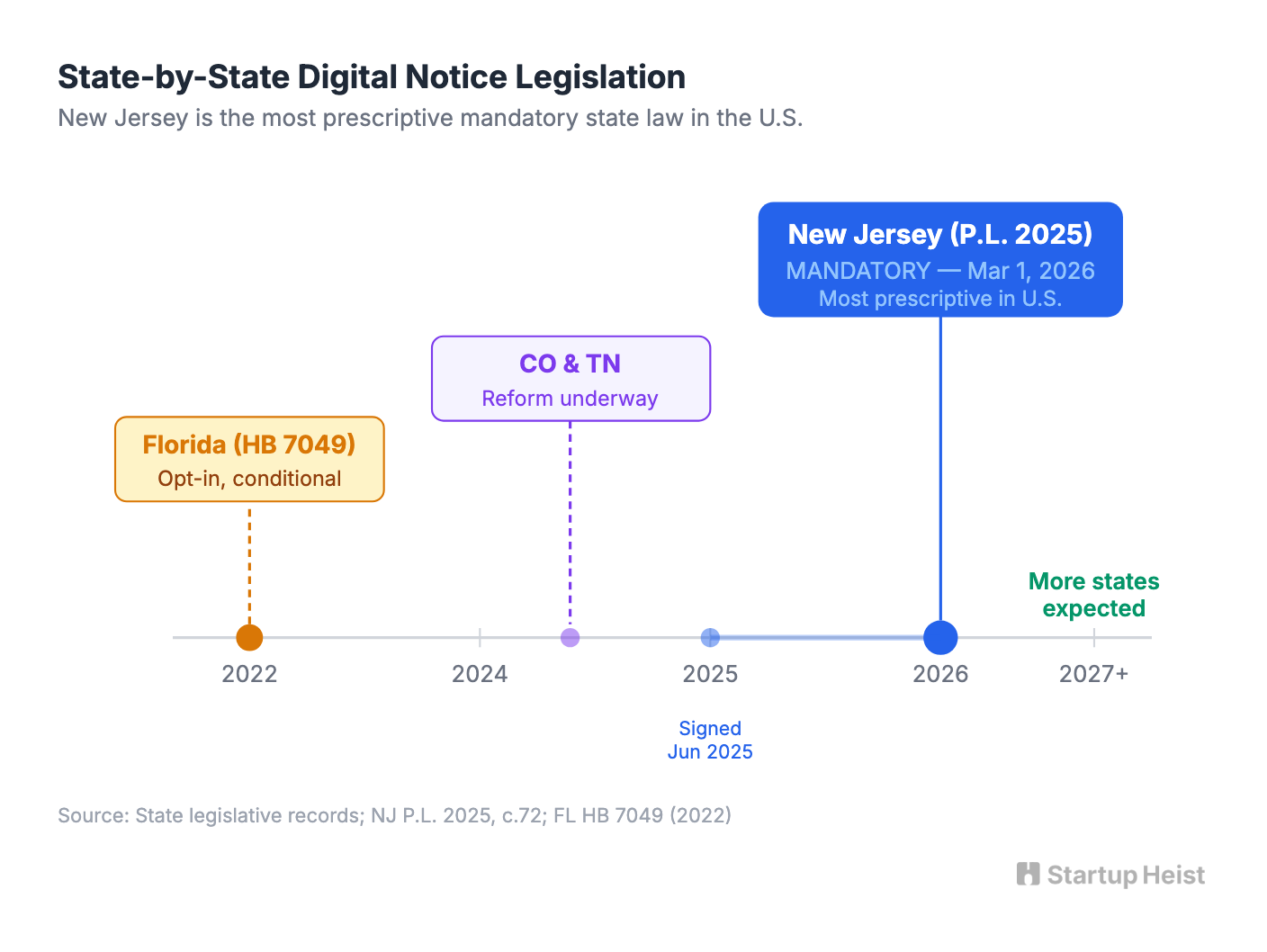
The statute also requires the NJ Secretary of State to establish a statewide webpage by March 1, 2026 linking to every public entity's notice page. That central portal creates a built-in discovery layer and an integration opportunity for any product serving this market.
All that specificity creates a narrow, well-defined product opportunity for anyone building legal notice management software.
Over a Thousand Entities, Zero Purpose-Built Tools
New Jersey has 564 municipalities, roughly 590 school districts, 21 counties, and hundreds of additional fire districts, utility authorities, housing authorities, and commissions. Well over 1,000 public entities now face a compliance workflow they weren't built to handle.
Most have websites managed by part-time staff, small regional web shops, or dominant municipal CMS platforms like CivicPlus and Granicus (which together hold over 54% of the local government website market). Those sites handle meeting agendas and recycling schedules. They weren't designed to function as compliance-grade publishing systems with audit trails, retention enforcement, and evidentiary documentation.
The Division of Local Government Services issued LFN 2026-01 recommending specific implementation measures: date-stamped screenshots, certification records, offline backup procedures. These aren't statutory mandates from P.L. 2025, c.72 itself, but they signal what the state expects a defensible compliance posture to look like. Smart product design bakes those recommendations in from day one.
Procedural Trust Is the Moat
A town clerk doesn't care about elegant typography. They care that a budget hearing notice stays visible for the right number of days, appears on the right page, shows up in the archive a year later, and leaves behind a clean record of who posted it, who approved it, when it went live, and what exact content was public at what time.
Once your product becomes the place where that record trail lives, you're no longer a widget. You're part of the municipal compliance stack. A municipality that trusts your system to produce defensible proof-of-publication isn't going to rip it out to save $500 a year.
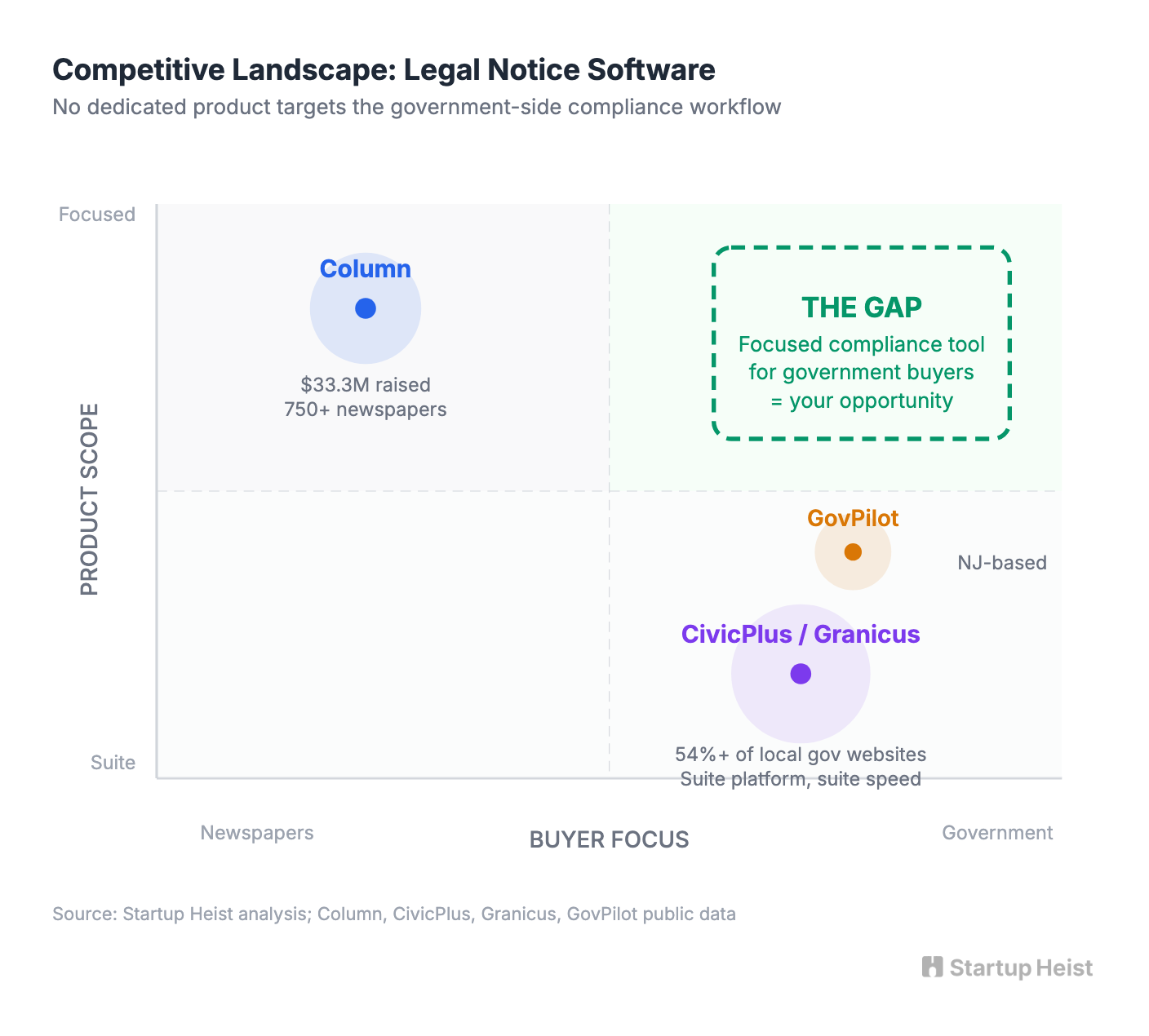
Column, the most visible startup in this space, has raised $33.3 million and serves over 750 newspapers. But Column's product was built for the newspaper side: intake, processing, and publication of notice ads for publishers. New Jersey's law redirects that flow to government websites, a different buyer with a different compliance workflow. CivicPlus, Granicus, and NJ-headquartered GovPilot could add notice features to their platforms, but they sell suites and move at suite speed. No dedicated SaaS product currently targets the government-website compliance workflow created by P.L. 2025, c.72. The gap is real and unoccupied.
The MVP That Matters
Version one needs five components. Nothing more.
1. Structured notice creation. Templates for the most common types: ordinance, budget hearing, bid/RFP, meeting notice, auction, audit synopsis, and a generic custom-notice type. Each template encodes New Jersey's default requirements (minimum display periods, required fields, archive retention). The clerk doesn't have to remember the rules. The product remembers for them.
Unlock the Vault.
Join founders who spot opportunities ahead of the crowd. Actionable insights. Zero fluff.
“Intelligent, bold, minus the pretense.”
“Like discovering the cheat codes of the startup world.”
“SH is off-Broadway for founders — weird, sharp, and ahead of the curve.”


