


The Unclaimed Property Hitman for Small Business
There's a strange category of B2B opportunity that doesn't look like software at first. It looks like paperwork, public records, and a slightly uncomfortable cold email. Underneath, it's pure arbitrage.
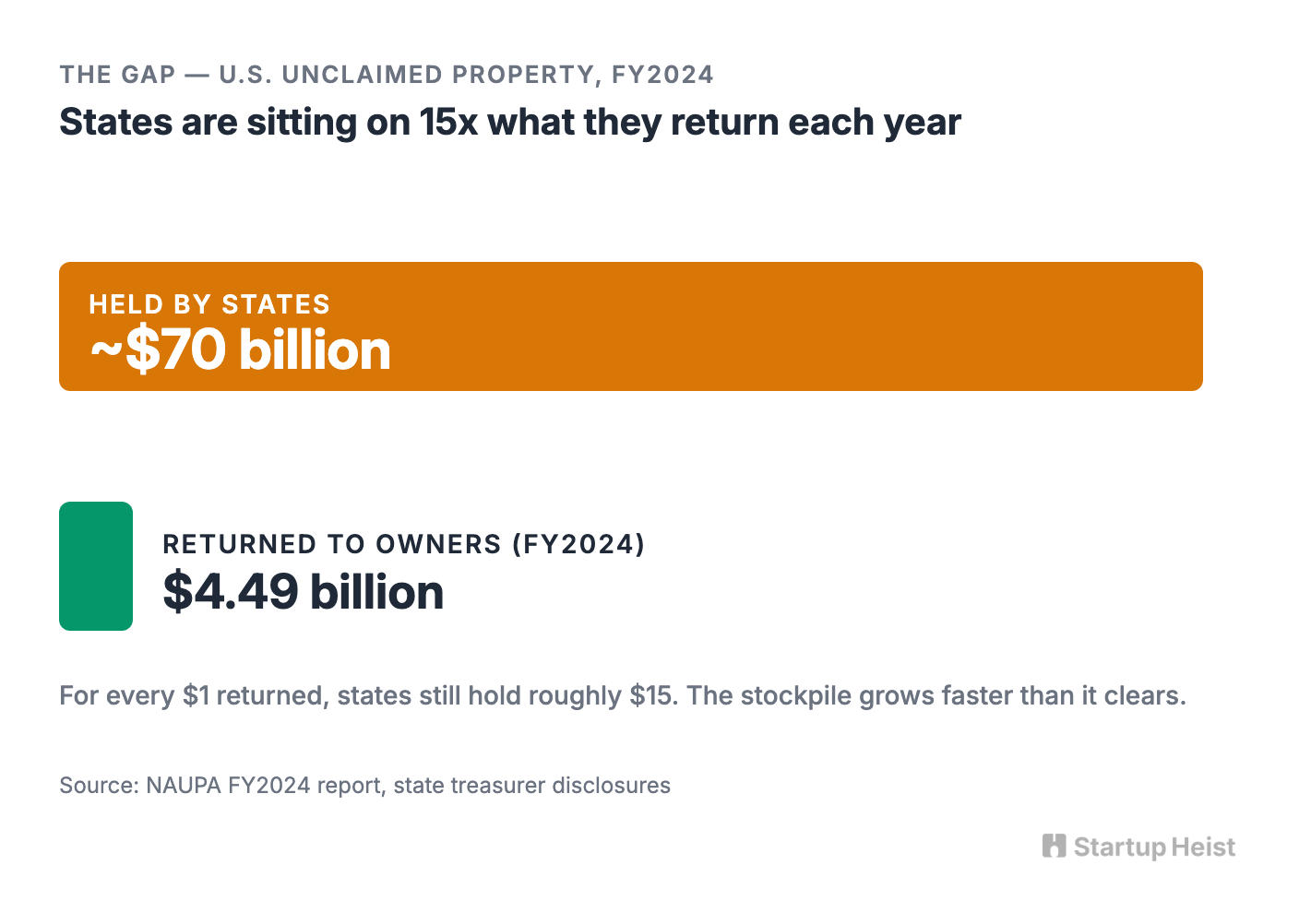
States are sitting on roughly $70 billion in unclaimed property. In fiscal year 2024 alone, state programs returned $4.49 billion to rightful owners, the highest figure NAUPA has ever published, and the stockpile keeps growing faster than it gets returned.
Most small businesses never check. A roofing company, a dental practice, a machine shop, a regional logistics outfit. Almost none of them sit down and search ten state treasuries for a forgotten $3,800 credit issued under their old operating entity.
So here's what the opportunity actually looks like. You build a small, compliance-aware recovery service for SMBs. You search state databases for active businesses with meaningful balances. You identify the owner or finance lead. You send a simple message: the state appears to be holding money under your business name, and you'll handle the recovery process for a contingency fee. No upfront payment. You only get paid if the claim clears.
This isn't a venture-scale moonshot. The first version is a cash-flow business, a high-margin solo practice or small agency. The second act is more interesting: software for claim workflow, multi-state search, document automation, and eventually the inverse market, compliance tools that help businesses avoid escheatment in the first place. The asset already exists. You aren't creating demand. You're identifying neglected value and making it easy to collect.
The money: Solo operator model: 25 closed claims a month at $420 average fee is $10,500 MRR. 50 claims is $21,000. States returned $4.49B in FY2024 and still hold roughly $70B.
Inside:
• Full MVP scope for SMB claim workflow
• State-by-state compliance playbook
• Outreach templates that read legitimate
• Second-act compliance software path
Why this exists
Unclaimed property is a large, ongoing administrative system. States hold abandoned bank balances, uncashed vendor checks, payroll, deposits, rebates, insurance proceeds, securities, and other financial property after dormancy periods expire. A lot of "boring" SMB money lands in exactly those buckets:
- old vendor refunds
- utility or lease deposits
- insurance reimbursements
- stale payroll or reimbursement checks
- customer credits never reissued
- entity remnants after a merger or rename
- checks issued to an LLC under a slightly old address or business name
The owner is busy running the business. The accountant may not know. The bookkeeper may have changed. The legal entity name may not match the current brand. The SMB owner has one finite resource, which is attention, and reclaiming dormant assets ranks below sales, payroll, and the brake light that just came on in the delivery van.
Which is why this opportunity is better than it first appears. The pitch isn't "help people find money." The pitch is "help time-starved small businesses recover assets they're economically irrational to chase on their own."
The market is real, but the wedge is narrower than the headline
The headline number is huge. NAUPA's FY2024 report says states returned $4.49 billion during the year while sitting on an estimated $70 billion in total unclaimed property. Pennsylvania alone returned a record $334.1 million in 2025, up from $272.2 million the year before, and still holds over $5 billion. California's controller has been publicly pushing the size of its pool, partly under federal pressure after a CBS California investigation triggered a congressional inquiry into how states use unclaimed funds before they're returned to owners.
The real opportunity is a specific slice of that pool with four traits:
- The claimant is a business, not an individual.
- The amount is large enough to justify a fee.
- The claim process is annoying enough that outsourcing is rational.
- The business is reachable through normal outbound channels.
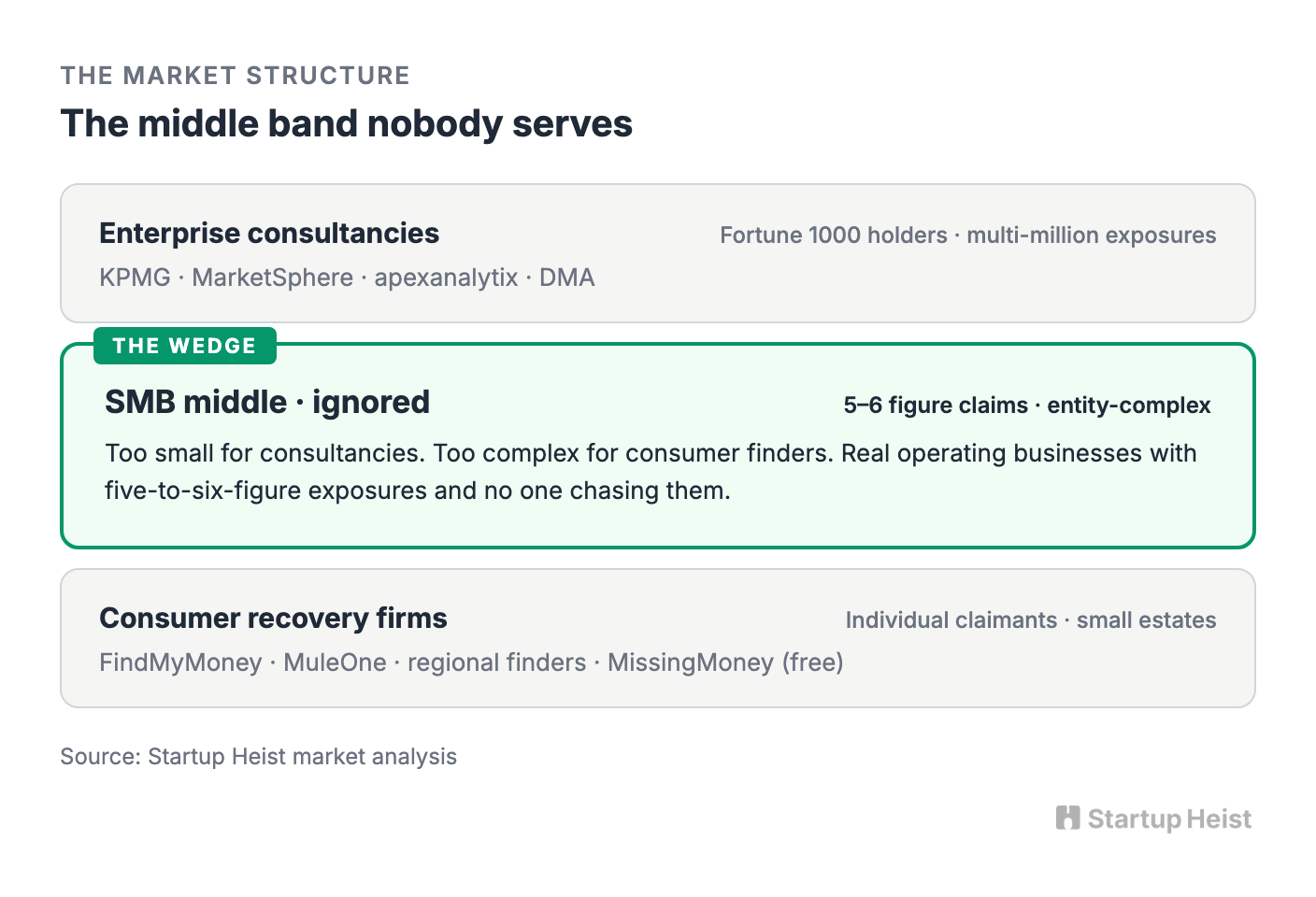
You aren't building a consumer search engine. MissingMoney already serves that role for free. You're building a done-for-you recovery layer for small businesses that don't want to touch the bureaucracy. Three players already share the field, and each one tells you where the gap is. The big consultancies (KPMG, MarketSphere, apexanalytix, DMA) work the enterprise top, recovering assets for Fortune 1000 holders with multi-million-dollar portfolios. Consumer recovery firms like FindMyMoney and MuleOne, plus dozens of regional finders, chase individual claimants and small estates. In between sits a wide, ignored band: real operating SMBs with five-to-six-figure exposures, too small for the consultancies to court and too entity-complex for the consumer firms to handle. That middle is where solo operators have historically made very good money in adjacent verticals like R&D tax credits, ERTC recovery, and surplus funds work. Same pattern, fewer entrants.
The best version isn't aggressive scraping
The sloppy version of this business is "scrape everything, blast cold email, hope legal doesn't notice." That version dies in a year.
The durable version is a data pipeline:

Unlock the Vault.
Join founders who spot opportunities ahead of the crowd. Actionable insights. Zero fluff.
“Intelligent, bold, minus the pretense.”
“Like discovering the cheat codes of the startup world.”
“SH is off-Broadway for founders — weird, sharp, and ahead of the curve.”


