


The Wayback Gap: Build the Evidence Vault for a Web That Keeps Rewriting Itself
The internet used to have an unofficial truth machine. If a company changed its pricing page, a politician scrubbed a promise, a hospital removed a safety claim, or a publication quietly softened a headline, reporters knew where to look. The Wayback Machine remembered.
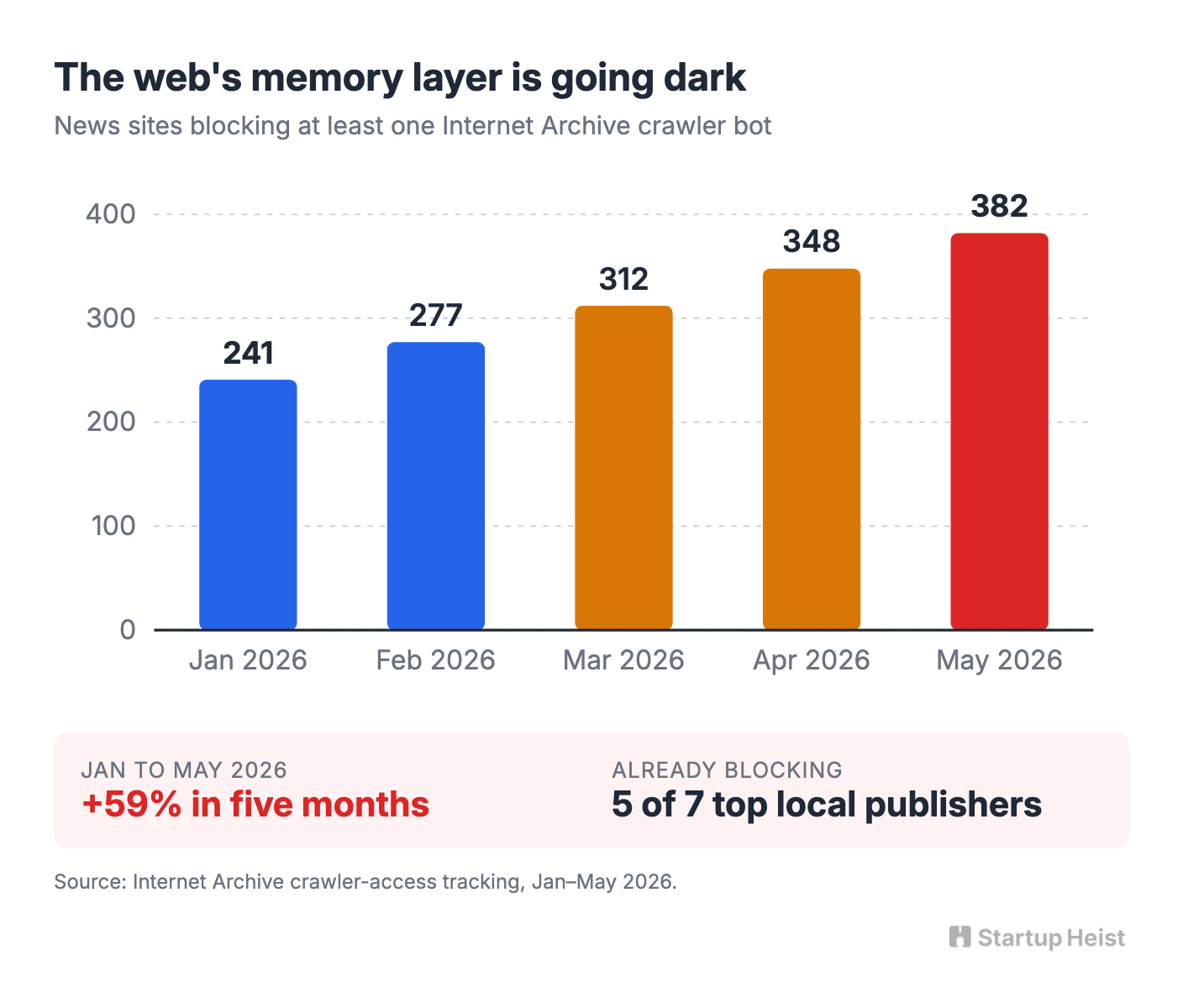
That fallback is breaking. Major news organizations are now blocking Internet Archive crawlers because they fear their archived stories will be scraped to train AI. In January 2026, 241 news websites disallowed at least one Internet Archive crawling bot. By May 2026, the count had climbed to 382, including outlets owned by five of the seven largest local news publishers in the country. The public web's memory layer is becoming collateral damage in the AI copyright war.
That breakdown opens a strange and specific business: a private, litigation-grade web evidence vault for the people whose work depends on proving what a page said before it changed. Reporters. Watchdog NGOs. Small legal teams. Compliance shops. Open-records researchers. The product captures a web page exactly as the user sees it, stores a timestamped and hash-verified snapshot, tracks how the page changes over time, and exports the result in a format a newsroom lawyer or litigation associate can actually file. Think DocuSign for web evidence, not Pocket for reporters.
Here's the opportunity:
The money: A solo founder can reach roughly $29K MRR (about $353K ARR) on a focused mix of individual, team, and legal plans, sold straight into communities that already feel the pain.
Inside:
• Seven-piece MVP from extension to export packet
• Four-tier pricing from $29 to enterprise
• Three-wave outreach with email templates
• Five trust moats a code cloner can't copy
The Web Became Too Editable
Modern accountability work runs on a simple act: proving what something said before someone fixed it. A reporter needs to show that a federal agency deleted a claim from a public health page. A watchdog needs to preserve a contractor's promise before it vanishes. A plaintiff's lawyer needs to capture a misleading product page before the defendant cleans it up. A compliance team needs to document what a vendor published on a specific date.
The old workflow was ugly but functional. Save the link, check the Wayback Machine, take screenshots, print to PDF, dump the files into Dropbox, and pray nobody asks about chain of custody. That held up when web evidence was occasional. It collapses now that everything important is web-native, constantly edited, personalized, paywalled, JavaScript-rendered, and increasingly walled off from public crawlers. The Wayback Machine still matters, but it was never built as a private evidentiary system. It is public, broad, incomplete by design, and dependent on the very crawler access publishers are now revoking. The archive cannot reliably capture the content reporters most need at the moment publishers slam the door.
The legal ground has shifted too. On September 4, 2024, the Second Circuit ruled against the Internet Archive in its controlled digital lending case, finding that scanning and lending books was not fair use because it served the same purpose as the originals. That case has nothing to do with saving a screenshot for an investigation, but it changed the temperature of the room. Any startup touching archival copies of copyrighted content now has to be deliberate about scope, user direction, and access control. That caution is the moat in disguise. The market does not need another pirate archive. It needs a narrow, user-directed web evidence tool, and the fear that keeps lazy founders away is exactly what protects the careful one.
Sell Private Proof, Not Public Archiving
The core promise fits on an index card. Capture any web page you lawfully access. Preserve what it said. Prove when you captured it. Export it when the story, the case, or the FOIA fight needs receipts.
That puts you in a different business from the Internet Archive in every dimension that matters. The Archive is public memory; you are building private evidence. The Archive crawls at scale; you capture only when a user clicks. The Archive serves pages to the world; you store controlled copies inside a team vault. One is a library. Yours is a work-product tool. The buyer is not paying for nostalgia. They are paying for defensibility.
The deliverable is not a folder of saved articles. It is a packet that carries the URL, the timestamp, the user who captured it, the browser environment, a full-page screenshot, a rendered PDF, the source HTML, the extracted text, a content hash, the change history, notes and tags, a Bates-stamped export, and an immutable audit log. That list sounds boring, and the boring is the entire product. When a reporter tells an editor "they changed the language after we called," the editor needs confidence. When a lawyer says "this was on the defendant's site on March 4," opposing counsel will ask how it was captured. A loose screenshot does not survive that question. A hash-verified, timestamped record does.
The Gap Is Narrower Than It Looks, And That's Good
Most founders get this wrong. They assume nobody serves this market, get excited, and build. The reality is more useful than empty space: a forensic web-capture category already exists, and it leaves a very specific seam open.
Page Vault sells court-admissible captures with affidavits, priced for law firms at around $195 a month per concurrent user or a couple hundred dollars per on-demand capture. WebPreserver and Pagefreezer wrap captures in timestamps, cryptographic hashes, and digital signatures, but sit at the enterprise archiving tier. Hunchly is the cheap, beloved Chrome extension for OSINT analysts and private investigators at around $110 a year, used by outfits like Bellingcat, but it stores a local case file and usually needs re-acquisition with a heavier tool before anything lands in court. Visualping monitors pages and fires alerts with highlighted screenshots, and even offers a free journalist plan, but it is built around the alert rather than the evidence packet. Read-it-later tools like Instapaper are built around reading, and Pocket's shutdown on July 8, 2025 reminded everyone that personal archives vanish on someone else's schedule.
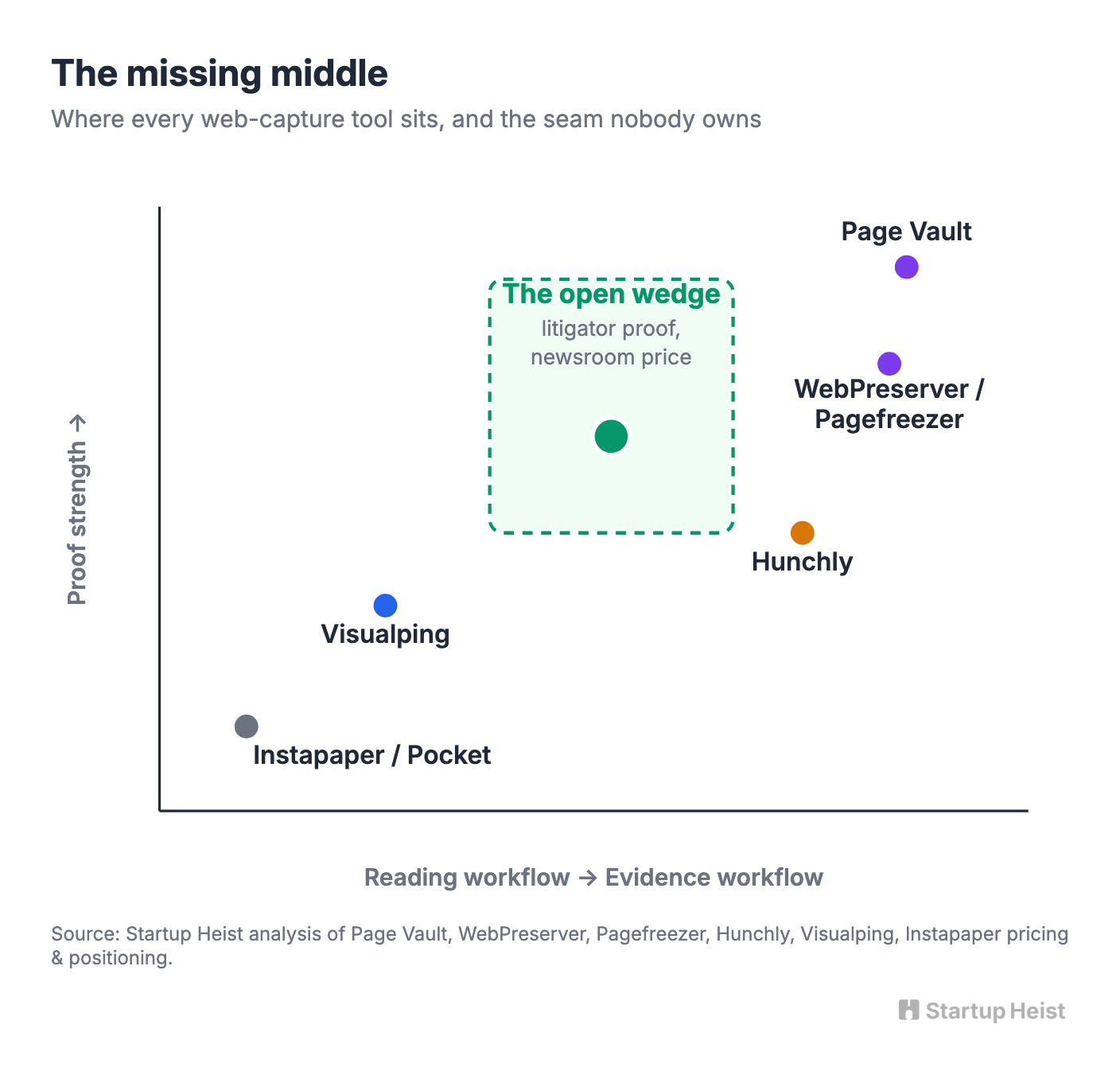
Stack those up and the seam is obvious. The forensic tools are priced and shaped for lawyers and investigators. The monitoring tools alert but never build a record. The reading tools are fragile. Nobody owns the moment the Wayback breakdown just made urgent: a working journalist or a three-person watchdog NGO who needs the same defensibility a litigator gets, at a price and in a workflow that fits a newsroom. The wedge is not "invent web capture." It is to take the litigator's standard of proof and hand it to the people the incumbents priced out, at the exact moment their old fallback died.
The Buyer Is Not "Journalists." It's Evidence-Dependent Small Teams
The first mistake would be selling this to individual reporters at $9 a month. Journalists have the pain, but newsrooms are broke and freelancers guard their subscriptions. A journalist-only product becomes a beloved $5,000-MRR utility. That is lovely, and it is not a business.
The real customer set is wider, and it all shares one nerve: someone said something online, then changed it, removed it, or denied it:
Unlock the Vault.
Join founders who spot opportunities ahead of the crowd. Actionable insights. Zero fluff.
“Intelligent, bold, minus the pretense.”
“Like discovering the cheat codes of the startup world.”
“SH is off-Broadway for founders — weird, sharp, and ahead of the curve.”


