


The Free Civic Domain Heist
America has a forgotten corner of the internet, and almost nobody remembers how to use it.
Under the old `.us` locality system, addresses like `ci.townname.pa.us` still exist. They were meant to give towns, local agencies, and residents a geographically honest American domain. In practice the system is a museum piece: stale locality lists, human registrars, and paper-era email workflows built around something literally called the "Interim .US Domain Template." Response times are measured in weeks. The domain itself is usually free. The process is anything but, and that gap is where the opportunity lives.

The obvious move is the wrong one. "Buy up abandoned government-adjacent registries and become a private domain baron" makes a great Hacker News thread and a terrible business. It is politically brittle, legally murky, and operationally miserable. The better play is more boring, which is exactly why it can work. Build a small, trusted civic web stack for the towns, HOAs, fire districts, and neighborhood boards that need a credible website and have no digital department to build one.
Call it TownStack. The pitch fits in a sentence. We get you a credible civic domain, launch a clean accessible website, post your agendas and announcements, and keep it running for a fixed monthly fee. The locality domain is the hook. The managed civic presence is the business.
Here's the opportunity:
The money: 300 civic sites at a blended $175/month is roughly $52,500 MRR, with setup fees on top and services upsells for `.gov` migrations.
Inside:
• Full MVP scope: civic CMS plus 3 modules
• Three-path domain concierge (.gov / .us / .org)
• Three-tier pricing against custom-quote incumbents
• One-state GTM with the audit-first cold open
The Long Tail Nobody Sells To
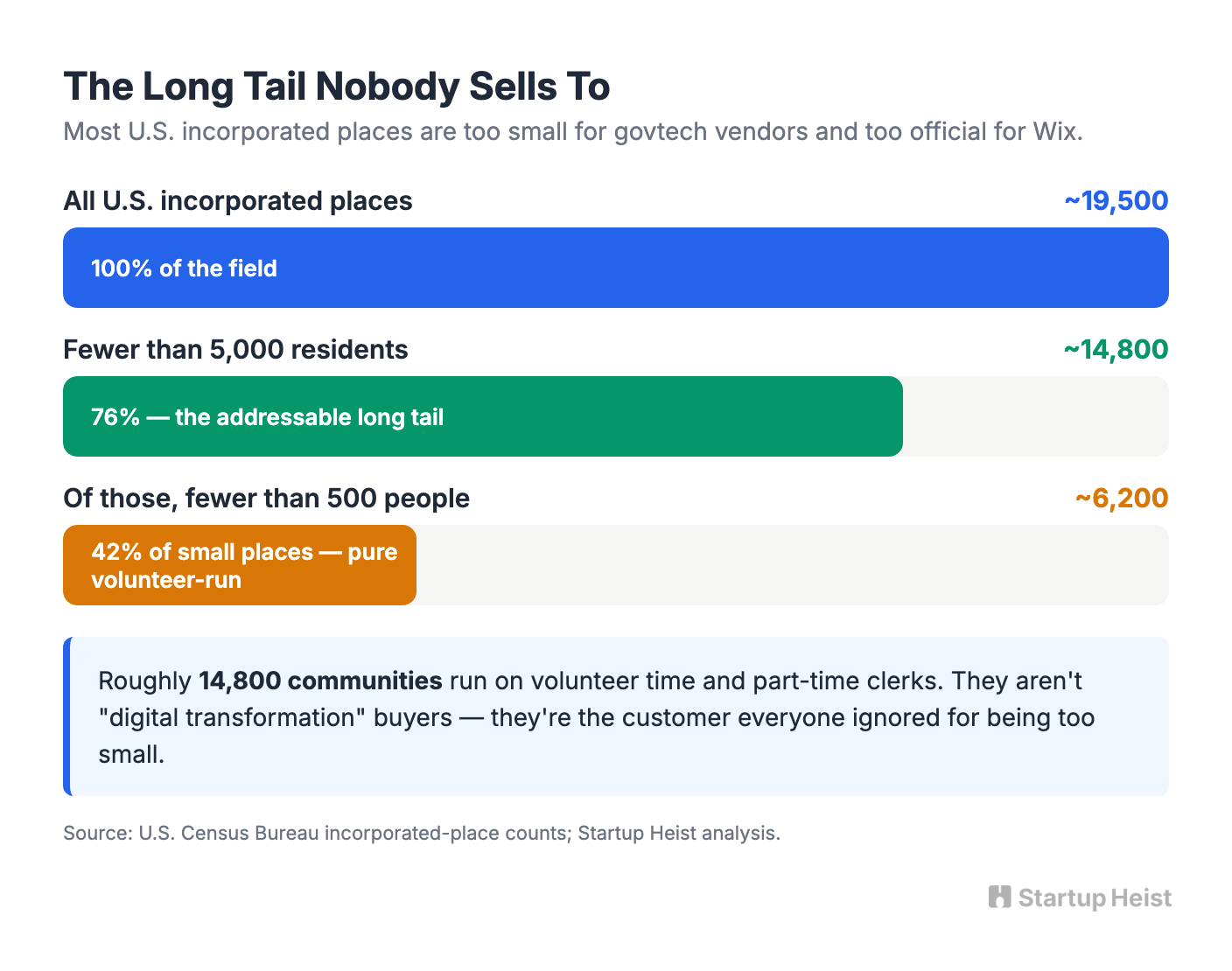
The U.S. has roughly 19,500 incorporated places. About 76% of them have fewer than 5,000 residents, and nearly 42% of those small places have fewer than 500 people. That's close to 14,800 communities running on volunteer time and part-time clerks. They aren't "digital transformation" buyers. They're town clerks, borough councils, fire district boards, library trustees, and HOA officers trying to get a meeting notice online without hiring an agency.
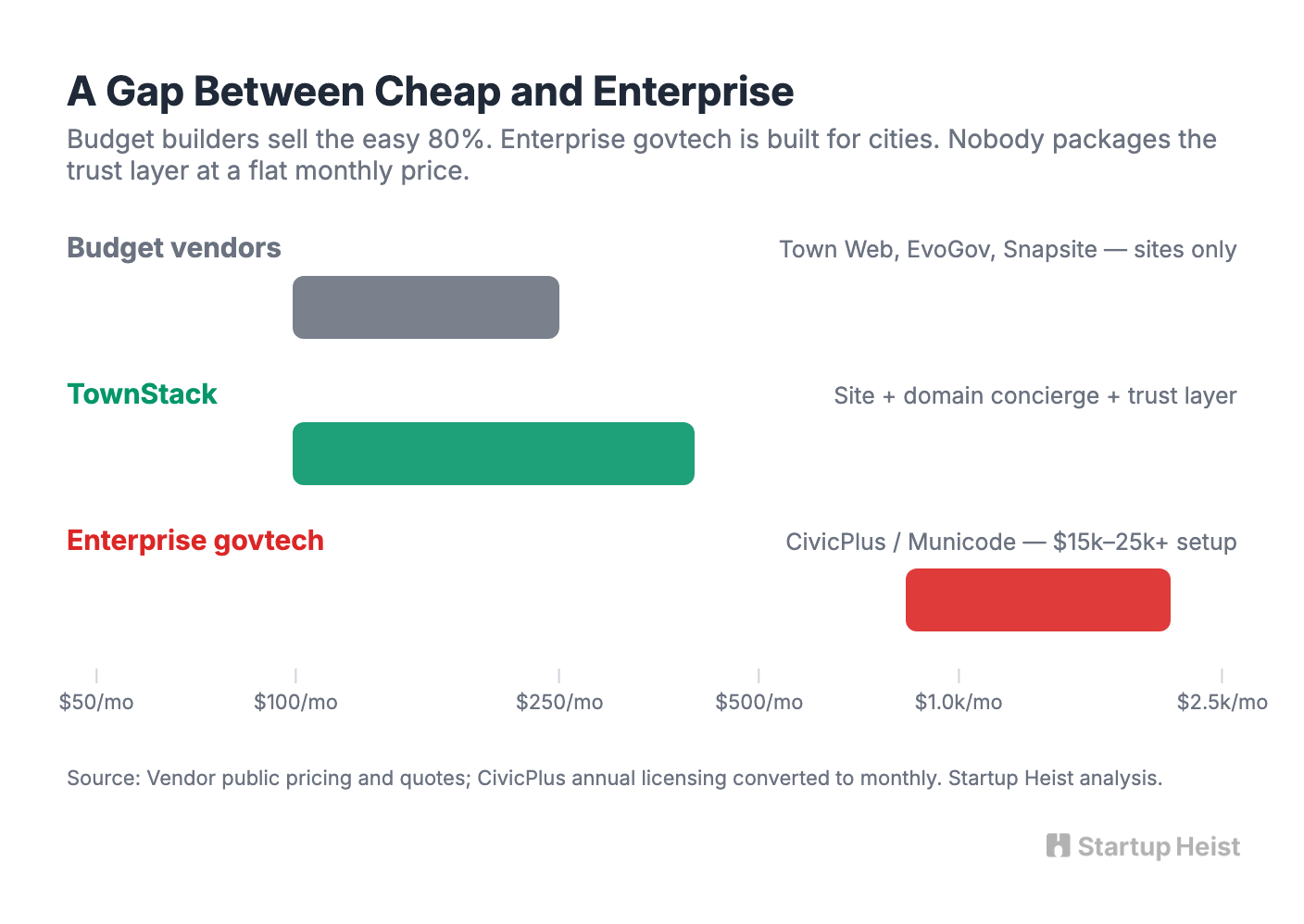
The serious govtech vendors are built for the opposite customer. CivicPlus and Municode sell real municipal software with custom quotes, population-based pricing, professional services, and implementation projects. A CivicPlus website build typically starts around $15,000 to $25,000 or more, with annual licensing and hosting commonly running $10,000 to $25,000 a year, closer to $1,000 to $2,000 a month than the "hundreds" small towns assume. That's sensible if you're a city with budget, staff, and procurement habits. It's absurd for a 1,200-person borough whose website was last touched during the Obama administration.
The cheap end isn't empty either. A cluster of budget vendors already chases small towns. Town Web, EvoGov, and Snapsite all sell low-cost municipal sites, typically around $99 to $250 a month with setup in the low thousands. So "small towns need cheap websites" is a solved problem. If that were the whole pitch, you'd be the fifth me-too vendor in a quote-form knife fight. The thing none of them package is the part that actually scares the clerk.
The Pain Is Legitimacy, Not HTML
A small town can already use Wix, Squarespace, WordPress, or a county-hosted page. Publishing HTML isn't the bottleneck. Civic publishing has weirder requirements than that. Residents need to know the site is official. Agendas have to live in predictable places. Minutes, ordinances, notices, and forms have to stay findable for years. Older residents need readable layouts. The clerk needs to update it without calling "the website guy," and the town needs that to survive the clerk leaving.
Civic trust is brittle, and the domain carries most of it. A town on `townname.com`, `townnamepa.org`, or `townname.wixsite.com` may be completely legitimate, but to a resident it reads as unofficial, which in 2026 reads as a possible scam. The federal `.gov` program fixes this for eligible entities. CISA verifies U.S. government organizations at every level and registers their `.gov` domains for free, with eligibility extending to cities, towns, counties, courts, tribal governments, special districts, and election offices.

But getting a `.gov` is its own bureaucratic gauntlet: eligibility checks, naming rules, an authorization letter from a senior official, DNS configuration, and a migration plan off the old domain. A part-time clerk reads CISA's instructions, closes the tab, and goes back to the Facebook page. The locality `.us` system is worse. The official path runs through a delegated manager who may be a city IT department, a state office, a volunteer, or, in the system's grimmer corners, a contact that no longer answers. New delegated managers are no longer being authorized, and undelegated locality domains are now generally restricted to local-government agencies, which only sharpens the case for a specialist who knows the path.
That's the real product. The boring, trust-bearing infrastructure that small civic bodies cannot navigate alone. Cheap website builders sell you the easy 80%. TownStack sells the 20% that determines whether residents believe the site is real.
Why Now
Two forces just made this sharper.
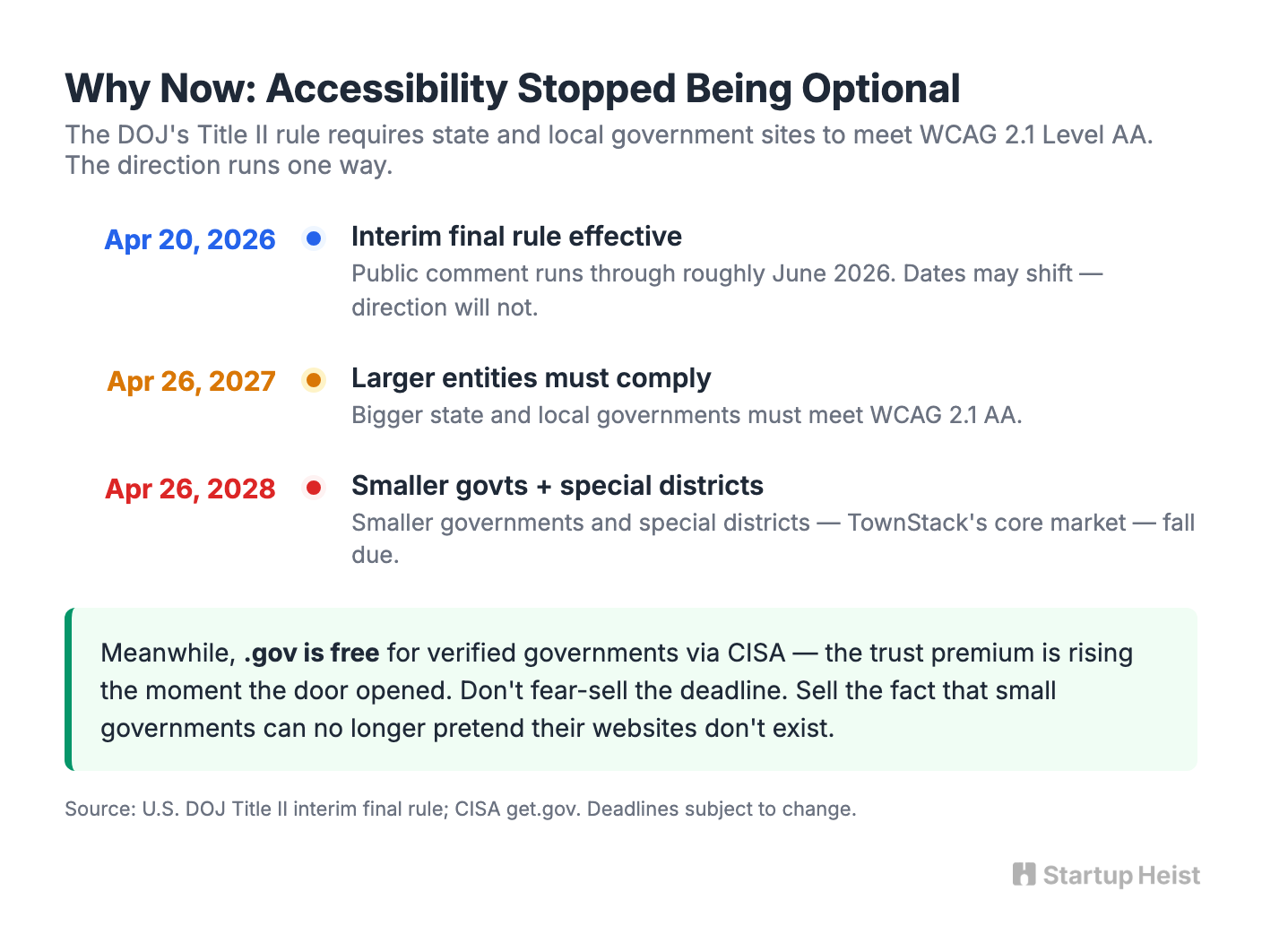
First, `.gov` is finally accessible and visible as a trust signal. CISA manages the top-level domain, registration is free for verified government organizations, and get.gov publishes a clear path for moving off `.com`, `.org`, or `.us`. The trust premium of `.gov` is rising at the same moment the door to it opened.
Second, accessibility stopped being optional. The Department of Justice finalized a Title II rule requiring state and local government websites and mobile apps to meet WCAG 2.1 Level AA. The timeline has already moved once. An interim final rule, effective April 20, 2026 and still under public comment through roughly June 2026, set current compliance deadlines of April 26, 2027 for larger entities and April 26, 2028 for smaller governments and special districts. The exact dates may shift again, but the direction runs one way. Don't fear-sell a moving target. Sell the fact that small governments can no longer pretend their websites don't exist.
The buyer never wakes up wanting SaaS. They wake up thinking the website is embarrassing, residents keep asking where the agenda is, an accessibility email arrived and nobody knows what it means, and the volunteer who handled the domain is gone. That's the sentence TownStack answers.
The Product
TownStack should not launch as a municipal operating system. That ambition is how it dies. The MVP is brutally narrow: a hosted civic website, a domain concierge, and three modules.
The homepage carries the official basics: contact details, office hours, board members, emergency notices, and search. The meetings module holds agendas, minutes, a calendar, a public-notice archive, PDF uploads, and optional email reminders. The resident module covers permits and forms links, service pages for trash and water and zoning, announcements, an FAQ, and an optional newsletter.
A clerk should never design a page. They log in and see a short list of verbs: add agenda, add minutes, add alert, add document, edit contact info, publish announcement. That's the entire interface.
The front end should look calm, official, and accessible. High contrast, clear typography, mobile-first, obvious navigation, printable pages, no clever UX. The clerk isn't trying to win a design award. They're trying to stop the phone from ringing.
The Domain Concierge
This layer is what separates TownStack from every cheap WordPress shop, and it's the part the budget vendors leave on the table.
Signup starts with a structured intake:

Unlock the Vault.
Join founders who spot opportunities ahead of the crowd. Actionable insights. Zero fluff.
“Intelligent, bold, minus the pretense.”
“Like discovering the cheat codes of the startup world.”
“SH is off-Broadway for founders — weird, sharp, and ahead of the curve.”


