


The GoodRx for Vet Visits
There is a moment in modern pet ownership when love turns into invoice management.
A dog limps. A cat stops eating. You go to the vet expecting worry, not a procurement problem. Then the estimate prints: exam fee, bloodwork, imaging, an injection, medication, a prescription diet, a follow-up, maybe a procedure. The number is rarely catastrophic. It is just high enough to trigger a quiet decision at the front desk. Pay now, finance it, defer the care, call a relative, surrender the animal, or stand in the parking lot Googling whether any of it can be done cheaper.
That last behavior is the opportunity.
Here's the opening:
The money: A solo founder can reach $20K to $75K MRR. At 1,500 paid decodes a month near $30 margin plus 2,500 household subscribers at $19, that clears $120K monthly.
Inside:
• Estimate-decoder MVP with five-question output
• Pricing ladder: $29 decode to $199/yr plan
• SEO + Reddit GTM with outreach templates
• Four compounding moats and a B2B path
The U.S. pet market is no longer a cute niche. The American Pet Products Association reported $158 billion in total pet spending in 2025 and projects $165 billion in 2026. Veterinary care and product sales alone hit roughly $41 billion last year and are projected near $42.4 billion this year. Ownership is stable, with about 95 million U.S. households keeping at least one pet. The category is enormous and resilient.
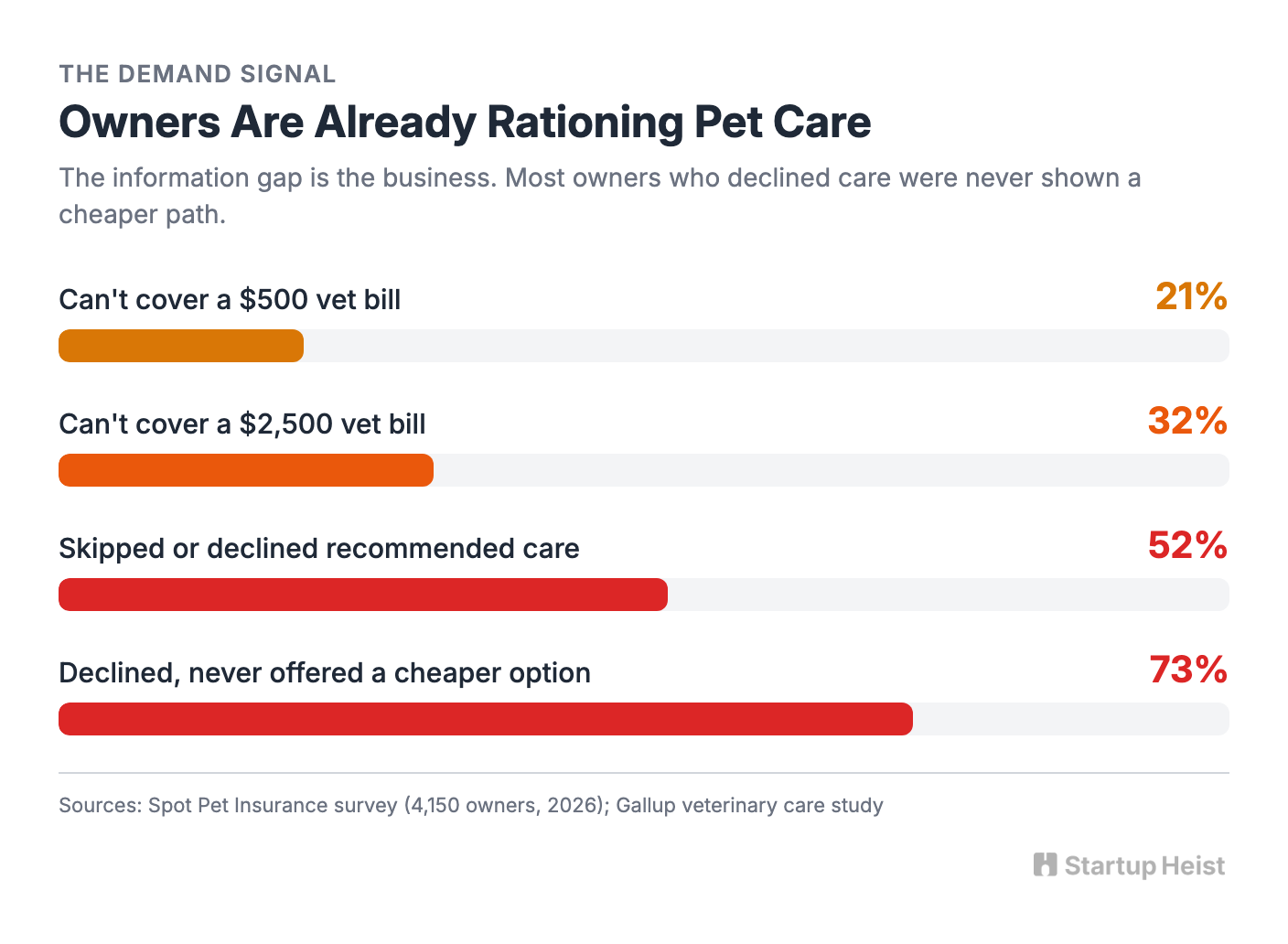
The affordability underneath it is cracking. A 2026 Spot Pet Insurance survey of 4,150 owners found that 21% already consider a $500 vet bill impossible to cover, and 32% say the same at $2,500. That same 32% would pay for their pet's procedure before their own. A Gallup study found 52% of U.S. pet owners had skipped or declined recommended veterinary care, and 73% of the owners who declined were never offered a lower-priced alternative by their vet. The Bank of America Institute pegged the cost of pet services like veterinary care 42% higher in 2025 than in 2019. Vetsource data shows visits falling for a fourth straight year, down about 3.1% in 2025, even as practice revenue rose on price increases. People still need the product. They are starting to ration it.
The default answer to all this is pet insurance. Insurance is useful, but it reimburses after the system has already priced the visit. It does nothing to tell an owner whether a $1,700 estimate hides $500 of avoidable markup, whether a medication can be filled at Costco for a fraction of the clinic price, whether the clinic is legally required to hand over a written prescription, or whether a cheaper equivalent is worth raising with the vet.
So the heist is not to become another pet insurer. It is to own the navigation layer that sits between the vet estimate and the household credit card.
Call it a GoodRx for vet visits: a consumer-facing estimate decoder and prescription savings navigator that helps owners read the bill, separate must-do care from shoppable line items, request written prescriptions without friction, and fill eligible medications through cheaper human-generic, warehouse, online-pharmacy, or discount-card channels.
This is not anti-vet, not telehealth, and not "AI replaces the veterinarian." It is a money coach for pet care.
The Arbitrage Is in the Estimate, Not the Exam
Veterinary medicine carries several kinds of cost, and they are not equally shoppable.
The exam matters. Diagnostics matter. Emergency surgery matters. Clinics carry rent, payroll, equipment, malpractice exposure, inventory risk, and brutal burnout. Any product that walks in yelling "vets are scammers" deserves to fail and will. But the invoice has layers. One is clinical judgment. One is operational overhead. One is plain consumer ignorance. And the last is old-fashioned retail markup.
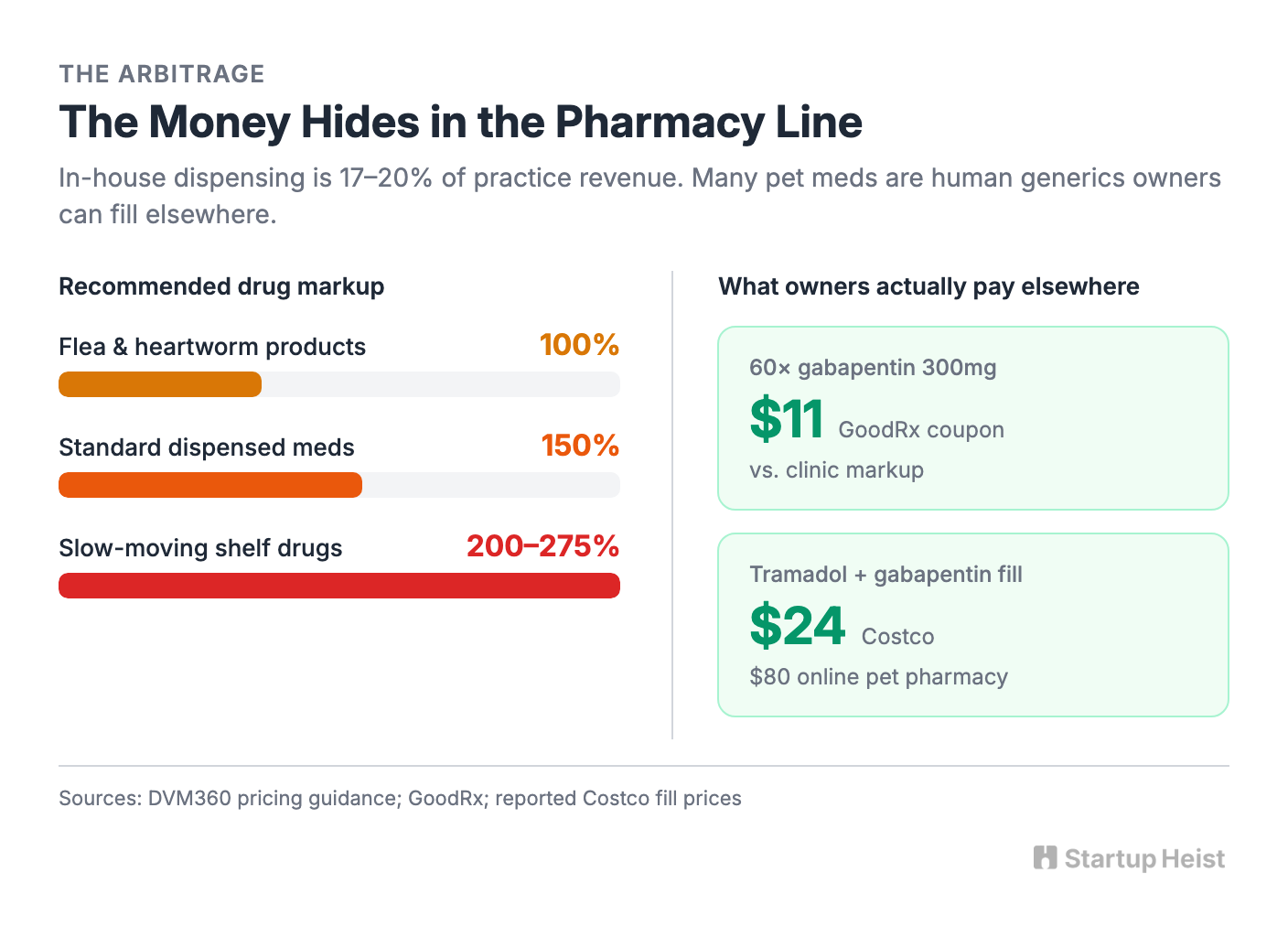
That last layer is where the money hides. Veterinary trade publications have treated drug markup as ordinary practice economics for years. DVM360 has published pricing guidance recommending 100% markup on flea and heartworm products, around 150% on standard dispensed medications, and 200% to 275% on drugs that sit on the shelf for months. In-house dispensing makes up an estimated 17% to 20% of practice revenue. The pharmacy is supposed to be a profit center.
That does not make every bill abusive. It means the bill contains shoppable components most owners have no idea how to shop. And the easiest one is medication.
Many common pet prescriptions are human generics: gabapentin, fluoxetine, amoxicillin, prednisone, trazodone, levetiracetam. The use is often off-label, which is normal in veterinary medicine, but the practical point is blunt. When a vet prescribes a drug a human pharmacy can fill, the owner can frequently use a discount program instead of buying it from the clinic. GoodRx says pet parents can use its coupons on human medications and advertises savings up to 80% off cash price. Sixty 300mg gabapentin capsules run about $11 with a GoodRx coupon. One Costco shopper filled tramadol and gabapentin for $24 after an online pet pharmacy quoted $80. Owners are already drifting this direction without a map: Vetsource data shows product-only vet visits fell 6.2% in 2025, the sharpest decline of any visit category. The product just makes that drift deliberate instead of accidental.
The savings exist. The problem is that the workflow is hostile. The vet recommends a drug. The clinic dispenses it before you think to ask. The online pharmacy needs an approval the clinic is slow to send. You do not know whether you are even allowed to request a written prescription, and you do not want to look cheap while your animal is sick. That is not a pharmacy problem. It is a confidence, translation, and workflow problem.
Why the Existing Players Leave the Gap Open
Chewy Pharmacy, Walmart PetRx, 1-800-PetMeds, Costco, and GoodRx already solve pieces of the medication-price problem. Chewy will even contact the vet for approval. But none of them own the moment that actually matters: the owner standing at the counter, staring at the estimate, before any of it has been bought.
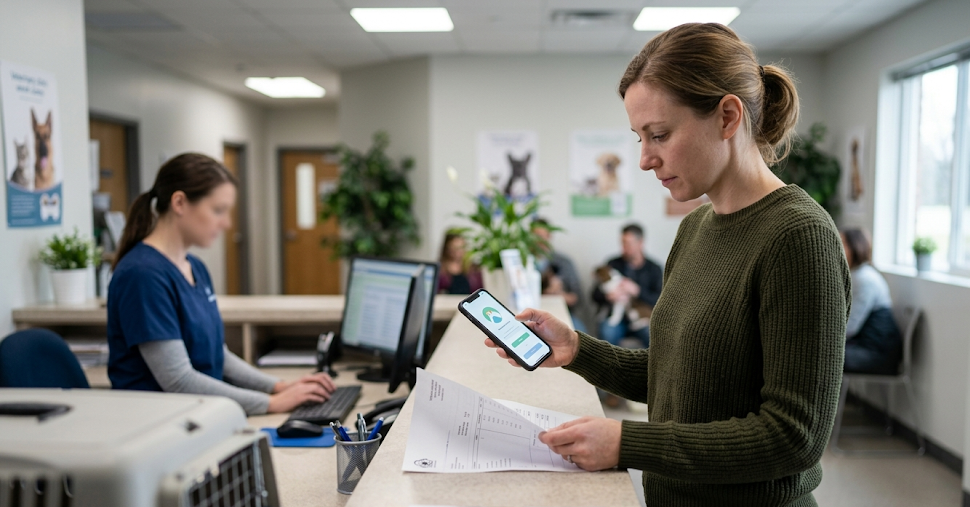
That moment is earlier, messier, and far more emotional than "find me the cheapest gabapentin." It sounds like: Is this quote reasonable? Do I have to buy all of this today? What here is actually urgent? Can I ask for a prescription without offending my vet? Is this the same drug I saw for $8 online? Will my pet be harmed if I wait two days for shipping? What do I even say at the front desk? Remember, 73% of owners who declined care were never even offered a cheaper option. The information gap is the business.
The pharmacies are transaction layers. Telehealth is a care-access layer. Insurance is reimbursement. Financing is debt. The missing layer is vet-bill navigation: a product that decodes the whole estimate and turns panic into a plan. It lives in the anxious, unowned moment right before the credit card comes out. Own it, and everything downstream follows.
The Product: Estimate Decoder Plus Rx Savings Navigator
The first product should be narrow, paid, and practical. An owner uploads a vet estimate, discharge note, medication list, or screenshot. The system returns a structured savings plan inside a defined turnaround window. The plan answers five questions:
Unlock the Vault.
Join founders who spot opportunities ahead of the crowd. Actionable insights. Zero fluff.
“Intelligent, bold, minus the pretense.”
“Like discovering the cheat codes of the startup world.”
“SH is off-Broadway for founders — weird, sharp, and ahead of the curve.”


