


The Weekend-Back Business: Selling Plumbers and HVAC Owners the Operating System They Already Paid For
Most home-service businesses don't fail because the phone stops ringing. They fail more quietly.
The owner becomes the dispatcher, estimator, scheduler, quote-chaser, invoice enforcer, complaint handler, software admin, and emergency backup technician. The business has revenue. The trucks are moving. The calendar looks full. Every operational decision still routes through one tired person.

The play is a done-for-you operations service for 5–15 person trades businesses doing $500,000 to $2.5 million in revenue. You come in, clean up the operational machine, configure Jobber, Housecall Pro, or ServiceTitan properly, wire the basic automations together with Zapier or Make, document the recurring workflows, train the office person, and stay 60–90 days to keep the machine running. Forget "AI for plumbers." Forget another lead-gen agency. The product sells the owner something more emotionally valuable than leads: fewer dropped balls, fewer late-night texts, fewer "did we follow up on that quote?" moments. Maybe their Saturday morning back.
The thesis is simple. The trades don't need more software. They need someone to make the software behave like an operating system.
Here's the opportunity:
The money: Two implementations a month at $8K each plus a handful of $1K retainers puts a solo operator at $20K–$30K MRR before hiring a delivery assistant.
Inside:
• 30-Day Ops Reset scope and deliverables
• Four-tier pricing from $750 audit to $12K lift
• Three-leak teardown outbound email
• Plumbing-specific moat and template flywheel
Why the market is large and labor isn't catching up
The U.S. home-services market sits between $650 billion and $842 billion in 2026 depending on how you count, with mid-single-digit growth projected through the rest of the decade. Mordor Intelligence forecasts $989 billion by 2031. The structural drivers are physical: the median age of homes purchased in 2024 was 36 years, up from 27 years in 2012. Spending tilts toward repair and replacement of essential systems, not new construction.
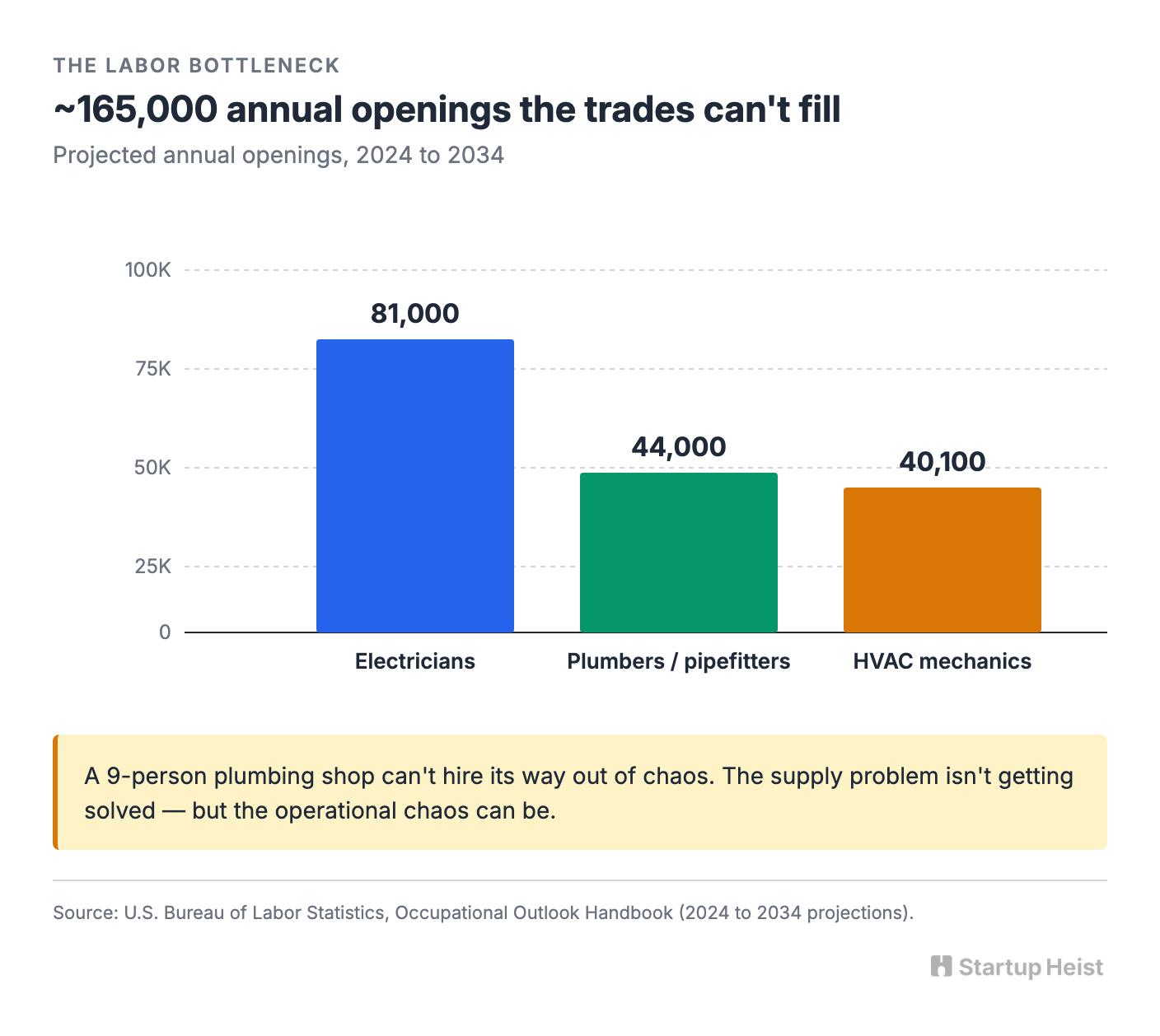
Labor sharpens the bottleneck. The Bureau of Labor Statistics projects roughly 44,000 annual openings for plumbers, pipefitters, and steamfitters between 2024 and 2034, around 81,000 annual openings for electricians, and roughly 40,100 for HVAC mechanics and installers. None of these categories are small. None of them are solving the supply problem fast.
A 9-person plumbing shop can't easily hire its way out of chaos. Hiring another technician grows revenue and adds dispatch complexity, quote volume, callbacks, inventory friction, payroll questions, and customer-communication load. At some point the owner doesn't need more demand. The business needs to stop depending on the owner's memory.
The pain is software underuse, not software adoption
The field-service software category is mature. Jobber, Housecall Pro, ServiceTitan, FieldEdge, Service Fusion, and ServiceTrade have educated the market. Contractors know they need a system. Many already pay for one. Housecall Pro alone serves more than 45,000 home-service businesses. Jobber's plans start around $49 per month for solo operators and scale into team tiers well above $100 per month. Both companies are profitable, well-funded, and shipping new features every quarter.
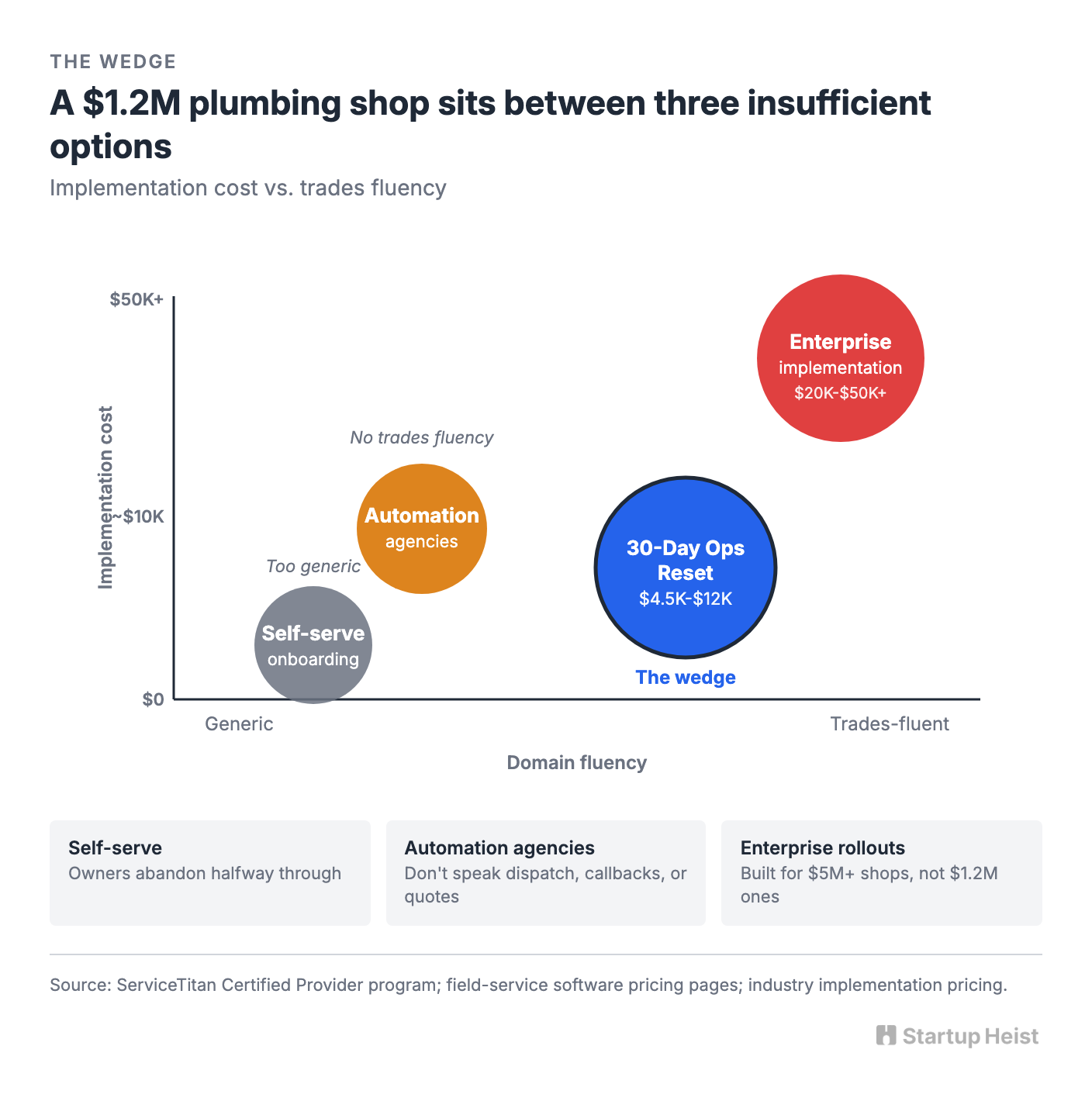
ServiceTitan validates the implementation lane directly. The company runs an official Certified Provider program with formal designations including Software Coach, Inventory Specialist, Certified Accountant, and Construction Specialist. That infrastructure exists because customers can't extract the value of the software on their own. Implementation is a real category, but the funded version is built for the top of the market, where ServiceTitan rollouts often run $20,000 to $50,000 or more for mid-size and complex rollouts once integrations and customization are factored in.

The 7-person plumbing shop doing $1.2 million sits below that lane. They don't need a transformation. They need quote follow-up that actually fires. They need online requests to stop disappearing. They need the receptionist to know what to say when someone asks about emergency service. They need estimates, invoices, deposits, scheduling, reminders, and reviews to behave as a single sequence. The opportunity is the wedge between three insufficient options: self-serve vendor onboarding (too generic), enterprise implementation (too heavy), and generic automation agencies (no trades fluency). The buyer doesn't want Zapier consulting. They want fewer operational leaks. Sell an operations reset.
The customer
Don't start with every trade. Start with residential plumbing or HVAC. Both share urgent demand, repeatable workflows, and high customer-communication load. The operational sequence is standardized across thousands of shops: lead intake, booking, dispatch, estimate, approval, completion, invoice, payment, review, maintenance plan, recall, warranty, follow-up. Pick one trade and the second is largely a rename.
The ideal first customer is a $750,000 to $2.5 million shop with 5 to 15 people, an owner-operator plus an office admin or dispatcher, and some messy combination of Jobber, Housecall Pro, ServiceTitan, QuickBooks, and spreadsheets. The pain is a busy calendar with sloppy follow-up and too many decisions still routed through the owner. The emotional state usually sounds like, "We're growing, but I'm still trapped." Avoid the solo handyman early. They love the idea and resist a $6,000 implementation. The right first customer has enough revenue for the pain to be expensive. Five missed $1,500 jobs per month makes the math obvious before the call ends.
The positioning has to be operational. "We automate your business" is dead language. Owners have heard that one too many times. Try something physical: we clean up the machine so jobs stop falling through the cracks. The owner doesn't want a futurist. They want a mechanic.
The 30-Day Ops Reset
The first version is a high-touch implementation package. Not software. Give it a concrete name.
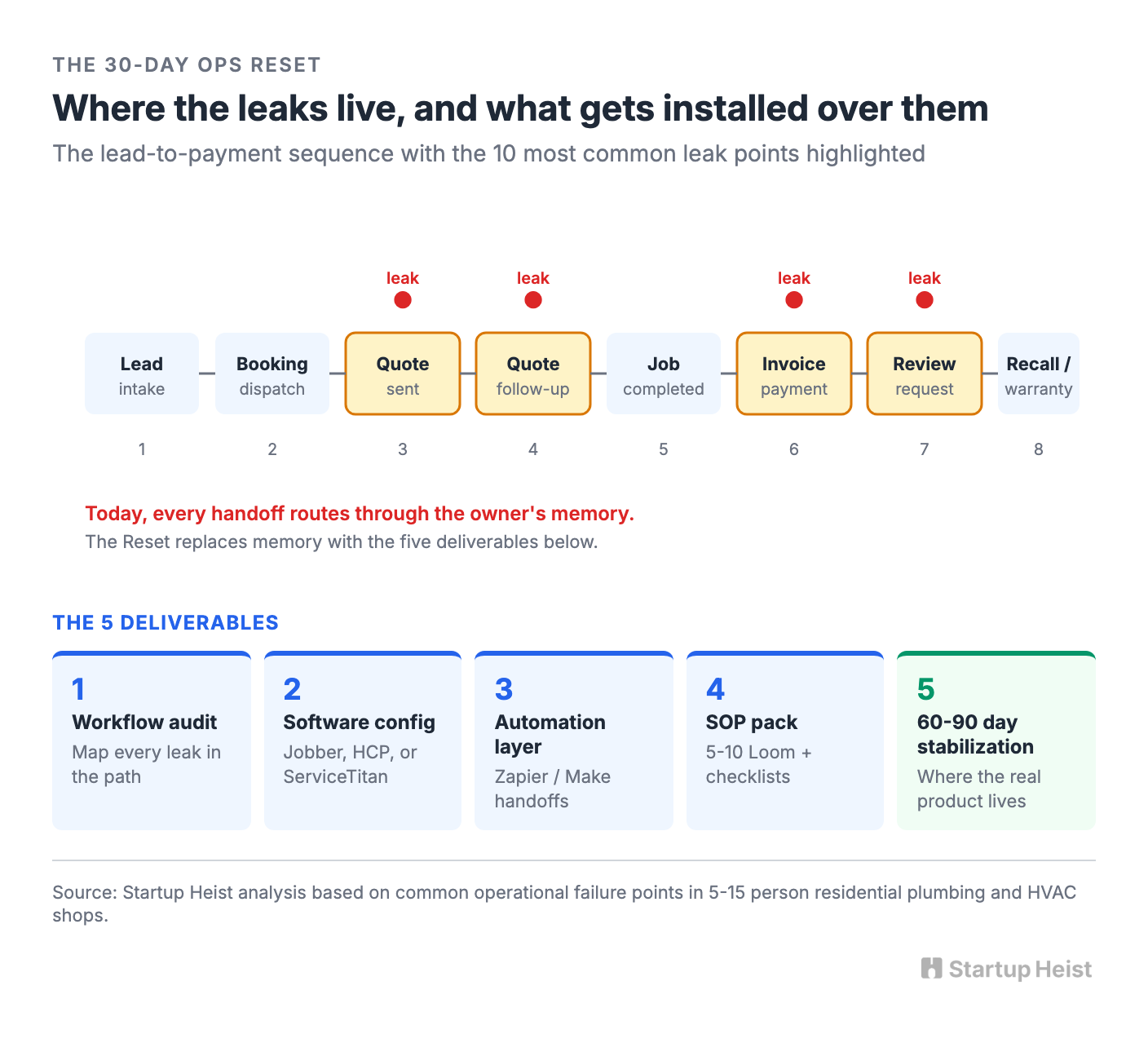
Call it the 30-Day Ops Reset. Sell it as a done-for-you operations cleanup for growing home-service companies that want Jobber, Housecall Pro, or ServiceTitan to actually run the business instead of becoming another ignored tool.
Five deliverables anchor the offer:
Unlock the Vault.
Join founders who spot opportunities ahead of the crowd. Actionable insights. Zero fluff.
“Intelligent, bold, minus the pretense.”
“Like discovering the cheat codes of the startup world.”
“SH is off-Broadway for founders — weird, sharp, and ahead of the curve.”


