


The $800 Loophole Died. Don't Build Another Tariff Calculator.
For years, a seller in Toronto, Manchester, Hong Kong, or Berlin could mail a $40 product to an American customer and never think about U.S. import duties. The package was worth less than $800, so it entered under the de minimis exemption. Fill out a customs declaration, ship the order, move on.
That operating assumption is gone.
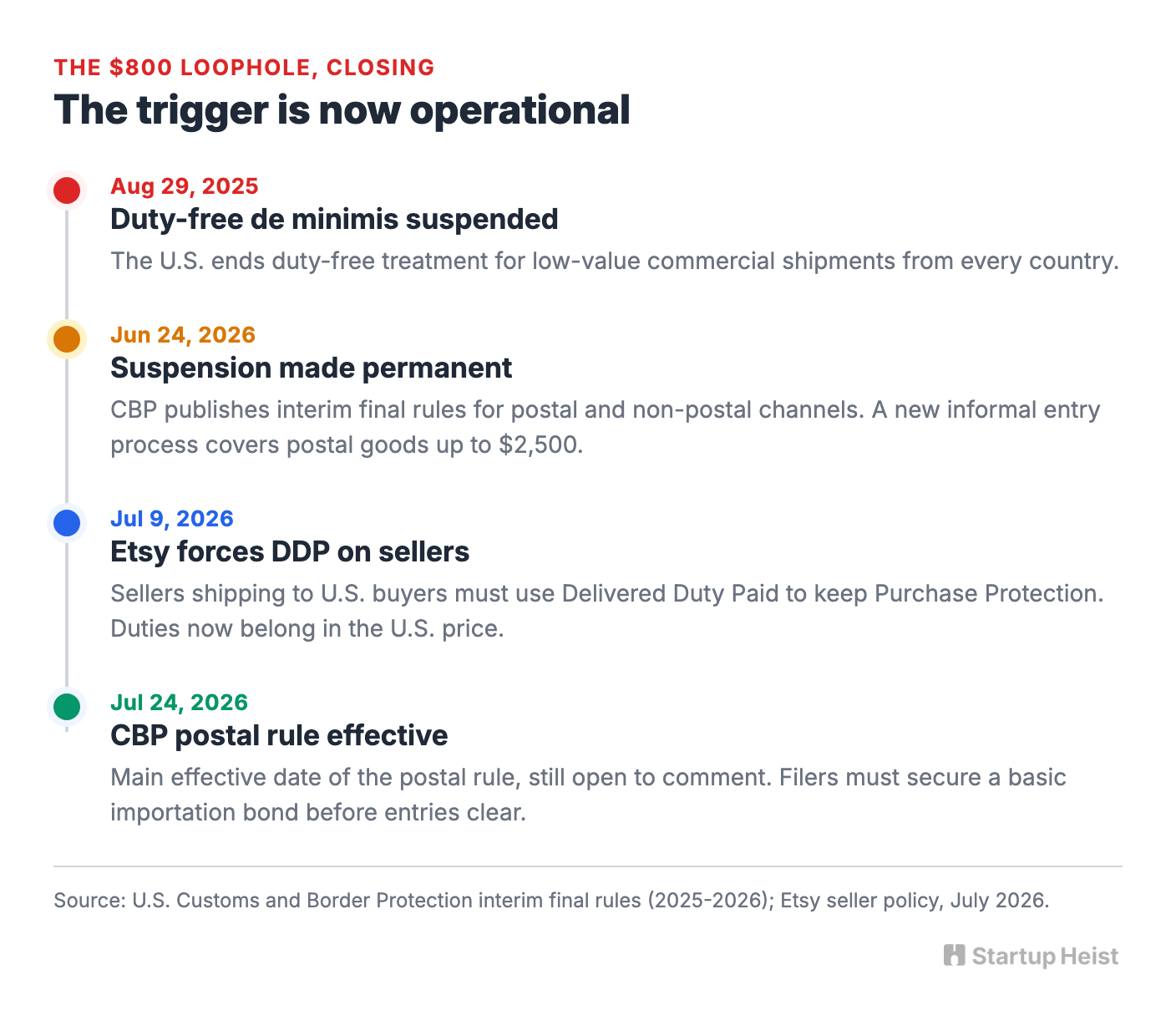
The United States suspended duty-free de minimis treatment for low-value commercial shipments from every country on August 29, 2025. On June 24, 2026, U.S. Customs and Border Protection made the suspension permanent, publishing interim final rules for both postal shipments and goods arriving through every other channel. The postal rule adds a new informal entry process for merchandise valued at $2,500 or less.

For a large retailer, this is another compliance line item. For a one-person Etsy shop, it's a pricing crisis.
The seller now has to know which tariff classification applies to the product, where it was legally manufactured, whether a trade agreement reduces the duty, which country-and-material surcharges stack on top, what the carrier will charge to advance the duty, whether the shipment can travel Delivered Duty Paid, and how much the U.S. price has to rise to protect the margin. Then the same questions repeat across Etsy, Shopify, eBay, and the seller's own website.
The opportunity is a lightweight landed-cost and customs-readiness product for non-U.S. micro-sellers shipping into the United States. One catch is worth stating up front: the obvious version, a tariff calculator, is already being commoditized. The stronger business is a cross-channel margin system that tells sellers which products still make money, what prices to change, what information is missing, and what to do before the next order ships.
The play, stated plainly:
The money: 1,000 sellers at $35 a month is $35K MRR, with a path to $126K MRR at 3,000 accounts, plus expert-review and broker-referral revenue.
Inside:
• Five-question margin engine for messy catalogs
• Five-version MVP: calculator to margin alerts
• Four-tier pricing plus paid expert review
• Four moats: memory, reconciliation, trust
The Trigger Just Became Operational
This stopped being a regulatory story that might matter someday. It's now wired into the daily workflow of marketplace sellers.
On July 9, 2026, Etsy began requiring sellers who ship to U.S. buyers to use Delivered Duty Paid shipping to qualify for Etsy Purchase Protection. Etsy is telling international sellers to build duties and import fees into their U.S. prices so the buyer sees the full cost at checkout. A seller who ships Delivered Duty Unpaid, and later faces a delayed or refused package, can be on the hook to refund the buyer, with the charge deducted from the seller.
The policy forces a cluster of decisions onto the seller before an order even arrives. What will the duty cost? How should the U.S. price change? Which DDP carrier should fulfill the order?
Etsy has already suspended label purchases for some postal services that can't support U.S.-bound DDP, and its shipping guidance now routes sellers toward a patchwork of regional carriers, consolidators, and third-party services that changes country by country. A UK seller is pointed at Royal Mail International Tracked DDP; someone else is pointed at UPS or FedEx. That fragmentation is the opening. What the seller wants isn't a tariff percentage; it's an answer to a business question: can I still profitably sell this to an American, and what do I change before I do?
The Customer Is Bigger Than a Hobbyist and Smaller Than an Enterprise
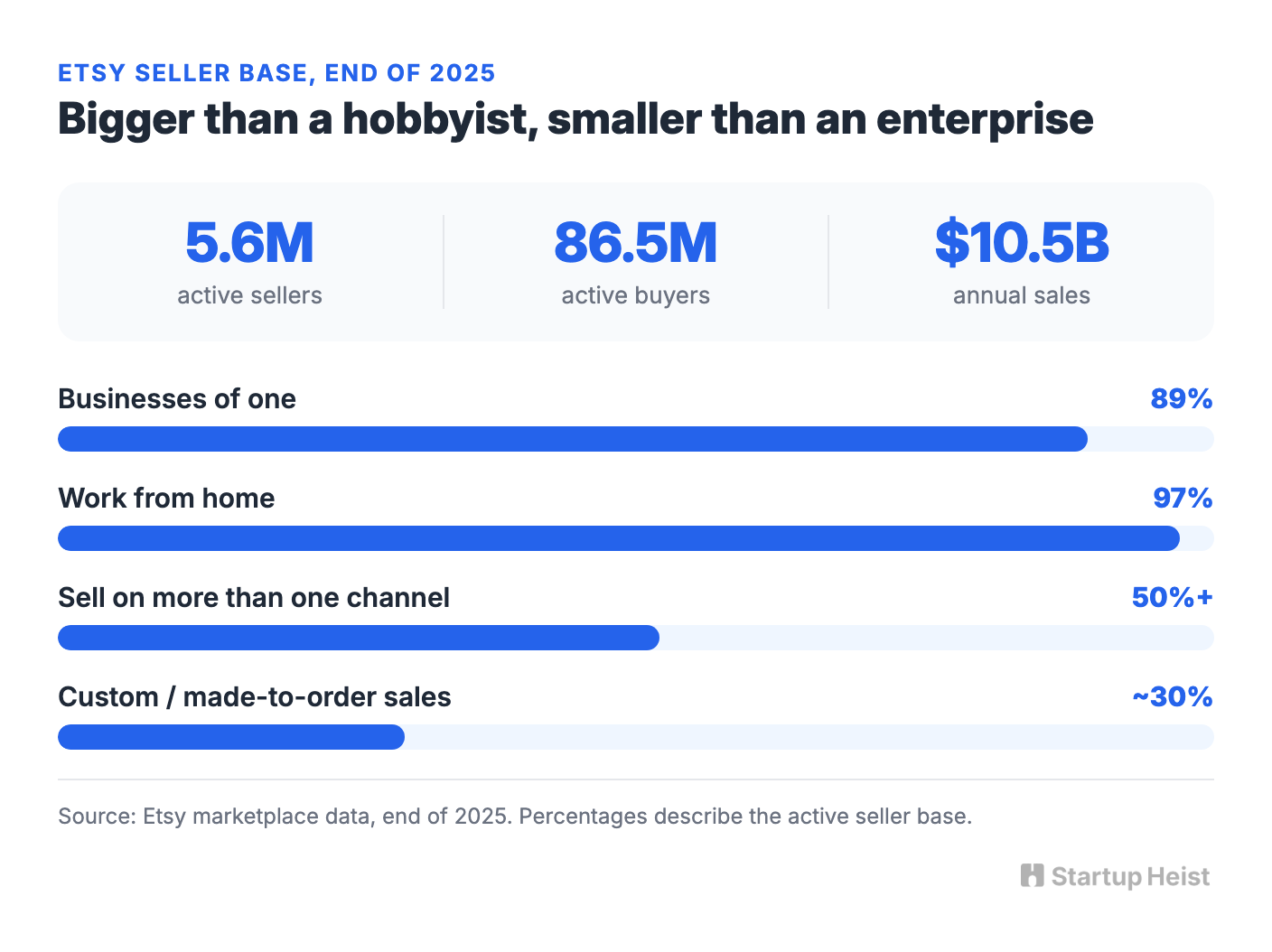
Etsy's marketplace had roughly 5.6 million active sellers and 86.5 million active buyers at the end of 2025, moving about $10.5 billion in annual sales. The shape of that base matters more than the headline. Around 89% are businesses of one, 97% work from home, and more than half sell through more than one channel. Sellers spend only about half their working time actually making or designing products; the rest goes to administration. Custom and made-to-order items are roughly 30% of marketplace sales.
These aren't supply-chain departments. They're jewelry makers, vintage dealers, print shops, ceramicists, small apparel brands, collectible sellers, and craft suppliers. Their product data is usually incomplete. A listing reads "handmade celestial pendant" and says nothing about the base metal, the coating, the origin, or the intended use. That's a terrible input for customs classification, which is precisely where the opportunity sits.
The initial customer isn't every Etsy seller. It's narrower: a non-U.S. seller with 20 to 500 monthly orders, real U.S. demand, five to a few hundred physical SKUs, and nobody on staff who handles trade compliance. The best early accounts share a few traits: U.S. orders are a big enough slice of revenue that leaving would hurt, the catalog holds products whose classification isn't obvious, the seller operates on more than one channel, and the gross margin is fat enough to survive duties once prices are adjusted.
Skip the merchants selling $5 products at $1 of profit. The software may correctly tell them their business no longer works, which doesn't produce durable subscription revenue. Start with sellers priced between roughly $30 and $250, where one classification mistake or surprise carrier fee erases $10 to $50 of profit but the order is still worth saving.
The Obvious Wedge Is Already Closing
A free U.S. tariff calculator is a fine acquisition tool. On its own, it isn't a company.
Easyship runs a free U.S. duty calculator and broader duty-and-tax features. Zonos calculates landed cost across more than 200 destinations and prices its guarantee at $2 per order plus 10% of applicable duties, taxes, and fees. Shopify calculates duties at checkout, classifies products by HS code and description, and sells broader international infrastructure through Managed Markets. And Etsy has now put its own U.S. tariff estimator inside the listing workflow, powered by Zonos, estimating duties, suggesting HS codes, and helping sellers build U.S.-specific prices. Etsy is explicit that the results are estimates and the seller remains responsible for validating them.
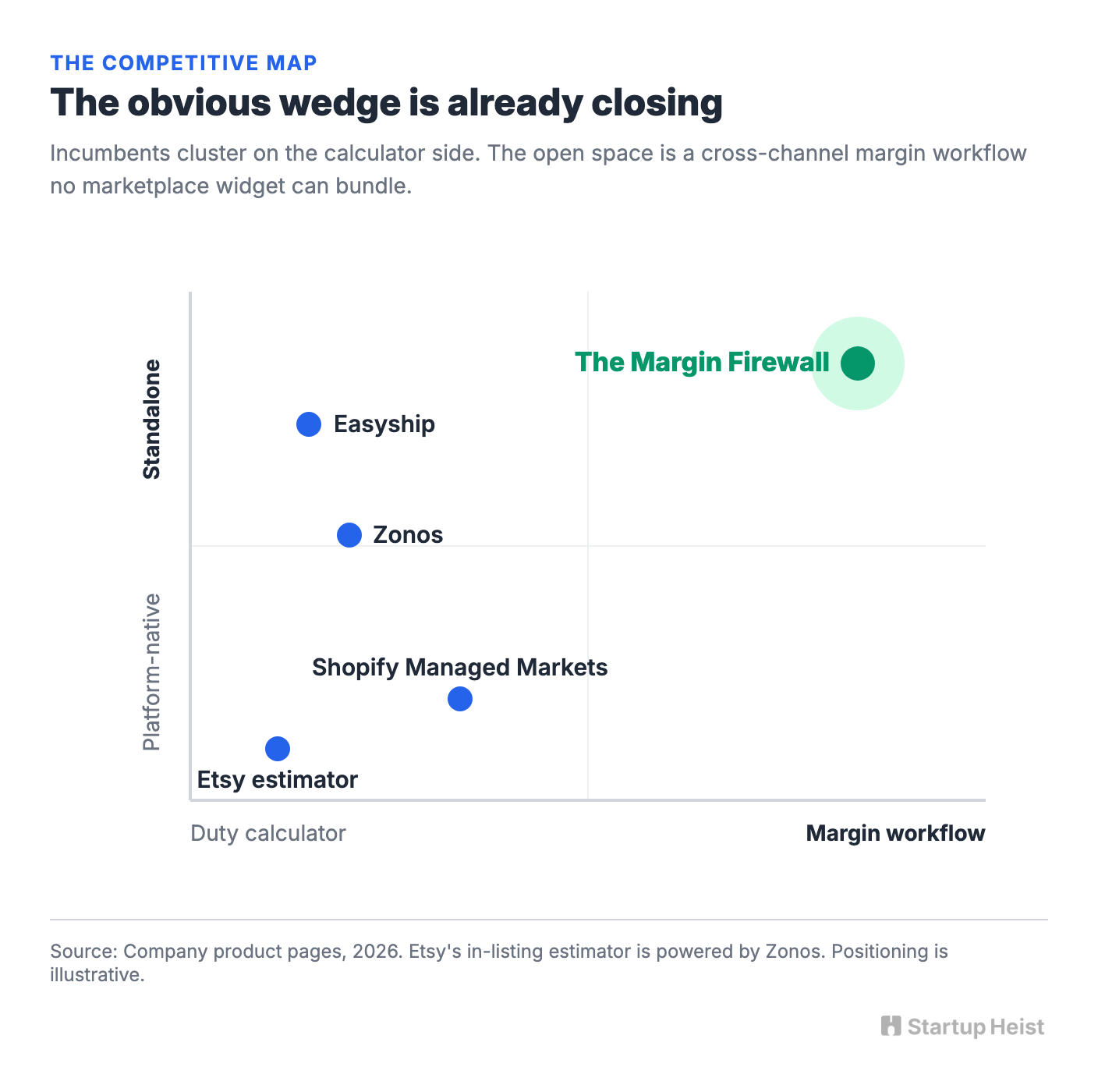
So the product question answers itself. Don't build "paste a description, get an HS code and a duty estimate." Etsy and Shopify can drop that feature next to the product listing, and they control the interface, the order data, and the checkout. A standalone founder won't out-calculate a platform that can bundle the same widget for free.
Build the other thing: import your catalog and orders, then see which U.S. listings are mispriced, which classifications are uncertain, what each carrier will actually cost, and exactly which prices and customs fields need to change. The calculation is only the lead magnet. The workflow is what people pay for.
The Product: A Tariff Margin Firewall
The interface should feel like a financial control panel, not a customs encyclopedia. The seller connects a store or uploads a CSV, and the product returns a prioritized list of actions:
Unlock the Vault.
Join founders who spot opportunities ahead of the crowd. Actionable insights. Zero fluff.
“Intelligent, bold, minus the pretense.”
“Like discovering the cheat codes of the startup world.”
“SH is off-Broadway for founders — weird, sharp, and ahead of the curve.”


