


The Dead SKU Heist
In January 2026, TRIANGL brought back the product that made it famous.
The Australian swimwear brand's neoprene bikinis were inescapable on Instagram in the mid-2010s. Bright, structural, slightly absurd, impossible to mistake for anything else. Then fashion moved on. TRIANGL retired the fabric, kept selling other swimwear, and its defining product became an artifact of an earlier internet.
A decade later it returned. The brand relaunched neoprene under an "OG Neoprene" banner, opening with the Valentina collection and following with Comporta. Lighter construction, softer feel, lower cuts. Same visual code, different garment. Pieces sold out.

The timing wasn't luck. At the start of 2026, TikTok searches for "2016" rose 452%. Searches for "2016 makeup" climbed 600%, "2016 songs" 290%, and roughly 56 million videos ran through the app's 2016 filter. Chokers, bomber jackets, oversaturated warm filters, Kylie Lip Kits, and TRIANGL bikinis all became cultural material again inside the same few weeks.
The nostalgia wave is distribution. Underneath it sits a data problem that won't expire when TikTok moves on to 2008.
Thousands of digitally native brands launched between 2012 and 2018. They shipped recognizable products, collected reviews, built email lists, and produced millions of campaign images. Then they discontinued nearly all of them, and the products scattered into Depop listings, Poshmark closets, eBay sold records, Reddit threads, support tickets, and boxes of samples in a founder's office.
Brands file all of that under history. It's closer to an underused product-development database, and almost nobody reads it.
The heist is to build a SKU Resurrection Desk: a productized research and launch service that finds discontinued products with credible remaining demand, proves that demand before anything gets manufactured, and helps DTC brands run tightly controlled archive drops.
Sell it as what it is. A cheaper way to decide what to make next.
Here's the business in brief:
The money: Three audits a month at $4,000, one validation sprint at $7,500, a launch every other month. Roughly $25,500 a month solo.
Inside:
• The 100-point Resurrection Score, weighted
• Three-stage pricing: audit, sprint, drop
• The teardown and cold email that convert
• The 30-day build, under $1,000 in tools
The 76% problem
Every consumer brand runs the same expensive loop: invent a product, design it, photograph it, buy inventory, buy attention, then find out whether anyone wanted it.
It mostly fails. Roughly 30,000 new consumer packaged goods launch in the U.S. every year, and only about 15% remain commercially viable after 24 months. Boston Consulting Group puts the launch failure rate at 76%, with two-thirds of the failures never selling 10,000 units. Apparel and beauty aren't measured as cleanly, but their mechanics are harsher: size curves, colorway bets, fit returns, and seasonal windows that close whether or not the product worked.
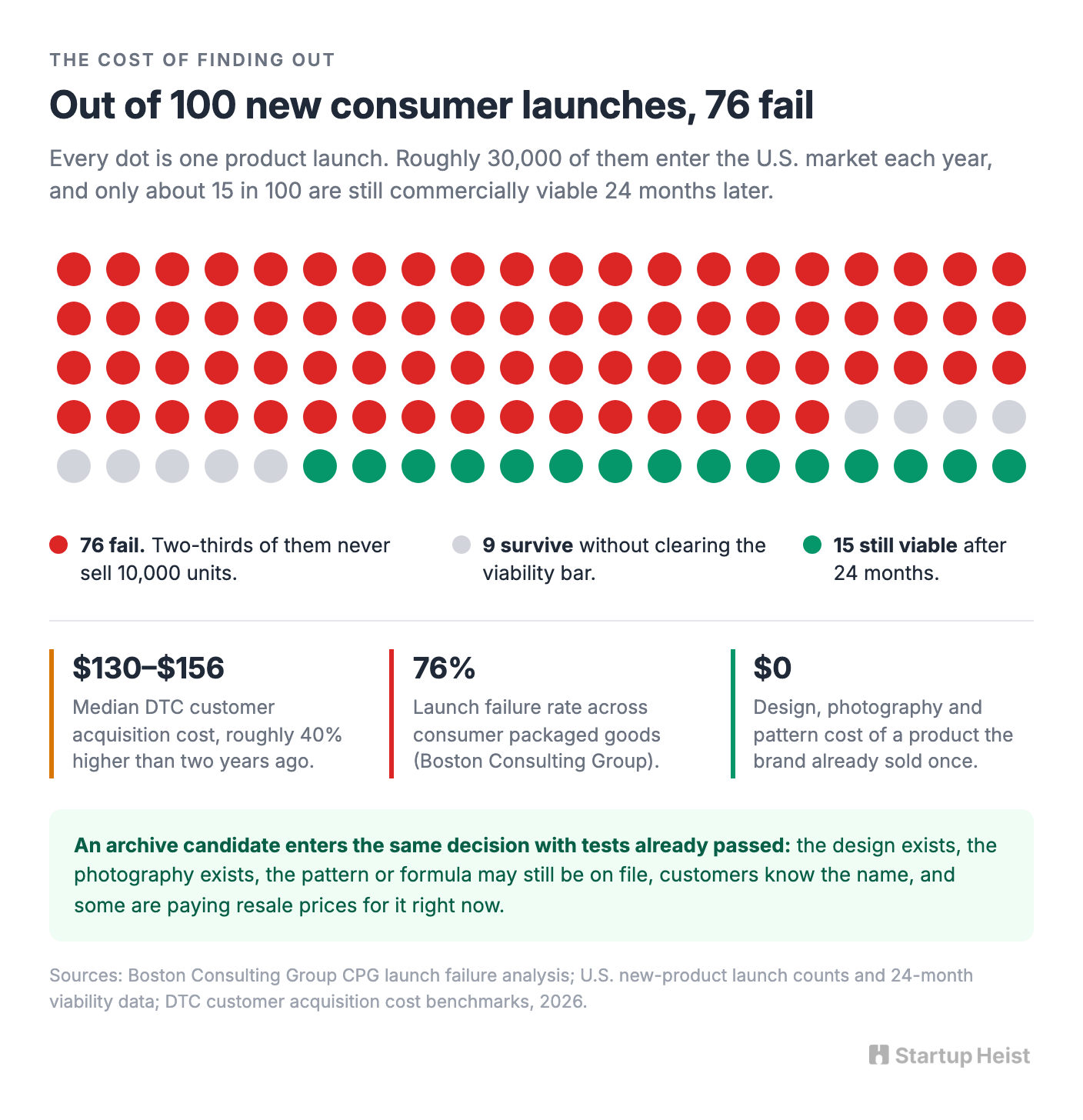
The cost of finding out has gone up too. Industry estimates put median DTC customer acquisition cost between $130 and $156, roughly 40% higher than two years ago, and Meta CPMs have risen again through 2026. Every new product has to clear a higher bar just to be seen.
An archive candidate arrives with several of those tests already passed. The design exists, the photography exists, and the pattern or formula may still be on file. Customers know the name, and some are actively hunting for it on resale platforms with their own money.
None of that makes a reissue a good idea. It makes the idea far cheaper to evaluate, and evaluation is what you're selling.
What the archive actually is
Most brands treat a discontinued SKU as a closed chapter, and the moment it leaves the catalog its evidence fragments. Sales history stays in Shopify. Reviews sit in Yotpo. Campaign performance lives in Meta and Klaviyo. Return rates hide in an operations tool. Customer requests scatter across Gorgias tickets, Instagram comments, and email replies nobody has read since 2019. No single person can answer a simple question about the thing: was it actually good, or did it just look good?
Meanwhile a second market keeps trading the product without the brand's involvement.
Marc Jacobs Beauty makes the case plainly. The line was discontinued in 2021 and kept a cult following on Reddit, TikTok, and resale sites for roughly five years, with original products trading on eBay and Mercari at about double their retail price. In 2026 Coty brought it back with a 72-piece relaunch, widely called one of the most-requested comebacks in recent beauty history. The signal was public the whole time.
The pattern runs across categories. The Ordinary brought back its Serum Foundation about two years after exiting makeup entirely, driven by customer requests. Glossier and Urban Decay have pulled products back from the vault. Louis Vuitton revived its Murakami monogram, and searches for the collaboration on resale platform FASHIONPHILE surged 1,100%.
Luxury houses staff teams for this work. At a $10 million DTC brand nobody owns the job, and that gap is your customer.
How to read a resale market
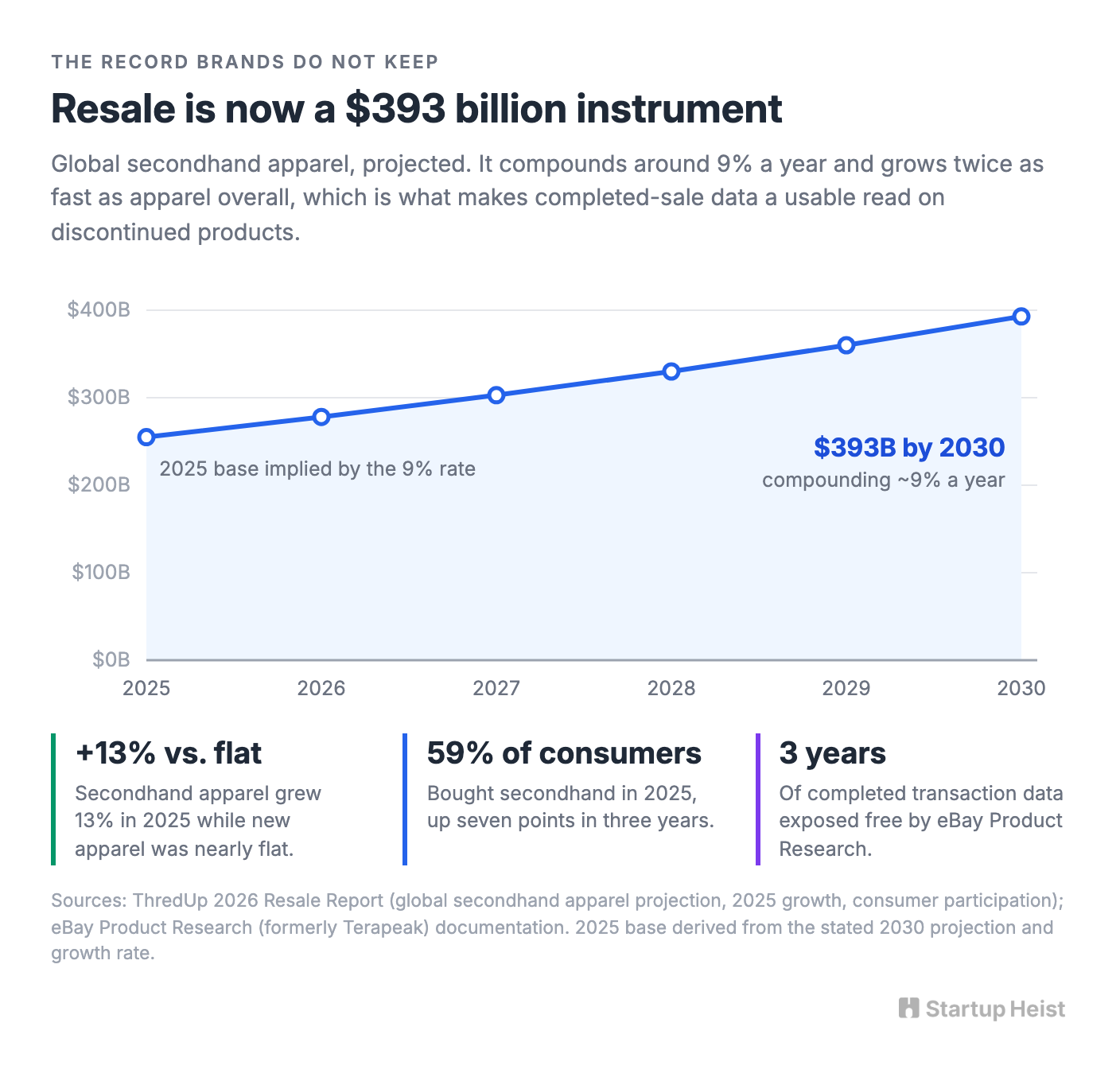
The secondhand fashion market doubles as an external record of which products held economic value after the brand stopped promoting them, and it's large enough to be a real instrument. ThredUp's 2026 report projects global secondhand apparel to reach $393 billion by 2030, compounding around 9% annually and growing twice as fast as apparel overall. It grew 13% in 2025 while new apparel was nearly flat, and 59% of consumers bought secondhand in 2025, up seven points in three years.
It's also fragmented, which is exactly why the opportunity exists. Depop, Poshmark, and eBay were built to help individuals transact. None was built to tell a brand that its discontinued coral swimsuit has stronger relaunch potential than the black one because it holds price better, has thinner active supply, sells across a wider size range, and shows faster search growth. The evidence is public; the decision layer on top of it doesn't exist.
eBay carries the most usable record. Its Product Research tool, formerly Terapeak, is free with any seller account and exposes up to three years of completed transaction data: average sold price, sold price range, number of sellers, and sell-through rate. Those are completed sales, not asking prices.
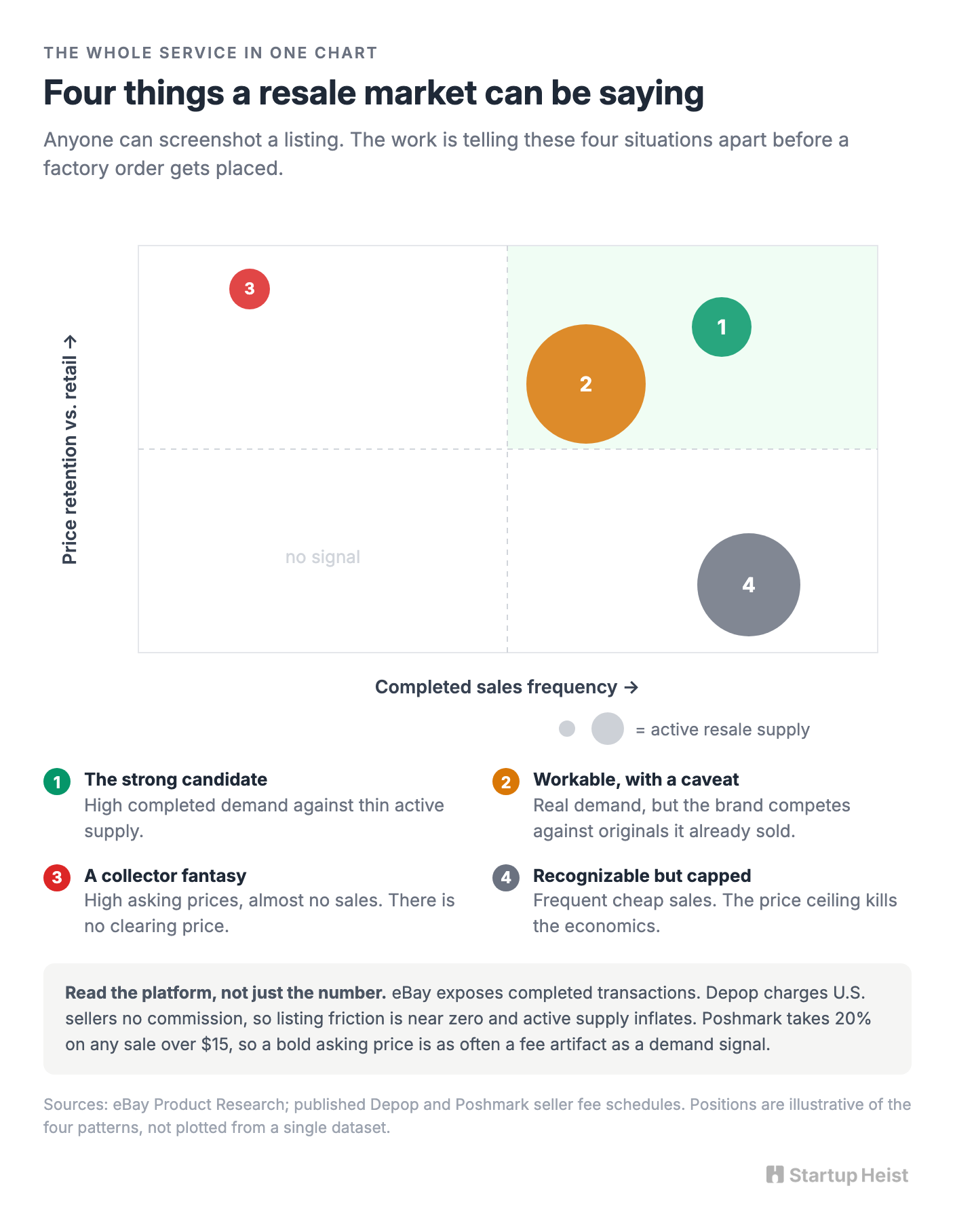
The other platforms need translation. U.S. sellers pay no Depop selling commission beyond payment processing, so listing friction is near zero, which inflates active supply and cultural chatter without proving anything sold. Poshmark takes 20% on any sale of $15 or more, which pushes sellers to list high, so a bold asking price is a fee artifact as often as a demand signal.
The work is separating four very different situations:
- High completed demand, thin supply. The strong candidate.
- High demand, abundant supply. Possible, though the brand competes against originals it already sold.
- High asking prices, almost no sales. A collector fantasy with no clearing price.
- Frequent cheap sales. Recognizable, but the price ceiling kills the economics.
Telling those apart is the whole service. Anyone can screenshot a listing.
Who actually has an archive worth mining
This doesn't work for every brand, and disqualifying prospects fast is what keeps the work profitable. A three-year-old supplement company has no archive. A commodity basics brand has old products nobody remembers, and no amount of storytelling manufactures nostalgia that was never there.
Unlock the Vault.
Join founders who spot opportunities ahead of the crowd. Actionable insights. Zero fluff.
“Intelligent, bold, minus the pretense.”
“Like discovering the cheat codes of the startup world.”
“SH is off-Broadway for founders — weird, sharp, and ahead of the curve.”


