


Build the Accessory Attach-Rate Layer for Shopify
The opportunity isn't another product customizer. It's a revenue instrument for brands that already sell charms, patches, pins, straps, clips, and every other thing that clips onto something else.
Shopify's app store lists 495 apps in its custom-products category. Monograms. Photo uploads. Engraving. 3D configurators. AR previews. Every permutation of "make this yours" already has a vendor, a pricing page, and a review count.
Building another product customizer would be a terrible heist.
But buried inside that crowded category is a much narrower job the incumbents treat as a checkbox: help a shopper visually attach real, separately stocked accessories to a real base product, then prove the behavior moved money.
Bag charms on totes. Pins on hats. Patches on jackets. Straps and clips on backpacks.
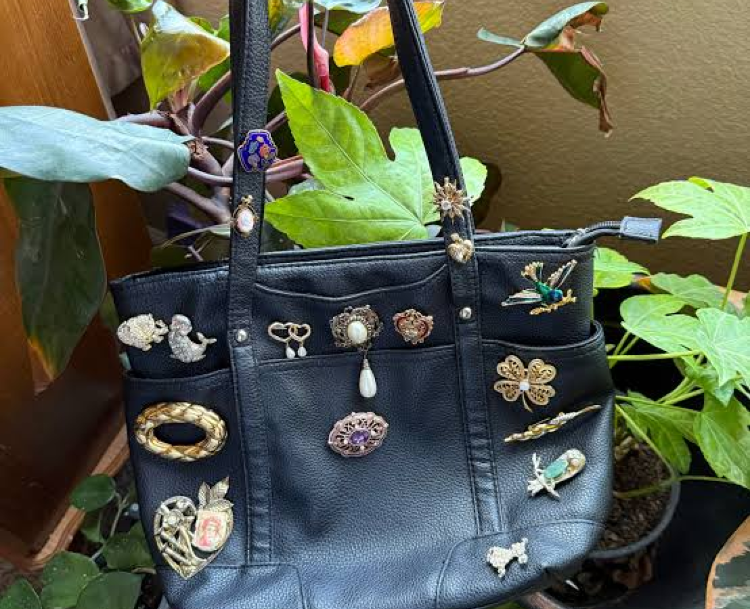
The merchant already sells the bag, and already sells the charms. Right now those SKUs live in separate corners of the storefront: a thumbnail grid below the fold, a carousel, a "you may also like" widget nobody reads.
Put the customer in front of the product instead. They see the bag. They tap a charm and it lands on an approved attachment point. They add a strap, move a pin, watch the running price climb. One click drops the bag and every selected accessory into the cart as real line items against real inventory.
Behind that interface, the merchant watches the number that matters: accessory attach rate, and the accessory revenue per base-product order it produces.
The canvas is just how you collect the data. The data is the business.
Here's the opportunity:
The money: 1,500 merchants at a blended $70 a month is $105,000 MRR. Crocs turned the same mechanic into $260 million a year from Jibbitz alone.
Inside:
• Seven-feature MVP scope, holdout test included
• Flat $29/$59/$99 pricing, no cut of sales
• The 100-email bag-brand outreach playbook
• The compatibility data competitors can't copy
The charm boom is measurable, and it happened fast
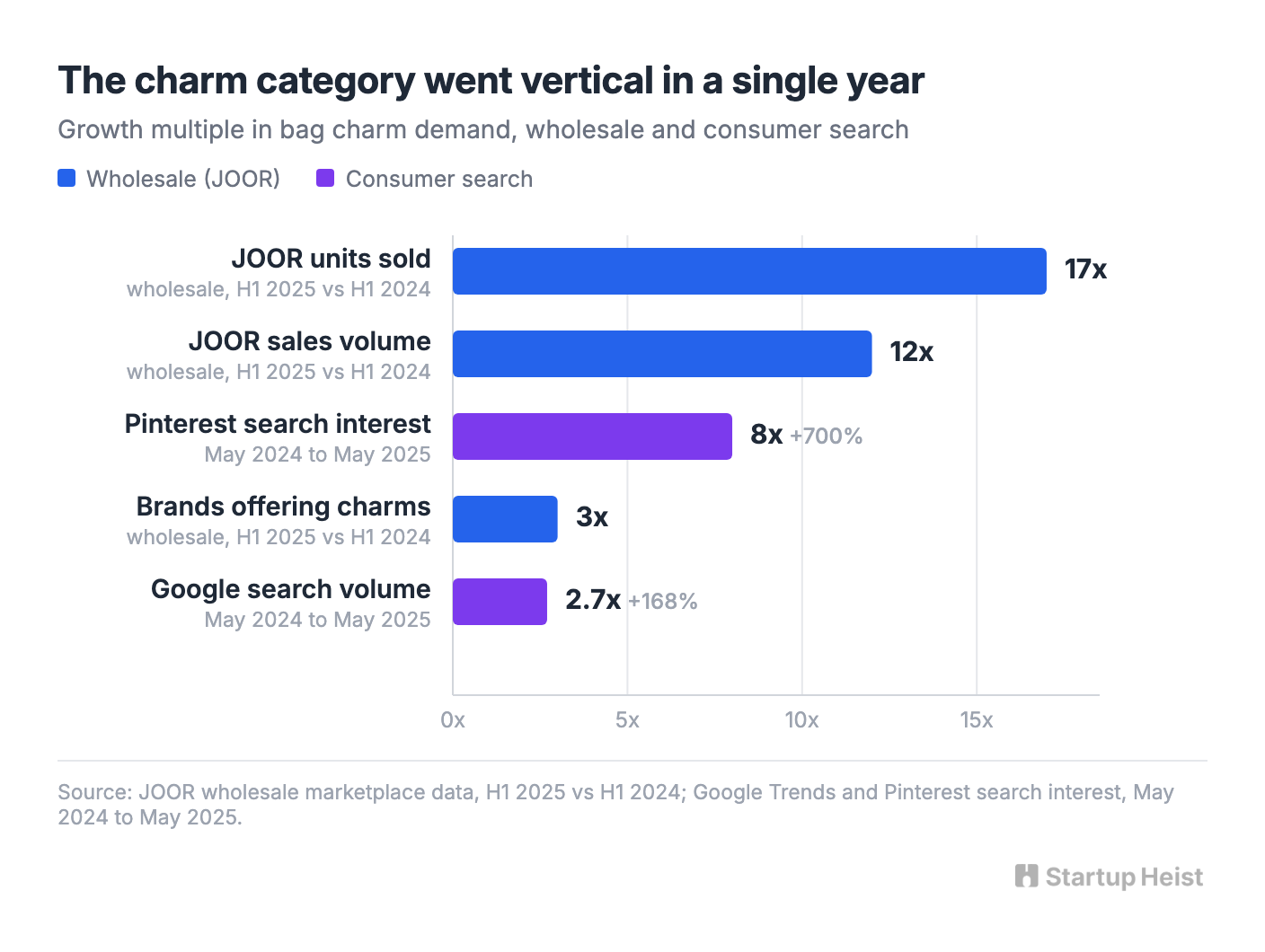
On the wholesale side, JOOR compared the first half of 2025 against the first half of 2024 and found bag charm sales volume up 12x, units sold up 17x, and the number of brands offering charms roughly tripled. Consumer demand tracked the same curve: Google searches for bag charms rose 168%, and Pinterest search interest climbed roughly 700% between May 2024 and May 2025.
Luxury noticed. Bloomberg reported on August 14, 2025 that designer houses were leaning hard into charms specifically because the big-ticket business had stalled. LVMH's fashion and leather goods division posted a 9% sales decline that quarter. Gucci fell 25%. Prada slipped 3.6%. Louis Vuitton's answer was a pair of collectible bag charms priced at $1,270 and $1,390, aimed at a shopper who would not buy another handbag but might decorate the one already in her closet.
Strip out the Labubu theatrics and the underlying mechanic is durable. A shopper who owns the expensive thing will keep buying cheap things that attach to it. Deloitte's 2026 consumer products research found 47% of consumers globally now behave as value seekers, including 35% of high-income households, and describes the shift as structural rather than a temporary reaction to prices. Preserve what you own and change it cheaply is exactly the behavior that math produces.
Meanwhile the platform underneath all of this keeps compounding. Shopify merchants moved $115.6 billion in GMV during Q2 2026, up 32% year over year and the fifth straight quarter above 30% growth. You don't need a slice of that. You need a few hundred merchants whose catalogs happen to have the right shape.
Crocs already ran the ten-year experiment
Crocs bought Jibbitz in 2006 for $10 million. In February 2026, on the Q4 call, CEO Andrew Rees put 2025 Jibbitz sales somewhere between $260 million and $270 million. The company describes its brand as standing on three platforms: clogs, sandals, and personalization.
None of which means a $260 million Shopify app market is sitting unclaimed. What it demonstrates is more useful than that. A physical product can become a platform for a stream of cheap, interchangeable, collectible purchases. The shoe creates the installed base. The charms monetize the attachment points forever after.
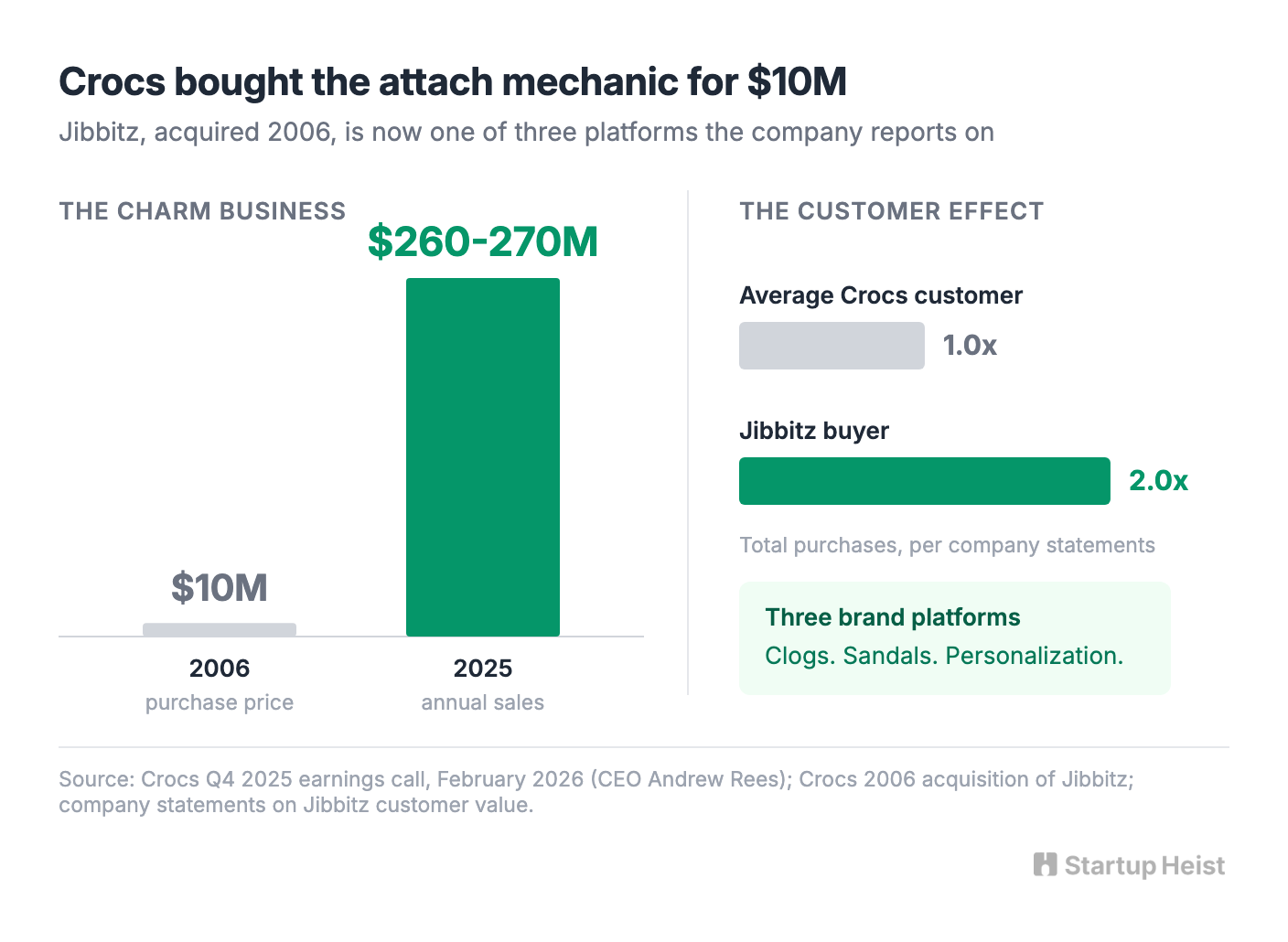
One detail from Crocs is worth more than the revenue figure. The company has said Jibbitz buyers are worth roughly twice the average customer in total purchases. Personalization there works as a customer-quality filter. The people who decorate the product stay longer and spend more.
And the add-on gets more desirable the moment a shopper can see it in place. A recommendation widget says other people bought this charm. A visual accessory layer says this is your bag with that charm on it. The second one closes the imagination gap, and closing that gap is the product you're selling.
Three apps already own the canvas
The drag-and-drop charm interface is not an unclaimed space, which is where most versions of this idea go wrong. It's already commoditizing.
Croco Charms launched on February 3, 2026 and ships the obvious version: drag charms onto anchor points on clogs, backpacks, and perforated accessories, preview instantly, add everything to cart together. It charges $25 to $99 a month, has zero reviews, and lists no analytics anywhere in its feature set. Charmi, a charm-bar builder aimed at jewelry, has been live longer, sits at five reviews, and prices from $12 to $129 a month by bundle sales volume, but it sells every configuration as a single bundled product, so the merchant loses per-SKU inventory truth and can never answer which charm sells. W3 Product Accessories has been selling one-click accessory add-ons since 2015 for $6.99 a month, with 98 reviews proving merchants will pay for attach mechanics and no visual layer at all.
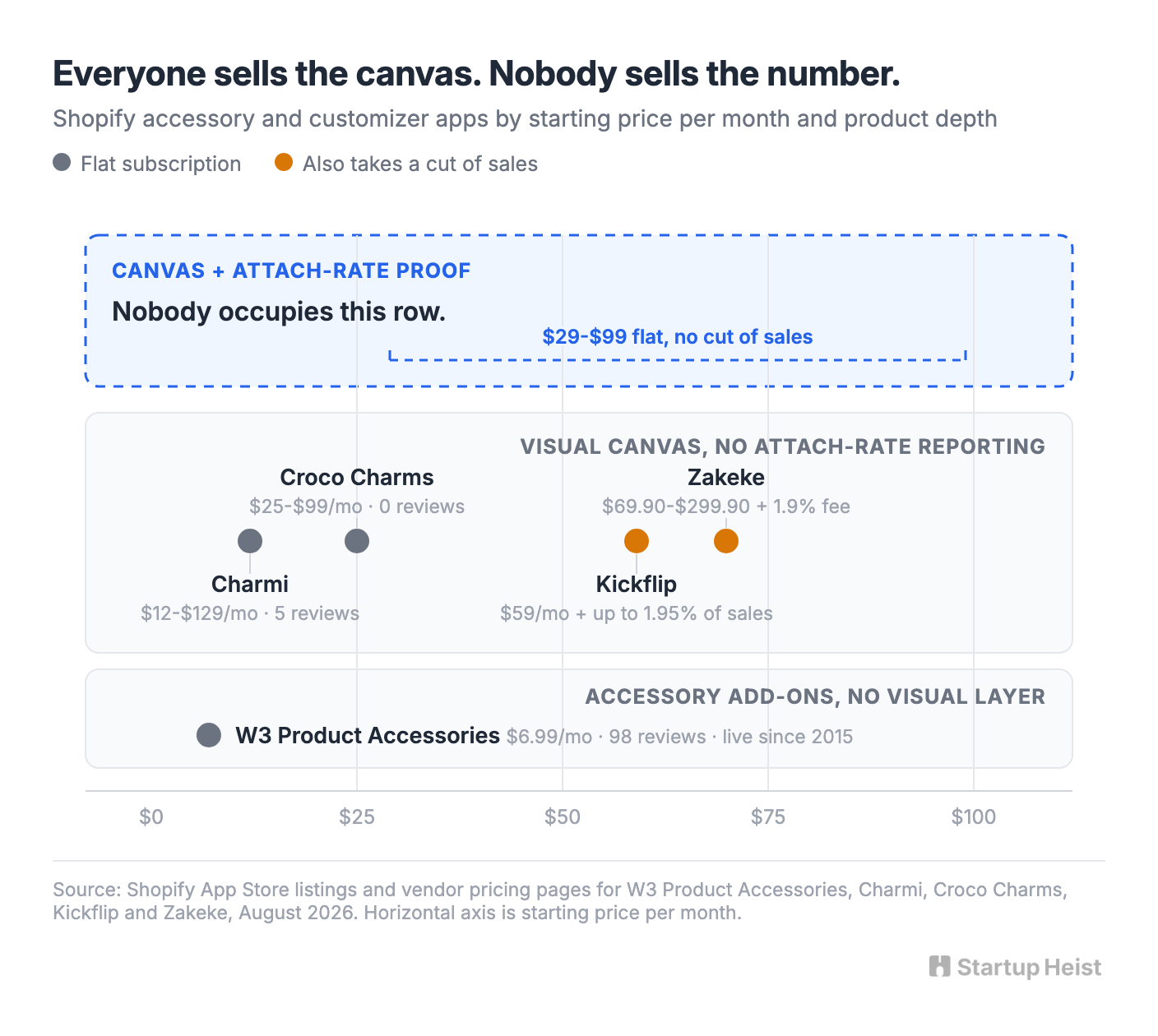
The heavyweights confirm the same blind spot from above. Kickflip charges $59 a month plus up to 1.95% of custom product sales, with white-labeling at another $49. Zakeke starts at $69.90 a month for ten published products with a 1.9% transaction fee, and runs to $299.90 at the top tier. Both are configuration-depth companies, and neither sells attach-rate measurement, because measurement isn't what a configurator customer buys.
Every one of them sells a canvas, and canvases get cheaper every quarter. What none of them sells is a number: a merchant-facing instrument that proves the canvas paid for itself.
The MVP is seven capabilities
Resist configurator scope. You don't need 3D, AR, engraving, customer artwork uploads, print-ready production files, or arbitrary component logic.
You're building visual merchandising for discrete accessory SKUs, and the narrow definition is what makes the whole thing shippable.
Unlock the Vault.
Join founders who spot opportunities ahead of the crowd. Actionable insights. Zero fluff.
“Intelligent, bold, minus the pretense.”
“Like discovering the cheat codes of the startup world.”
“SH is off-Broadway for founders — weird, sharp, and ahead of the curve.”


