


The Shared Salon Suite Has a Back-Office Problem
Independent estheticians already split rooms to cut rent. The open lane is a $49-a-month system that keeps an approved sharing arrangement organized and financially fair, starting in the one state that publishes every suite license on the internet.
A salon suite is a strange little business. An independent esthetician rents a private room inside a larger building, brings their own clients, sets their own prices, and keeps every dollar of every facial. No salon owner takes a cut of the ticket; the professional pays flat weekly rent instead.
The deal works beautifully when the book is full and sours fast when it isn't. Take an illustrative suite at $450 a week: $23,400 a year before insurance, equipment, or product. A practitioner with enough clients for three days a week still pays for seven, and the room sits dark more than half the time.
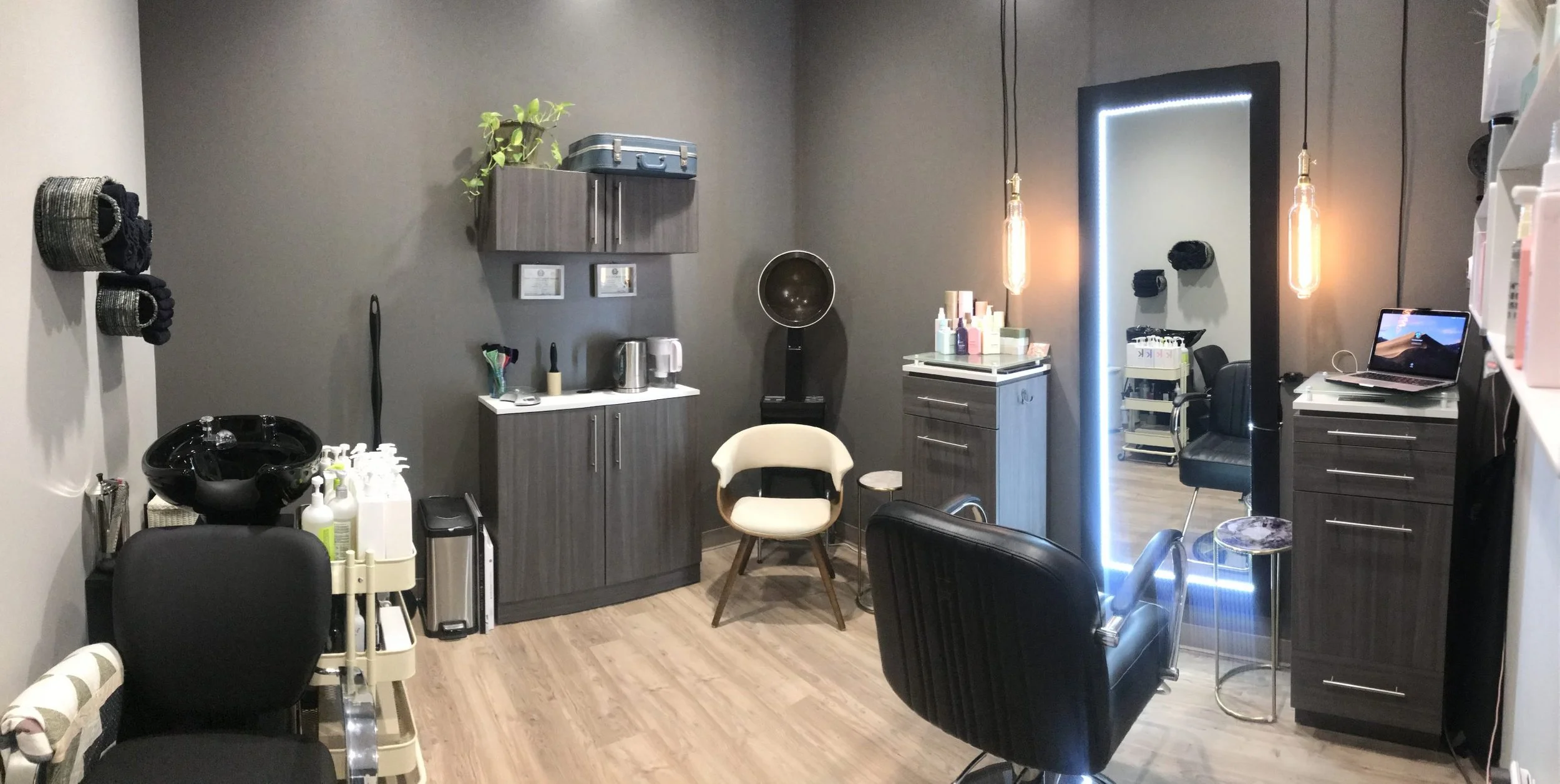
So professionals share. Sola Salons says on its own rental page that "some beauty and wellness professionals choose to share suites and split shifts to reduce weekly rental costs." Listing sites carry room-share ads priced by the hours used. In August 2026, the salon software company salonMonster published a guide titled "Before You Split Rent, Split the Rules," built around a hypothetical pair of colorists who bought product whenever something ran low until neither could say who owned what.
Sharing saves rent and creates a pile of small decisions: who gets the room on the Friday after Thanksgiving, what happens when a license lapses, who paid for the last case of wax, and how the leaseholder proves to an inspector that everyone working in the room is licensed. Today those answers live in a Google Calendar, a spreadsheet, a folder of insurance certificates, and a long group text.
The opportunity is to replace that pile with one system. Call it ChairSplit: a lightweight back office for small groups of licensed estheticians who already have permission to share a commercial salon suite. It manages the room schedule, the people authorized to work in it, and the money they owe each other. Client booking and room discovery stay out of scope, and no software can make an unapproved sublet legal.
The money: 250 suites at $49/month = $12,250 MRR, about $147,000 a year. Texas lists 17,472 licensed salon suites in a free public file, 7,261 of them in DFW.
Inside:
• Weekly rent-split ledger and sample statement
• TDLR open-data prospecting playbook for DFW
• Operator and host outreach templates
• Pilot kill metrics and payback math
The empty room creates the value
Suppose the host pays $450 a week and finds three colleagues willing to pay $90 each for one recurring day.
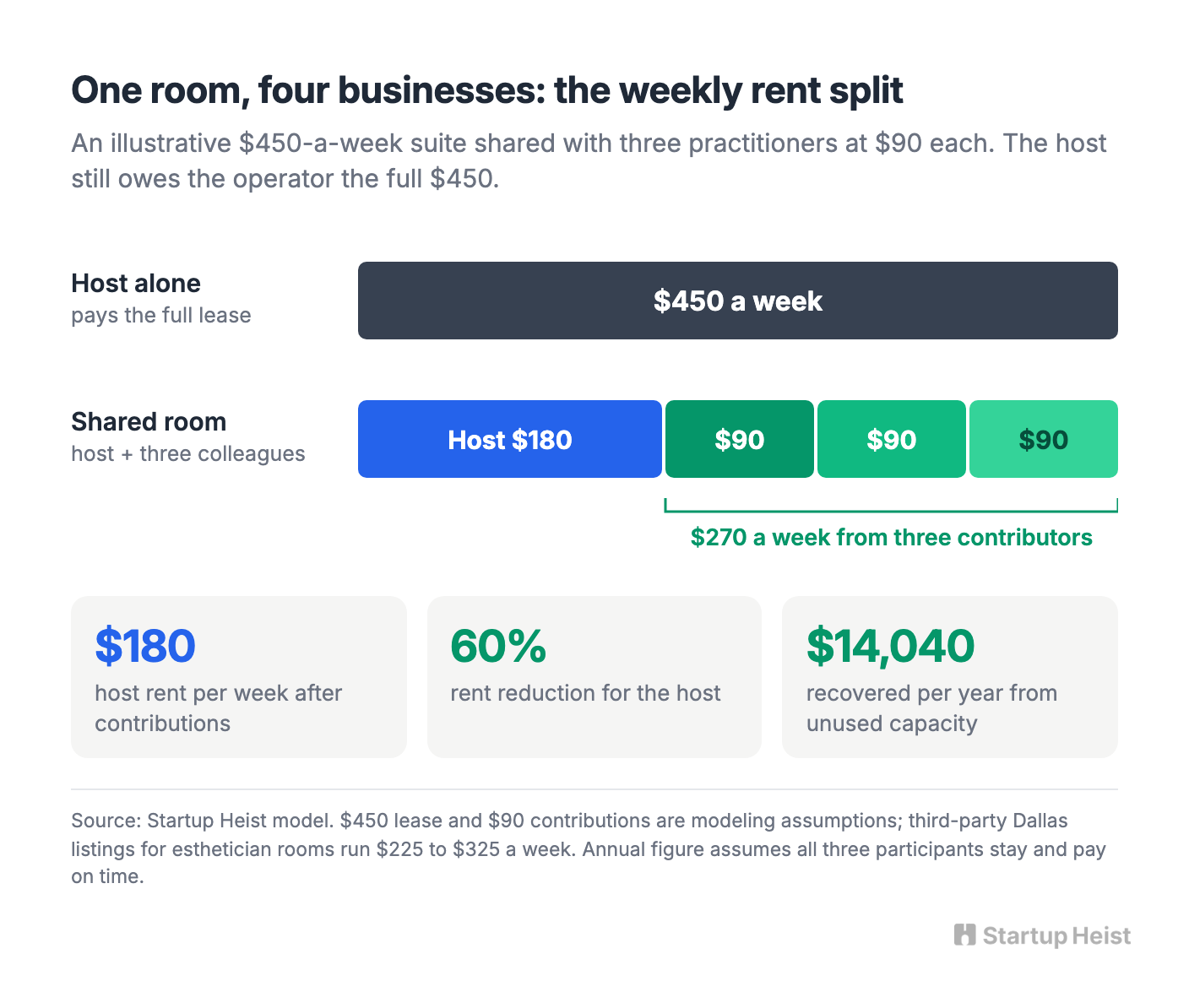
Over a year, the host recovers $14,040 from capacity that was going unused, as long as all three participants stay and pay on time. The host still owes the operator the full $450, still carries the lease, and still absorbs extra cleaning, supplies, and wear. The $450 and $90 figures are modeling assumptions. Salon suite rental prices swing widely by operator and metro, and third-party Dallas listings for esthetician rooms run closer to $225 to $325 a week.
The structure holds at any price point: one fixed facility cost split across four separate businesses on four schedules, with real money changing hands every week. The value exists the moment the group forms. ChairSplit's job is to keep the arrangement intact, because a missed payment or a double-booked Saturday is usually how these groups end.
The supply of suites keeps growing
The rooms keep multiplying. On October 13, 2026, Sola announced 22 new franchise units, its strongest signing quarter in three years, including a six-unit agreement in Dallas. The chain now runs 759 locations serving more than 22,000 independent beauty and wellness professionals. Phenix Salon Suites opened 26 locations in 2025 and plans about 30 more in 2026. Every new building adds rooms that need a full book to pay for themselves, and many tenants don't have one. ShearShare, a Dallas-founded startup that raised more than $5 million for a marketplace of short-term salon and barbershop space, already showed that beauty workers will rent space by the day when someone makes it easy.
The professionals are a steady, self-employed population. The Bureau of Labor Statistics counts about 104,200 skincare-specialist jobs in 2025, projected to reach 113,300 by 2035, a 9% gain. Roughly 29% are self-employed, which implies about 30,000 independent estheticians nationally. Most will never share a room, so treat that figure as the outer boundary of the market.
Texas already wrote the product spec
Texas licenses each salon suite as its own business. The Texas Department of Licensing and Regulation (TDLR) calls it a mini-establishment: a leased room or suite inside a licensed barbering or cosmetology establishment, walled off from common areas, licensed for $70 every two years. On sharing, TDLR's FAQ is direct. Asked whether a mini-establishment licensee may let other licensees work in the suite, it answers: "Yes, if they are properly licensed."
The same FAQ spells out the paperwork. The licensee "must maintain the name, license number, and license expiration date of each person" working in the suite, and the license must be displayed inside the room at all times. The state requires a roster, and spreadsheets handle rosters badly once people start rotating in and out.
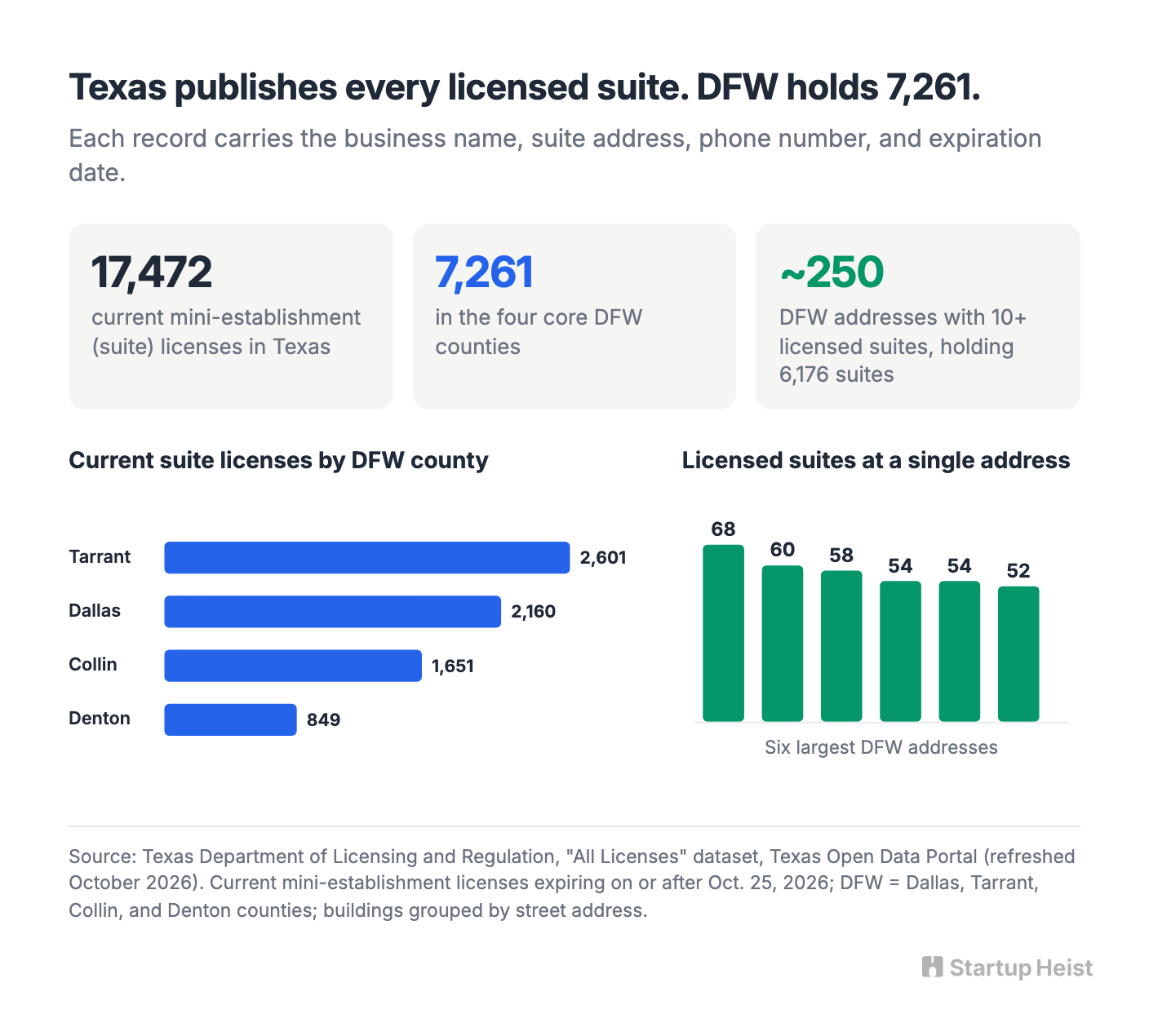
The best part is the data. TDLR publishes its full license file on the Texas Open Data Portal as a free, queryable API, refreshed in October 2026. It lists 17,472 current mini-establishment licenses in Texas, with 7,261 in the four core Dallas–Fort Worth counties alone. Each record carries the business name, suite address, phone number, and expiration date. Group the DFW records by street address and about 250 buildings each house ten or more licensed suites. One public file gives you the operator target list, the host prospect list, and the license-expiration feed for the product.
The software gap sits between three categories
Beauty software is crowded, and each tool was built for a different relationship. Vagaro lets a salon owner store renter contracts and collect booth rent automatically, and its resource scheduling allocates rooms and equipment for client appointments. In April 2026, Sola launched mySOLA powered by Vagaro, bundling booking, payments, marketing, and client acquisition for its tenants. Salonist gives each renter a private calendar and client list while the owner watches rent status on one dashboard. Salon Suite Solutions automates rent collection and tenant communication for suite landlords. On the product side, SalonScale charges $49 a month for one stylist and $99 for two to three to measure product usage by weight, and Vish starts at $40 a month with scale-assisted costing.
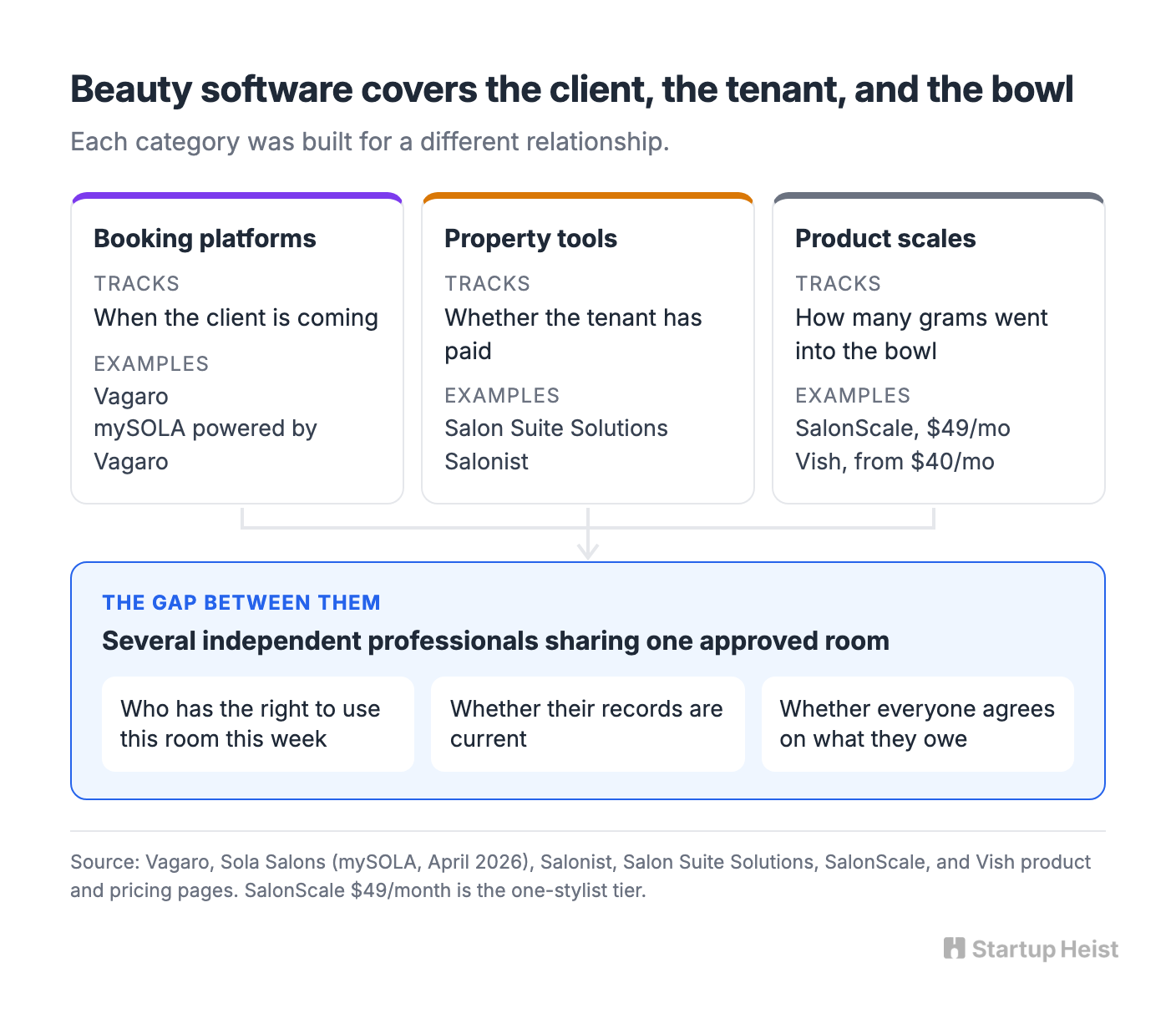
Booking platforms track when the client is coming, property tools track whether the tenant has paid, and product scales track how many grams went into the bowl. ChairSplit tracks who has the right to use this room this week, whether their records are current, and whether everyone agrees on what they owe. For many groups, Vagaro or an operator's existing setup will cover that well enough. The founder's job is to find the groups for whom the handoffs between systems still hurt, and the Texas license file says where to start looking.
The product: one weekly operating record
The first version makes a single promise, every week, everyone knows where they stand, delivered through three connected jobs.
Unlock the Vault.
Join founders who spot opportunities ahead of the crowd. Actionable insights. Zero fluff.
“Intelligent, bold, minus the pretense.”
“Like discovering the cheat codes of the startup world.”
“SH is off-Broadway for founders — weird, sharp, and ahead of the curve.”


