


The Romance Backlist Gold Rush
The opportunity: build the adaptation studio that turns proven indie romance novels into buyer-ready vertical dramas.
A new entertainment supply chain is forming, and it has a gap in the middle.
On one side sit thousands of self-published romance authors holding finished books, established characters, sequels, reader reviews, Kindle Unlimited page reads and mailing lists. That adds up to years of hard evidence that people will pay to find out what happens next.

On the other side sit mobile entertainment companies that need exactly that kind of story. Their format is vertical drama: a movie-length plot cut into 50, 80, sometimes 100 one-to-three-minute episodes, shot for a phone held upright, each episode ending on a betrayal, a reveal, a kiss or a door flying open.
Between those two sides sits a business a small team can build without raising a dollar:
The money: Four $4,500 packages plus 15 $600 audits = $27,000 a month in author-paid fees, before any deal closes. ReelShort now promises a book adaptation every month.
Inside:
• The six-factor Vertical Adaptation Score
• Four-tier pricing from $495 audits
• Author and buyer outreach email scripts
• A 90-day MVP and rights-audit intake
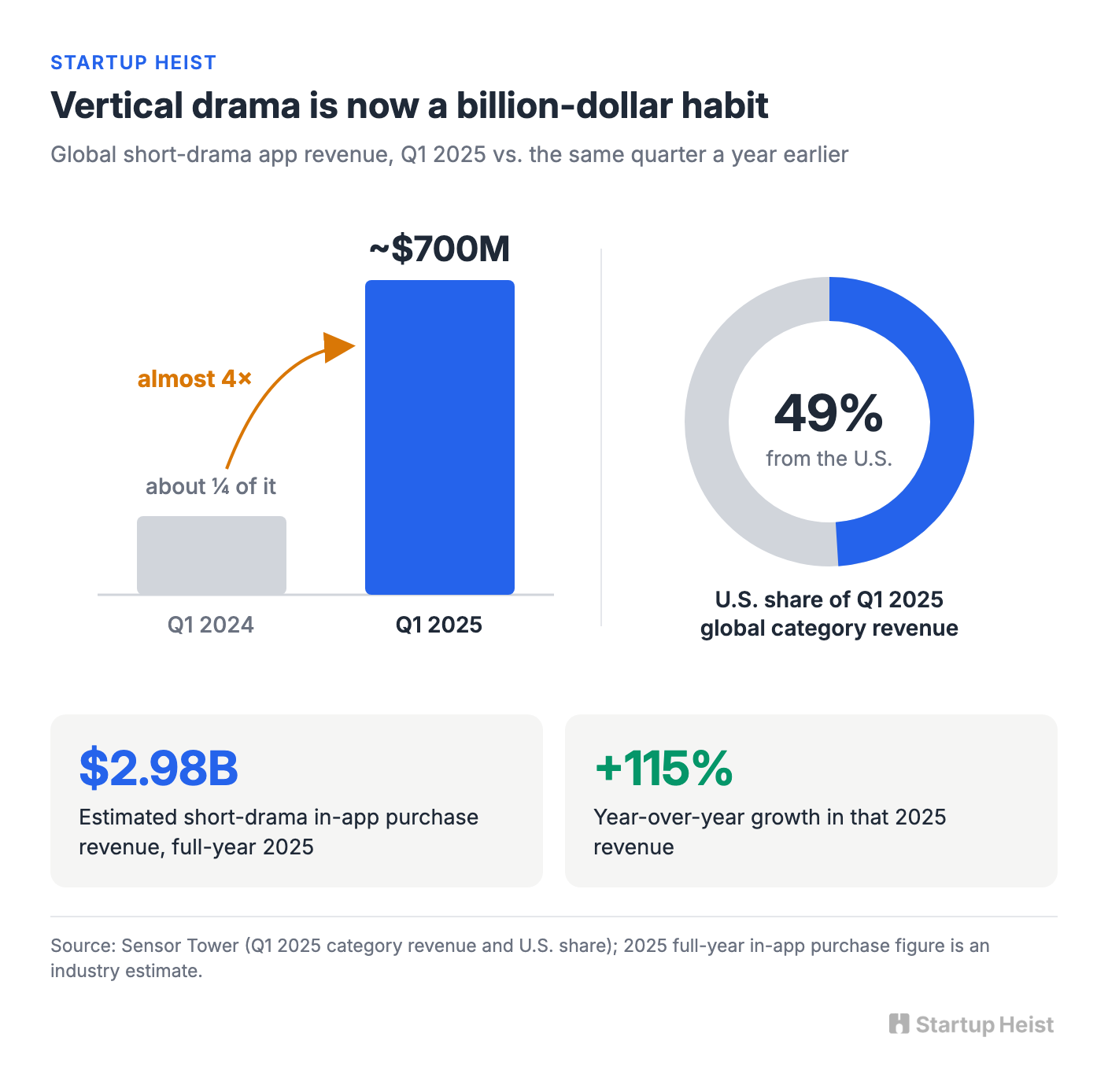
The format has stopped being a curiosity. Short-drama apps generated an estimated $2.98 billion in in-app purchase revenue in 2025, up 115% year over year. Sensor Tower measured nearly $700 million in global category revenue in Q1 2025 alone, almost four times the same quarter a year earlier, and the U.S. supplied 49% of it. For a builder, though, the more useful signal comes from what the buyers are doing with that money.
The buyers are shopping for books
On July 24, 2026, DramaWave, one of the category's fastest-growing apps, posted a Los Angeles role for a Director of Licensing to lead its U.S. book-to-vertical-drama acquisitions. The mandate reads like a business plan: scout Kindle Unlimited, indie publishing, BookTok, genre imprints and agency catalogs; negotiate option and purchase rights; build bundled, multi-title deals; and design a scalable "IP acquisition machine," complete with acquisition models and pricing tiers.
ReelShort has already shown why. Its adaptation of Cora Reilly's mafia romance Bound by Honor passed 400 million views, and the cast reunited for the sequel Bound by Love on May 28, 2026. A third Reilly title, Bound by Duty, followed in August 2026. On June 30, 2026, ReelShort premiered Things I Wanted to Say, the first screen outing for Monica Murphy's BookTok-favorite Lancaster Prep series. ReelShort now says it will release a book adaptation every month, drawn from "bestselling and up-and-coming authors." Inkitt runs the same logic as one closed loop: stories surface on its reading platform, graduate to its Galatea app, and get adapted into series on its CandyJar streaming app.
Book IP is becoming the raw material of vertical television, and the platforms know it. What none of them can do efficiently is read their way through every independent romance author in America, which is where your company comes in.
Why a proven book beats a fresh idea
Vertical drama is cheap next to conventional television, but it isn't free. A professional U.S. series typically costs $150,000 to $300,000 and shoots in eight to ten days. SAG-AFTRA's Verticals Agreement, signed October 13, 2025, drew its low-budget line at exactly $300,000.
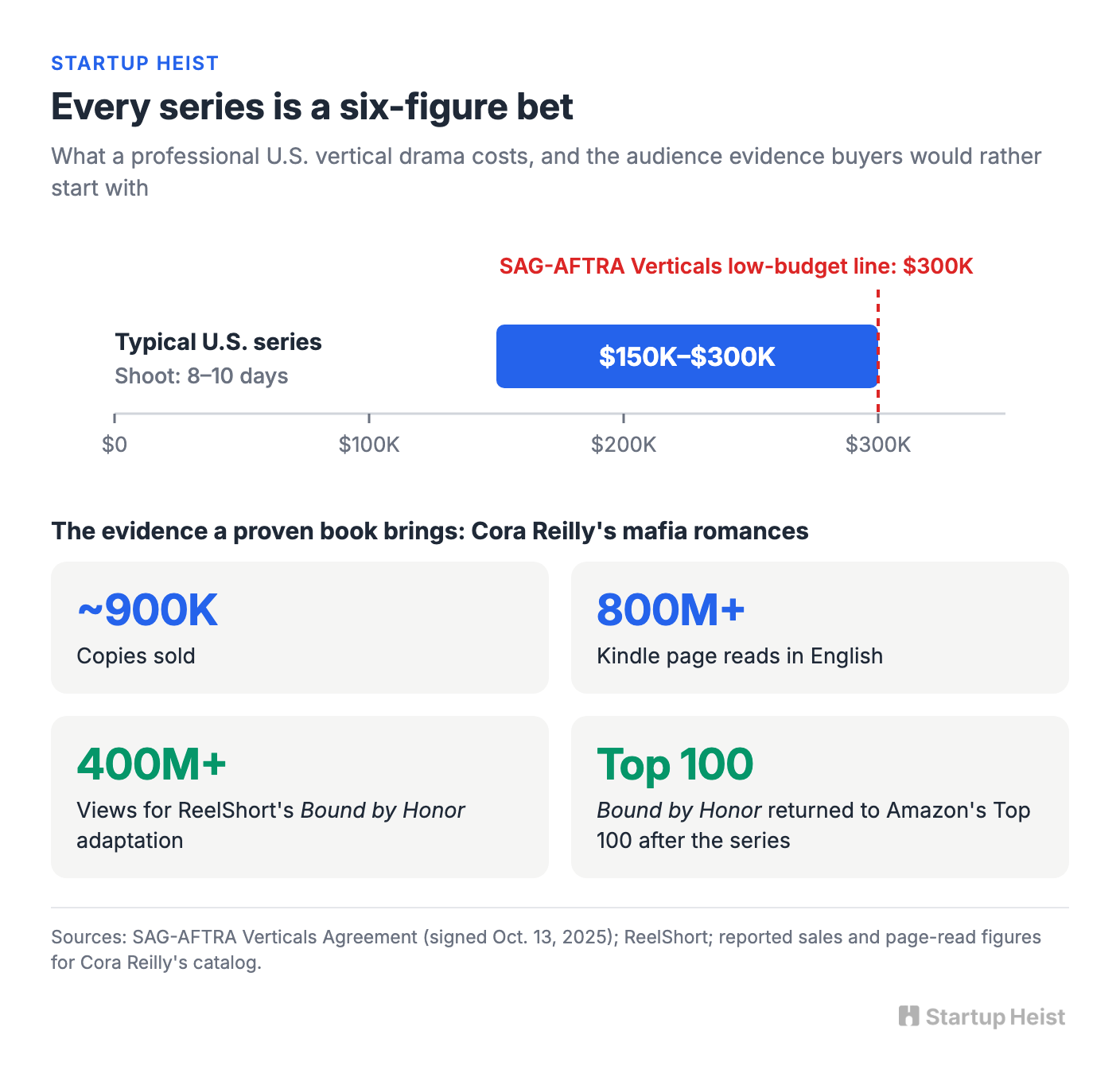
If you're about to spend $200,000 on production and more on paid acquisition, you'd rather start with a novel that already has 1,800 reviews, a rabid newsletter list and four sequels than with an idea someone floated in Tuesday's development meeting. Reilly's catalog explains the bet. Her mafia romances have sold nearly 900,000 copies and logged more than 800 million Kindle page reads in English. The ReelShort series then sent Bound by Honor back into Amazon's Top 100, so the show borrowed a pre-built audience and grew it.
The platforms already have reach. What they're competing for now is stories with evidence behind them.
The arbitrage is translation
A 350-page romance and an 80-episode microdrama look like the same product in different containers, and the resemblance is misleading.
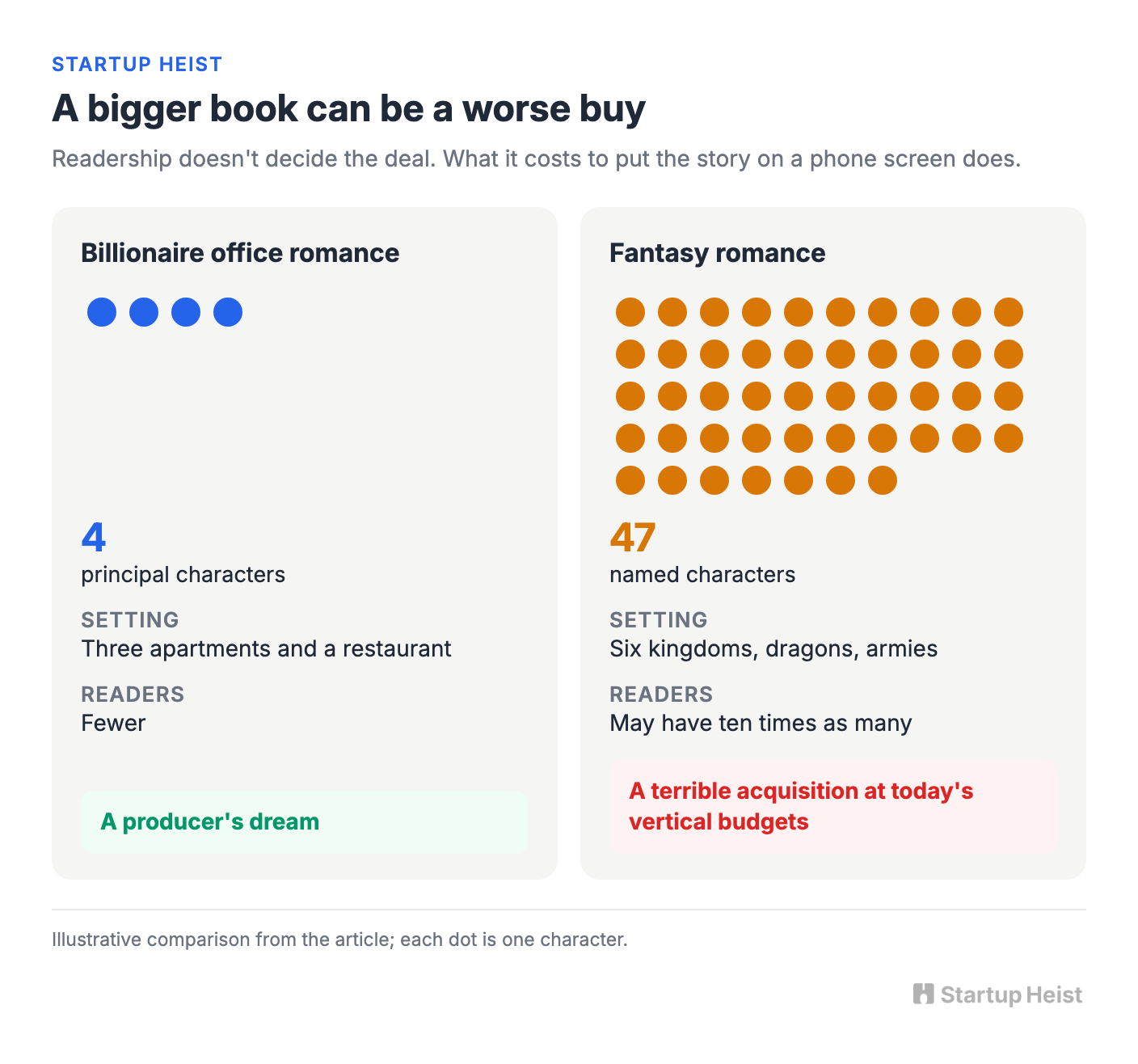
A novel can spend pages inside a character's head, which a phone screen can't do. It can establish its setting slowly, while a vertical episode wants conflict in the first ten seconds and rarely survives 45 seconds without a reversal. A good book also isn't automatically a cheap one to shoot. A billionaire office romance with four principal characters, three apartments and a restaurant is a producer's dream, whereas a fantasy romance with six kingdoms, dragons, armies and 47 named characters may have ten times the readers and still be, at today's vertical budgets, a terrible acquisition.
Large language models will commoditize the job of turning prose into screenplay format. The work that stays valuable settles four things: whether the rights are clean, whether the story holds viewers episode to episode, whether someone can shoot it inside a vertical budget, and whether it can be packaged in the language buyers already use. That takes editorial judgment, production sense, rights discipline and buyer knowledge, with AI working behind the curtain.
The books most likely to work
A studio that promises to adapt any novel ends up competing with Fiverr. Pick a hunting ground instead: independently published contemporary romance, and adjacent commercial romance series, where the author controls the audiovisual rights.
Then study the platforms. ReelShort's book hits skew hard toward high-stakes romantic melodrama. GoodShort's catalog is tagged with CEO, contract marriage, mafia, secret identity and revenge. DramaBox promotes titles like From Contract Lover to the Billionaire's Bride. The trope labels matter less than the engine underneath them, which is revealable information:
- He is secretly rich.
- She is secretly pregnant.
- The marriage is fake.
- The person walking into the room is someone we thought was dead.
Every unrevealed fact is stored narrative energy. An episode releases one unit of it and immediately sets up the next. Marriage of convenience, secret identity, revenge, rejected mate, forbidden love, secret baby, enemies-to-lovers and status reversal all adapt well for the same reason: they're built out of secrets with timers on them. If you can read a manuscript and count its timers, you have a skill most buyers would pay to borrow.
Build the Vertical Adaptation Score
Your first proprietary asset is a scorecard, and it comes well before any software.
Unlock the Vault.
Join founders who spot opportunities ahead of the crowd. Actionable insights. Zero fluff.
“Intelligent, bold, minus the pretense.”
“Like discovering the cheat codes of the startup world.”
“SH is off-Broadway for founders — weird, sharp, and ahead of the curve.”


