


The Quiet Room: Build the Retention Layer for Paid Newsletters
The opportunity is a small, text-first, invite-only discussion product for paid newsletter writers and podcasters. A calm branded reader salon that lives in the gap between "comments under a post" and "we now run a Discord server."
The heist is refusing to build another community platform. The winning version is the smallest piece of community software that makes a creator's paid membership measurably harder to cancel.

Here's the shape of it before the arithmetic:
The money: At $59 a month, 100 creators is $5,900 MRR and 500 is $29,500. Text is cheap to host, so most of it survives to the bottom line.
Inside:
• Full MVP scope, CSV import to moderation
• $59 pricing and the payback arithmetic
• Cold-start sequence for the first four weeks
• Kill criteria and the retention-analytics act
The internet doesn't need another community platform
Creator community software is crowded and expensive, which is exactly what leaves room underneath it.
Circle's entry plan runs $89 a month plus a 2% transaction fee, and it bundles discussions with courses, events, memberships, websites, payments, and analytics. Mighty Networks starts at $79 with the same 2% cut. Discourse charges $100 for its Pro tier. At the low end, Heartbeat opens at $49 but caps you at 350 members and takes 5% of transactions. Podia starts at $42, includes community on every plan, and also takes 5% at the entry tier.
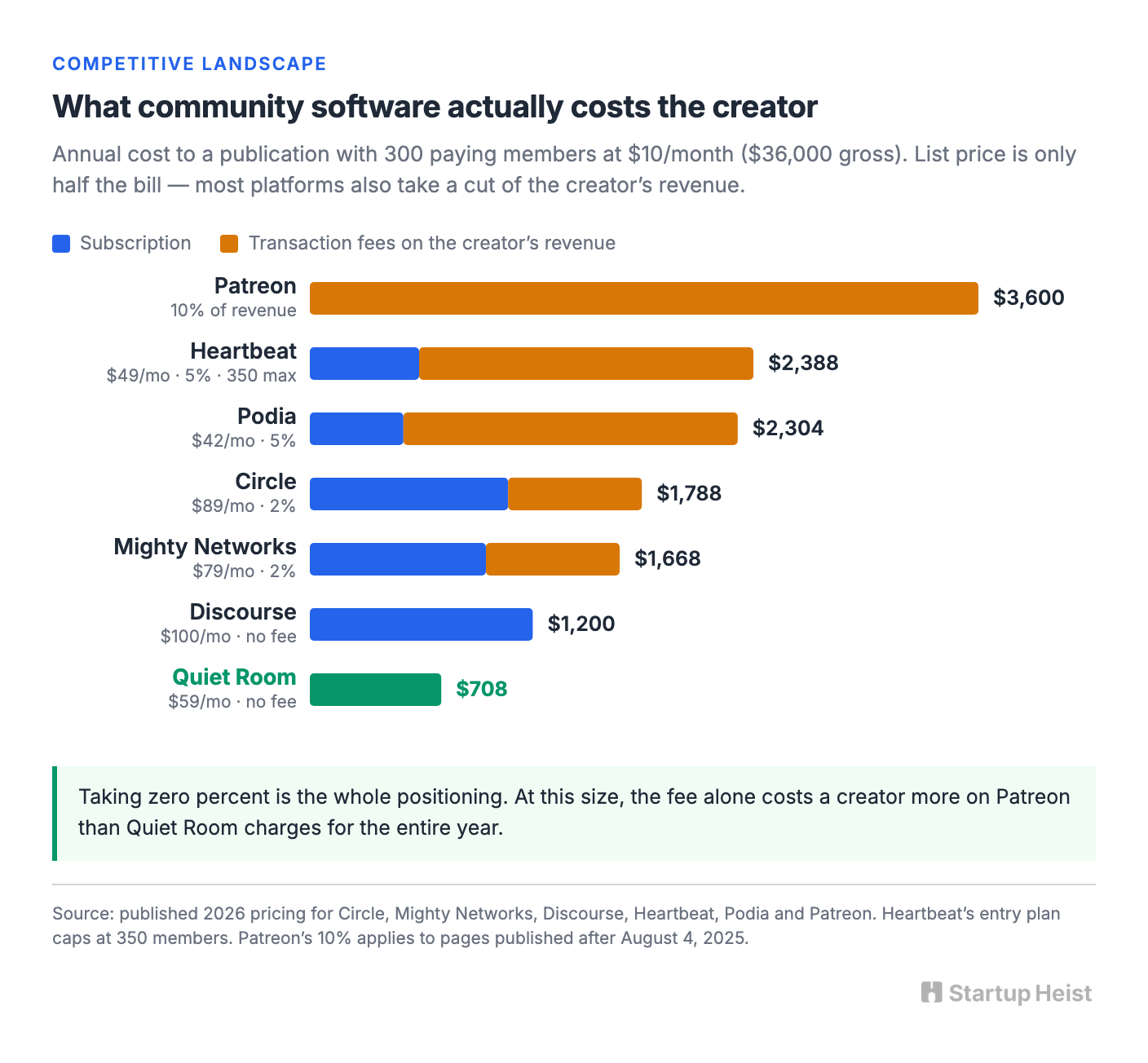
The obvious pitch is dead on arrival. "Circle costs $89, we'll sell you a nicer forum for $50" is a race you lose to companies with a five-year head start and better funding. The wedge has to be the job the software gets hired for.
Every one of those platforms is built to answer one question: how do we help you run a community business? They sell courses, events, payments, member profiles, gamification, and enough surface area to keep a full-time community manager busy.
A writer with 400 paid subscribers isn't trying to build a community business. She already has one, and she's trying to keep it. She wants Wednesday's essay to become Thursday's intelligent conversation. That's the whole job.
The economics: churn is the actual product
Churn is the number nobody puts on a landing page, and it decides whether a paid newsletter is a business or a treadmill.
Substack announced it had crossed 5 million paid subscriptions in March 2025, with more than 50,000 publications earning money on the platform. The figure counts subscriptions rather than individual readers, so it isn't a market size. What it establishes is that paying a writer directly is now ordinary behavior for a large population of readers.
beehiiv's State of Paid Newsletters 2026 gives you the shape of those businesses. The median paid newsletter charges $10 a month or $100 a year, unchanged since 2024. Median free-to-paid conversion sits at 0.62%, so roughly six paying readers per thousand subscribers. Lifetime value ranges from $83 to $230 depending on vertical.
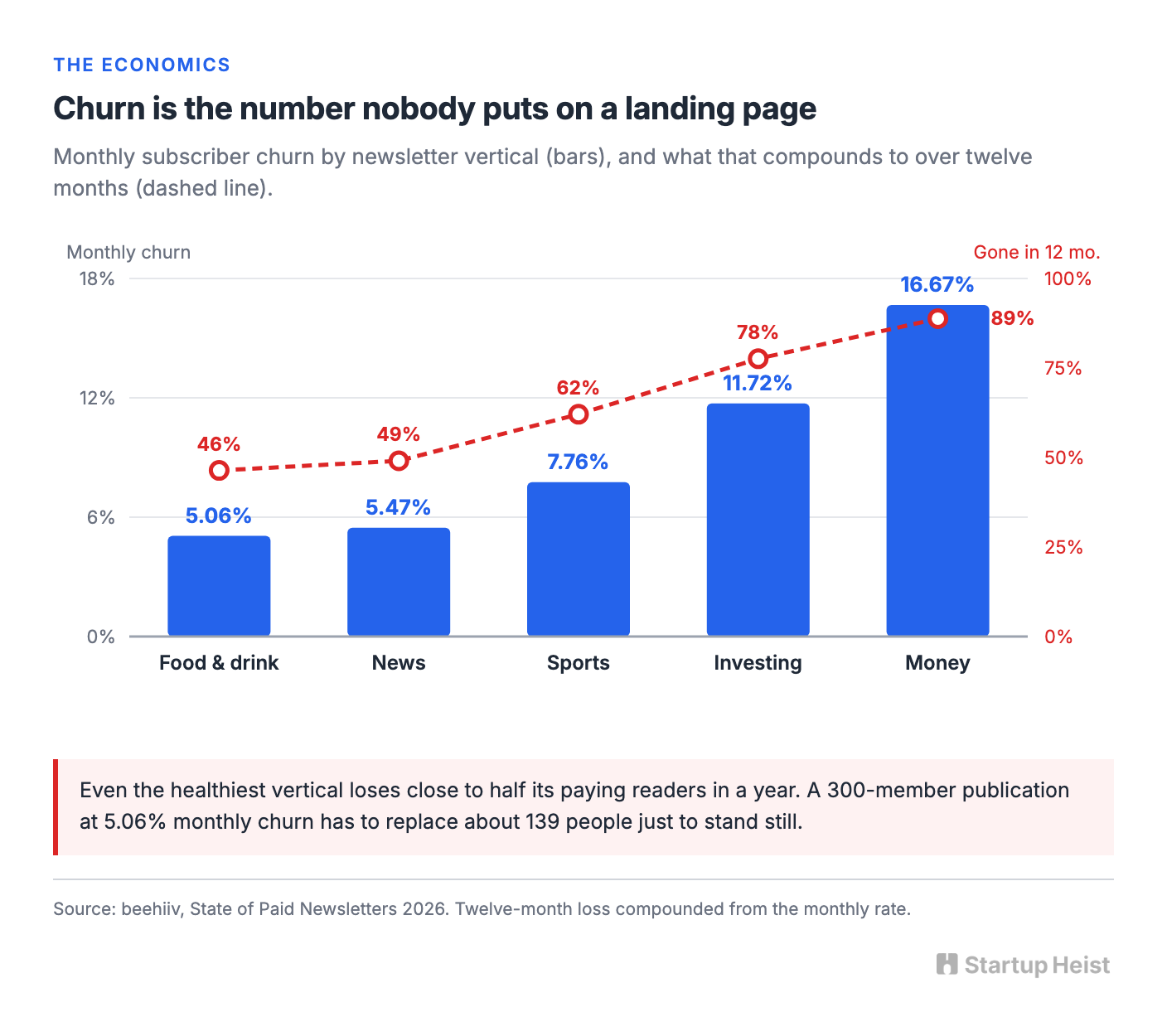
Subscriber churn runs from 5.06% monthly in food and drink, the healthiest vertical, up to 16.67% in money. News sits at 5.47%. Sports at 7.76%. Investing at 11.72%.
Even the good end of that range is brutal. A 5% monthly churn rate means about 46% of your paying readers are gone within twelve months. A publication with 300 members at $10 loses roughly 139 of them over a year and has to replace every one to stand still.
Acquisition is the part everyone already sells the creator. The harder problem starts the month after someone pays, when the membership has to keep feeling worth $10 against a credit card statement that arrives every thirty days. More essays help, and a paid tier still creates pressure to offer something free readers can't get. Community is the most common answer to that pressure, and the one most likely to fail, because running it badly is worse than not running it at all.
The competitor that kills you isn't Circle
Circle is easy to point at because you can undercut it on price. The genuine threat is software that's good enough and already sitting inside the creator's workflow. Ghost shipped a substantial comments upgrade on May 27, 2026, adding deeper reply threading, upvotes and downvotes, and pinned comments for moderation. Substack Chat lets writers gate the whole chat space, or individual threads, to paid subscribers. Patreon bundles chats, polls, and comments into its core product, and pages published after August 4, 2025 pay a standard 10% platform fee for the whole bundle.
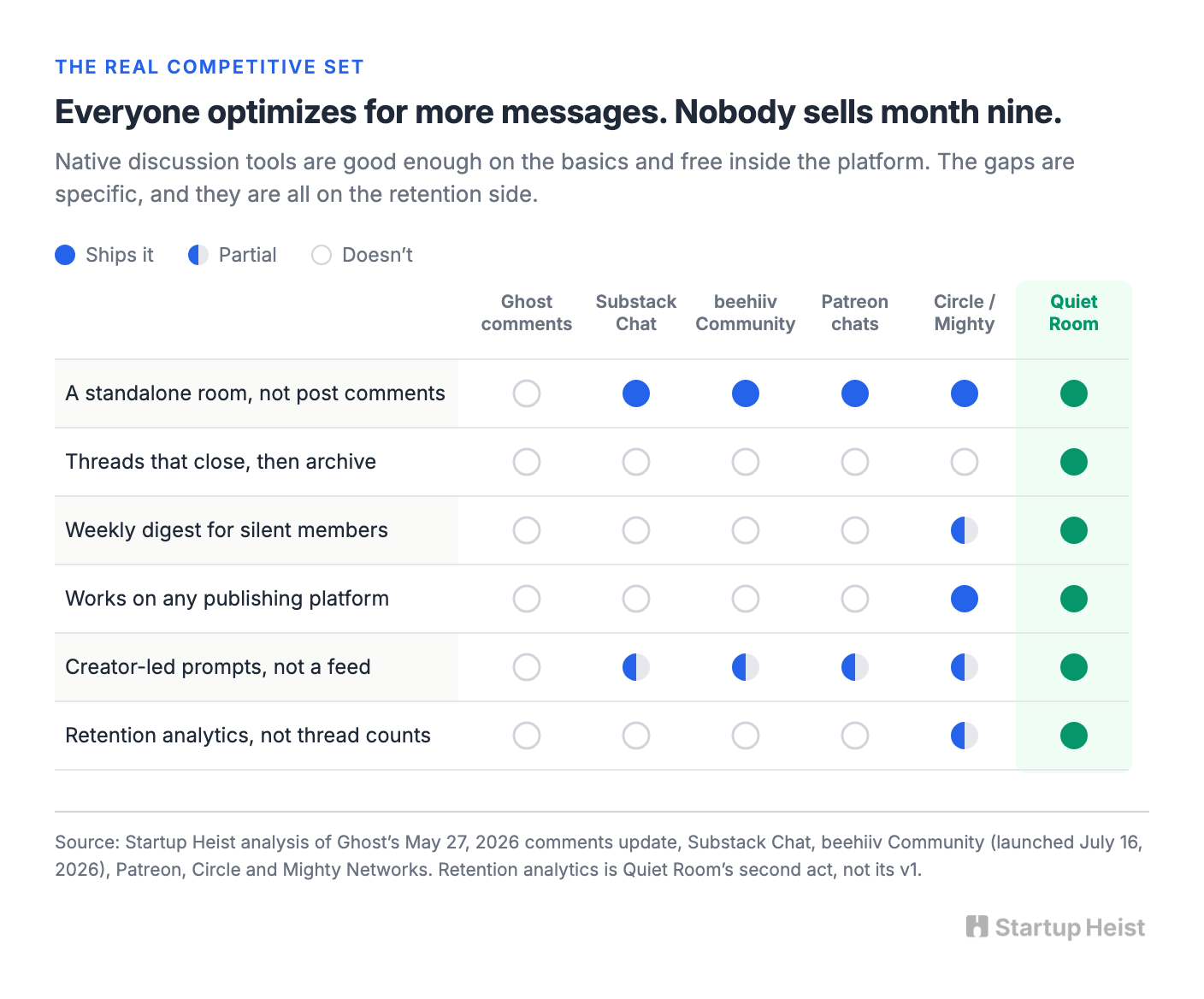
Then, on July 16, 2026, beehiiv launched Community: a branded discussion forum built directly into the newsletter platform, with paid-tier gating, moderation tools, direct messages, a follow graph, and a dedicated space that syncs published posts and their comments automatically. The nearest thing to "a discussion room attached to your paid newsletter" now ships free inside a major newsletter platform, at zero incremental workflow cost to the creator. Private comments are table stakes, and building a better comment section is a losing hand.
Look closely at what those products actually do, though, and the gaps are specific. Substack Chat is a stream: threads never close, nothing gets archived as a library, and there's no digest pulling absent members back. Ghost comments hang off individual posts, so there's no standalone place for a conversation that isn't about a particular essay, and as of early 2026 Ghost still had no public comments API. beehiiv's Community lives on beehiiv, which does nothing for the writer on Ghost, Memberful, or Patreon, and its DMs and follow graph point it straight at the volume model. Every one of them optimizes for the same thing: more messages, more replies, more activity.
None of them sell the thing the creator actually needs, which is a defensible reason a member stays subscribed in month nine.
The product: a reader salon
Say the newsletter is called The Portico and it has 600 paying readers. At the bottom of each week's essay is one link: Continue the discussion in the Reader Room.
Unlock the Vault.
Join founders who spot opportunities ahead of the crowd. Actionable insights. Zero fluff.
“Intelligent, bold, minus the pretense.”
“Like discovering the cheat codes of the startup world.”
“SH is off-Broadway for founders — weird, sharp, and ahead of the curve.”


