


Mechanical Turk Is Closing the Gate. Sell Researchers the Escape Hatch.
Amazon is putting Mechanical Turk into maintenance mode. On July 30, 2026, AWS stops accepting new customers. Existing accounts keep working. AWS says it will continue investing in security and availability but has no plans to add features.
A frozen platform is a stranger thing than a dead one. Existing accounts keep humming along. Meanwhile every new lab, every incoming graduate student, every UX team, every AI startup without an account has to go shopping for MTurk alternatives. The installed base stays put. The pipeline of new users gets rerouted overnight.

The obvious move is to build a participant marketplace. Don't. The opportunity is helping research teams carry their existing studies to the next platform without losing the qualification logic, payment rules, participant controls, and quality procedures they accumulated over a decade of trial and error.
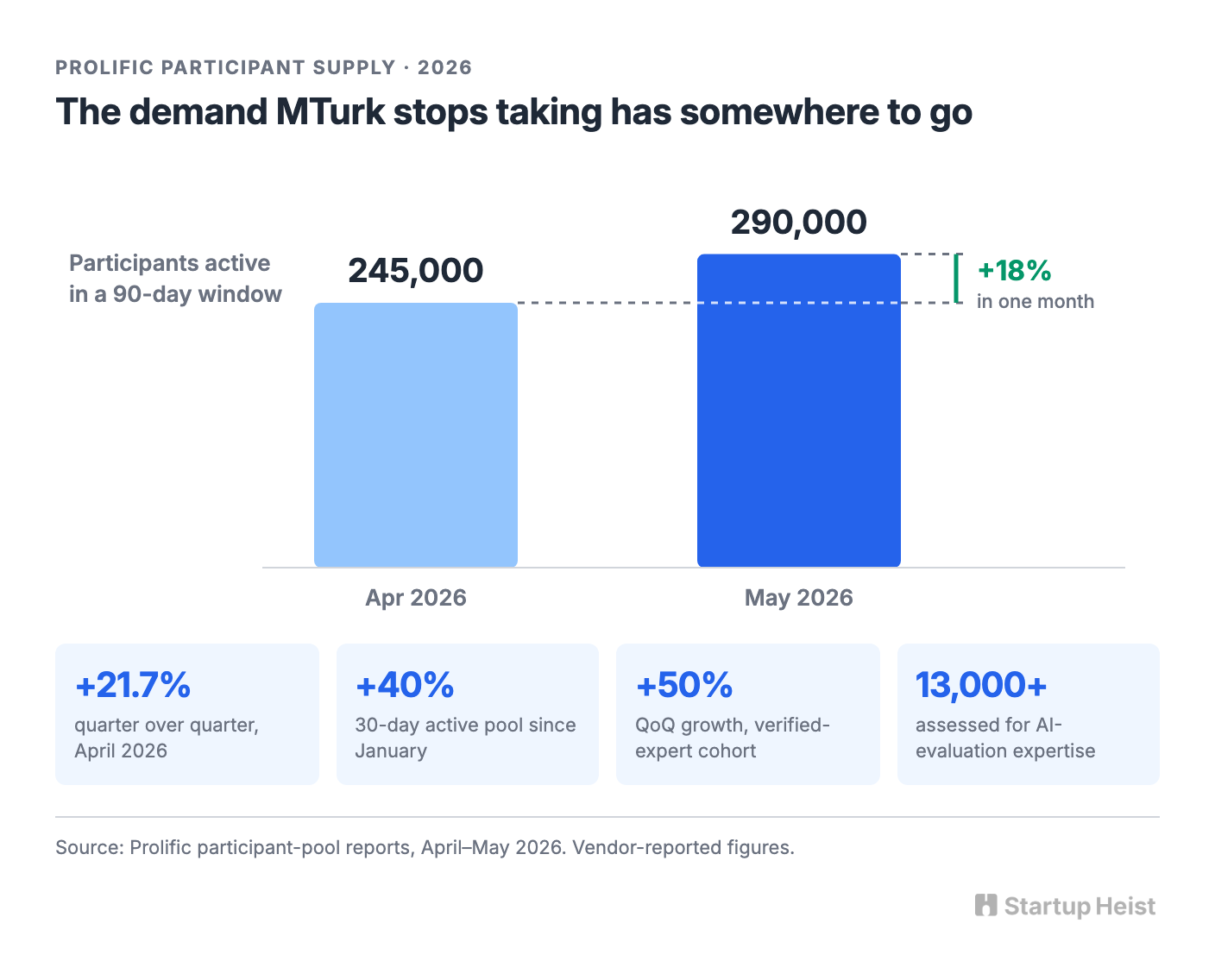
The money: Fifty labs at $199 a month plus four $1,500 migrations is about $18,600 monthly. Prolific's pool went from 245,000 active in April 2026 to 290,000 in May.
Inside:
• Full migration-pack and study-QA product scope
• Prolific vs. Connect budget math, line by line
• $1,500 sprint plus $199/mo workspace pricing
• Four compounding moats and six red flags
Built correctly, the migration wedge opens onto something more durable: the neutral quality-control and institutional-memory layer sitting between researchers, survey software, and participant platforms. It's a micro-SaaS and research-operations business with a hard date stamped on its acquisition window.
AI Ate the Machine Built to Fake AI
Mechanical Turk launched in 2005 as "artificial artificial intelligence," humans doing the work software couldn't yet handle. Sentiment tagging, image labeling, CAPTCHA solving. The joke was in the name, and for twenty years it worked.
Then the software caught up and turned on its host. Studies published through 2025 found that somewhere between a third and nearly half of MTurk workers were submitting AI-generated output as human judgment. In one May 2024 climate survey, half the workers who started never finished. Researchers began documenting duplicate response patterns, synthetic language, and open-ended answers that looked unusually polished because a language model wrote them.
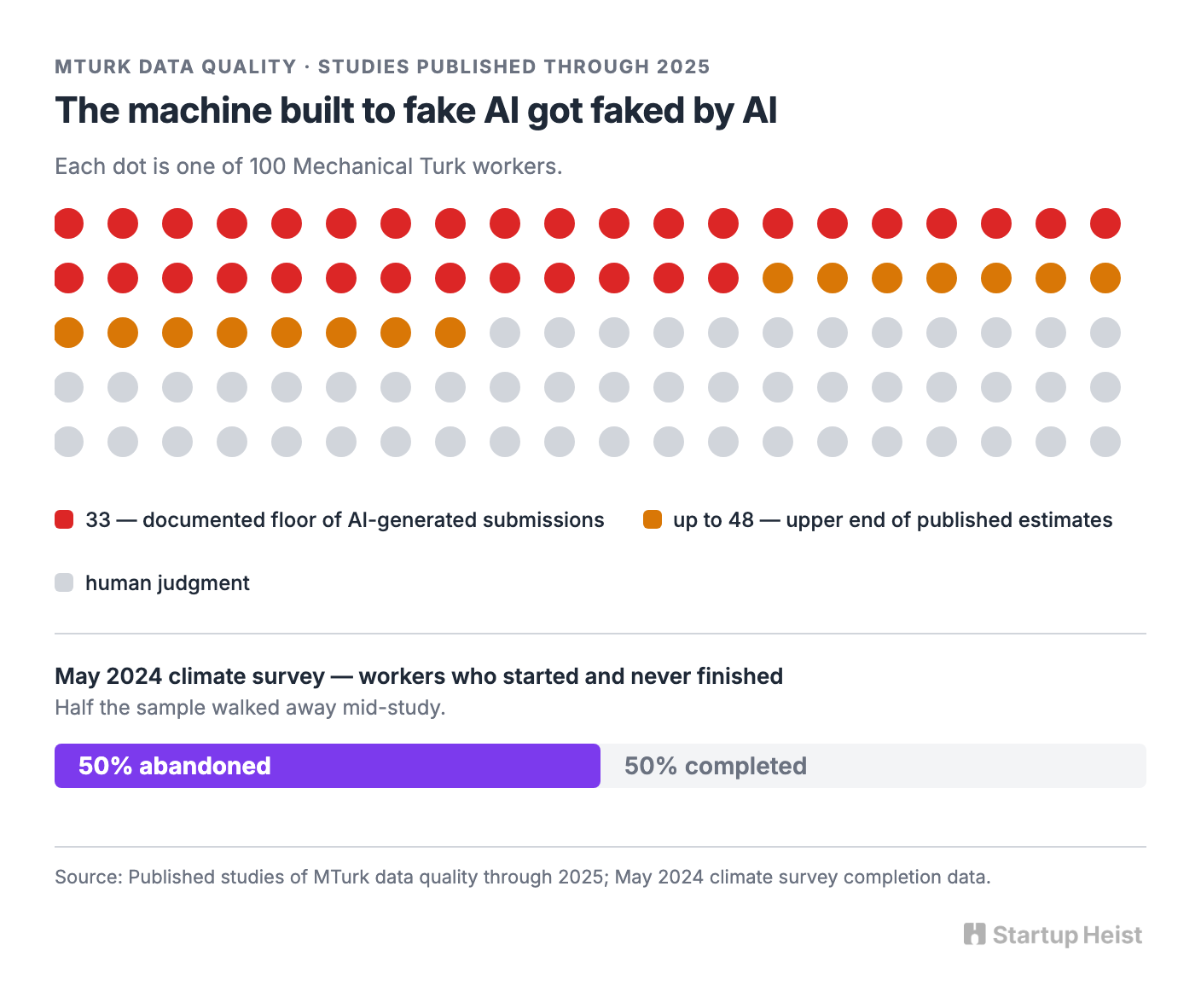
The recursion is brutal. Labs that published MTurk-annotated work in 2023 and 2024 can't determine, from their data alone, what fraction of their labels came from the same models those labels were meant to train or evaluate. No major venue has announced a systematic audit. That question doesn't go away when Amazon closes the door. It follows every one of those researchers to whatever platform they land on next.
Amazon has a newer answer to the labeling market in SageMaker Ground Truth, which sells managed annotation without the overhead of running a marketplace of humans. Amazon didn't kill Mechanical Turk so much as stop defending a service that had already lost the thing it was selling.
What Actually Breaks When a Lab Moves
Researchers built entire operating systems on top of Mechanical Turk.
A single study might carry worker qualification requirements, approval-rate thresholds, geographic restrictions, blocklists inherited from previous studies, survey links with worker IDs embedded in the URL, completion codes, rejection procedures, bonus calculations, follow-up invitations, consent language written around one specific recruitment flow, scripts that merge MTurk exports with Qualtrics data, and informal rules for spotting a suspicious submission.
Those details live in a former graduate student's spreadsheet, a lab wiki nobody has touched in three years, and a folder named `final_study_v7_REAL`.
Prolific will tell you it takes fifteen minutes to get started, and that's true. Creating an account is easy. Reconstructing why your lab blocklists 400 worker IDs takes considerably longer. The average behavioral lab has sampled thousands of MTurk workers across years of studies, and the rules encoding that history are worth far more than the account they lived in.
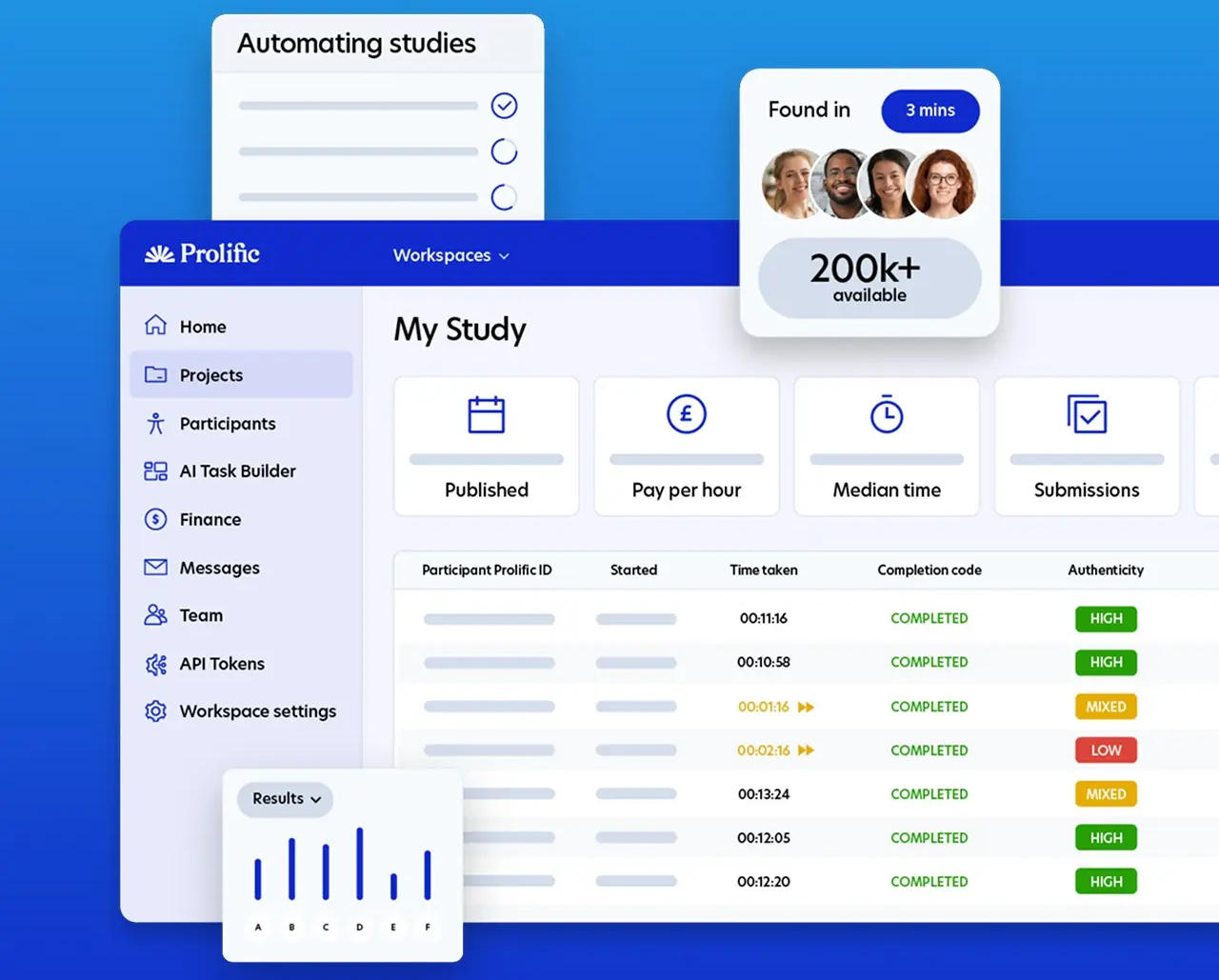
The destination platforms use different terminology, fee structures, participant identifiers, screening policies, completion flows, and rejection rules. Prolific records participant IDs through URL parameters and supports multiple completion paths, custom screen-outs, participant groups, allowlists, and blocklists. Connect offers demographic targeting, quotas, prior-participation targeting, completion branches, and CSV-based participant management. Both are capable. Neither is interchangeable with what a lab already built.
Moving is closer to porting a small application to a new operating system, with the original developer already graduated.
Let Prolific and CloudResearch Own the People
Building a new panel means recruiting and verifying thousands of participants, fighting fraud, processing payments, maintaining geographic coverage, balancing supply against demand, and convincing skeptical researchers that an unknown marketplace produces defensible data. That's a capital-intensive trust problem wearing a software costume.
Prolific is winning that fight in public. In April 2026 it reported more than 245,000 participants active in a 90-day window, growing 21.7% quarter over quarter. By May 2026 the 90-day pool was above 290,000 and the 30-day pool was up 40% since January. Its verified-expert cohort in finance, legal, and languages is the fastest-growing segment at 50% quarter over quarter, and more than 13,000 participants have been assessed for AI-evaluation expertise. Prolific has been publishing "stop using MTurk for your research" content for years and now gets to watch Amazon prove the point.
Connect counters with hundreds of demographic attributes, quotas, longitudinal tooling, and a 25% academic platform fee that undercuts Prolific's 33.3%.
They own participant recruitment and supply. Let them. They're also, conveniently, running the demand generation this business rides for free.
The startup owns the work immediately before and after recruitment: translating the old study, configuring the new workflow, documenting why each rule exists, monitoring response quality, producing a defensible record of exclusions, and preserving the setup for whoever inherits the project. The research-operations layer is where the heist sits.
The Product: Three Jobs in One
The first product combines three related modules.
Unlock the Vault.
Join founders who spot opportunities ahead of the crowd. Actionable insights. Zero fluff.
“Intelligent, bold, minus the pretense.”
“Like discovering the cheat codes of the startup world.”
“SH is off-Broadway for founders — weird, sharp, and ahead of the curve.”


