


Don't Build ReelShort for Books. Sell the Ads.
China ran a very expensive experiment on everyone's behalf. Its ultrashort-drama industry spent years industrializing one- and two-minute melodramas for phones: billionaire romances, revenge arcs, hidden heirs, rebirth plots, supernatural lovers, cliffhangers every ninety seconds. Then AI video got good enough to swap out the production line. By May 2026 the format had reached 851 million users and an industry value above 100 billion yuan. After ByteDance released Seedance 2.0 in February 2026, generating video for roughly 1 yuan per second, Zhengzhou, the city that had styled itself China's "Vertical Hollywood," watched AI displace live shoots within a single quarter. The China Netcasting Services Association reported that more than 95% of the roughly 128,000 ultrashort dramas released in Q1 2026 were AI-generated.
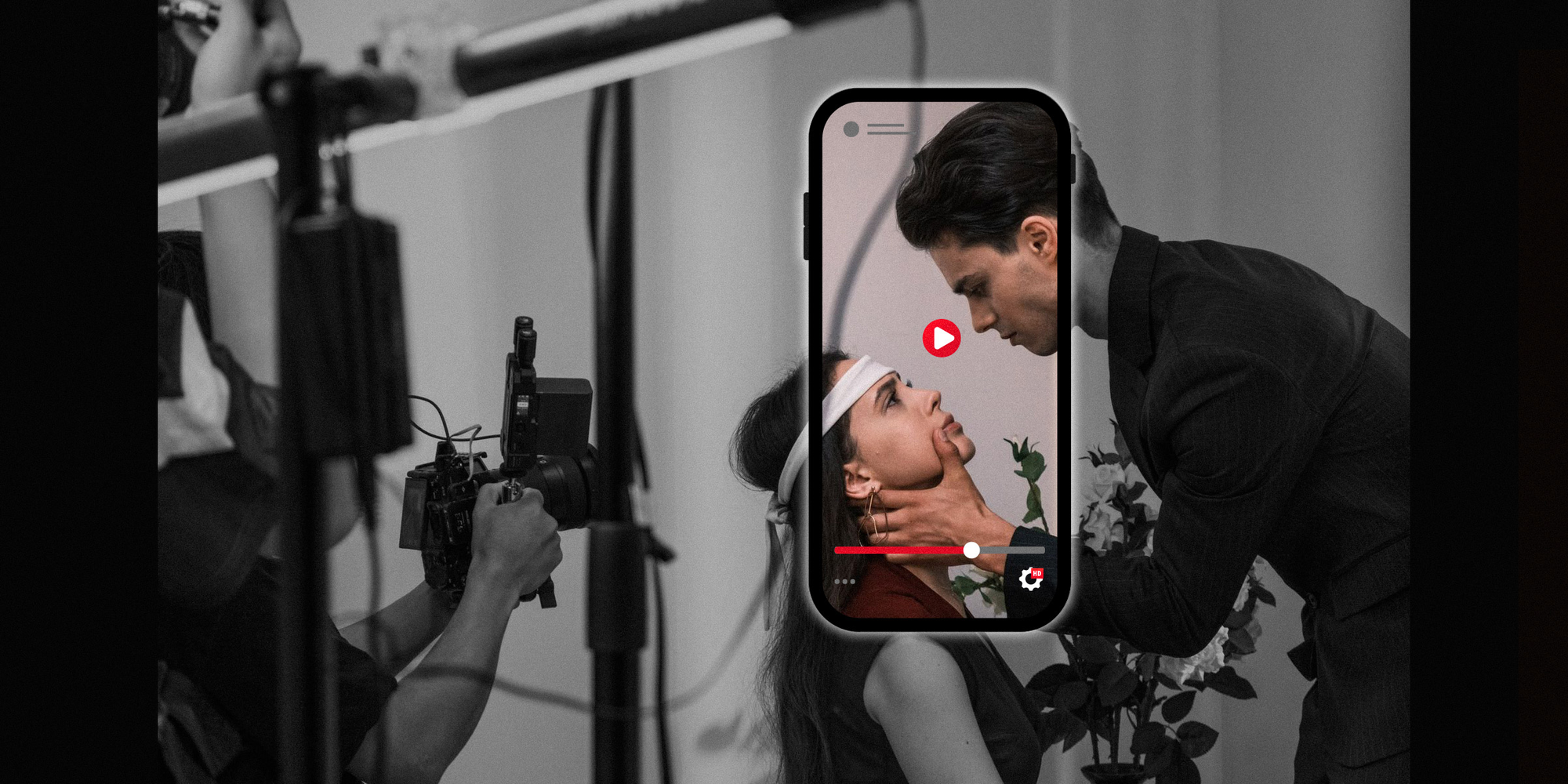
Copying that and launching another vertical-drama app would be the wrong heist. The better opportunity sits one layer upstream: a productized microdrama advertising studio for romance and romantasy authors. Take an author's proven novel, extract its strongest trope, opening tension, and cliffhanger, and turn those ingredients into 8- to 30-second vertical scenes built for TikTok, Reels, Shorts, and paid social. Then send the viewer to the book.
That one layer of distance changes the economics. A vertical-drama app has to finance original entertainment, acquire story rights in the hope that somebody watches, and buy both creators and viewers. An author already owns the IP, already has the product, and in many cases already spends real money acquiring readers. Selling better acquisition creative into a budget that exists is a much easier business than building the budget from scratch.
The short version, before the details:
The money: Twenty authors on a $3,000 monthly retainer is $60,000 MRR, sold into budgets that already exist: top-earning romance authors average about $4,500 a month on marketing.
Inside:
• Four price tiers, $950 pilot to $5,000 retainer
• Seven-system MVP, none of it software
• Cold email script and the four-variant ad test
• The tagging taxonomy that becomes the moat
Three markets just collided, and nobody has built the bridge
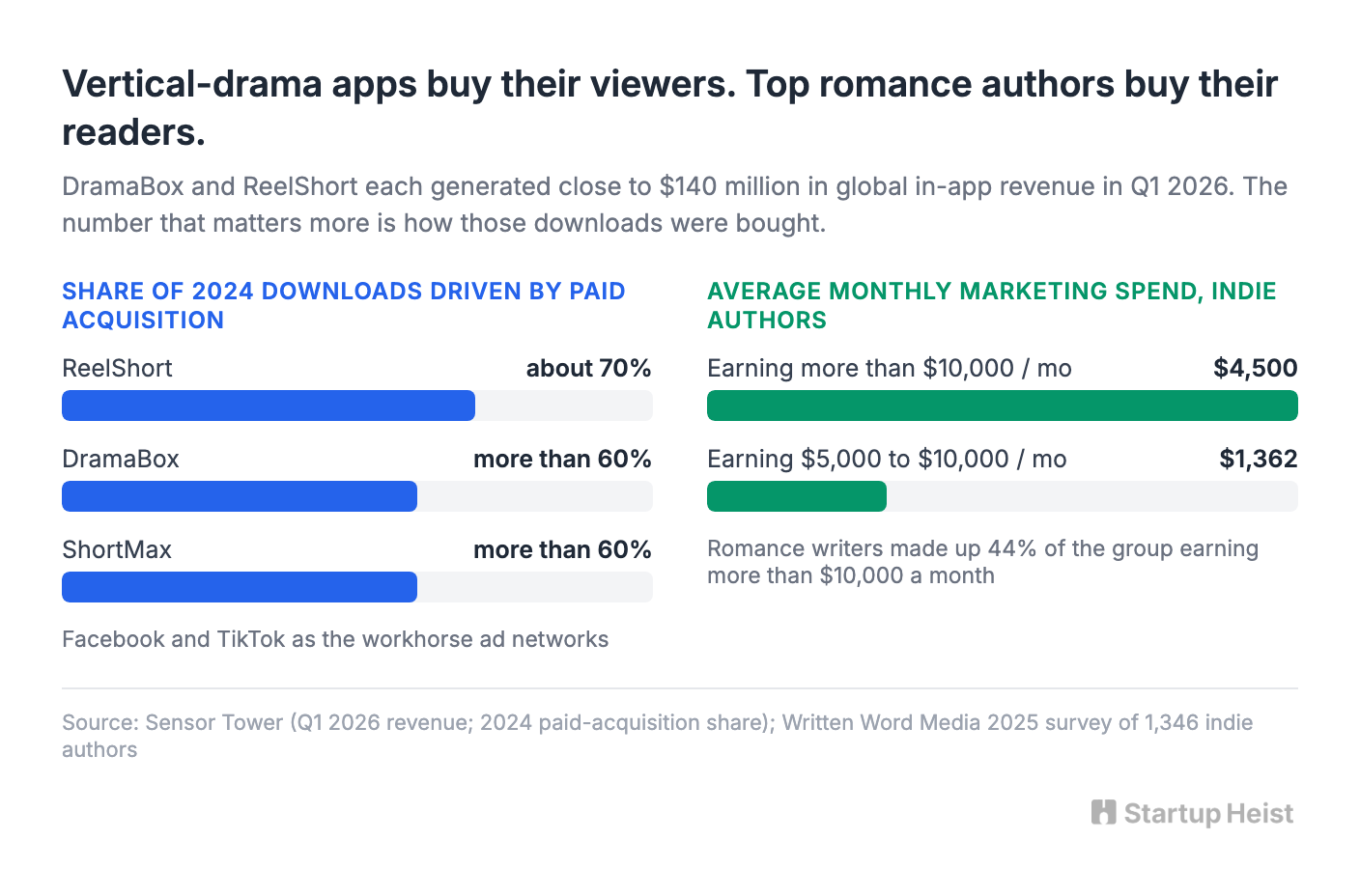
The first market is vertical drama itself. Sensor Tower reports DramaBox and ReelShort each generated close to $140 million in global in-app revenue in Q1 2026, inside a category that cleared roughly $750 million in purchases and 850 million downloads for the quarter. The number that matters more is older: in 2024, paid acquisition drove more than 60% of downloads for DramaBox and ShortMax and about 70% for ReelShort, with Facebook and TikTok as the workhorse ad networks. So these companies have proven something more useful than "people will watch melodramatic vertical video." They've shown it acquires paying customers at scale, on the same platforms where books get sold.
The second market is social book discovery. TikTok, citing NielsenIQ BookData and Media Control, says more than 50 million books recommended through BookTok were sold across Germany, the UK, Spain, Italy, Austria, and Switzerland in 2025, worth about €800 million. The UK alone attributed 11 million book sales and £86 million to BookTok. Watch how those videos actually work and you'll see they're direct-response ads, whatever the creators call them. Nobody summarizes a 400-page novel. The reader gets one feeling: He married her because of what? The king doesn't know she's the assassin? He can hear everyone's thoughts except hers? Vertical drama is engineered to deliver precisely that feeling in under ten seconds. Holywater, the Ukrainian company behind the My Passion reading app and the My Drama video app, already runs this loop in reverse, using audience data to pick novels from its own catalog and adapt them into vertical series; one contest-winning romance became a series with over 10 million views. LoveHit, a Los Angeles studio launched in September 2026, is adapting public-domain classics like Pride and Prejudice and Wuthering Heights into vertical-drama originals. Both are entertainment companies making shows. Neither sells ad creative to a living author with a backlist.
The third market is the indie-author advertising economy. Written Word Media's 2025 survey of 1,346 indie authors found that romance writers made up 44% of the group earning more than $10,000 a month, roughly double their share of the overall sample. That top tier reported average marketing spend of about $4,500 a month, against $1,362 for authors earning $5,000 to $10,000. It's a self-selected survey rather than a census, but even a self-selected survey shows that a specific subset of authors already behaves like a small media company, with a catalog, an acquisition budget, and a working sense of customer lifetime value. That subset is your customer. The debut novelist with $200 and a dream isn't, and neither is the author who wants a pretty trailer for launch day. You want the one who says, "I spend $5,000 a month on Meta. Can your creative beat what I'm running?"
Make ads that feel like scenes from a show, never trailers
Traditional book trailers have a positioning problem. They mimic miniature movie trailers, with atmospheric music, stock footage, floating quotes, the cover, maybe a dramatic narrator. The AI book trailer makers already on the market, Bookbrush's Trailer Creator, Pexo, Invideo, and the $30 Fiverr gigs, automate exactly that formula: blurb and cover in, cinematic clip out. They're pleasant to look at and give nobody a reason to keep watching. The vertical-drama playbook runs the other way: open in the middle of a conflict, reveal the trope immediately, withhold the explanation, plant one unanswered question, and cut before the resolution so you can sell access to it. For a book, the "next episode" is the novel.
Take a marriage-of-convenience romance. The bad creative reads, "An unforgettable story of passion, secrets and second chances." The good creative opens on a woman in a wedding dress in an elevator beside a man who refuses to look at her. Text on screen: RULE #1 OF OUR FAKE MARRIAGE: DON'T FALL IN LOVE. He glances at his phone. A message appears: Your wife knows why you really married her. Cut. Book cover. Read Chapter One. Nothing about that adapts the book; it extracts the book's commercial DNA, and extraction is the discipline the whole company gets built around.
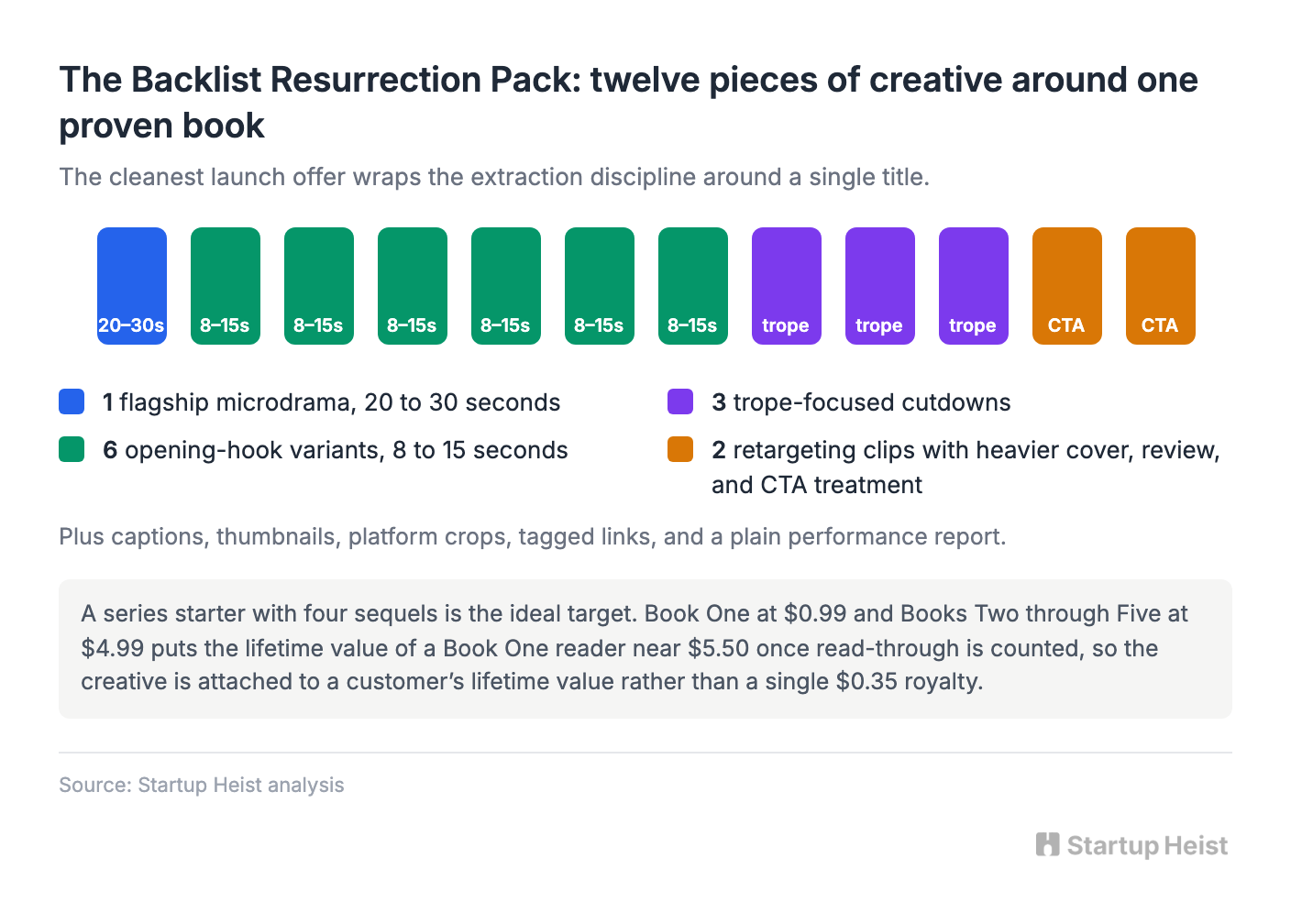
The cleanest launch offer wraps that discipline around a single title: one 20- to 30-second flagship microdrama, six 8- to 15-second opening-hook variants, three trope-focused cutdowns, and two retargeting clips with heavier cover, review, and CTA treatment, plus captions, thumbnails, platform crops, tagged links, and a plain performance report. Twelve pieces of creative around one proven book. Call it the Backlist Resurrection Pack, because the name explains the job: take an asset the author already owns and make it earn again. A series starter with four sequels is the ideal target. One common indie model, with Book One at $0.99 and Books Two through Five at $4.99, puts the lifetime value of a Book One reader near $5.50 once read-through is counted. Your creative is now attached to a customer's lifetime value rather than a single $0.35 royalty.
The unit that matters is attempted seconds
AI video is cheap enough to make this business possible and still expensive enough, in human attention, to make "generate an entire show" a trap. Runway's developer API prices Gen-4 Turbo at 5 credits per output second and Gen-4.5 at 12, with credits at a penny each, so $0.05 and $0.12 per second. Stronger models cost more: Seedance 2.5 at 720p runs about $0.30 per output second, and Veo 3.1 with generated audio about $0.40. On paper, a 10-second shot is nearly free.
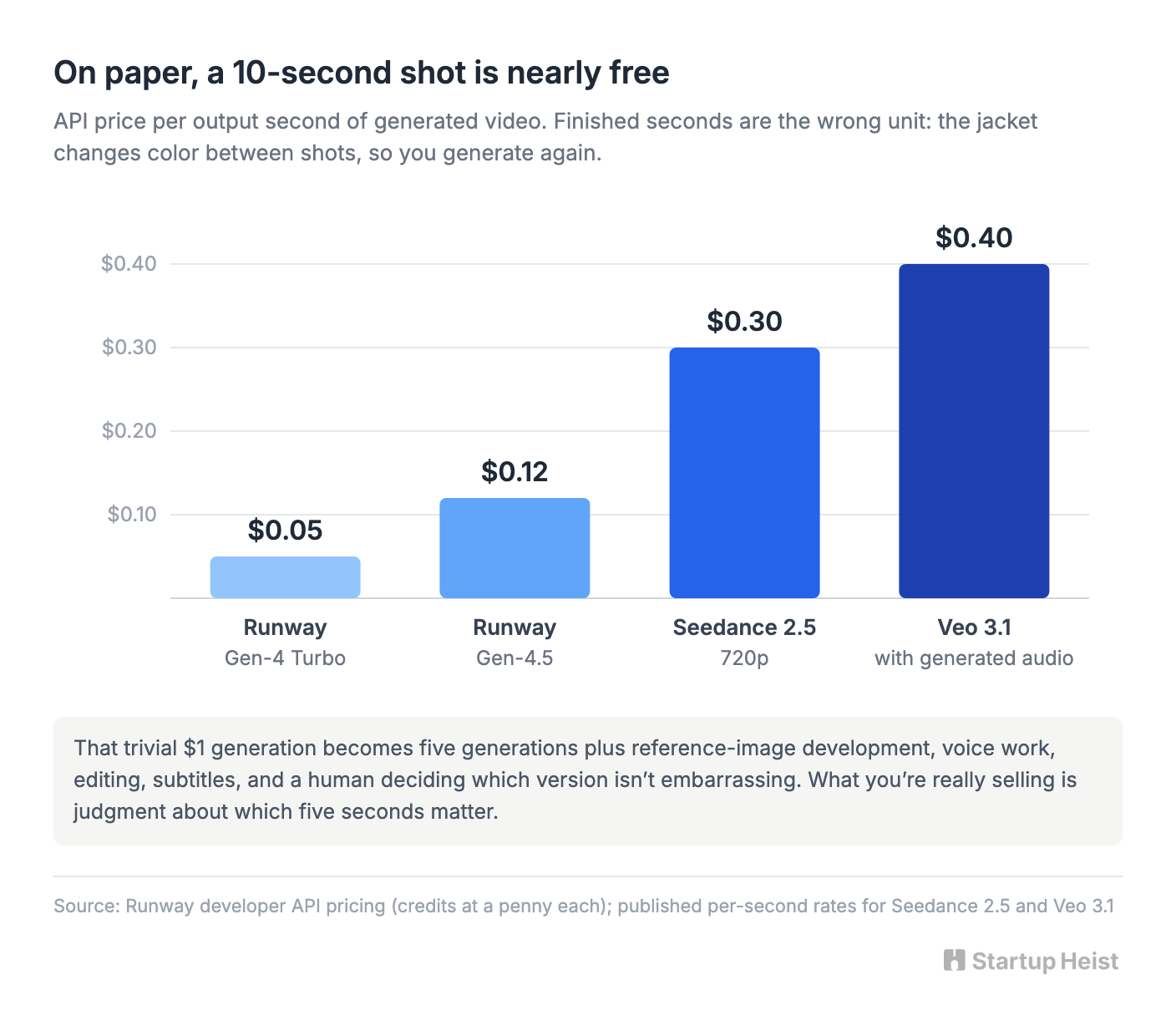
Finished seconds are the wrong unit. The character's jacket changes color between shots, so you generate again. Her face drifts, his hand grows a sixth finger, the camera move wrecks the composition, the dialogue lands a beat late. That trivial $1 generation becomes five generations plus reference-image development, voice work, editing, subtitles, and a human deciding which version isn't embarrassing. Twenty episodes of that, with continuity across all of them, is a full-time production company.
Twelve short ads sidestep the trap. You can spend disproportionately on the five seconds that matter, throw away weak shots without guilt, test several openings instead of forcing continuity across a season, and switch model providers the moment the landscape shifts. What you're really selling is judgment about which five seconds those are.
Who you sell to
The ICP is narrower than "indie authors." Target authors and small presses with five traits.
Unlock the Vault.
Join founders who spot opportunities ahead of the crowd. Actionable insights. Zero fluff.
“Intelligent, bold, minus the pretense.”
“Like discovering the cheat codes of the startup world.”
“SH is off-Broadway for founders — weird, sharp, and ahead of the curve.”


