


The Invoice Inbox With a Bouncer
Software reads invoices for a few dollars a month. Nobody sells bookkeepers a clean answer to the question that comes first: who was allowed to send this one?
A supplier emails an invoice to a restaurant. The owner forwards it to the bookkeeper, whose invoice capture tool reads the vendor, the amount, and the due date, then drafts a bill in QuickBooks. The whole loop costs less than lunch. Hubdoc does it for $12 a month. Dext starts at $25.21 a month on annual billing. QuickBooks Online handles a version of it inside the subscription a client already pays for.
The unsolved part sits one step earlier. A bookkeeping practice with twelve clients, each with twenty recurring suppliers, is managing 240 supplier relationships, all pushing documents through forwarding rules, shared inboxes, and personal Gmail accounts. One supplier moves billing to an outsourced platform. Another sends the same invoice twice. A third arrives from a lookalike domain with new bank details. The software extracts all of them perfectly, and somebody on the team still has to decide which ones belong.

A controlled front door for vendor invoices, built for bookkeeping firms, would own that decision. Every supplier gets its own submission address, tied to sender identities an administrator has approved. Each incoming message is checked against that policy, unexpected changes get flagged, and a record of what happened is preserved before anything reaches the books. The product sits in front of the bookkeeper's existing stack and owns the moment an invoice enters the business.
The opportunity in brief:
The money: 300 practices at a blended $120 a month is $36,000 MRR. Mercury, Ramp, and Rho already gate senders inside single companies.
Inside:
• Seven-capability MVP and inbound email stack
• Usage-based pricing with an honest ROI check
• Prospecting sources and outreach template
• 30-day pilot plan with decision gates
The Trust Gap in AP Automation
Accounts payable automation is a crowded, mature category: Forrester's Q4 2025 landscape report, published in January 2026, counted 41 vendors with meaningful AP invoice automation revenue, spanning capture, matching, and payment.
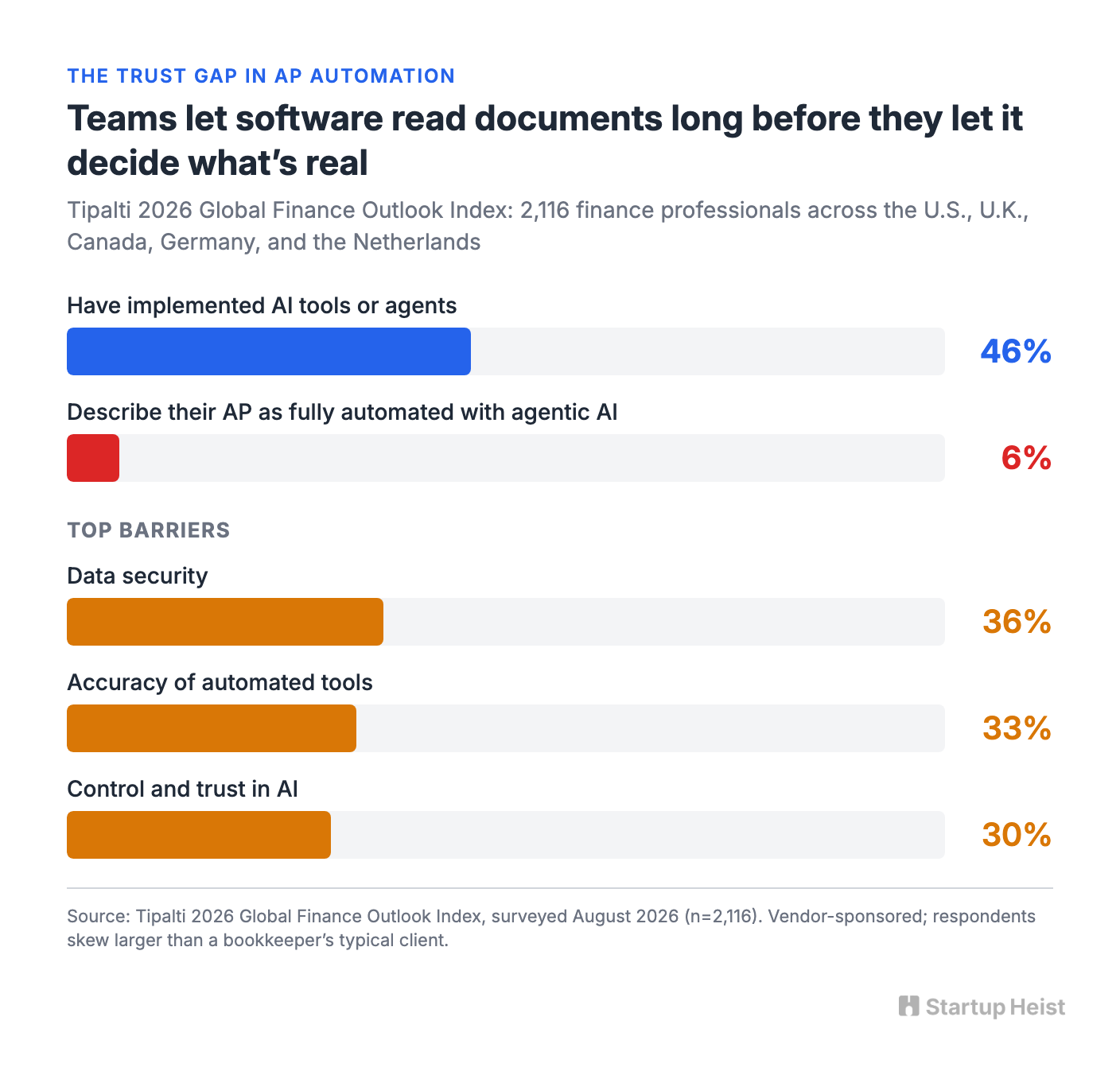
What lags is confidence in the automated result. Tipalti's 2026 Global Finance Outlook Index surveyed 2,116 finance professionals across the U.S., U.K., Canada, Germany, and the Netherlands in August 2026. Forty-six percent have implemented AI tools or agents, yet only 6% describe their AP as fully automated with agentic AI. The top barriers were data security (36%), the accuracy of automated tools (33%), and control and trust in AI (30%). The survey is vendor-sponsored and skews larger than a bookkeeper's typical client, but the gap itself is telling: teams let software read documents long before they let it decide what's real.
The fraud numbers explain the caution. The Association for Financial Professionals reported on April 14, 2026 that 76% of U.S. organizations faced attempted or actual payments fraud in 2025, and 74% were affected by business email compromise. The FBI's Internet Crime Complaint Center logged 24,768 BEC complaints in 2025 with $3.05 billion in reported losses, roughly $123,000 per complaint. Those figures span every kind of email fraud, and no inbox gateway would stop all of it, but they put the inbox at the center of how money gets redirected.
Where the Incumbents Stop
Incumbents do far more than read documents. Dext already shows the original email trail, removes duplicates, notifies users of rejected submissions, and lets admins block individual addresses and whole domains. BILL ships approval workflows, permissions, and audit records. A startup can't charge a premium for blocking senders, showing the source email, or catching duplicates.
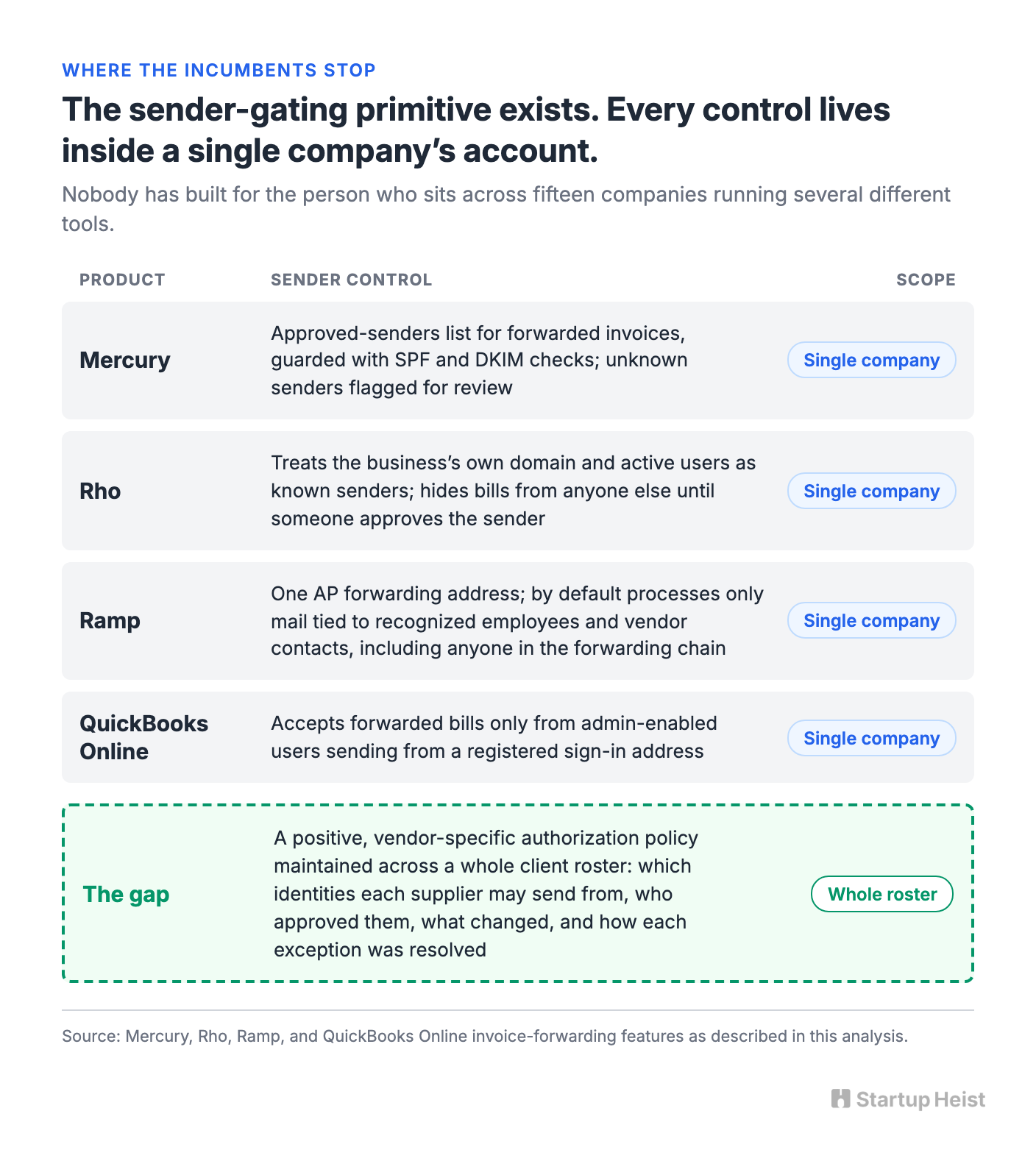
The sender-gating primitive exists too, which is both validation and warning. Mercury lets a business keep an approved-senders list for forwarded invoices, guards it with SPF and DKIM checks, and flags unknown senders for review. Rho goes further, treating the business's own domain and active users as known senders and hiding bills from anyone else until someone approves the sender. Ramp gives each business an AP forwarding address and by default processes only mail tied to recognized employees and vendor contacts, including anyone recognized in the forwarding chain, which is exactly where trust leaks. QuickBooks accepts forwarded bills only from users an admin has enabled, each sending from a registered sign-in address, so in practice a supplier can't email it directly. Every one of these controls lives inside a single company's account, and nobody has built for the person who sits across fifteen companies running several different tools.
That person is the buyer. A small business with ten suppliers can get by with a shared mailbox. A bookkeeping firm serving fifteen of them juggles separate entities, supplier lists, inboxes, and client employees, and every client breaks the rules in its own way. The math works at that altitude: thirty minutes saved for each of fifteen clients is seven and a half hours a month, and one sale spreads across the whole roster.
Start with owner-operated practices of roughly 5 to 25 active clients, with recurring vendor invoices and a team already running QuickBooks Online or Xero. Large corporate AP departments already buy from Forrester's 41, and a sole proprietor with three invoices a month doesn't have the problem.
The gap worth testing is a positive, vendor-specific authorization policy maintained across a whole client roster: which identities each supplier may send from, who approved them, what changed, and how each exception was resolved. That's a competitive hypothesis, and Mercury, Ramp, and Rho have already shown they can build the primitive the day they decide bookkeepers matter.
How the Front Door Works
Take a bookkeeping firm called Northstar Books. One of its clients is a restaurant, and one of the restaurant's suppliers is Acme Produce. Instead of having Acme send invoices to accounts@restaurant.com, Northstar generates a dedicated address: acme-produce.k7m2@invoices.example.com. The address is unguessable and maps to one client and one supplier. An administrator approves billing@acmeproduce.com as Acme's sender, and Acme keeps using ordinary email, with no account, app, or portal.
From there, every message passes through five steps.
Unlock the Vault.
Join founders who spot opportunities ahead of the crowd. Actionable insights. Zero fluff.
“Intelligent, bold, minus the pretense.”
“Like discovering the cheat codes of the startup world.”
“SH is off-Broadway for founders — weird, sharp, and ahead of the curve.”


