


The Second-Stop Test
Kroger has your family's cereal at $4.29, plus a digital coupon for milk if you remembered to clip it. Aldi has an acceptable cereal substitute at $2.89. Publix is running buy-one-get-one on chicken. Walmart is cheapest on three pantry items and eight minutes in the wrong direction.
You could shop all four and save money. You could also turn Saturday morning into a logistics operation to save $11.
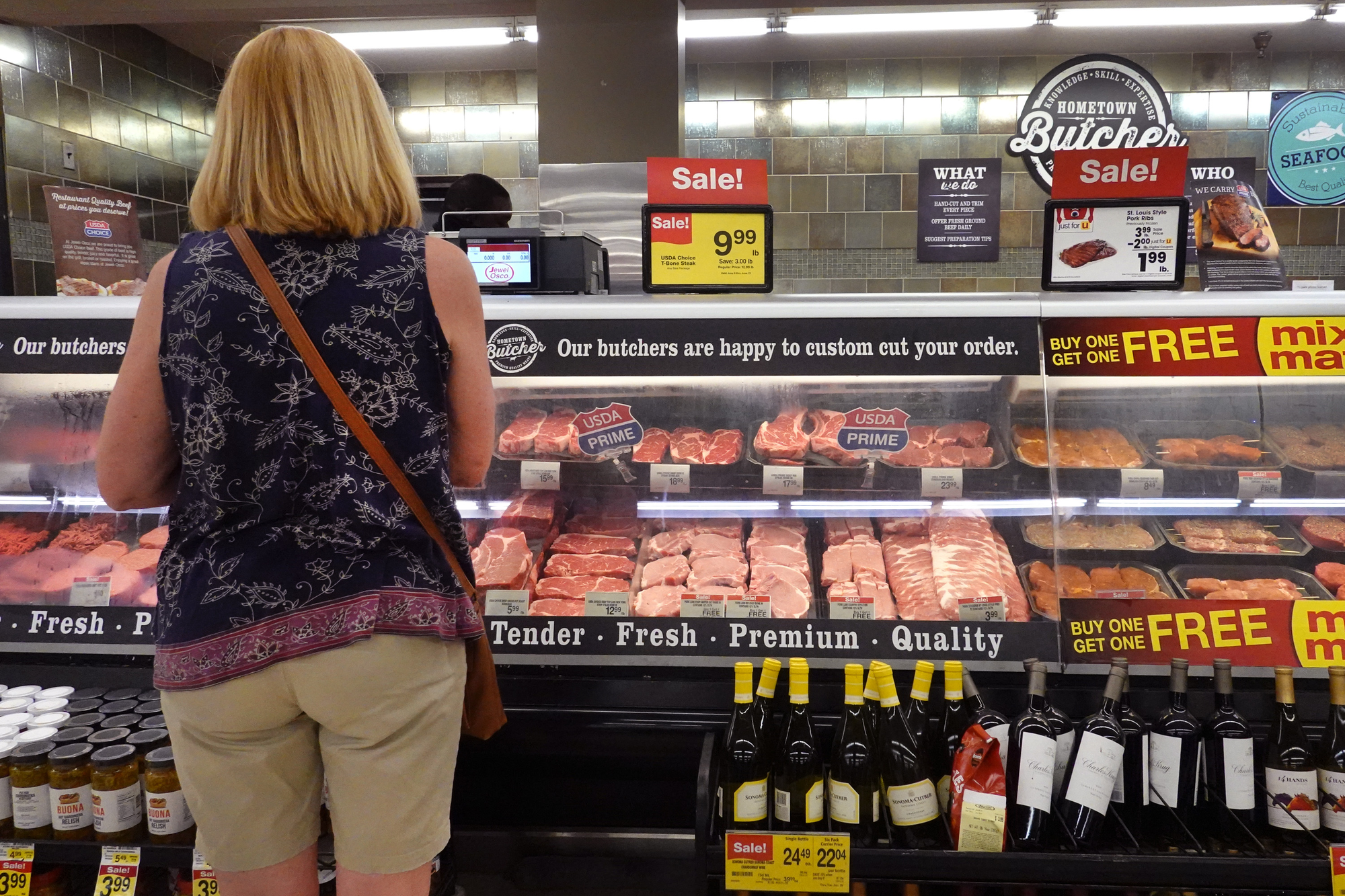
Every grocery savings app solves the easy half of that problem. Finding a cheaper item is a database query. Deciding whether the cheaper item justifies a second stop is a judgment call, and almost nobody has been willing to make that call on the shopper's behalf.
The opportunity is a weekly household basket optimizer with exactly one job: tell a family whether to make a second grocery stop this week.
The money: 1,000 households at $39 a year is $39,000 ARR. Ten thousand is $390,000, on infrastructure that costs low hundreds a month.
Inside:
• Kroger API limits and the 40-100 SKU catalog
• A 4-week concierge test with 25 households
• Three-tier pricing and near-zero-cost GTM
• Four moats, from substitutions to receipts
A household stores its recurring list, its preferred stores, the substitutions it will accept, its loyalty memberships, and a minimum savings threshold. Every Friday the software prices that basket and returns three options. One store, easiest. Two stores, best realistic value. Or skip the extra stop, because the theoretical savings evaporate once you price the drive, the time, the coupon conditions, and the package-size mismatches. That third answer is the whole business; the first two are table stakes.
Grocery shopping quietly became a procurement job
Inflation stopped being front-page news. The shopping habits it installed in American households stayed.
USDA's July 2026 Food Price Outlook expects food-at-home prices to rise 2.7% in 2026, just above the 2.6% twenty-year average. That headline is unremarkable. Underneath it, beef and veal are forecast up 10.7%, sugar and sweets 7.2%, fresh vegetables 6.8%, and eggs down 30.7%.
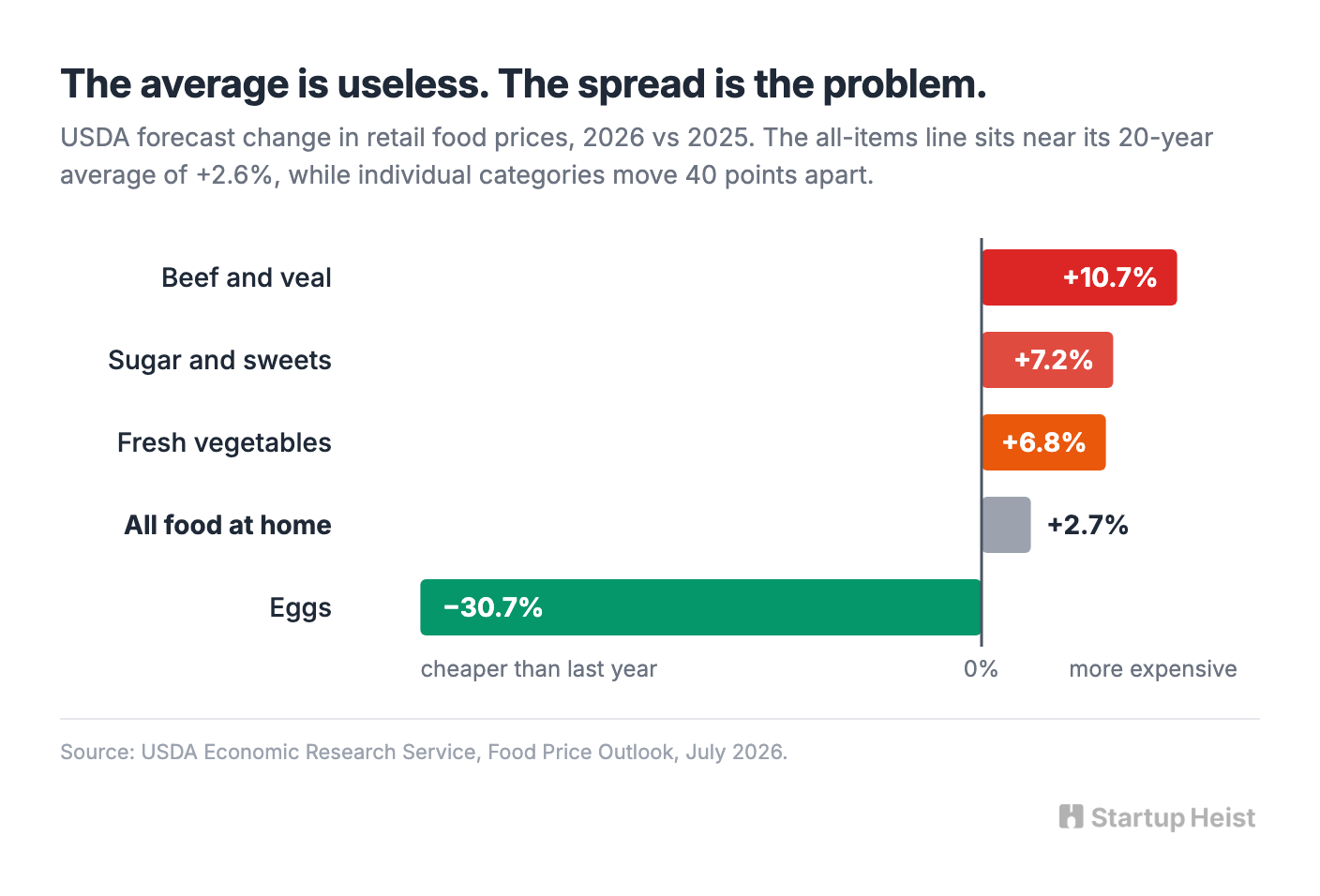
That spread is what breaks a shopper's mental model. "Eggs are expensive" was true in January 2025 and is wrong now. "Aldi is cheapest" holds for pantry goods and collapses on produce. Any heuristic a family carries into the store can be correct one quarter and expensive the next.
So families started doing the work themselves. McKinsey surveyed 5,000 North American shoppers in March 2026 and found 51% cutting impulse purchases, 47% trading into private label, 43% leaning harder on promotions, and 43% comparing prices more carefully. Trip frequency rose 5% year over year while baskets shrank. Shoppers are splitting missions: stock up here, buy fresh there, grab fill-ins somewhere else.
Retailers are making that work harder. Grocery executives told McKinsey that about 35% of their promotions are already fully personalized, and they expect 55% within two to three years. The payoff is real on their side: loyalty members who redeem personalized offers spend 4.3 times more per year than shoppers who don't. Meanwhile 71% of consumers say they'd rather have simple, consistently lower prices than high base prices plus a stream of offers they have to chase.
Retailers keep adding personalization while shoppers keep asking for less homework, and the gap between those two lines is where the money sits.
The obvious version already shipped, and barely sold
Don't build a search box that tells someone which nearby store has the cheapest eggs. That product exists several times over, and it's free.
Flipp aggregates weekly ads across more than 2,000 stores. GroceryChop compares live prices across 100-plus chains with UPC matching, a 72-hour data-freshness gate, a list optimizer, and an AI assistant, with no account required. Basket, the venture-backed original in the category, was acquired by Fobi in May 2022 and now collects reviews from users reporting the app stopped working. Grocery price comparison has taught consumers the information is worth roughly zero dollars, and taught founders that a comparison engine alone retains nobody.
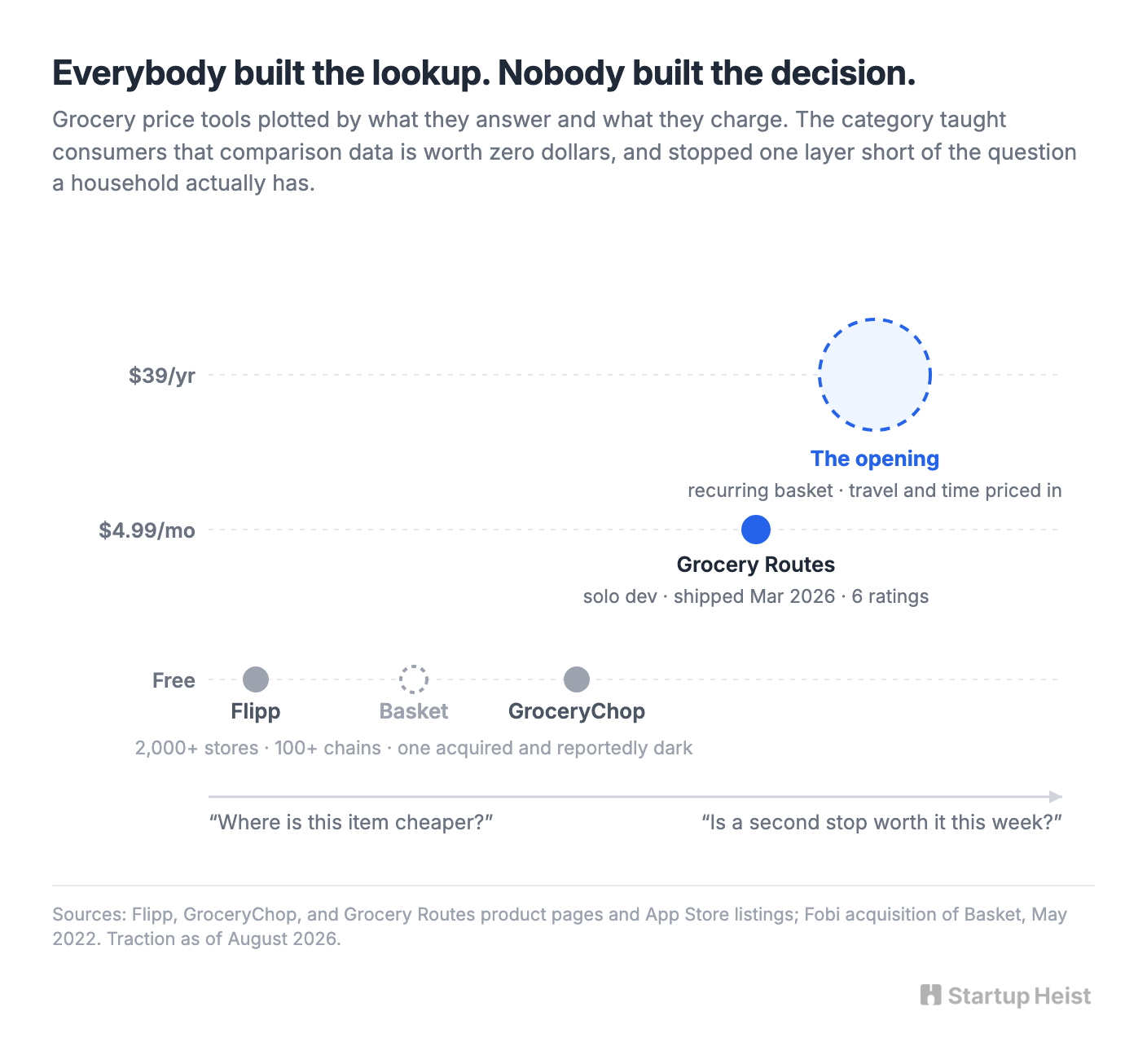
The second-stop calculation itself has already shipped too, which the people pitching this idea usually don't know. An app called Grocery Routes launched on the App Store on March 24, 2026, built by a solo developer, and its pitch is best-price routing that shows one store for everything or a split across two, "letting you decide what's worth the extra stop." It charges $4.99 a month. As of August 2026 it has six ratings. GroceryChop's split-trip mode does something similar, spreading a list across a small number of nearby stores so it doesn't send you across the county, and it's free.
That's validation and warning in one. The framing is right, and the market is barely contested. A solo builder shipped the core feature in March 2026 and nobody noticed, which should tell you the feature isn't the company.
The problem worth solving sits one layer down: given what my household actually buys every week, how much hassle should I accept this week? That question belongs to a specific family rather than to a search query, and products that answer it are much harder to abandon.
Sell the decision, not the data
The email that lands Friday afternoon reads like this.
Simplest, Kroger only: $126. Best value, Kroger plus Aldi: $113. Extra distance 4.8 miles, extra time 21 minutes, travel cost $3.10, net savings $9.90. Your threshold is $15.
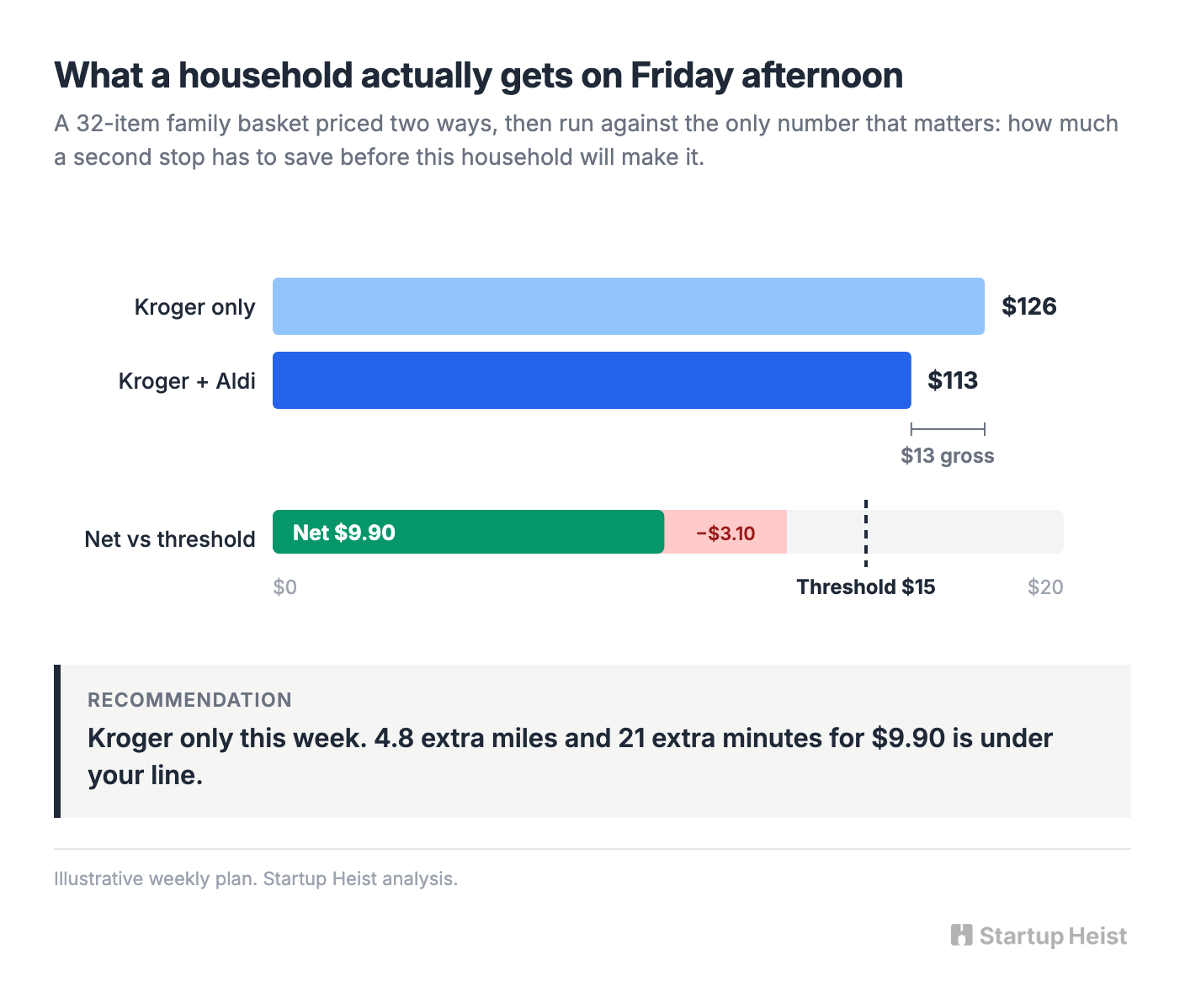
Recommendation: Kroger only this week.
Compare that to "Aldi cereal $2.89, Kroger cereal $4.29," which hands the shopper a research project instead of closing one.
A good optimizer should be almost aggressively conservative. When the second stop is marginal, it should say so and tell the household to stay home. That feels backwards for a savings product, and it's the only way this earns enough trust to change where a family drives on a Saturday. Becoming the household's default answer to a weekly question matters far more than proving the software can find deals.
Unlock the Vault.
Join founders who spot opportunities ahead of the crowd. Actionable insights. Zero fluff.
“Intelligent, bold, minus the pretense.”
“Like discovering the cheat codes of the startup world.”
“SH is off-Broadway for founders — weird, sharp, and ahead of the curve.”


