


Ghost Has a Paywall. It Doesn't Have a Paywall Lab.
Paid newsletters spent the last five years solving the first-order problem, which was how to charge readers at all. That problem is closed. Substack made paid newsletters mainstream, Ghost and beehiiv made it easy to own the audience and keep the revenue, and Stripe turned recurring billing into plumbing. A writer can launch a publication on a Tuesday, set monthly and annual plans, drop a paywall into a post, and collect money by Friday.
The second-order problem is still wide open. Nobody has told that writer where the paywall should sit, what it should say, which plan it should push, or whether any of those choices made more money than the alternative would have.

Ghost hands publishers every knob. A public-preview divider goes anywhere in a post. Multiple paid tiers, monthly and annual billing, discounts, free trials, a customizable membership CTA, payments straight through Stripe. What Ghost doesn't provide is an experimentation layer: something that assigns readers to variants, ties each variant to paid conversion and retention, and tells the operator which monetization rule wins. Ghost's native analytics, rebuilt in the August 2025 Ghost 6.0 release, show member growth, MRR, and which posts drive paid signups. Useful, but it's a rearview mirror. It reports what happened and can't run a controlled test.
The heist: build a Ghost-first paywall experiment toolkit for independent paid publications. Start with deterministic A/B tests of preview length, paywall copy, offers, and plan presentation, connect Ghost and Stripe outcomes back to each experiment, and report which rule produces the most revenue per reader. Personalization comes later, once the data justifies it.
Think of it as a revenue lab for newsletters, and the lab framing is what keeps it small enough for one or two people to build. The brief:
The money: 250 Ghost publications at $200 a month is $50,000 MRR. Paid newsletter revenue on beehiiv alone went from $8 million to $19 million in one year.
Inside:
• Five deterministic experiments to run first
• Theme-partial architecture, gate stays native
• Flat pricing ladder, $99 to $999 a month
• Outreach email plus the 90-day plan
The money is already there
The category needs no invention. Substack announced five million paid subscriptions on March 11, 2025, less than four months after crossing four million. beehiiv's State of Paid Newsletters report, published June 22, 2026, shows paid-subscription revenue on its platform rising from $8 million in 2024 to $19 million in 2025, a 138% jump, with $35 million projected for 2026. The median paid newsletter on beehiiv charges $10 a month or $100 a year.
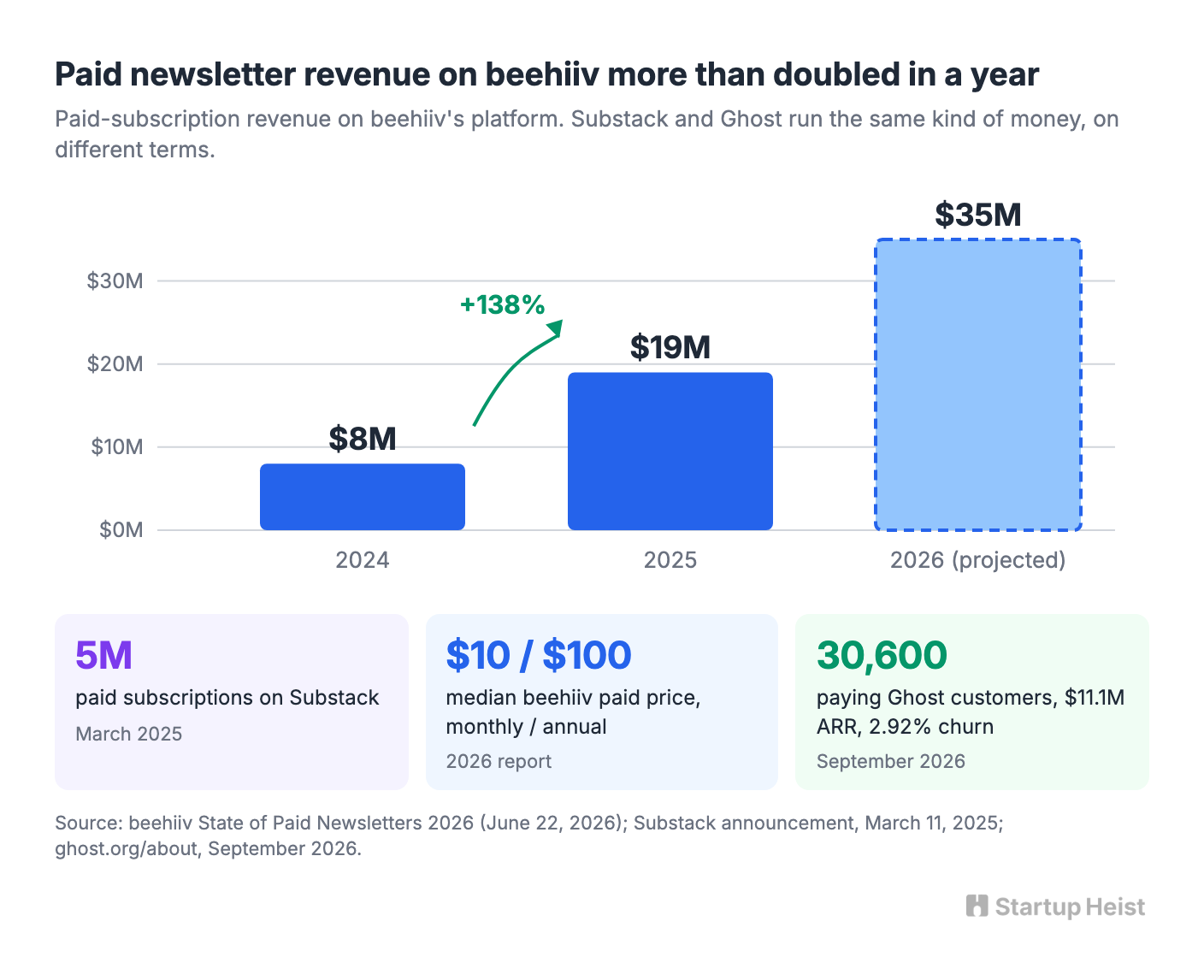
Ghost is the smaller platform, and that's the point. Ghost publishes its numbers live: as of September 2026, roughly 30,600 active paying customers, an $11.1 million annual revenue run rate, and 2.92% net churn. Its Publisher plan, the tier that unlocks paid memberships, custom themes, the Admin API, and webhooks, runs $29 a month on annual billing at 1,000 members. Nobody is going to raise a Series B on "A/B testing for 30,000 Ghost sites," which keeps the venture-backed generalists out.
The customer is a narrow slice of those 30,600 sites: publishers already earning $5,000 to $100,000 a month in subscription revenue, running a custom theme they control, drawing enough qualified traffic to generate regular paywall encounters, and operating without a growth or data team. A writer earning $300 a month doesn't need paywall optimization; they need distribution. For the writer earning $20,000 a month, a 5% revenue lift is worth $1,000 a month, which makes a $149 or $299 tool an easy yes.
Why Ghost, not Substack
Substack is where the pain is most visible, and it's the wrong place to build.
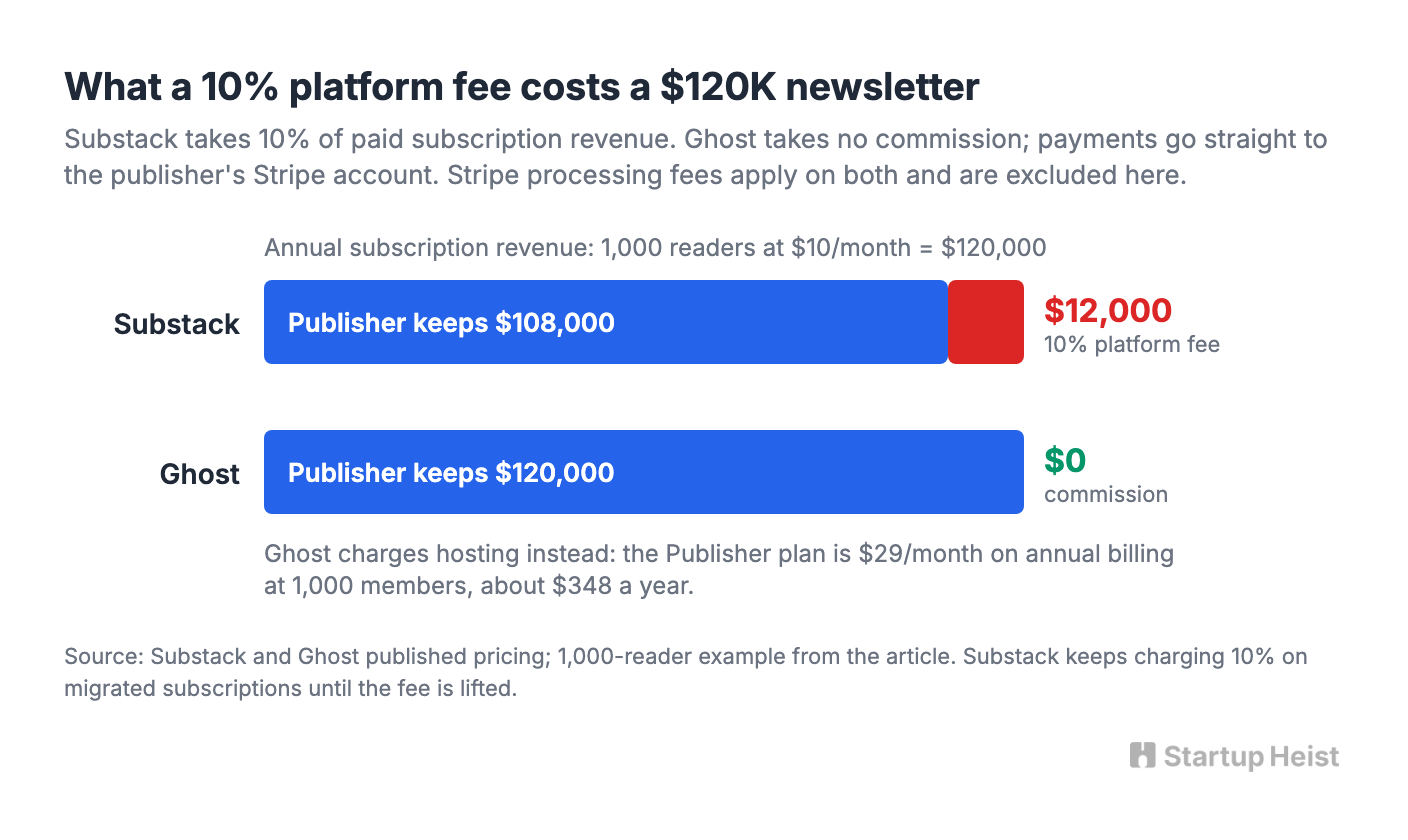
Substack takes 10% of paid subscription revenue on top of Stripe's processing fees. A publication with 1,000 readers at $10 a month sends Substack $12,000 a year. Ghost takes no commission on membership revenue; payments go directly to the publisher's Stripe account. Ghost's documented Substack migration path imports posts, free members, and paid subscribers through the connected Stripe account, with a detail that's easy to miss: Substack keeps taking its 10% on migrated subscriptions until the fee is removed, and Ghost's concierge team helps get it lifted. Publishers who go through that process arrive on Ghost acutely aware of what every percentage point of revenue is worth.
The more practical reason is that you can build on Ghost. It supports custom themes, sitewide JavaScript through code injection, an Admin API covering posts, members, tiers, and offers, a member-facing Portal with deep-linkable checkout, and outgoing webhooks. That's enough surface to instrument a publication without becoming the CMS or the billing system.
Platform risk is real on every hosted stack. beehiiv already charges 0% on paid subscriptions on its Scale plan and keeps pulling monetization features into core, and Ghost isn't standing still either: it shipped a referral channel for paid memberships on May 21, 2026 and gift access to paywalled content on July 6, 2026. Neither is an experimentation feature, but assume the same erosion risk over a multi-year horizon. Build around a hosted platform and you can spend six months on a feature the platform ships as a checkbox. Open source and publisher-owned, Ghost puts a floor under that risk without removing it: a publisher with a custom theme runs infrastructure they control and expects to extend it.
What you are actually selling
The weak version of this company is "A/B testing for Ghost." Generic experimentation is a commodity. Humblytics sells web experiments plus Stripe revenue attribution from $79 a month. Inside the Ghost ecosystem, Outpost sells conversion CTAs, metered registration walls, and retention emails to Ghost publishers from $50 to $60 a year. Neither runs controlled monetization experiments scored on subscription revenue, and neither knows what a Ghost tier or offer is. Even so, a random-number generator bolted to a conversion dashboard won't beat either of them.
The valuable version is a newsletter monetization operating system that understands how paid Ghost publications work. The software arrives with opinions. A publisher connects Ghost and Stripe and, before designing a single test, sees something like: "Your annual plan accounts for 62% of new subscription revenue. Your paywall defaults readers to monthly. Test annual-first presentation." Or: "Long-form analysis posts convert three times better than news posts. Test a shorter public preview on analysis only." Or the one that builds trust: "This variant increased checkout starts but produced more discounted monthly subscribers. Revenue per 1,000 visitors is lower. Keep the control."
That last line is the product. Plenty of dashboards can report that Variant B converted at 1.14%. Almost none will tell a publisher that Variant B lost money, and that sentence is what they'll pay for.
The metric that matters, and the math that kills most tests
Unlock the Vault.
Join founders who spot opportunities ahead of the crowd. Actionable insights. Zero fluff.
“Intelligent, bold, minus the pretense.”
“Like discovering the cheat codes of the startup world.”
“SH is off-Broadway for founders — weird, sharp, and ahead of the curve.”


