


The Owner Copilot Hiding in Every Empty Appointment Slot
Small businesses do not need another dashboard.
They need something closer to a sharp assistant who taps them on the shoulder and says, "You have a gap at 2:30. Three people on your waitlist asked for that exact window. Want me to text them?"
The opportunity sits right there: a proactive SMS owner copilot for appointment-based local businesses, beginning with salons, spas, barbershops, and boutique fitness studios. Skip the chatbot framing, the reporting dashboard, and the vague "AI for small business" pitch. Picture a text-message operator that watches the calendar, spots revenue leaks, suggests the next action, and lets the owner approve it by replying "yes."
Here's the opportunity:
The money: 300 salons paying $149/month is roughly $44.7K MRR. Hair salons average a 15% no-show rate and lose $2.5K to $5K monthly in missed appointments.
Inside:
• Four MVP playbooks for salon SMS automation
• Three-tier pricing from $49 starter to multi-location
• Vagaro and Mindbody integration playbook
• Five moats for the appointment recovery layer
The timing is unusually good because the behavior has just been legitimized at the enterprise level. On April 7, 2026, PAR Technology launched PAR Intelligence, an "agentic OS" for multi-unit operators built on roughly 12 billion annual transactions and 640 million customer profiles. Within the same window, Block introduced Managerbot inside the Square platform, an explicitly proactive agent that monitors stock levels, sales velocity, weather, and local events, then nudges the seller before they think to ask. Toast and Thanx have shipped comparable tools over the past year.
A category becomes easier to sell once the largest vendors teach the market what the new interface looks like.
For the last decade, small-business software asked owners to log in, interpret data, and decide what to do. The next interface is a short operational prompt:
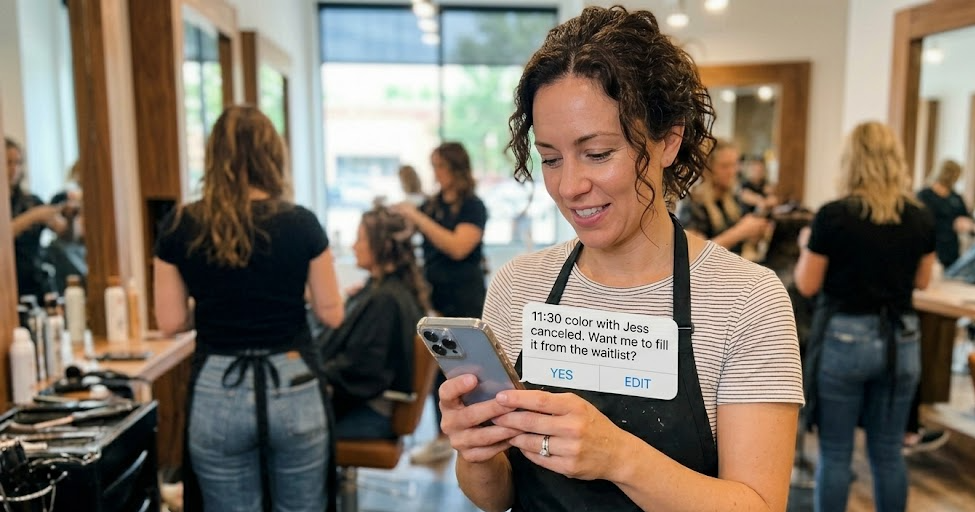
"You had a cancellation tomorrow at 11:00. There are 4 waitlist clients who prefer mornings. Want me to send a first-to-claim message?"
Small operators will respond to that voice in a way they never responded to BI dashboards.
Why this is not "just reminders"
Booking platforms already have reminders and waitlists. Booksy can auto-text waitlisted clients when openings appear. Mindbody runs SMS class waitlists with auto-add and first-to-claim modes. Vagaro offers three automated notification modes (First in Line, Instant Book, and Money Maker, which texts the customer with the highest-priced appointment when a slot opens) plus a manual "You Pick" mode.
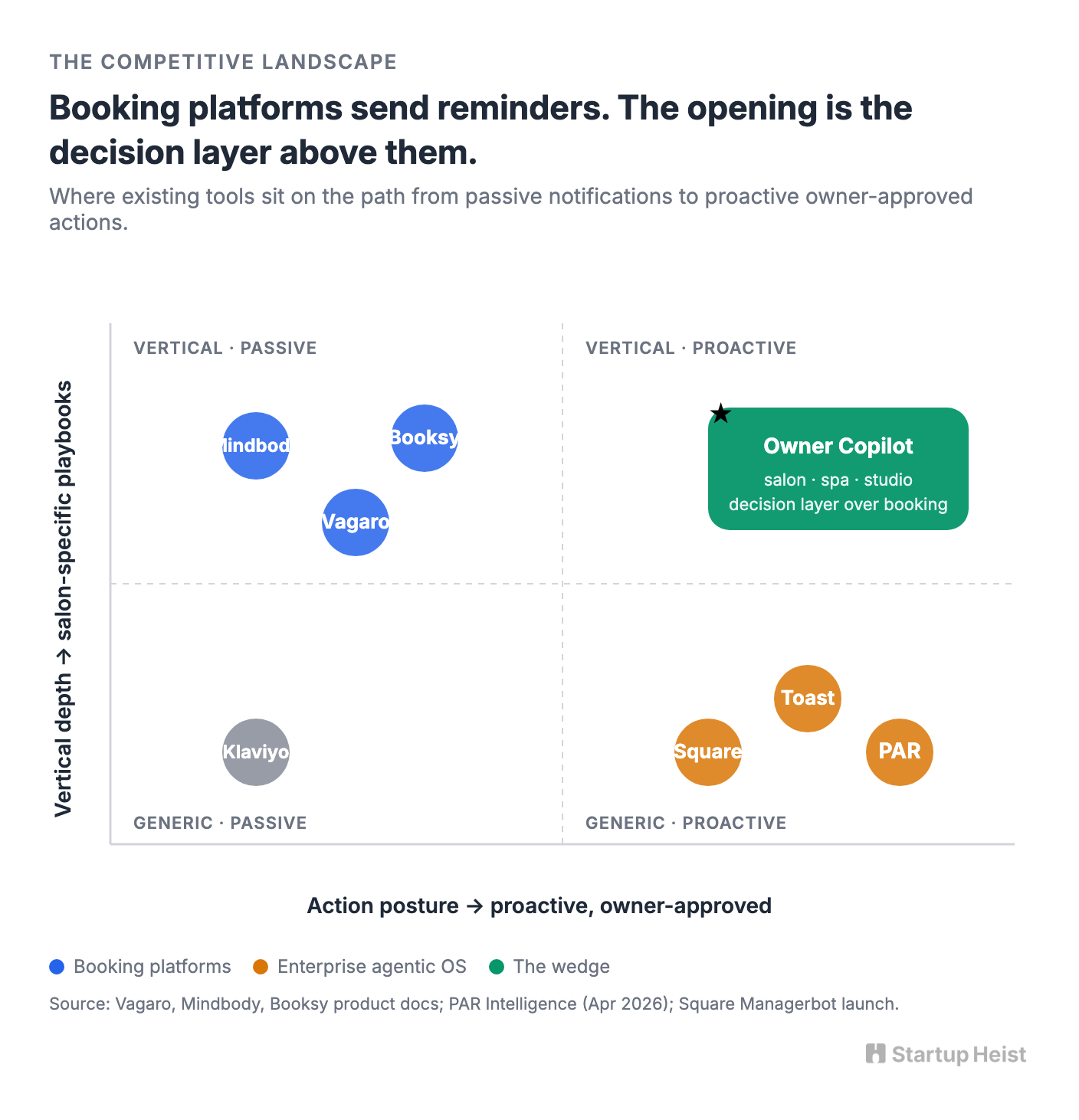
A startup cannot win as a Vagaro, Mindbody, or Booksy alternative by saying, "We send texts." The product has to own a higher-value layer: decision orchestration. A reminder says, "Your appointment is tomorrow." A waitlist feature says, "A slot opened. Click here." An owner copilot says, "You have a revenue gap, here are the best candidates, here is the message I recommend, and I can execute it if you approve."
The owner is buying recovered revenue and reduced mental load. Communication is the surface. The product is the decision layer underneath.
Why salons and studios are the right wedge
Selling this to "local businesses" sounds reasonable and is wrong. Most local businesses lack the clean data structure this product needs. Auto shops run variable, parts-dependent, multi-hour jobs. Restaurants are attractive, but Square and PAR are already pushing aggressively there. General home services have larger tickets and heavier dispatch complexity.
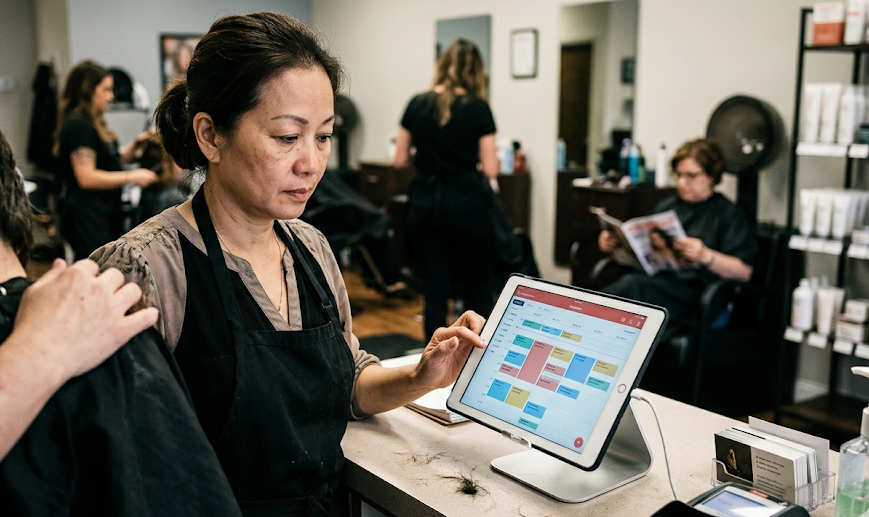
Appointment-based beauty and wellness fits better. IBISWorld pegs the U.S. Hair & Nail Salons industry at $92.5 billion in 2026, spread across roughly one million businesses with low market concentration. The largest player, Regis Corp, holds only about 1.5% of the market. That is a fragmented, owner-led, digitized-enough market with thousands of operators already paying $30 to $300 a month for booking software. Add boutique fitness, massage, med spa, and barbershops, and the surface area widens further.
The workflow is also emotionally obvious. A 90-minute color appointment that cancels late can wreck a stylist's shift. A small Pilates studio with a same-day class waitlist has demand sitting nearby, but the operator still has to notice, decide, message, and follow up. Industry data on no-shows tells the same story: hair salons average a 15% no-show rate, climbing to 20% without automated reminders. Salons commonly lose between $2,500 and $5,000 a month to missed appointments. The product earns its keep right inside that gap.
The pain is measurable
For an appointment business, inventory is time. Once 2:00 PM passes, that slot cannot be resold. The math at a modest salon makes the case quickly:
- 5 service providers
- 6 appointments per provider per day
- 25 operating days per month
- 750 monthly appointment slots
- Average ticket: $85
- No-show or late-cancel leakage: 5% (a deliberately conservative haircut on the 15% industry average)
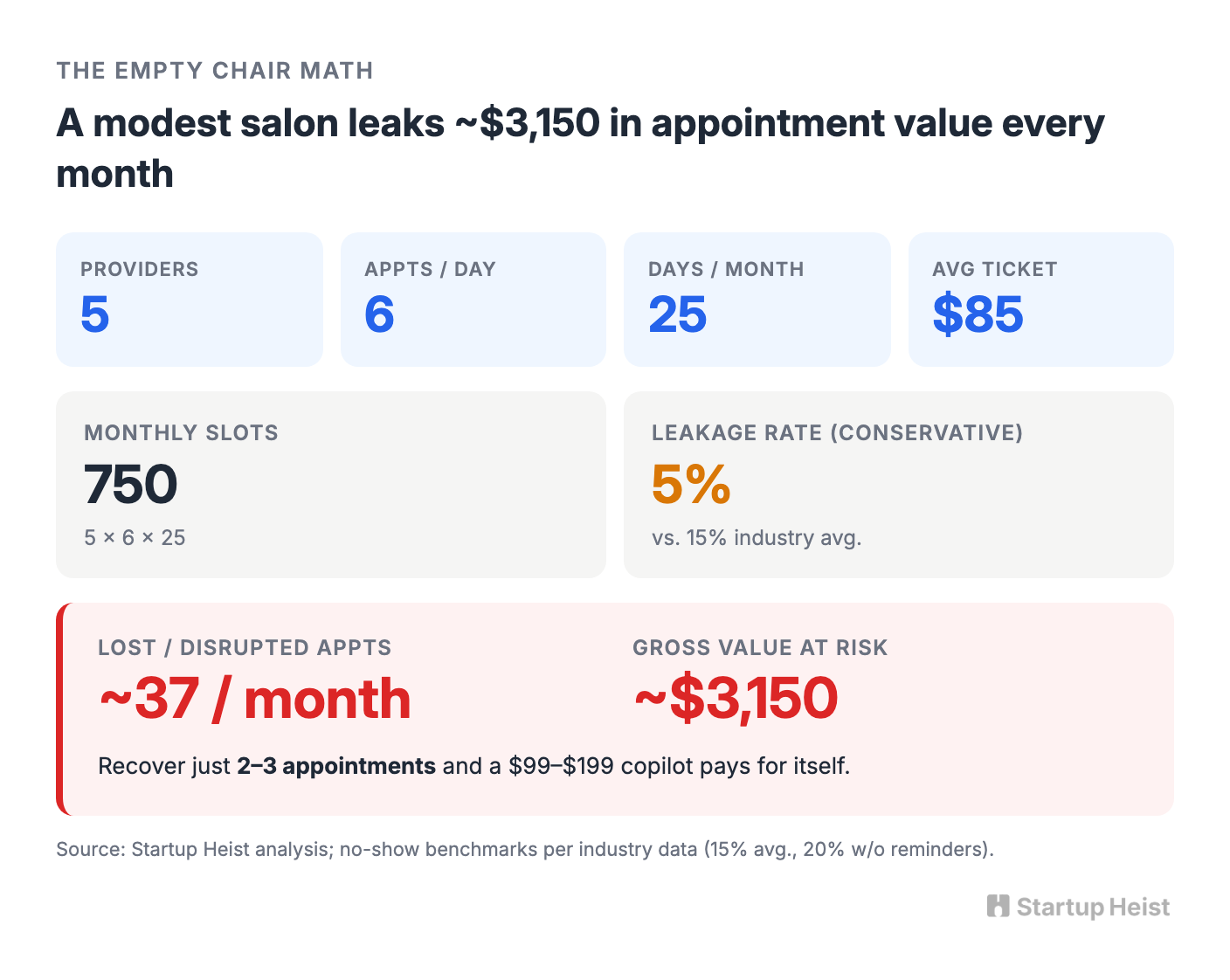
That is roughly 37 lost or disrupted appointments per month, or about $3,150 in gross appointment value at risk. The copilot does not need to save all of it. It needs to recover a few slots.
If the product helps fill 4 to 6 appointments per month, it justifies a $99 to $199 monthly fee. If it consistently fills 10 or more, the value becomes obvious. The pricing anchor sits there: recover two appointments and this pays for itself.
Don't sell AI. Sell found revenue.
The play
Build an SMS-first owner copilot for appointment businesses. The first version focuses on one painful metric: appointment recovery.
A salon, spa, barbershop, massage practice, or boutique fitness studio already lives inside scheduling software. They have appointments, cancellations, no-shows, waitlists, staff calendars, client records, and class rosters. The shortage isn't software. The work still happens manually, in the gap between the software and the owner's attention.
A cancellation comes in. The slot opens. The owner is cutting hair, training a client, doing payroll, cleaning the studio, or answering Instagram DMs. By the time they notice, the slot is dead.
This product catches the leak while it is still recoverable. The core loop is simple:
Unlock the Vault.
Join founders who spot opportunities ahead of the crowd. Actionable insights. Zero fluff.
“Intelligent, bold, minus the pretense.”
“Like discovering the cheat codes of the startup world.”
“SH is off-Broadway for founders — weird, sharp, and ahead of the curve.”


