


The Electric Bill Autopsy
Gas prices are easy to hate. The number stands in six-foot type beside the highway, and when it jumps, everyone sees the same increase at the same moment. Politicians respond within the week.
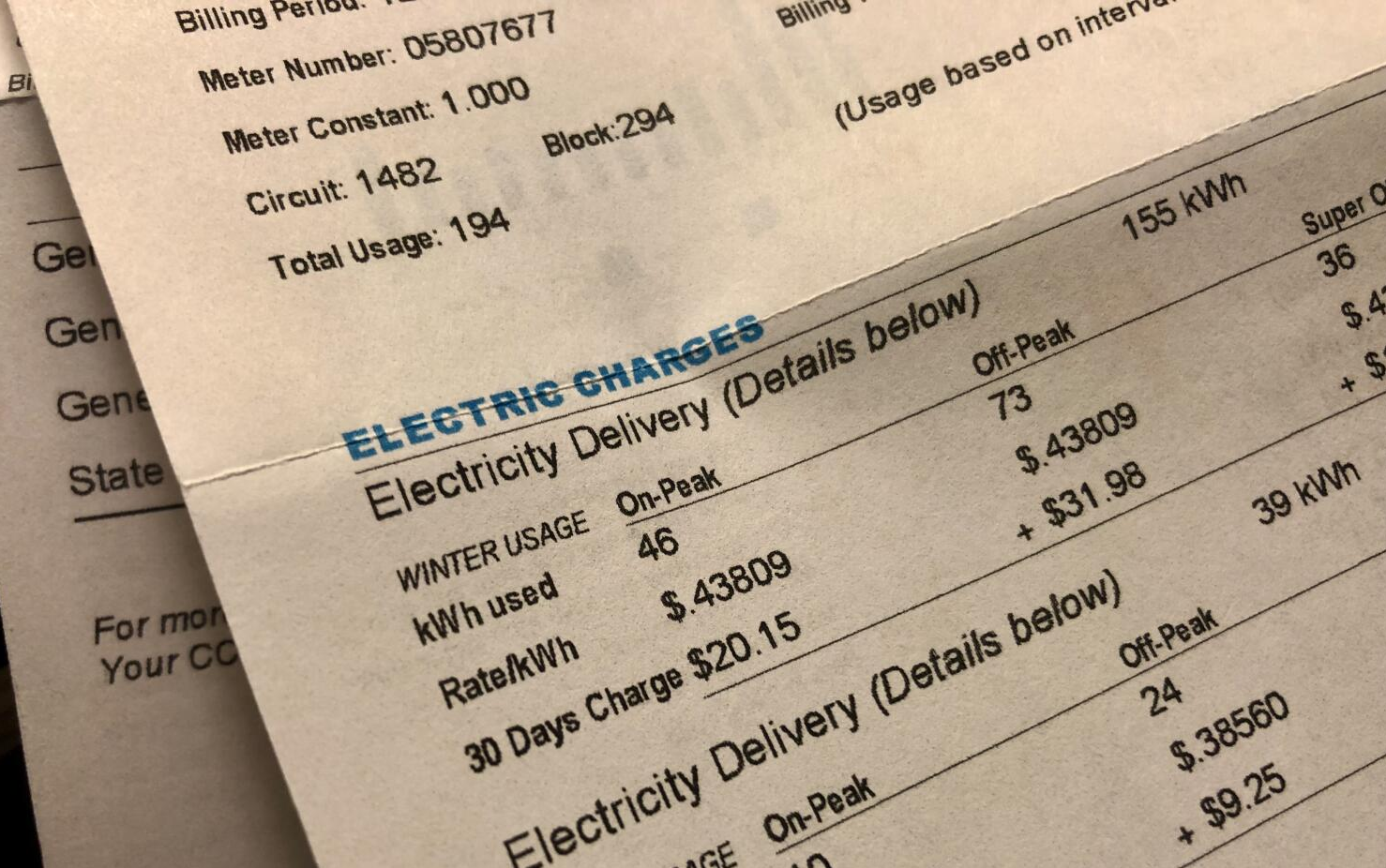
Electricity hides. A homeowner opens a bill and finds the amount due went from $146 to $219. The cause could be a heat wave, a longer billing cycle, an expired supplier contract, a new transmission rider, an approved rate case, or the data center campus going up two towns over. The answer is printed on the bill, but it's written in tariff language almost no ratepayer speaks.
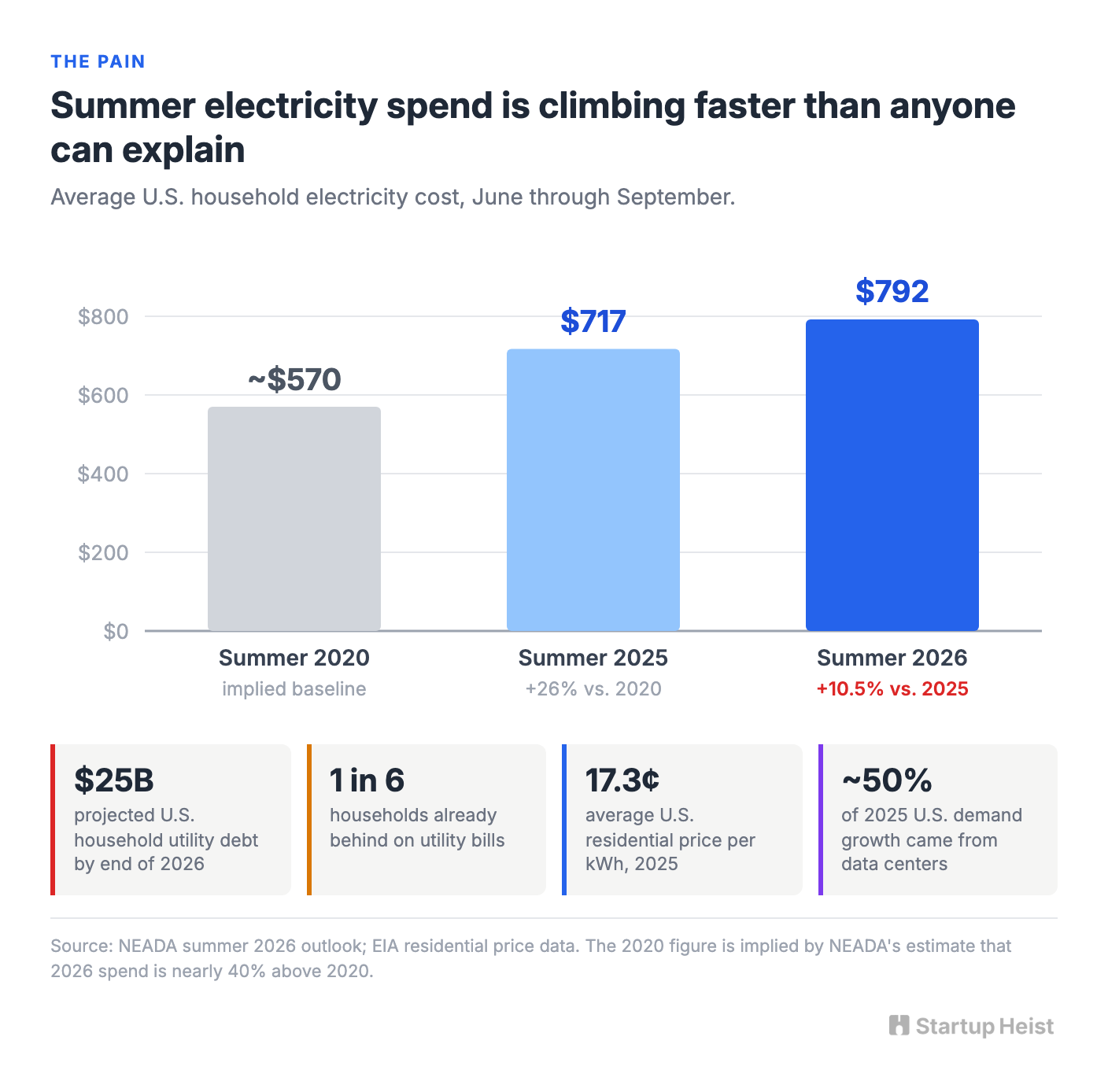
That confusion is getting expensive. The National Energy Assistance Directors Association projects the average U.S. household will spend about $792 on electricity from June through September 2026, up 10.5% from summer 2025 and nearly 40% above 2020. One in six households is behind on utility bills, and NEADA expects total utility debt to reach roughly $25 billion by year-end. Residential electricity prices averaged about 17.3 cents per kilowatt-hour in 2025, and data centers accounted for roughly half of all new U.S. electricity demand growth in 2025.
The politics have caught up to the bills. On July 21, 2026, the House Energy and Commerce Committee advanced the Ratepayer Protection Act by a 52 to 0 vote, pushing state regulators to consider making data centers of 100 megawatts or more pay the full cost of the grid upgrades they require. Outside Washington, a June 2026 tracking report counted 430 local opposition groups with more than 525,000 members fighting data-center projects, and on July 18 organizers staged 142 protests across 42 states. A June 2026 Reuters/Ipsos poll found only 14% of Americans would support a data center in their own community.
Millions of households are angry about a number they can't decompose. Here's the opportunity:
The money: 10,000 households at $29 a year plus 50 pro accounts at $249 a month is roughly $36,000 MRR. PPL customers overpaid $7.2 million in May 2026 alone.
Inside:
• Six-part forensic report MVP, two states
• Event pricing: free scan, $29/yr, $9 report
• Professional tier ladder: $149 to $499/mo
• 90-day build keyed to rate-reset news
Skip the energy marketplace, the smart thermostat, and the temptation to make it political. The wedge is a narrow product that answers one question: why did my electric bill go up, and what can I realistically do about it?
The winning version launches with a handful of utilities in Pennsylvania and Ohio, parses the customer's bill, decomposes the increase dollar by dollar, flags relevant supplier and regulatory actions, and helps the customer file an informed public comment when a rate case is open.
Call it the Electric Bill Autopsy.
The Product Is an Explanation, Not a Dashboard
Utilities already give customers dashboards: monthly usage charts, payment history, average temperature, generic conservation advice. What they never answer is the customer's actual question. My bill went up $63; what caused each dollar of it?
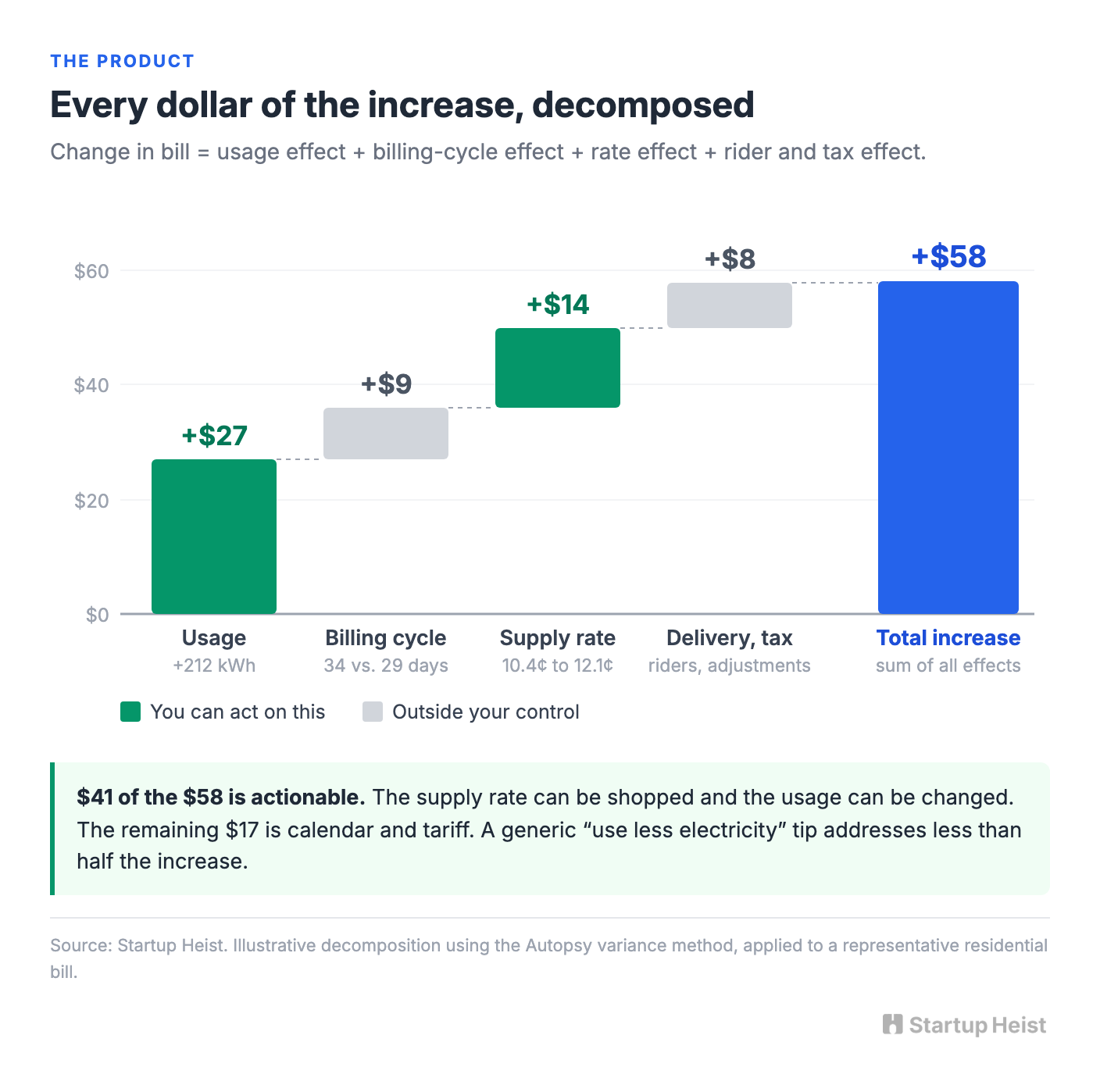
Treat a bill increase like a financial variance analysis. Change in bill = usage effect + rate effect + billing-cycle effect + fixed-charge effect + rider effect + supplier effect + taxes and adjustments. The customer uploads the current bill plus the previous one, or the same month last year, and the product returns a plain-English report:
Your bill increased by $58.
- $27 from additional usage: you used 212 more kilowatt-hours.
- $9 from a longer billing cycle: 34 days instead of 29.
- $14 from a higher supply price: your supplier rate rose from 10.4¢ to 12.1¢ per kilowatt-hour.
- $8 from delivery and transmission changes, taxes, and adjustments.
Then it separates what the customer can control from what they can't. Compare the supply rate against the utility's default Price to Compare. Check the supplier contract's expiration date and cancellation fee. Switch suppliers where retail choice exists. Enroll in budget billing. Apply for assistance. Follow the active rate case and comment before the deadline. Call the utility if the meter reading looks estimated.
The typical energy product jumps from "your bill is high" straight to "use less electricity." The Autopsy tells the customer whether using less would even address the problem. If 80% of an increase came from an expired supplier contract, unplugging the toaster is theater.
The Evidence Standard Is the Moat
The data-center backlash will bring users to the door, but it can't become the analytical method.
A June 2026 working paper from EPRI and Watershed researchers tested the assumption directly and found that data-center growth between 2015 and 2024 modestly lowered average residential rates. A doubling of data-center capacity cut residential prices about 3.5%, and rates in the average state would have been roughly 6% higher without the data centers built from 2019 to 2024. The authors warn that future supply constraints could reverse the effect. Reality is messier than the protest signs.
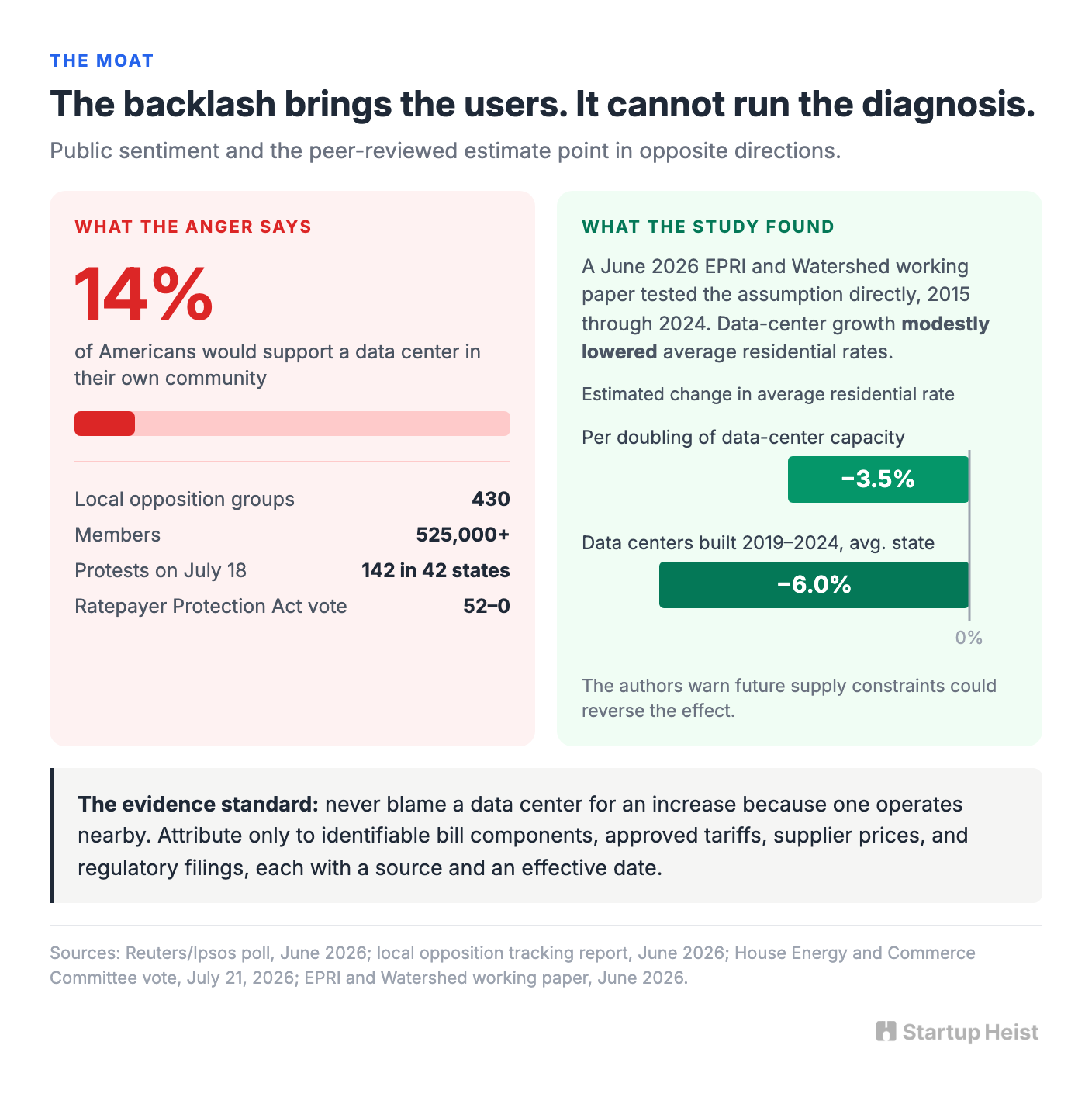
So the product holds an evidence standard. Never blame a data center for a bill increase because one operates nearby. Attribute increases only to identifiable bill components, approved tariffs, supplier prices, or regulatory filings. Separate what a utility requested from what regulators approved. Show the source and effective date behind every claim.
Angry consumers can already find someone online to tell them every increase is caused by AI, renewables, utility greed, or the political party they dislike. What they can't find is a neutral reconciliation of the numbers. That neutrality is the defensible position, because it's the one thing an outrage economy won't supply.
Start Where Diagnosis Leads to Action
A nationwide launch would be a mistake. Electric bills vary by utility, state, rate class, supplier, tariff, and billing format, and riders that mean one thing in Ohio mean something else in Minnesota. The parsing software is straightforward; the continuously maintained mapping between bill formats, tariffs, supplier contracts, and regulatory dockets is not. The first market needs painful prices, confusing bills, at least one immediate action the customer can take, and public regulatory data a small team can monitor.
Unlock the Vault.
Join founders who spot opportunities ahead of the crowd. Actionable insights. Zero fluff.
“Intelligent, bold, minus the pretense.”
“Like discovering the cheat codes of the startup world.”
“SH is off-Broadway for founders — weird, sharp, and ahead of the curve.”


