


The Decision Layer Hiding Inside YouTube Comments
A creator opens YouTube Studio the morning after a sponsored video goes live. Most of the comment section is trivial. "Great video." "First." "Where'd you get that shirt?" Then there's this one:
"Funny how you suddenly love this product now that they're paying you."
It isn't spam or hate speech, and it almost certainly doesn't violate any YouTube policy. What it does is create a decision. Reply and you look defensive. Delete it and someone screenshots the deletion. Ignore it and the thread grows underneath a video a brand paid five figures to sponsor.

Now multiply that by two hundred a week: accusations, bait, genuine complaints, safety questions, political provocations, attacks on employees, competitor mentions, claims about a sponsor's product, and the whole gray band between "annoying" and "send this to my manager right now." At that volume, moderation stops being a filtering problem and becomes a judgment problem.
There's a clean piece of software hiding in that distinction. Build a YouTube-first comment decision copilot that tells professional creators whether to reply, hide, ignore, or escalate, based on their own safety rules, public voice, and active sponsorships, while leaving the final action to the human. Every toxicity detector on the market already handles the easy half. What nobody has built is the layer between YouTube's moderation tools and a person whose entire business is attached to their own name.
Here's the shape of it:
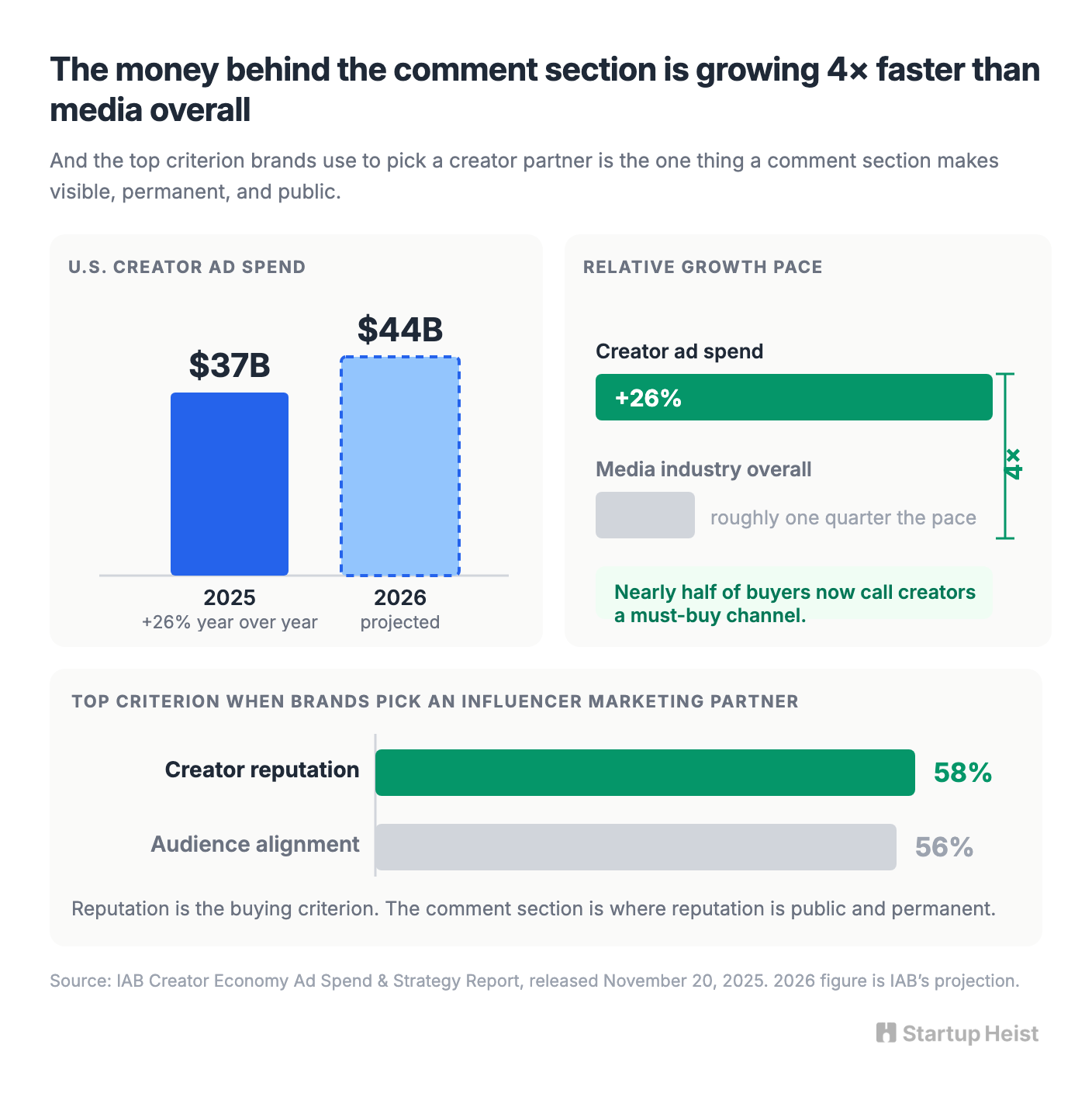
The money: Forty talent-manager accounts at $399 a month is $16,000 MRR. Creator ad spend hit $37 billion in 2025, and 58% of brands buy on reputation.
Inside:
• Six-week build plan for the decision queue
• Sponsor playbooks that hold up with legal
• Pricing that dodges the $29 filter anchor
• The audit email that opens creator sales
The comment section is a governance problem
The default comment moderation product assumes a simple loop: bad comment, detect it, remove it. That loop works beautifully on spam, slurs, scams, and repetitive abuse, and badly on the comments that actually consume a human being's attention.
In an unreviewed arXiv preprint posted in August 2026, researchers Yunhee Shim and Shagun Jhaver surveyed 584 active content creators about three ways to handle a hateful comment: delete it, reply to it, or ignore it. Creators rated deletion the strongest option for their own emotional safety. They rated both deletion and replying as better than ignoring for managing how they appear to an audience. They rated replying as offering the most algorithmic upside. The finding that matters most for anyone building here: perceived algorithmic benefit did not significantly predict which strategy a creator was actually willing to use. Safety and impression management did.
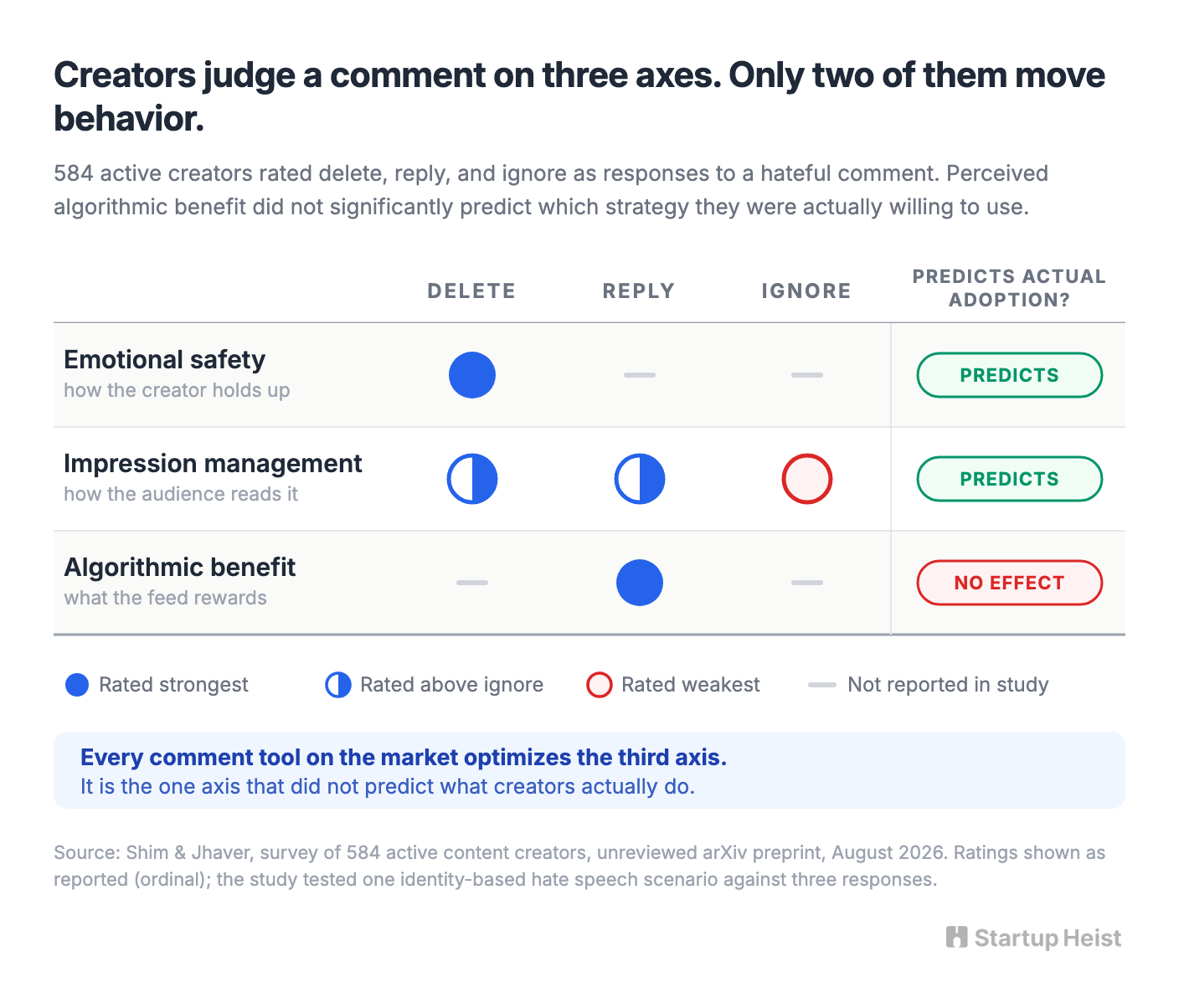
The result rules out two obvious products. If creators were mining engagement out of every troll, the right build would be an engagement optimizer. If they mainly needed offensive text removed, the right build would be a better filter. The data supports neither. What creators are doing, comment by comment, is a miniature act of governance. Does this response make me look thin-skinned? Will answering invite more of it? Will my audience read silence as dodging a fair question? Does the sponsor need to hear about this before I touch it?
The same study describes moderation as a visible signal, a way creators show an audience how they govern their own community. It isn't cleanup work happening backstage; it's part of the product a creator presents.
One caveat before anyone builds a market-size slide out of a single paper. The study ran an identity-based hate speech scenario against exactly three responses. Sponsor complaints, product criticism, and a four-option AI assistant all sit outside what it tested. Nothing in it proves anyone will pay for this software. What it does establish is more useful: the decision is multidimensional, and every existing tool treats it as one-dimensional.
YouTube already drew the line for you
On June 26, 2026, YouTube rolled out AI comment tools inside Studio to all creators globally on desktop. Creators can now search their comments semantically, in natural language up to 100 characters, asking for things like comments about their appearance or requests for a follow-up video. They get suggested topic filters such as "Negative feedback." They can pull up a comment, open the three-dot menu, and surface every other comment that means roughly the same thing.
The feature stops there. It finds and groups, without recommending anything or moderating anything. YouTube shipped the retrieval layer and deliberately stopped short of telling a creator what to do about what they found.
This is the most valuable piece of competitive intelligence available in the category, and it's free. The platform with the most comment data on earth, the strongest incentive to reduce creator burnout, and effectively unlimited engineering capacity looked at this problem and drew its boundary at retrieval. Anything on the near side of that line is commodity infrastructure you should never build. The far side is where the product is.
Everyone else is selling volume
The market for social media comment moderation tools is crowded, and it is crowded in one direction. Replient sells AI comment management across Instagram, Facebook, TikTok, YouTube, LinkedIn, and app store reviews, starting at €39 a month for 1,000 processed comments and one brand, climbing to €249 for 10,000 comments and ten brands. CommentGuard starts at $29 for 5,000 comments and 1,000 AI replies, topping out around $199 before custom tiers. NapoleonCat runs a unified social inbox with sentiment tagging, spam and hate detection, and auto-moderation rules. BrandBastion sits upmarket with enterprise crisis monitoring and brand safety coverage.
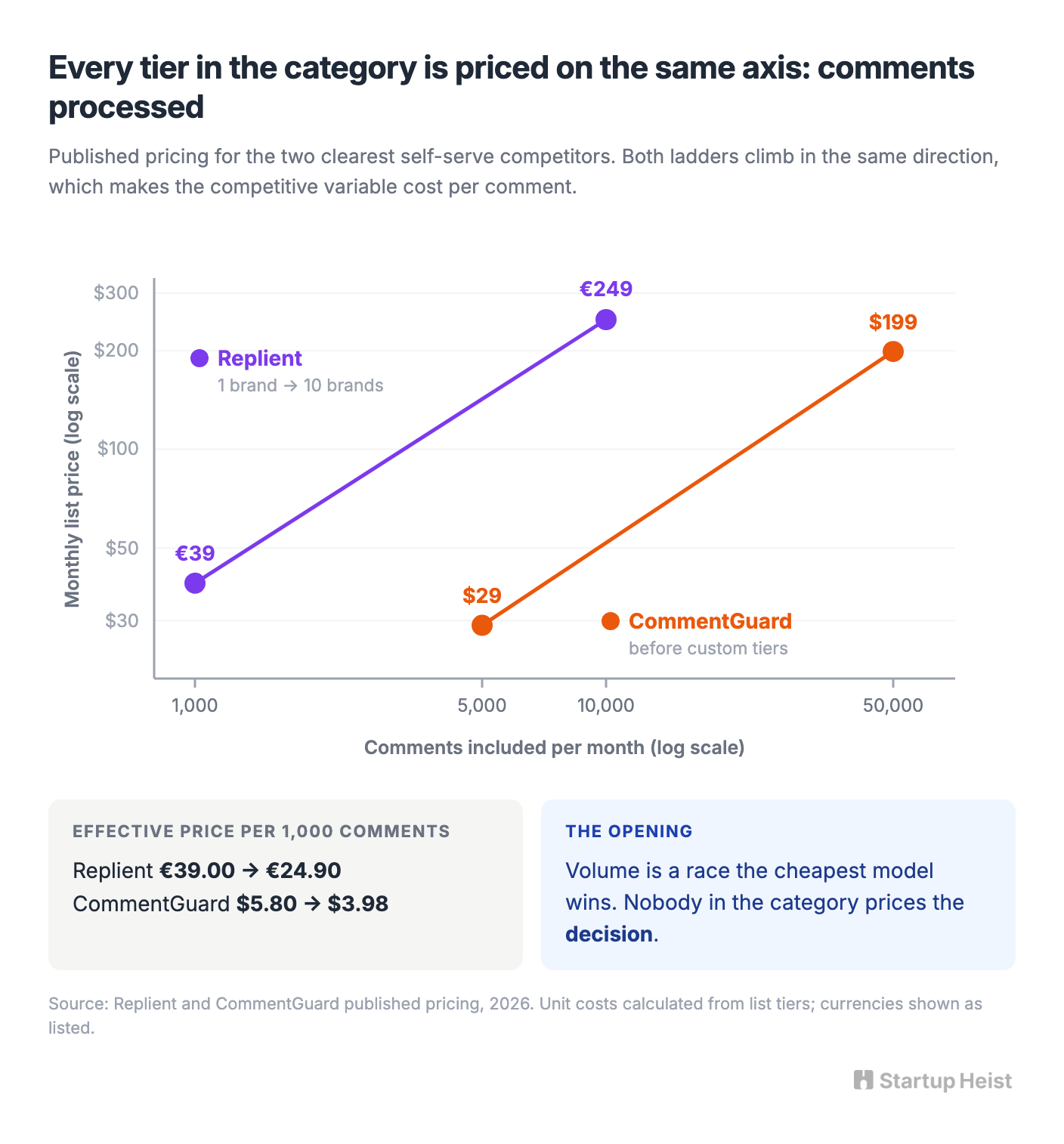
Look at what those price cards have in common. Every tier is denominated in comments processed and replies generated. The whole category has agreed that the unit of value is throughput, which makes the competitive axis cost per comment, which makes the endgame a race to the bottom that the cheapest model wins. "AI reads your comments and writes replies" is finished as a business. It's a feature now, and soon it'll be a checkbox.
The wedge is the sponsored video
Sponsor-aware moderation is where that commodity pricing breaks, and the money explains why.
Unlock the Vault.
Join founders who spot opportunities ahead of the crowd. Actionable insights. Zero fluff.
“Intelligent, bold, minus the pretense.”
“Like discovering the cheat codes of the startup world.”
“SH is off-Broadway for founders — weird, sharp, and ahead of the curve.”


